
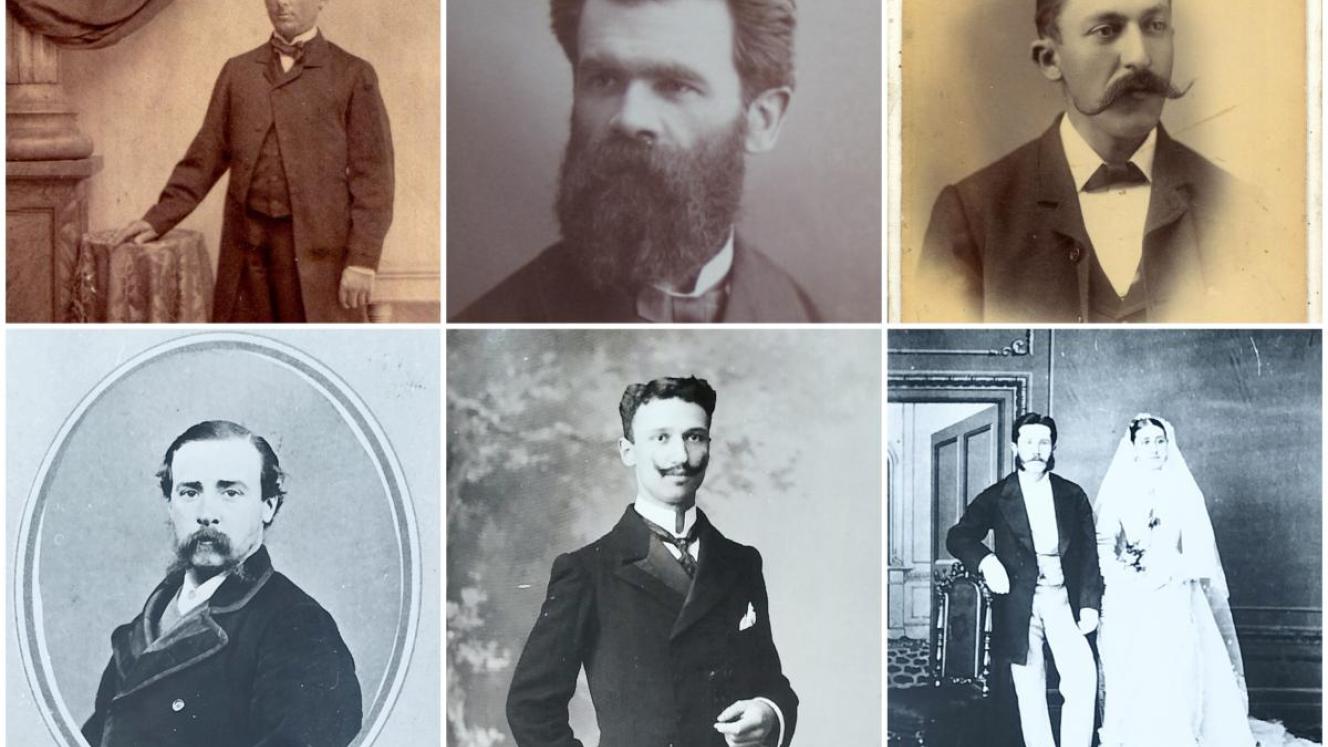
Located on the Mooi River, 120 km west-southwest of Johannesburg, the town of Potchefstroom was founded in 1838, one year before the invention of the photograph.
Colloquially referred to as Potch, the second-oldest European settlement in the Transvaal became the first capital of the Transvaal and remained the capital until displaced by Pretoria. In May 1860, Potchefstroom became the "chief city" of the republic, and the capital moved to Pretoria.
Originally carrying the names Mooirivier, Vryburg, Potschefstroom and Potscherfstroom (Haasbroek, 2024), several theories exist about the origin of the city's name. According to one theory, it originates from Potgieter + Chef + stroom (referring to Voortrekker leader and town founder Andries Potgieter; "chef" indicates the leader of the Voortrekkers, and "stroom" refers to the Mooi River).
Jenkins (1971 – from Wikipedia) stated: "Others, however, attribute the name as having come from the word 'Potscherf', meaning a shard of a broken pot, due to the cracks that appear in the soil of the Mooi River Valley during drought resembling a broken pot".
During the First Anglo-Boer War, the British garrison was besieged in Potchefstroom (December 1880 to March 1881), whilst they held the town during the Second Anglo-Boer War (1899–1902).
This article provides a synopsis of photographers who established themselves in Potchefstroom between the 1850s to 1920s. Some photographers settled in Potchefstroom, whilst others may briefly have visited the town, especially during the two Anglo-Boer Wars. Only photographers who have been confirmed to have resided in town are recorded.
Brief history of photography – The World and South Africa
Niépce, in his early 60s in 1827, captured the first ever permanent image in the east of France. He passed away six years after this invention. The Frenchman, Louis Daguerre, improved on the work of his fellow Frenchman, namely, to invent the permanent photograph in 1839. Today, these permanent images, produced between 1839 and 1860, are commonly referred to as daguerreotypes.
The first experimental photographs taken in South Africa were by a Cape observatory employee, Charles Smyth. Smyth achieved this a few months after Daguerre announced his invention.
The first professional photographer to settle in South Africa was the Frenchman MJ Leger, who opened his studio in Port Elizabeth during 1846. Carel Sparmann opened his studio in Cape Town the following year (1847). During the early years of South African photography, most photographers either settled or started in Cape Town or its immediate surroundings.
Potchefstroom photographers
Gouws (2016) indicates that in 1870, Potchefstroom experienced a new phase of economic growth. This appears from the trading licences issued in that year. Licences were issued for 62 shops, 11 builders, 17 butchers, 23 itinerant traders, 32 liquor licences, 4 auctioneers, 3 attorneys and 4 bakeries. Interestingly, no photographic studios have been recorded unless they were recorded under the shops category.
It is therefore important to record, as best as possible, professional photographers who based themselves in Potchefstroom between the 1850s and 1920s. Identifying any photographers from before 1865 is a near impossibility, in that the photographic format in use, the Ambrotype, typically did not include the name of the photographer. In this article, one photographer, who relied on the Ambrotype process, is however revealed. Photographers who travelled through town and captured some photographs during their brief stay are not included in the list provided below. See one such photographer’s work around 1888 at the end of this article.
To date, 24 photographers who settled in Potchefstroom have been identified. There may well have been others whose photographic works have not been identified to date.
Surrounding towns such as Klerksdorp, Ventersdorp, and Venterskroon fell under the Magistrate of Potchefstroom. Photographers who resided in these towns may also have set foot in Potchefstroom to capture photographs, but they are also not recorded in the list below. Potchefstroom-based photographers who were also active in towns other than Potchefstroom are, however, still recorded.
Potchefstroom photographers all had diverse backgrounds. They originated from countries such as England, Germany, Austria, France and Switzerland. One was a South African-born photographer (Schikkerling), who became a well-established business entrepreneur in town. Although Potchefstroom is older compared to Pretoria, more photographers based themselves in Pretoria during the comparative period (click here to read more on photographers active in Pretoria).
The list below does not purport to be a complete list of Potchefstroom photographers, nor is the detail on each photographer complete or sufficiently comprehensive. It is therefore acknowledged that ongoing research is required to expand on the research.
1. Bartholomew Thomas William (1877 – 1916)
Bartholomew was born in England in 1877. When he arrived in South Africa is not known.
Both his marriage and death certificates confirm that he was a photographer by profession.
He married Eva Annie Thurman in Port Elizabeth in 1908. The couple had four children.
At the time of his death, the Bartholomew family resided in Pretoria. Bartholomew died at the young age of 39. The family, in all probability, moved to Pretoria due to Bartholomew’s ill-health conditions.
His studio location in Potchefstroom is not known at this stage. No record exists of him being active in Pretoria as a photographer.
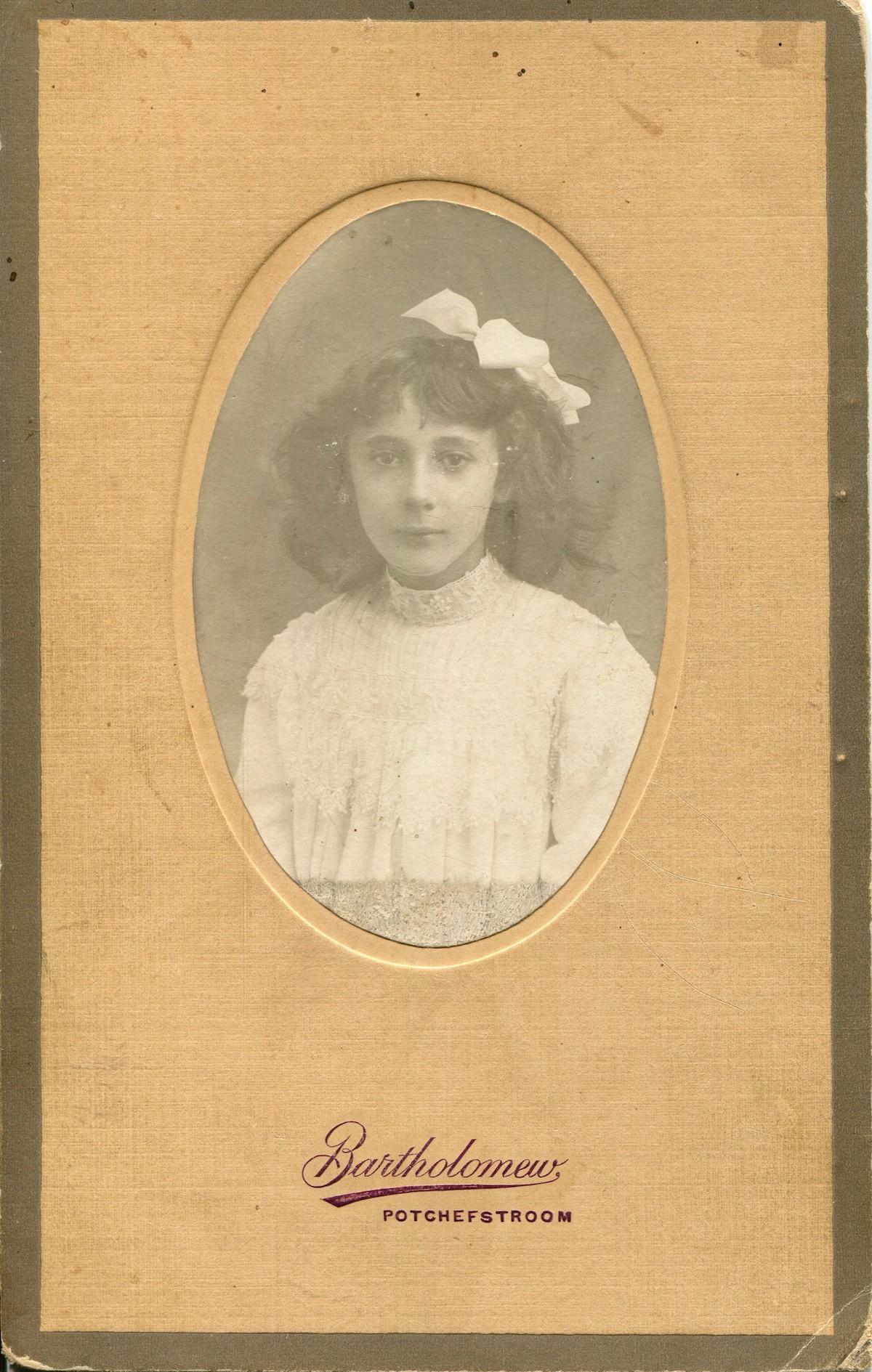
Photograph by Bartholomew, circa 1910. The young girl is Truddchen Stam, who was adopted by AR Fleischack, an attorney in town and brother to photographer Max Fleischack. Truddchen later married a Muller. Photograph provided by Potchefstroom Museum.
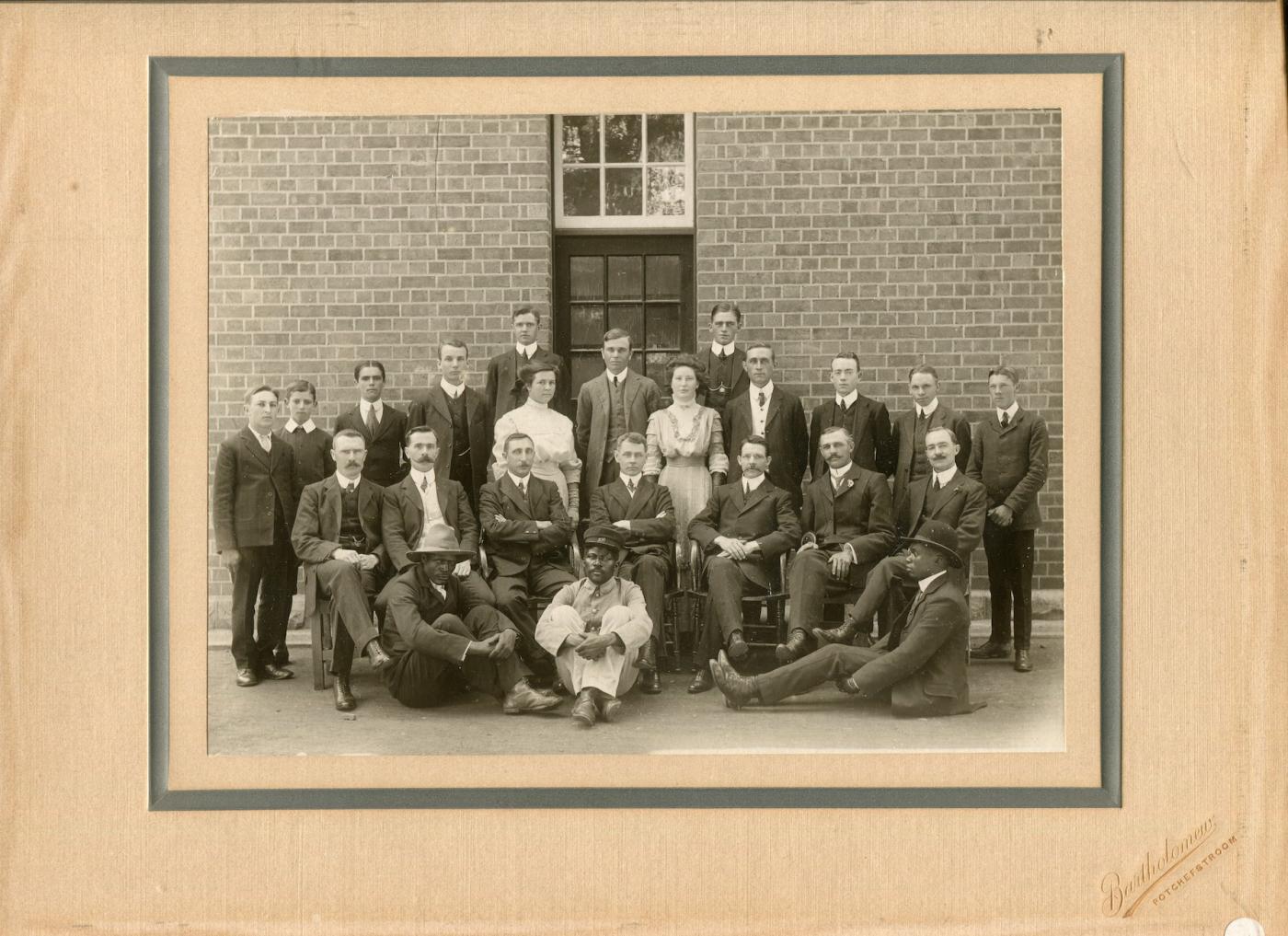
A large format photograph by Bartholomew of Potchefstroom’s Post Office employees, captured on 4 December 1910. Photograph provided by Potchefstroom Museum.
2. Bennett Marcus (1866 – date of death unknown)
Little information is available on the British photographer Marcus Bennett, who based himself in South Africa during the Anglo-Boer War.
He was born in England in 1866 and got married in England in 1908, a few years after his return from South Africa.
The South African National Archives curates several Kimberley Siege photographs captured by Bennett.
Before the Kimberley Siege (1899-1900), Bennett seems to have initially based himself as a photographer in Johannesburg (in 1897). Bennett, in all probability, settled in Potchefstroom after the Kimberley Siege and before returning to England.
One archival record indicates that Marcus Bennett submitted a claim for goods seized by the Boers at 14 Streams (near Kimberley).
Bennett also co-published a photobook titled “The Transvaal through a camera” around 1900.
Below is also a photograph taken by E. Bennett during the Anglo-Boer War period – It is suggested, for now, that the initial is a typo and is actually a photograph by Marcus.
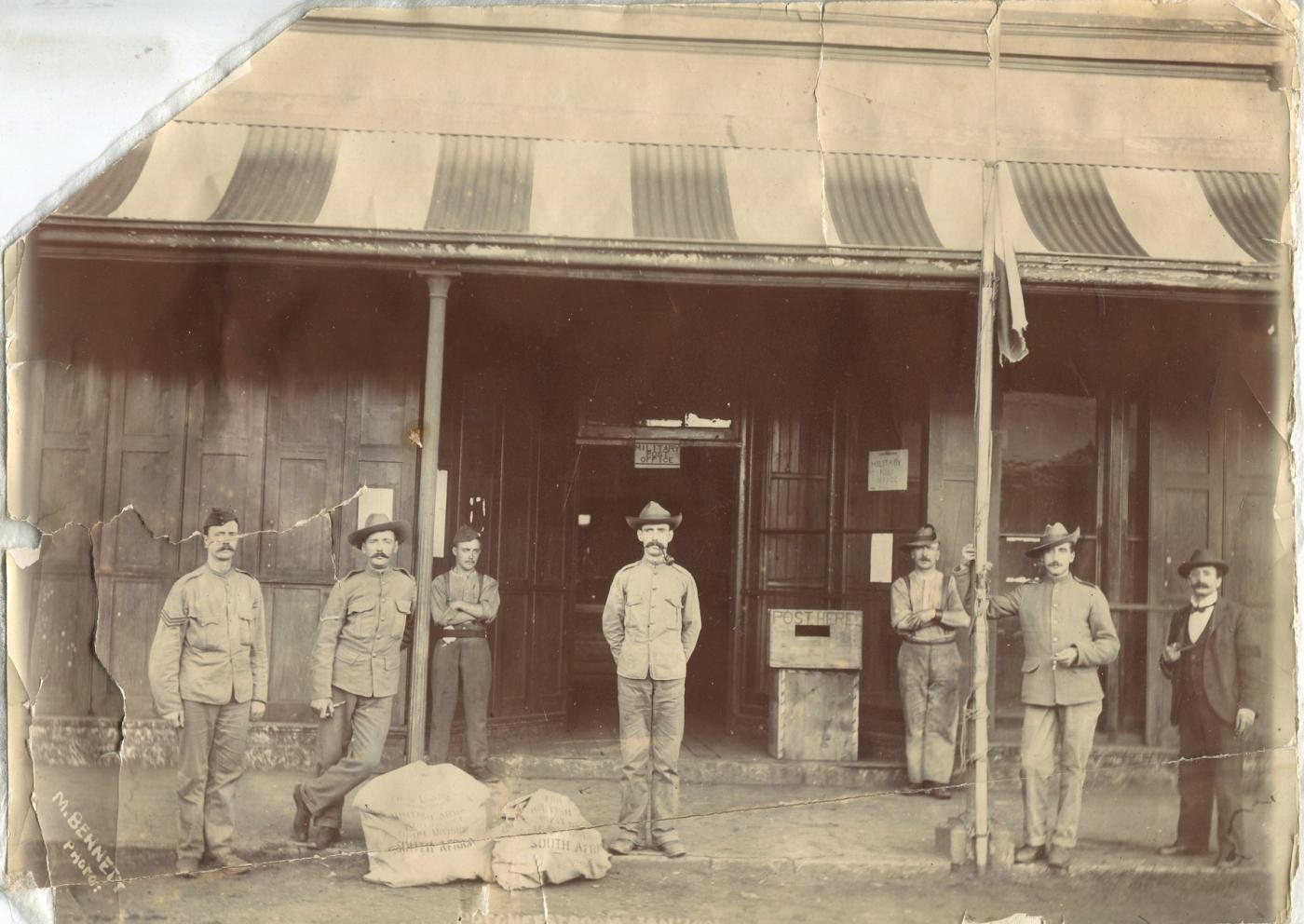
The military post office in Potchefstroom during the Anglo-Boer War by Marcus Bennett (circa 1900). Photograph provided by Potchefstroom Museum.
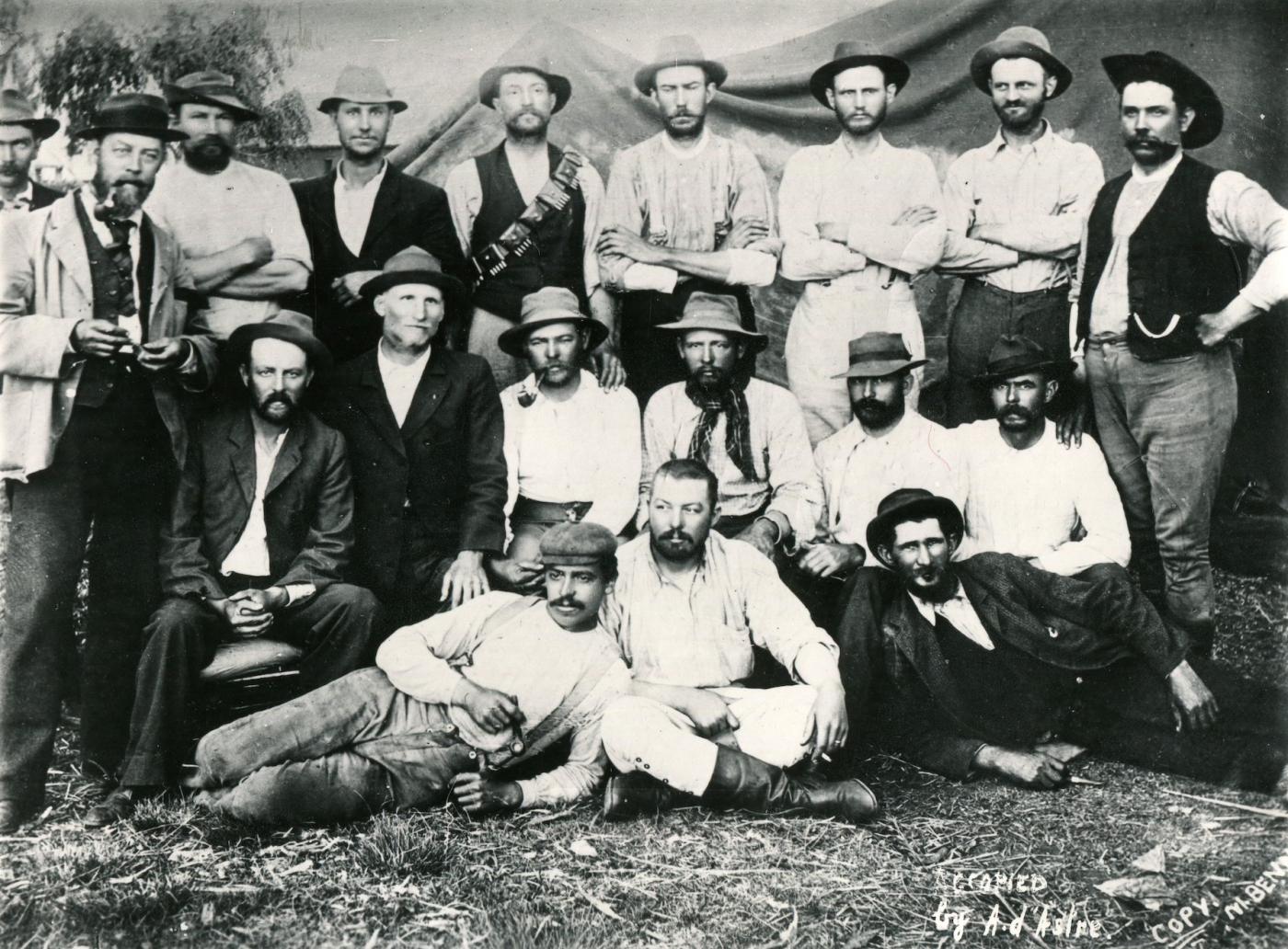
Marcus Bennett photograph captured during the Anglo-Boer War (circa 1900). This photograph by Bennett was reproduced by d’Astre, another prominent photographer in town. d’Astre was clearly an ethical photographer in that not many photographers at the time would have recorded that they reproduced the work by another photographer. Photograph provided by Potchefstroom Museum.
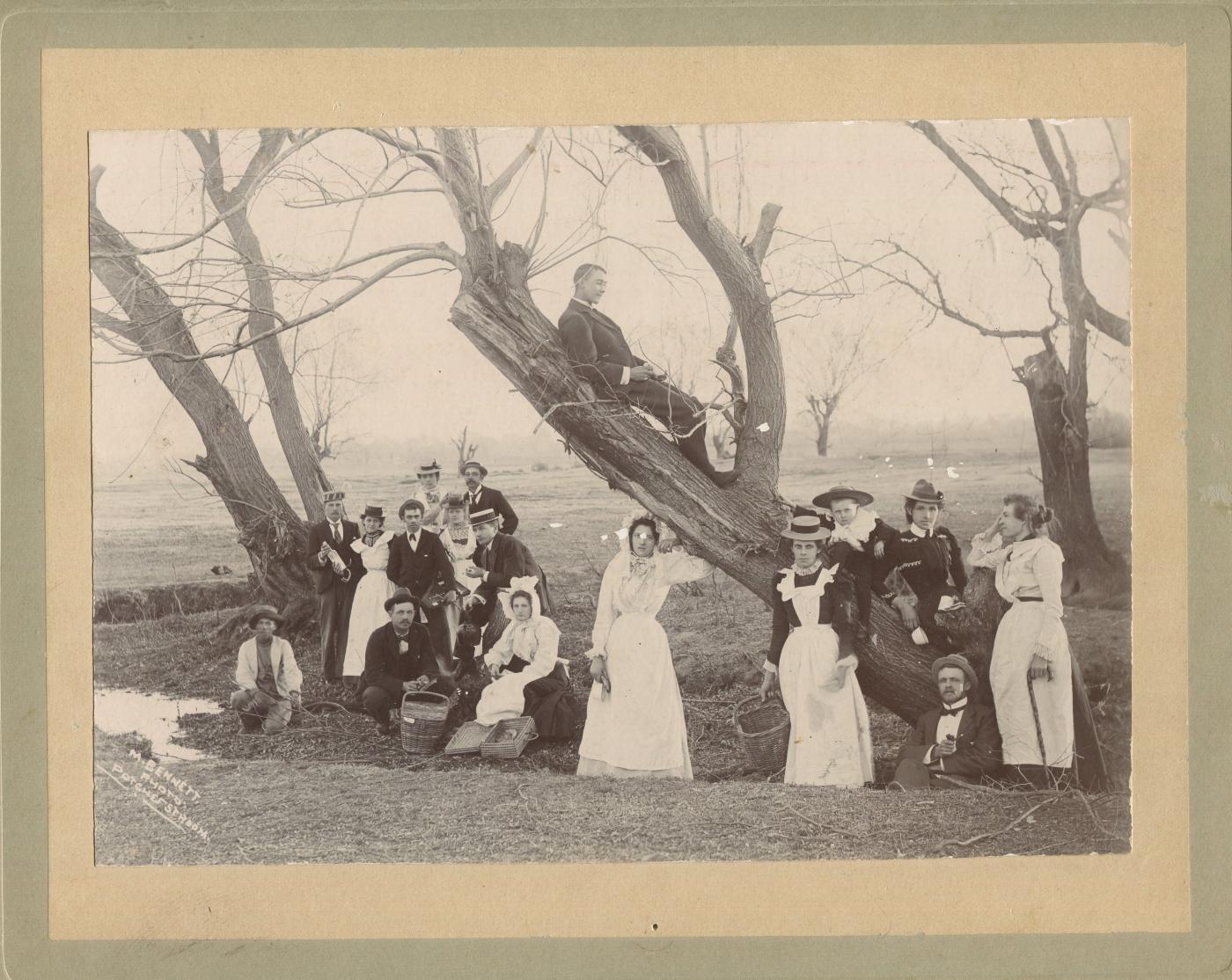
An interesting composition. This picnic photograph was captured by Marcus Bennett just outside of town (circa 1905). Note the young helper sitting on the left of the photograph. Whether the sitter in the tree seated himself in the tree on his own accord or on request of the photographer is not known. Photograph provided by Potchefstroom Museum.
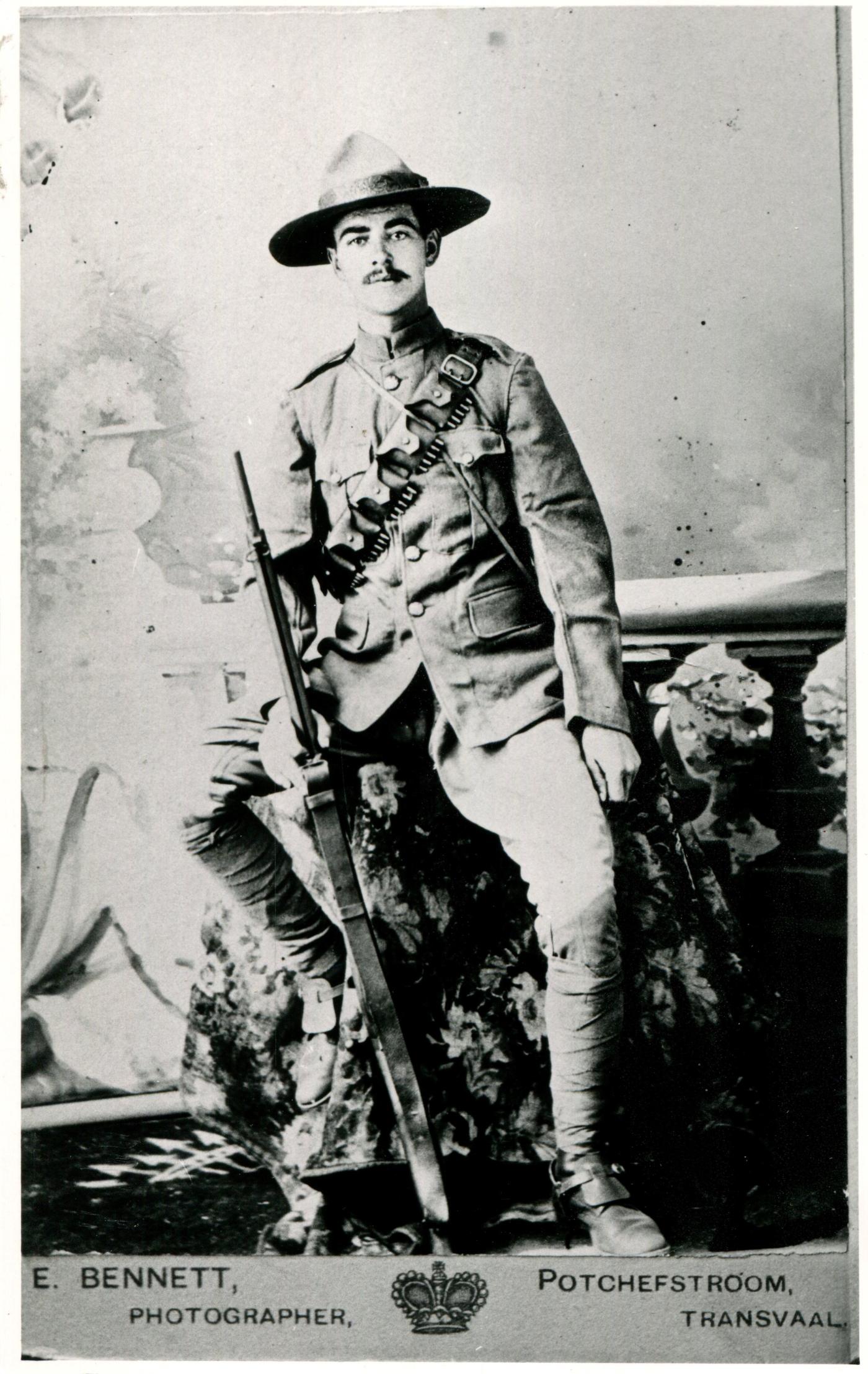
A reproduction photograph of 23-year-old Ernest Slatter, attached to the South African Constabulary during the Anglo-Boer War. To date, no E. Bennett has been recorded as an active photographer based in South Africa. It may therefore just be that the initial E is a misprint, which was not an uncommon occurrence on these earlier card-mounted photographs. Photograph provided by Potchefstroom Museum.
3. Chambers Alec (Dates of birth and death unknown)
Other than the Potchefstroom directory for 1922, confirming that Alec Chambers was based in town at the time, little is known about him. The search for Alexander also did not assist.
His studio was based in Berg Street.
It is recorded that he also published postcards under his name.
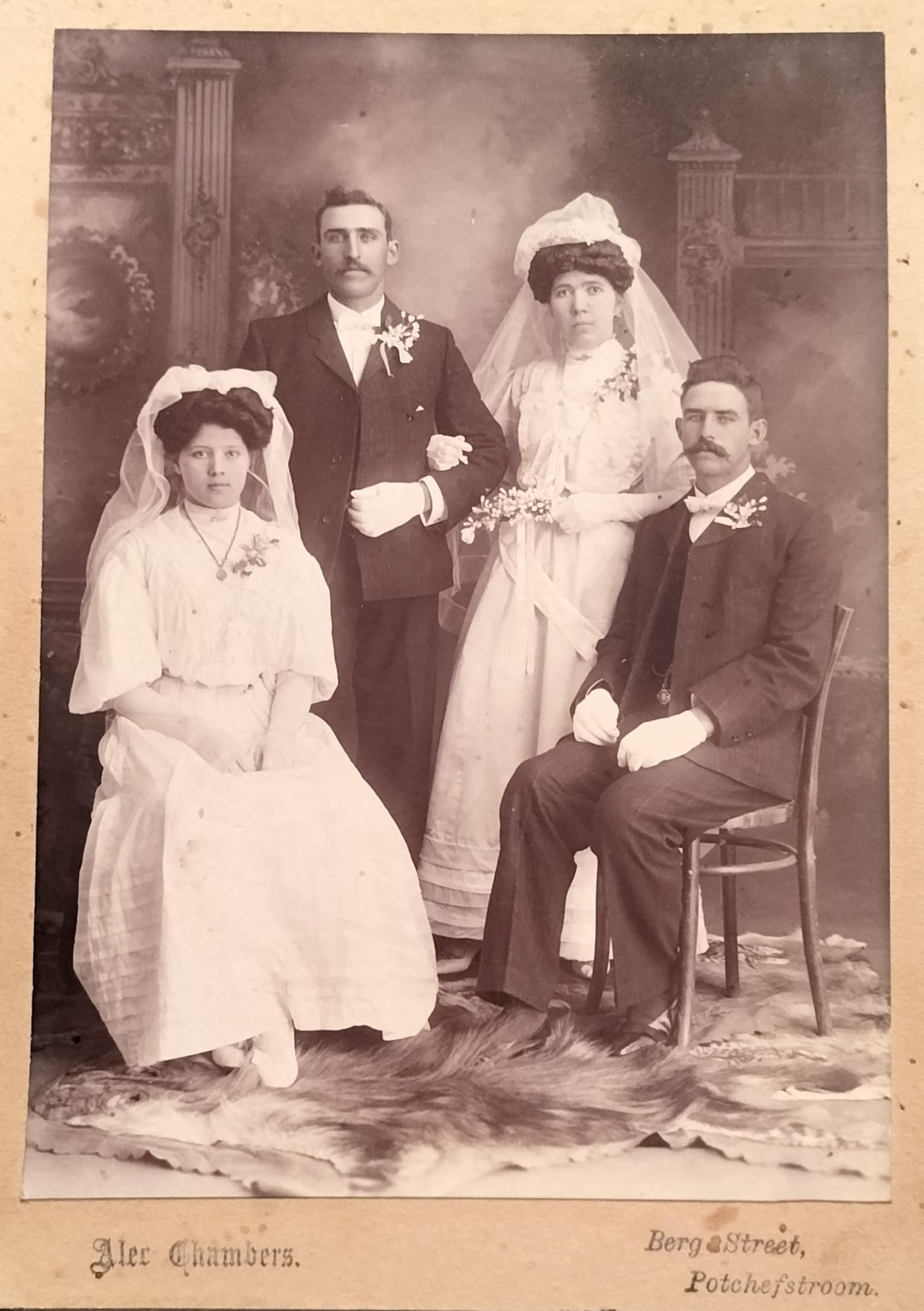
Cabinet Card format photograph by Alec Chambers (circa 1905), who was based in Berg Street, Potchefstroom. The wedding couple/s are unknown. Note the elaborate studio backdrop as well as the animal skin on which the sitters are seated.
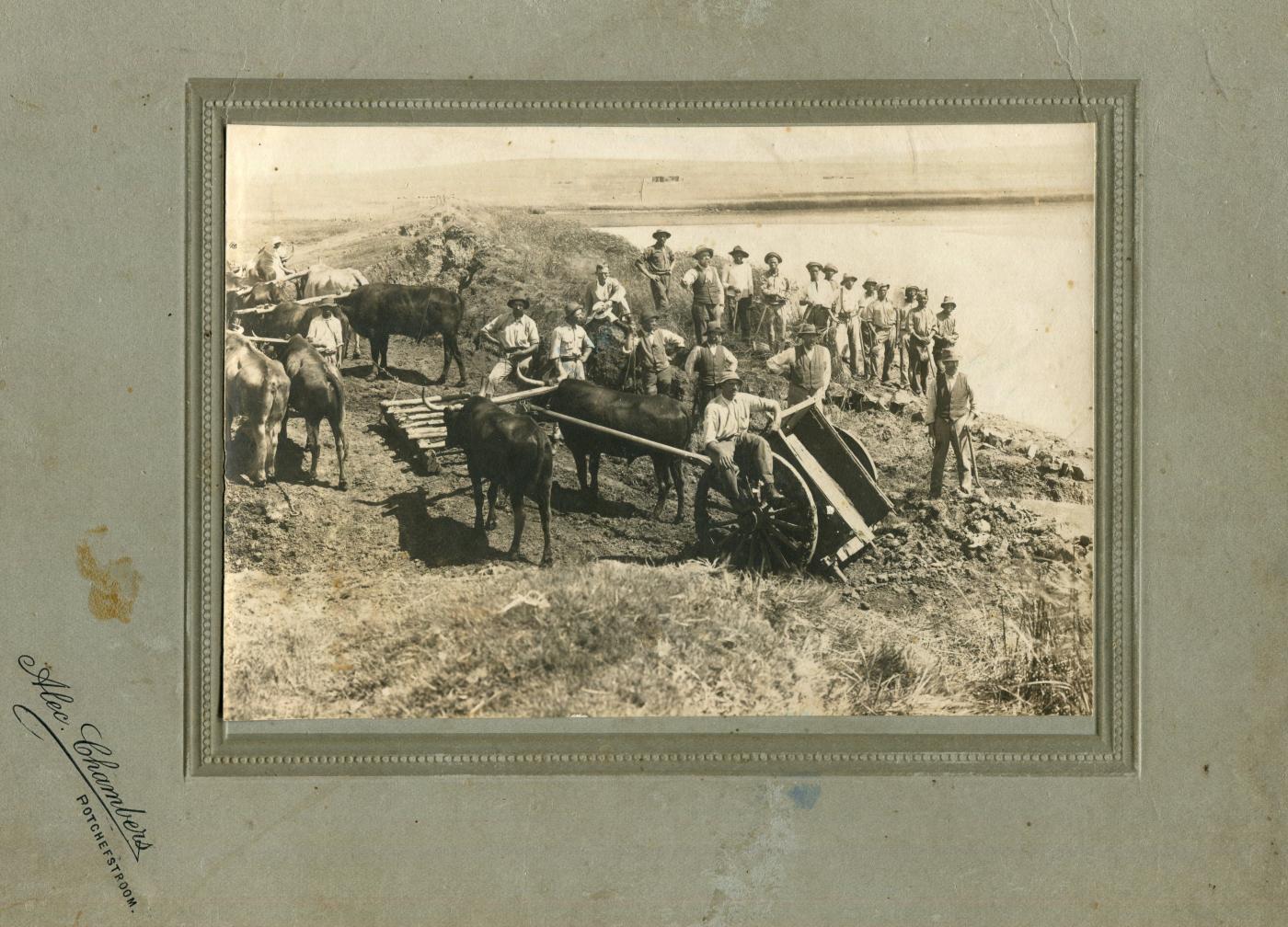
Large format photograph, by Alec Chambers, showing the Potchefstroom dam wall under construction (circa 1908). Photograph provided by Potchefstroom Museum.
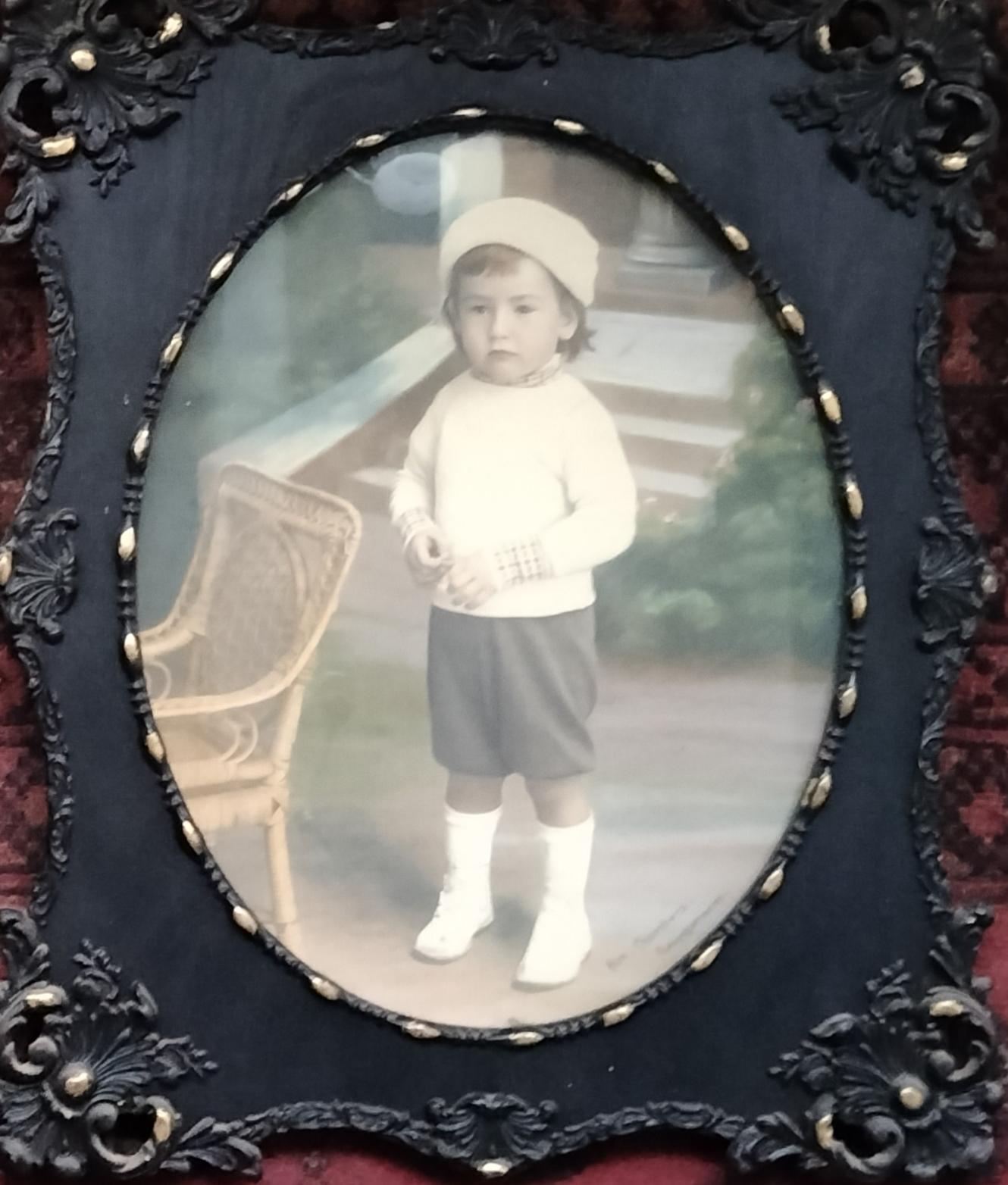
Large photograph in an elaborate wooden portrait frame of an unknown boy by Alec Chambers. The enlarged photograph (circa 1912) has been hand-coloured.
4. Chittenden Alfred (1858 – 1918)
Chittenden was born in England in 1858. He married Elizabeth Maria Christina Evans in Potchefstroom in April 1887.
It is not known for certain whether Chittenden made a living as a photographer. Given that the photograph below contains his handwritten details, he may well have been an amateur photographer.
At the time of his death in Johannesburg in 1918, his occupation is recorded as a motorcycle dealer who resided in Klerksdorp.
Elizabeth passed away in Johannesburg in 1947.
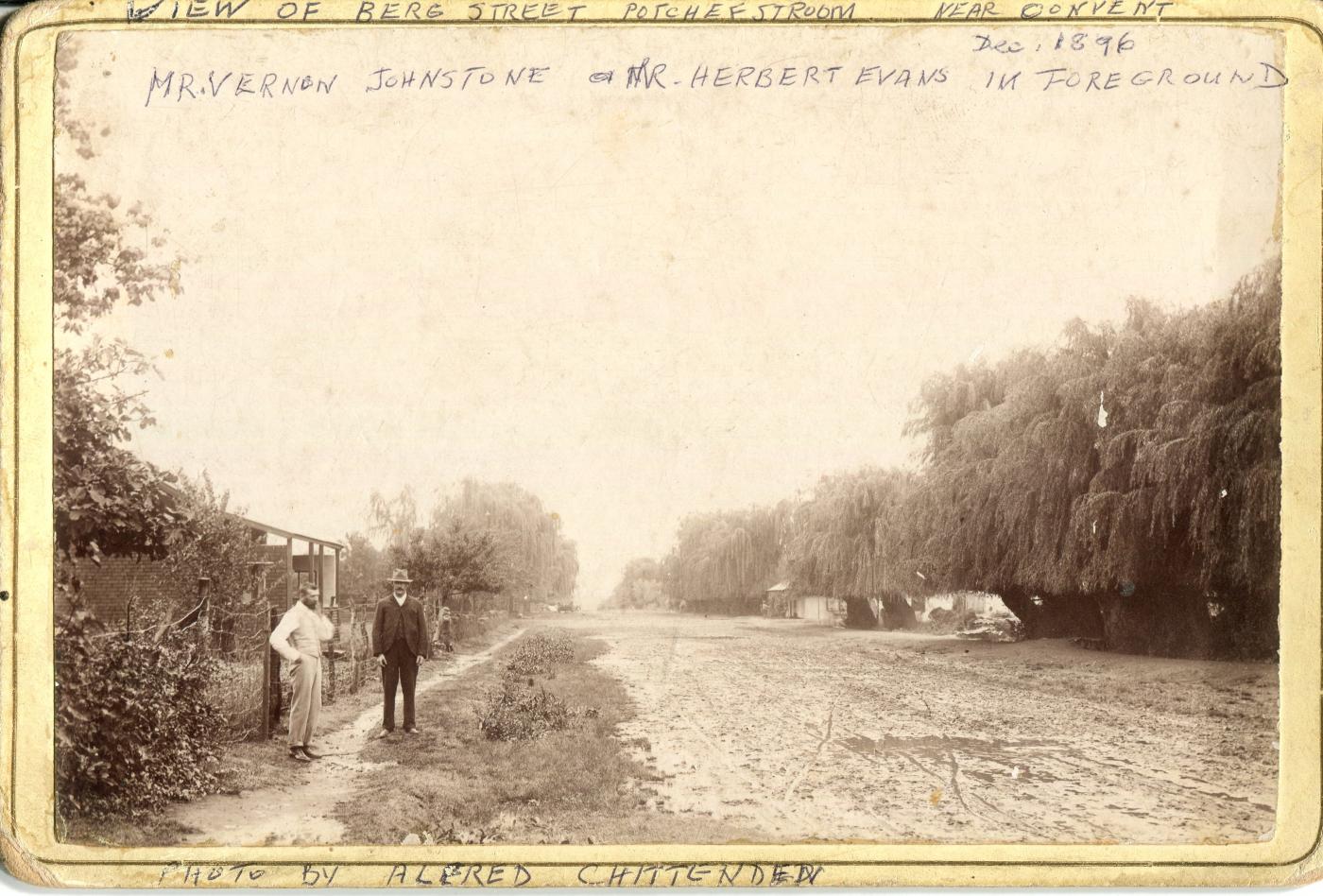
An Alfred Chittenden photograph captured in December 1896. The men standing in Berg Street (near the Convent) are Vernon Johnstone & Herbert Evans. To date, this is the only photograph identified to have been captured by Chittenden. It therefore still needs to be established whether Chittenden was a professional or amateur photographer. Photograph provided by Potchefstroom Museum.
5. Coop Fred (1876 – 1937)
Born in 1876 in Birmingham, Fred Coop emigrated to South Africa in 1903 at the age of 27.
Six years later, on 20 October 1909, aged 33, he married 19-year-old Sophia Rebecca Kuhn (born in Heilbron) at the Potchefstroom Wesleyan Church. Coop resided at du Plooy Street at the time of their marriage.
Coop owned The New Gallery in Potchefstroom and self-published picture postcards of Potchefstroom. He seemingly also did work for The Field publication. Documentary evidence also suggests that Coop did some photographic work on the Potchefstroom experimental farm during 1906. An invoice dated July 1906 shows him charging £33 for an assignment completed for them.
It is recorded that the printing press on which The Potchefstroom News was printed belonged to Fred Coop en Colin Wade. According to Wade, Coop was the photographer while he (Wade) was the editor of the newspaper (Herald, 28 June 1957).
Coop eventually moved to Pretoria around 1910, where he continued his photographic career until 1915. It is recorded that his studio was based at 220 Church Street and that he resided at 377 Pretorius Street in Pretoria. Whilst in Pretoria, Coop advertised in Lockhead’s guide as follows:
Dudley Sepia' is the very last word in artistic photography. There is a softness and truth about these pictures, which has never before been equalled, and they have the painter-like quality so admired by connoisseurs.
Coop eventually became a farmer in Volksrust, where he passed away in August 1937.
Rebecca passed away at the Weskoppies asylum in 1960 following thrombosis in the leg.
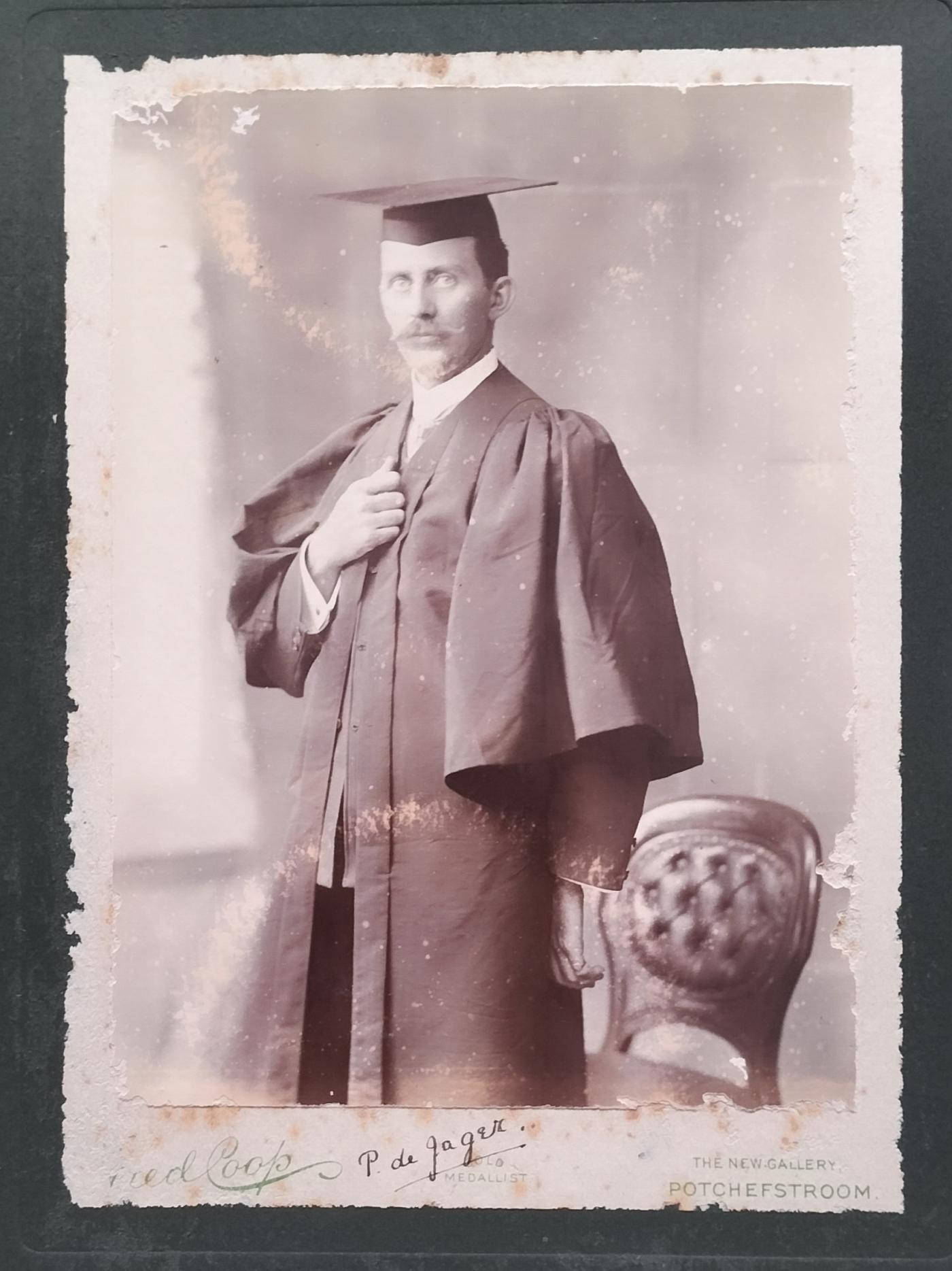
Large format photograph by Fred Coop (circa 1908) of P de Jager on his graduation day. Coop's studio was named "The New Gallery". Coop also proudly advertises that he is a photographic gold medallist.
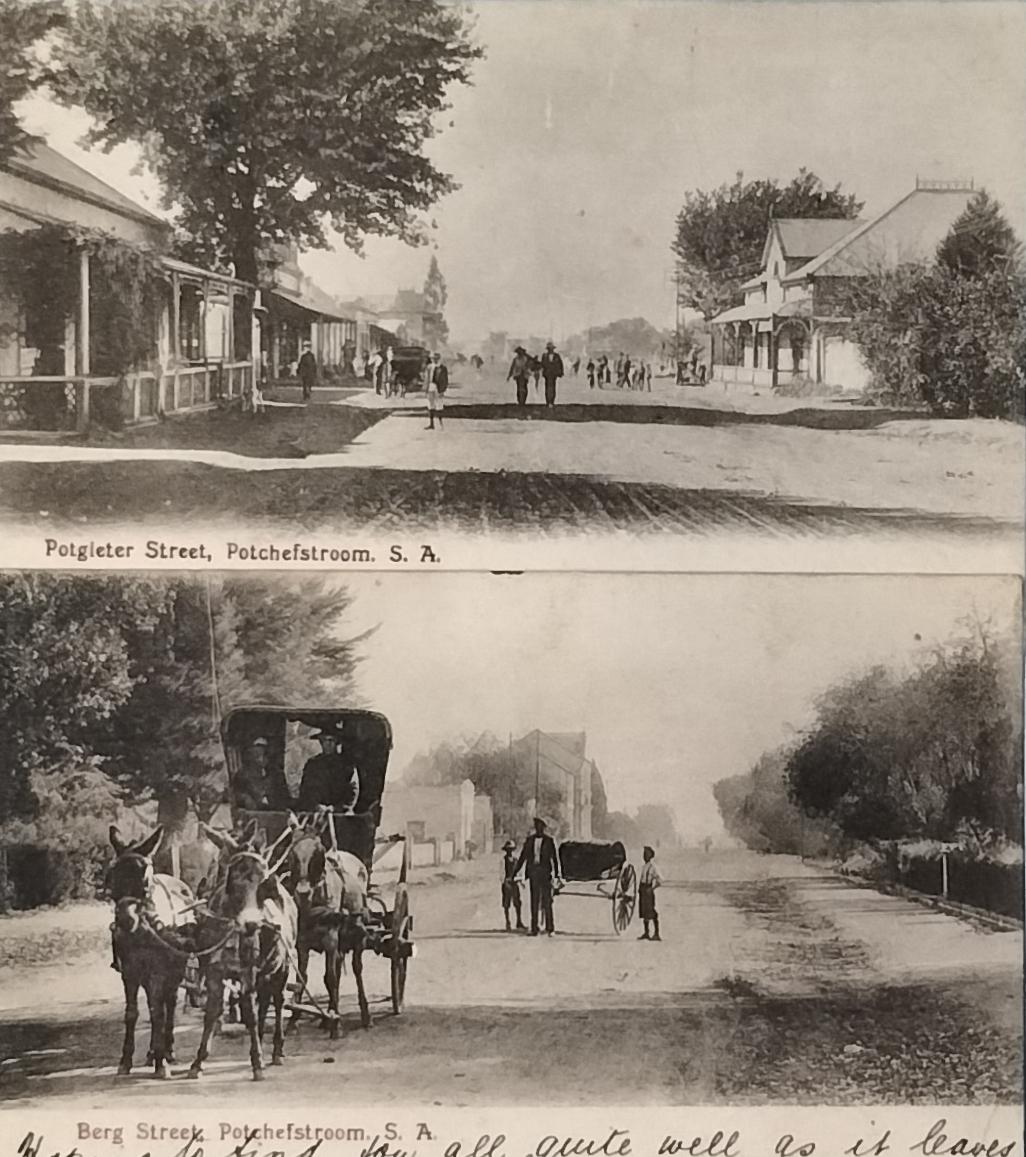
Coop was commercially astute. He captured many images of the town Potchefstroom, which he then converted to postcards for commercial resell at local stationers or could be bought from him directly. This approach would have ensured a steady income for him. These two postcard images show Berg and Potgieter Streets in Potchefstroom (circa 1905).
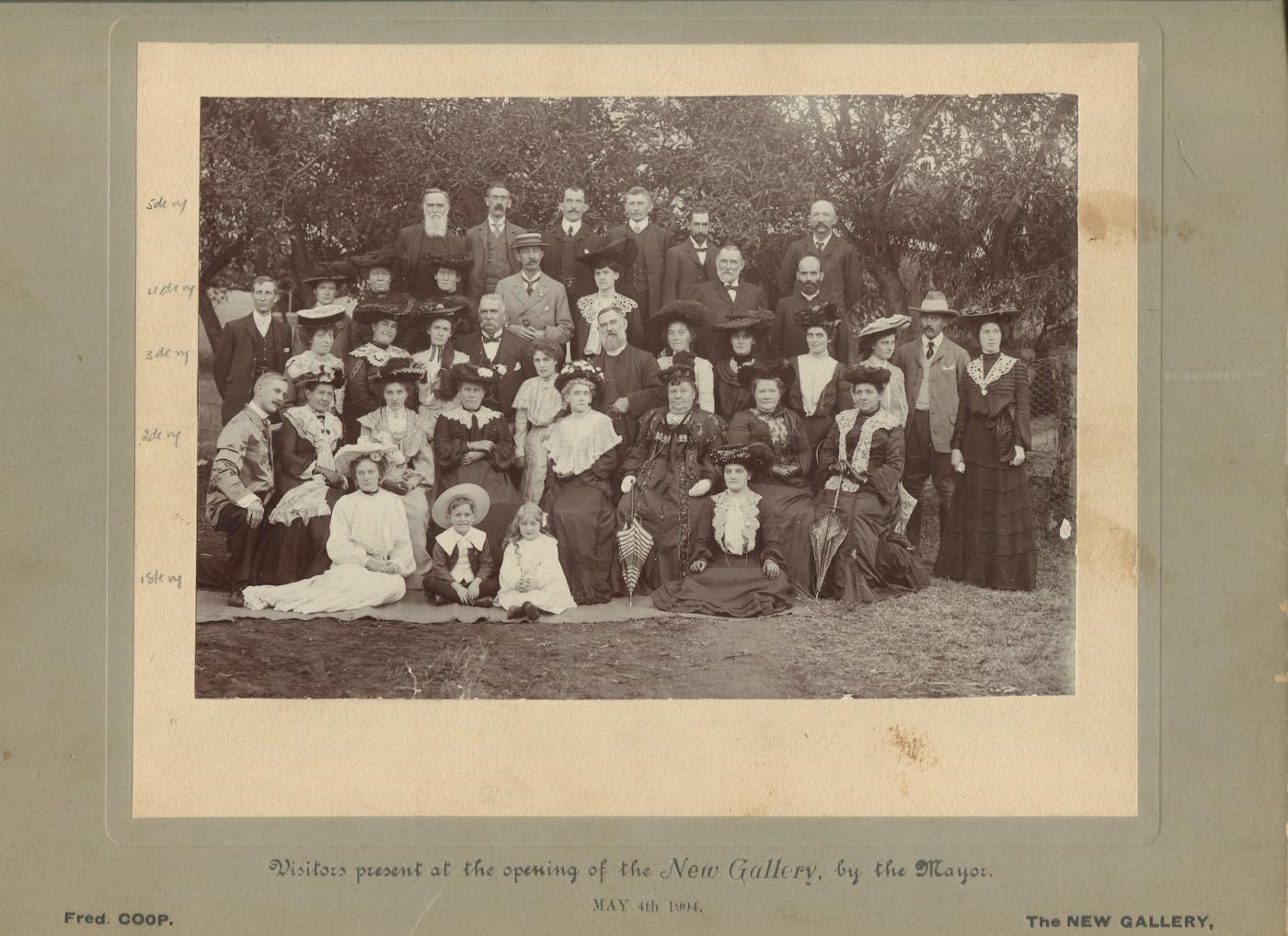
Large format photograph taken during the opening of Fred Coop’s “New Gallery” in May 1904. The sitters were in attendance when the Town’s mayor formally opened the studio. Photograph provided by Potchefstroom Museum.
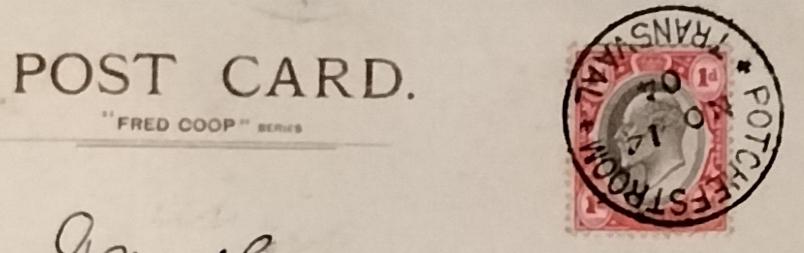
The back of a circulated picture postcard confirming that Fred Coop was the photographer and publisher (with date stamp of 1904)
6. Croydon H (Dates of birth and death unknown)
Other than the photographs below, confirming Croydon’s activity in Potchefstroom during the 1890s, no information could be obtained about him.
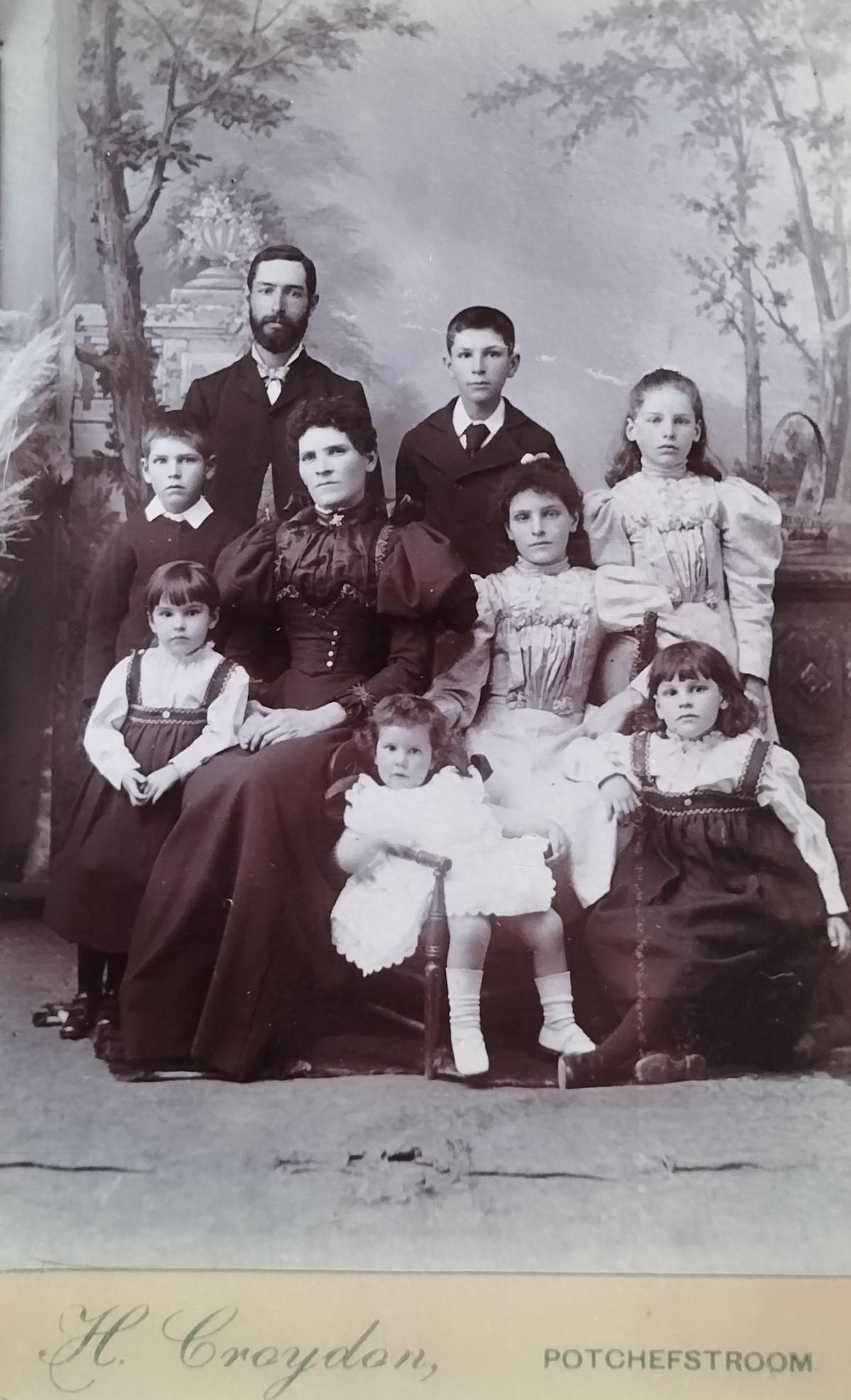
Cabinet Card format photograph by H Croydon of an unknown couple and their seven children (circa 1897). Although very little information could be obtained about Croydon, the backdrop in use suggests that he was a well-established photographer.
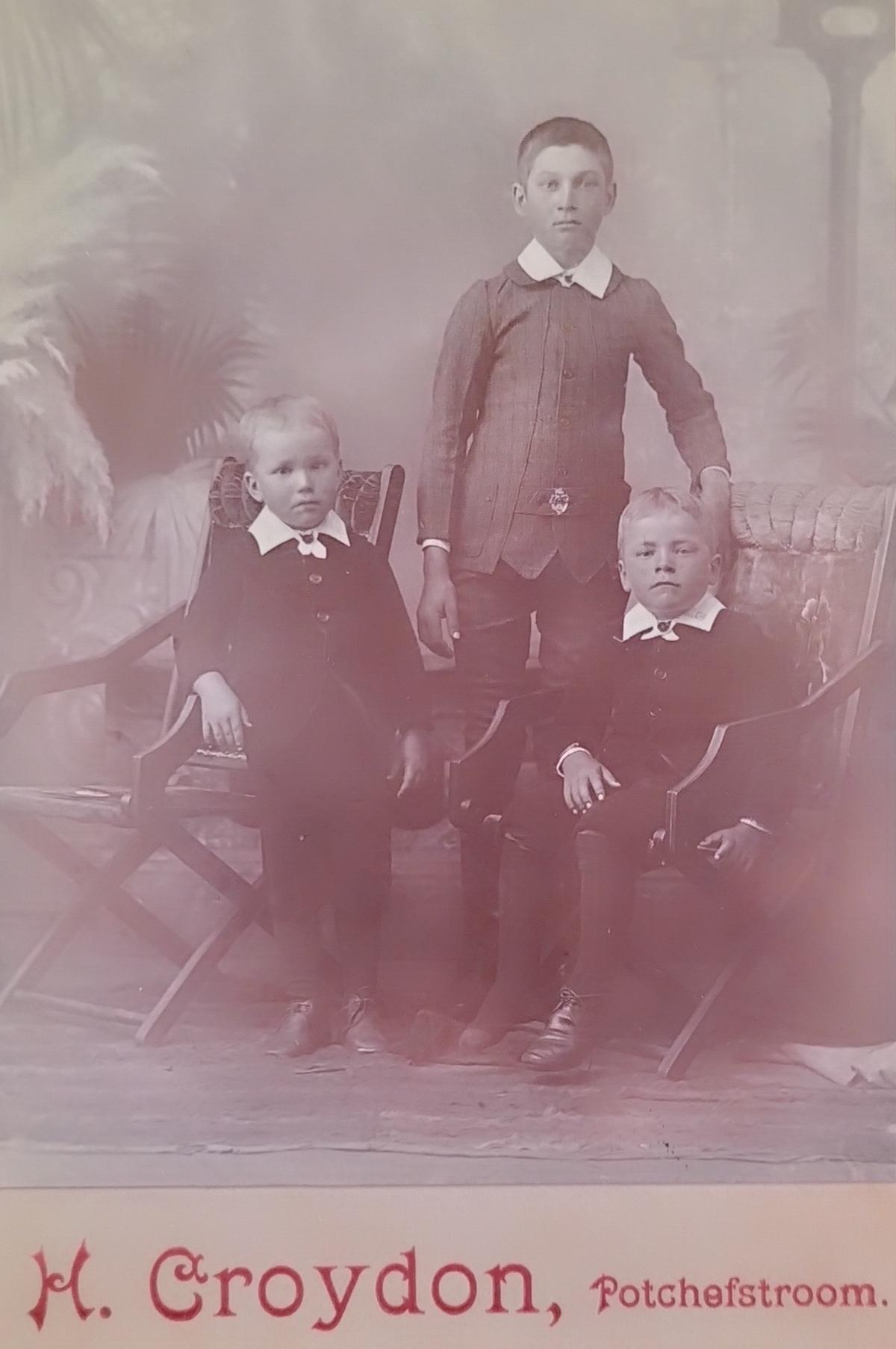
Cabinet Card format photograph by H Croydon of unknown brothers (circa 1898). In this image, Croydon seems to have used a different backdrop from the one in the image above.
7. d’Astre Auguste Frederic Edouard d’Ange (1872 – 1955)
French-born d’Astre (various spellings of his four names have surfaced) was the grandson of a French count as well as the grandson, from his mother’s side, of the well-known snuff merchant and painter, Otto Landsberg. It has been suggested that d’Astre settled in Potchefstroom in 1902, whereafter he immortalised the social and cultural landscape of Potchefstroom as a photographer.
Being the more prolific of all early Potchefstroom-based photographers, his photographs continue to be valued for their historical importance.
d’Astre married Potchefstroom-born Emma Mary Ann Evans in Johannesburg on 6 April 1915. He was 41, and Emma was 35. The couple did not seem to have their own children, as it is recorded that they adopted a daughter, Noëlle Lynette Firminger. They also seem to have taken Emma’s younger sister, Dulcy Angus Evans, born in 1911, under their wing.
Unlike some other early South African-based photographers, d’Astre did not shy away from photographing the Black South African population. Janse van Rensburg (2006) points out that most of his photographs are of individuals but also points out the significance of the group photograph of the Potchefstroom “Pospersoneel” (Post Office staff) and the “RE Officer’s Mess Staff” which include both white and black sitters. Janse van Rensburg (2006) continues by stating that several other group photos show blacks and whites who could have been friends or colleagues. Some photographs of white family groups also include several Black people.
d’Astre died in Potchefstroom on 23 August 1955 at the age of 83. He was a widower at the time of death, in that Emma passed away in May 1947. Interestingly enough, d’Astre signed both Emma’s death certificate as well as their wedding certificate, preceded by multiple initials, as de Landsberg.
A large part of his collection of glass plate negatives is held in the collection of the Potchefstroom Museum.
d’Astre also held a prospecting license (in 1913 at least), confirming his diversity as a businessperson.
He was also in a photographic partnership with Smith in Cape Town.
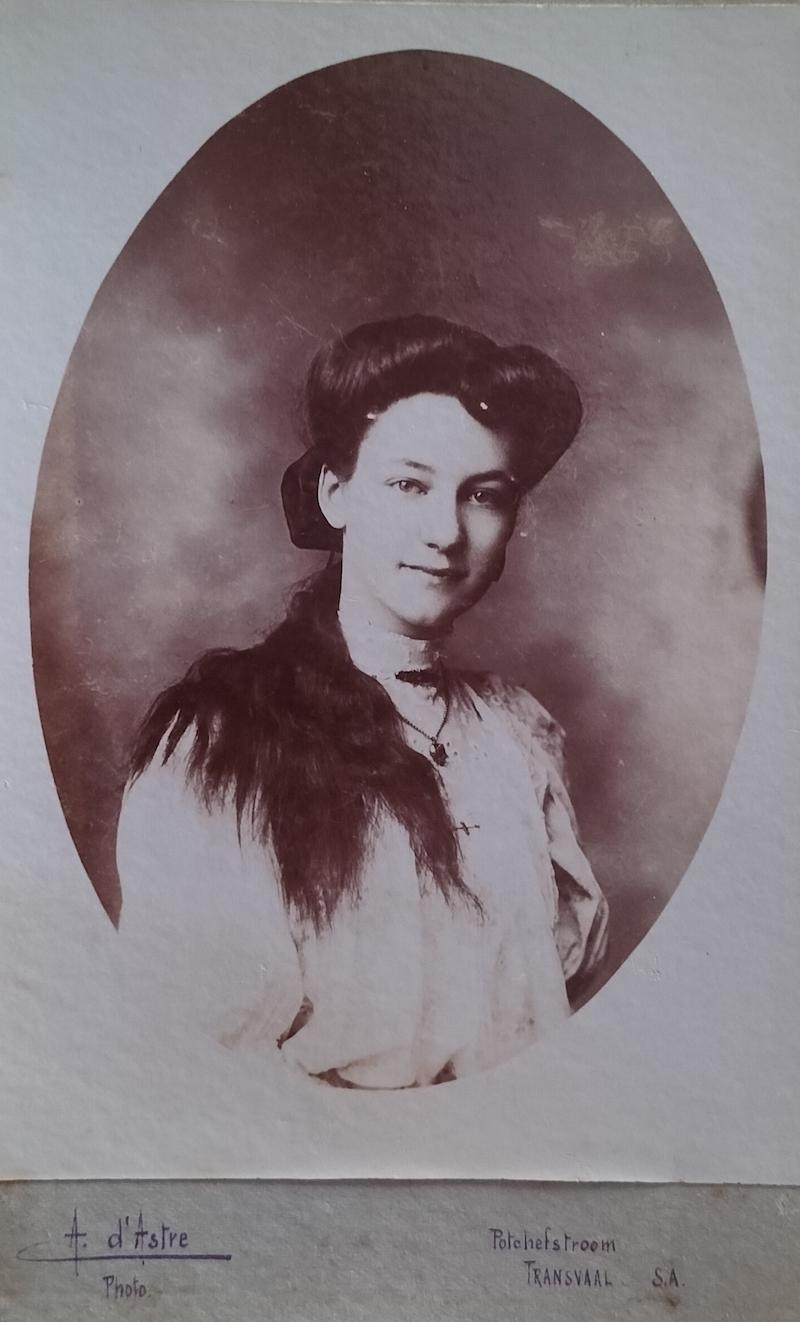
Cabinet format photograph by August d'Astre of an unknown sitter (circa 1908). Although d'Astre was a prolific photographer in Potchefstroom, the Hardijzer Photographic Research Collection ironically only holds this Cabinet Card format photograph by him, possibly suggesting that the cabinet card format was not a favourite photographic format for him to use.
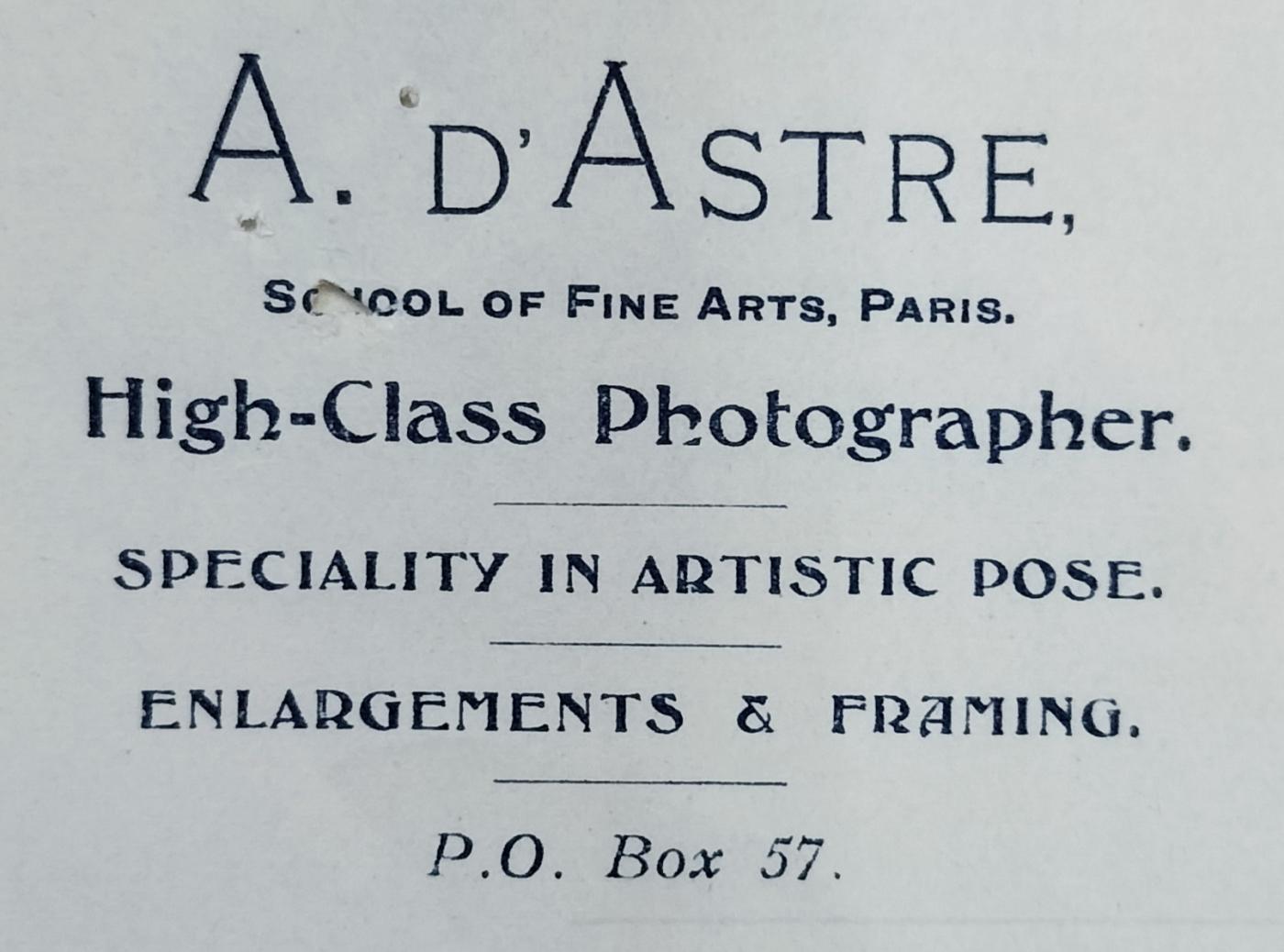
d’Astre’s letterhead confirming that he obtained his training at the School of Fine Arts in Paris (copied from document held in South Africa National Archives – Pretoria)
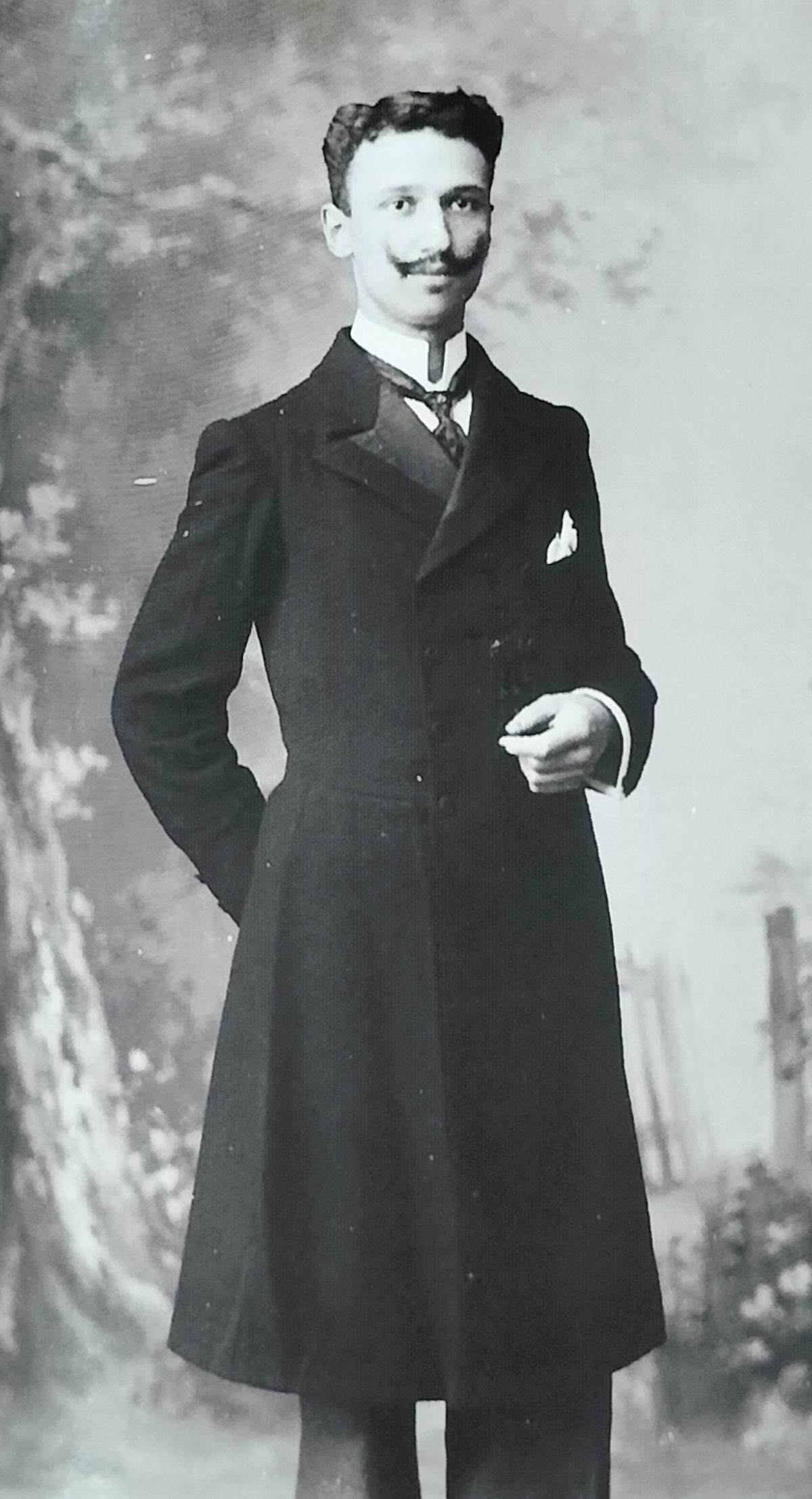
The photographer d’Astre by an unknown photographer, circa 1890s. This photograph may have been taken in Europe prior to his arrival in South Africa. Photograph provided by Lennie Gouws.
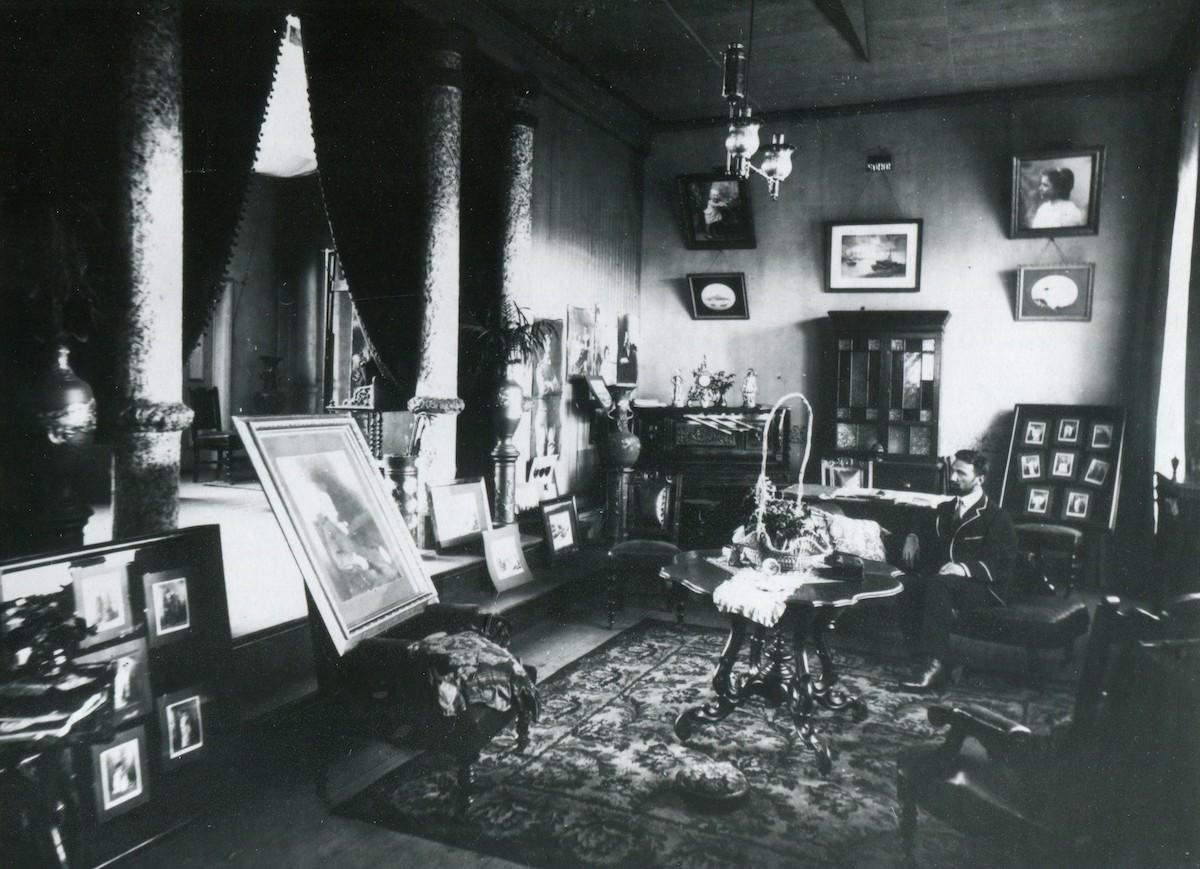
d’Astre seated in his studio (circa 1905) surrounded by photographic portraits. Photograph provided by Potchefstroom Museum.
8. Duffus Bros (William 1858 – 1940 & John 1864 – 1957)
John ("Jack") and William ("Willie") Duffus (Duffus Bros.) appear to have arrived in southern Africa in 1889, where they embraced the embryonic profession of photography.
William was an art student in Aberdeen. The brothers sailed to South Africa in 1889. They established photographic and art studios in Johannesburg, Potchefstroom, and Cape Town. Their primary studio was in central Johannesburg (1891 – 1921), where they flourished and owned property.
A successful claim for compensation following the demolition of a commercial property they were leasing resulted in an award sufficiently large enough for them to purchase their own premises - formerly Cuthbert's Corner in Joubert Street, Johannesburg - plus a substantial house in Parktown. Later, they had a studio at Burlington House (later known as Duffus Buildings) on Pritchard Street.
The studio in Potchefstroom, where they seem to have been active during 1893 only, may not have been managed by the brothers themselves, but by a partner, AJ Heydenrych. Little is known about Heydenrych. The Hardijzer Photographic Research Collection also only holds one example of their studio work in Potchefstroom, possibly confirming that they would not have been active in town for more than a year.
John married Isabella Ross in Cape Town in December 1901. No marriage record has been traced for William.
According to a claim for compensation lodged against the British Government after the Anglo-Boer War (1899-1902), the brothers, described as artists and photographers, left their business in the Transvaal on 15th October 1899 for Cape Town and returned to Johannesburg after the hostilities ceased on 6th April 1901. During, and after the Anglo-Boer War, they photographed many eminent Boer War personalities of the day - Boer and Brit alike (Pelteret, 2007).
Of interest is that William painted portraits of Carel Petrus and Johanna Jacoba Heydenrych. AJ Heydenrych, was in all probability, related to the couple painted by William.
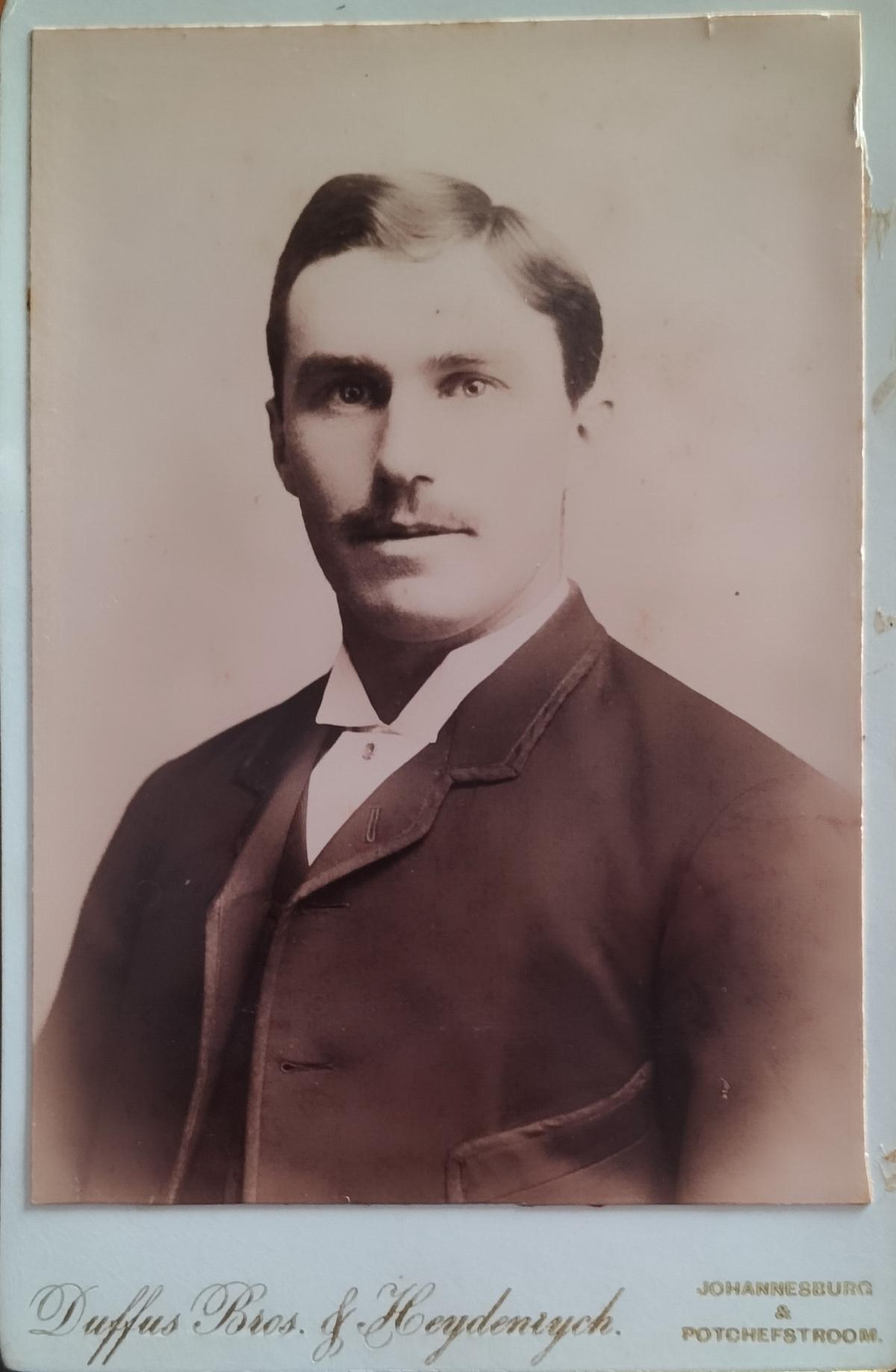
Cabinet format photograph by Duffus Brothers and Heydenrych (1893). The Duffus brothers were Johannesburg-based. Although no information could be obtained on Heydenrych, it is suggested that Heydenryck managed the Potchefstroom-based studio on behalf of the Duffus Brothers.
9. Fleischack Max (1860 – 1942)
German-born Max married Getrude Leigh Robins in Johannesburg in December 1900. It is recorded on his marriage certificate that he was a legal practitioner. Photography therefore would have been a part-time activity for Max. His brother, AR Fleischack, was also an attorney in town.
The couple had no children. Max died in January 1942, and Gertrude 2 months later in March.
His father, Julius, who passed away in Potchefstroom in 1897, was the Attorney General in Prussia. Max’s mother, Marie Fleischack died in Potchefstroom in June 1916.
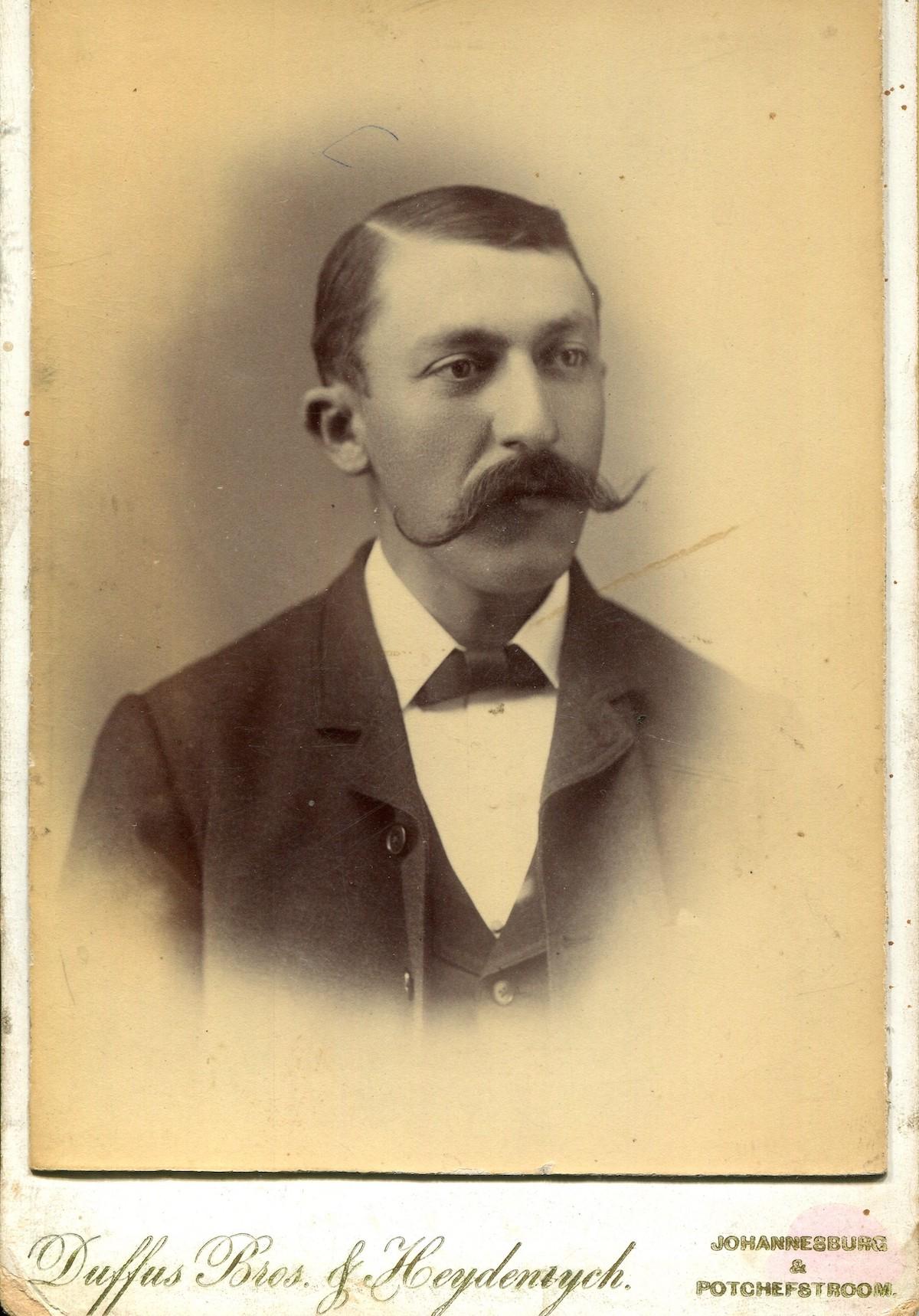
The photographer Max Fleischack as photographed by Duffus Brothers and Heydenrych (circa 1893). Photograph provided by Potchefstroom Museum.
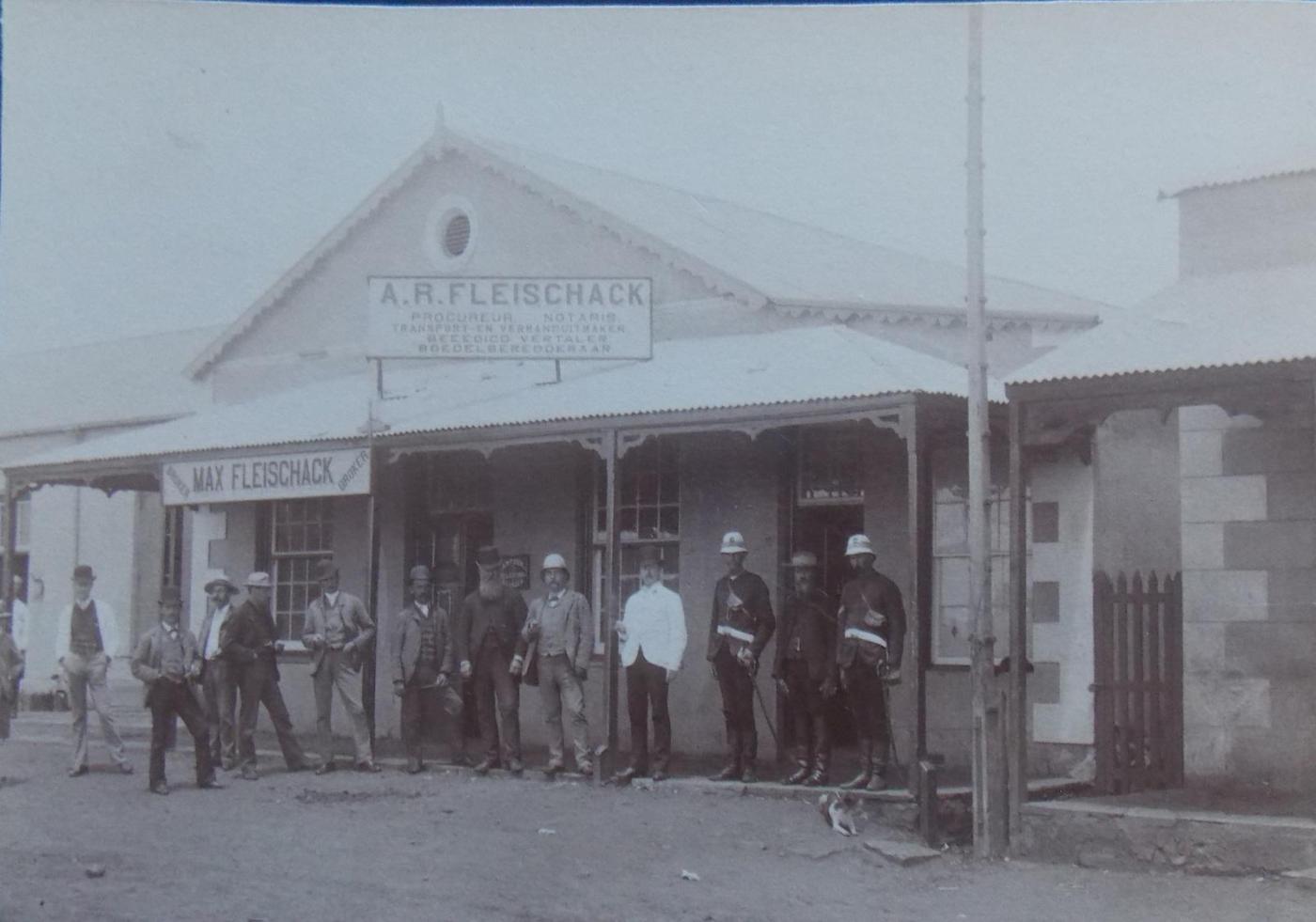
A photo from the late 19th century shows the offices of attorney AR Fleischack. Max Fleischack, whose signboard is also visible, was not only a photographer but also a broker who shared offices with his brother. Max more than likely took this picture. Photograph provided by Potchefstroom Museum.
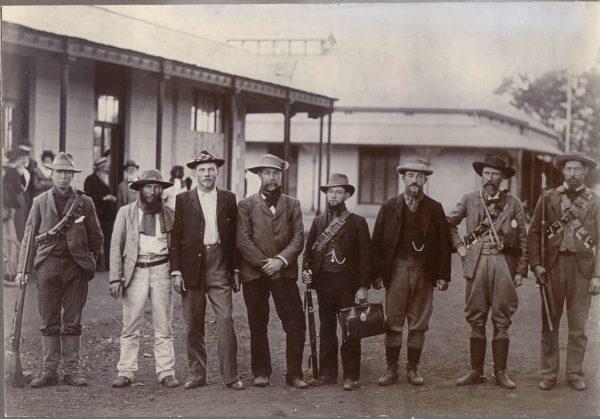
General Christiaan de Wet and his men. This photograph was taken when de Wet visited Potchefstroom on 27 August 1900 during the Anglo-Boer War. The photo was taken by Max Fleischack, who had his photographic studio in the building to the left behind the group. Photograph provided by Potchefstroom Museum.
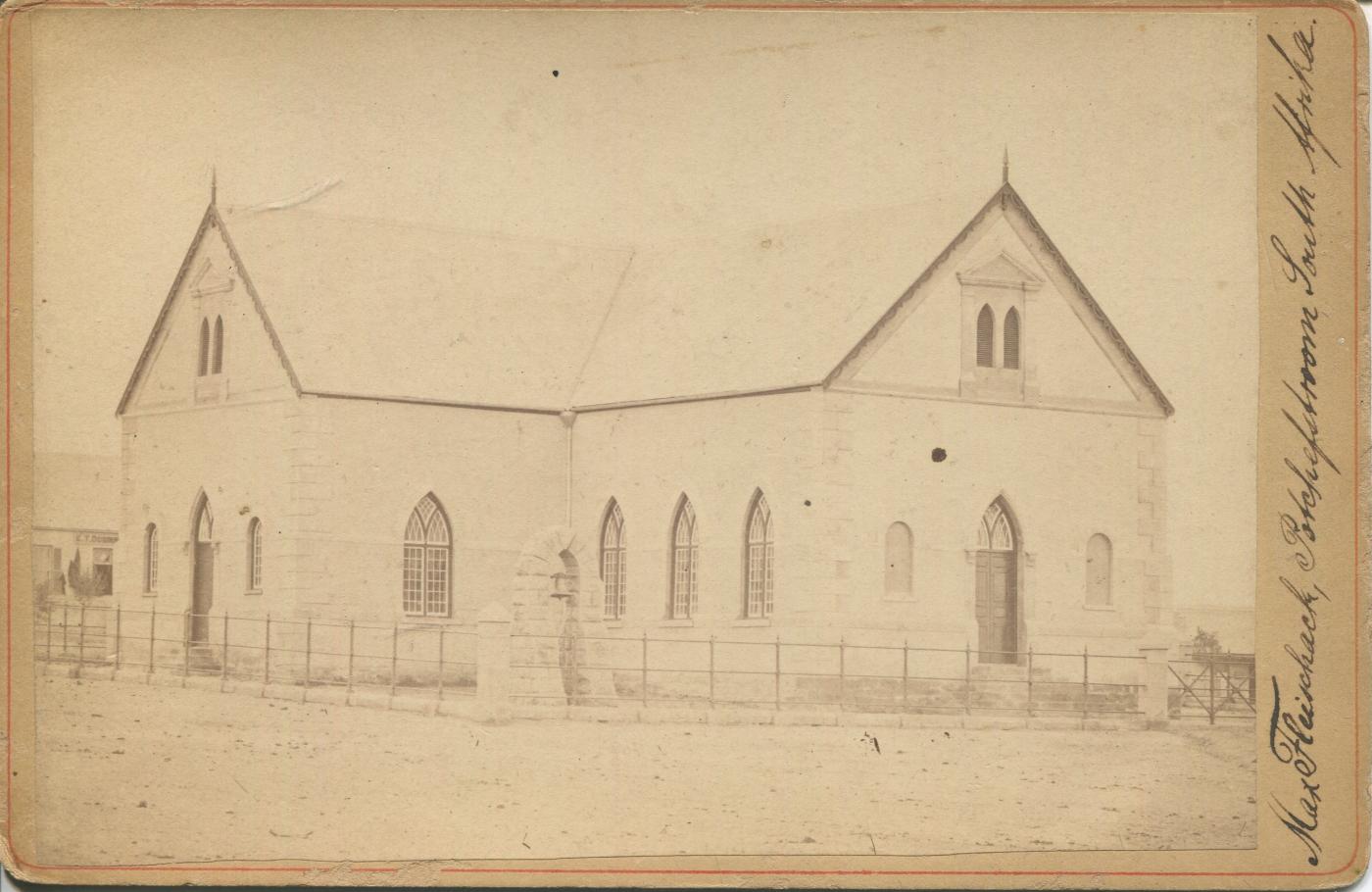
A Cabinet Card format photograph by Max Fleischack of a church building yet to be identified (circa 1890). Photograph provided by Potchefstroom Museum.
10. Frost Daniel George William (1859 - 1933)
Frost is thought to have based himself in Potchefstroom in the late 1880s and early 1890s.
It is recorded that a Daniel George Frost applied to do diamond prospecting in Lichtenburg in 1905. He also resided in Krugersdorp during the Anglo-Boer War. In a claim he submitted after the war, he is described as a homeopathic doctor with doubtful loyalties.
It could not be determined beyond doubt whether this was the actual Potchefstroom-based photographer.
Frost was also active in Durban and Wolmaransstad.
No photograph captured by him whilst based in Potchefstroom has been identified to date.
11. Gros Henri Ferdinand (1842 – 1915)
Swiss of origin, Gros was the first photographer to have settled in Pretoria (1875 – 1890). Click here to view detailed article on this photographer.
Gros first established himself in Burgersdorp towards the late 1860s with a fellow Swiss citizen and photographer, Weber, before moving on to Bloemfontein and from there to the Diamond fields.
After their Bloemfontein stint, Gros went on his own at the Diamond Fields Superb Saloon in 1872 (before moving on to Pretoria in 1875).
It is not known where the Gros studio was located in Potchefstroom. It is assumed that he rented studio space and travelled to Potchefstroom occasionally for a short while before the excursions were no longer viable. There is also the remote possibility that he may have had an assistant photographer located in Potchefstroom.
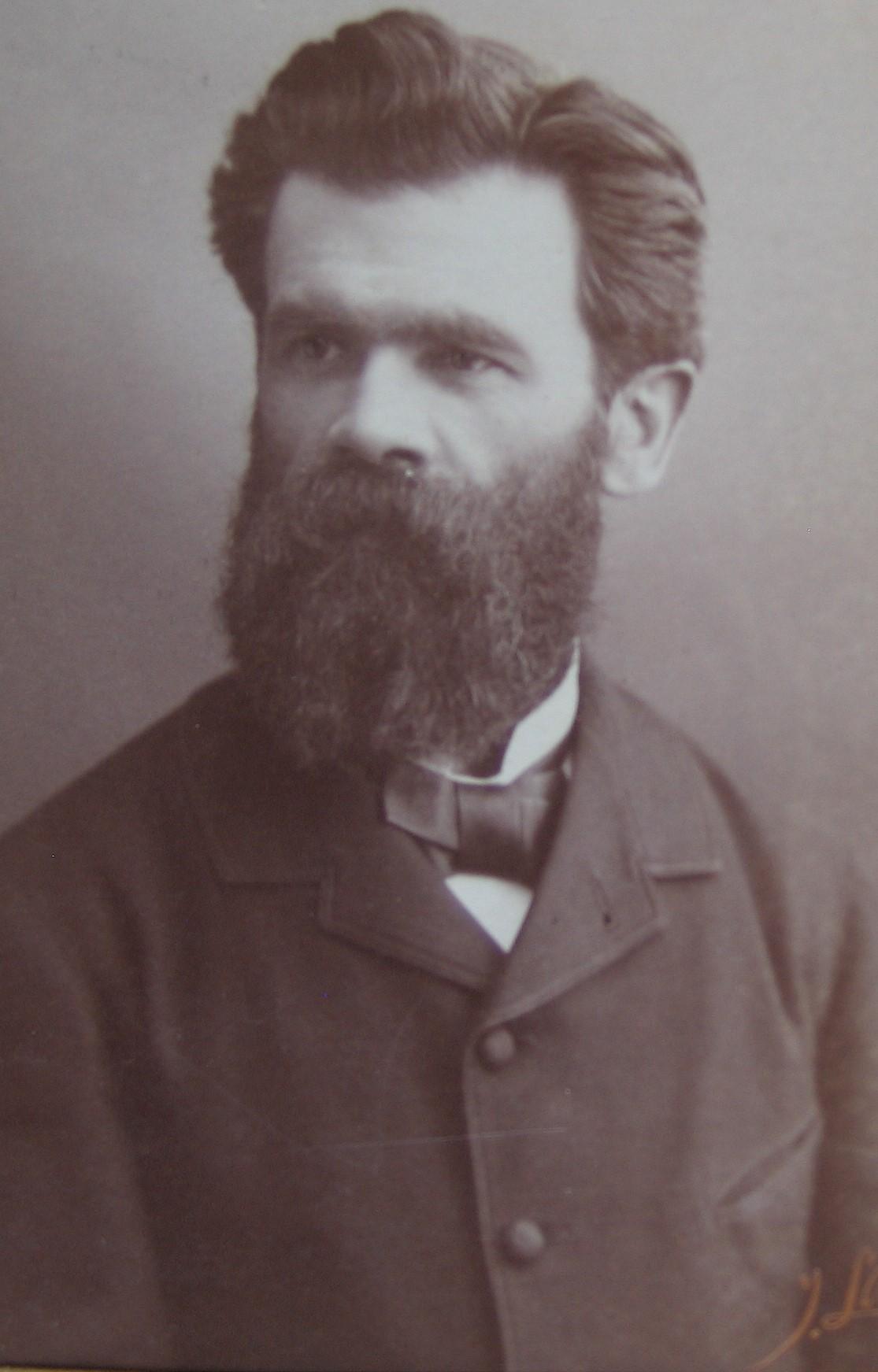
The Swiss photographer Henri Ferdinand Gros, who eventually established himself in Pretoria for several years before returning to his country of birth, also left his footprints in Potchefstroom. Photograph obtained from the Heys family album.
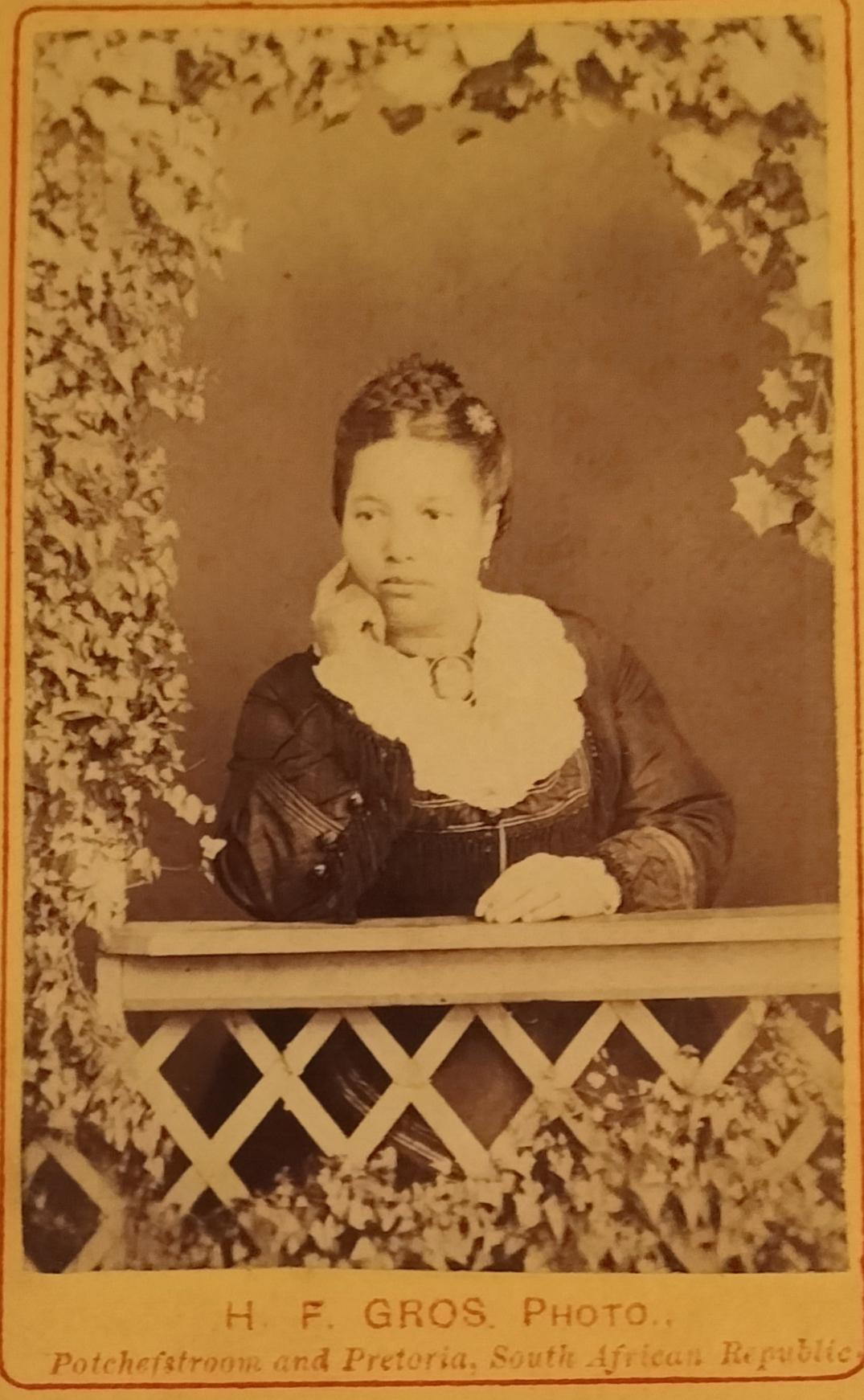
Early Carte-de-Visite format photograph of Mrs Bergsma by Henri Ferdinand Gros (Circa 1874). Gros, who was the first photographer to settle in Pretoria, was either a visiting photographer to Potchefstroom, or he had an assistant managing a studio in town.
12. Hale Matthew (1837 – 1887)
When Hale arrived in South Africa is not known, but it would have been before 1862.
Hale married Cordelia Jane Blackbeard on 13 July 1869 in Kleinfontein (Queenstown). He was 31, she was 24 (born in Grahamstown). She passed away on 23 November 1923 in Klerksdorp.
Hale was born in London in 1837 and died at the early age of 50 in Klerksdorp during 1887. His death certificate was co-signed by his wife Cordelia Jane and field cornet PJ Cronje. The couple had 8 children at the time of his death. His death certificate confirmed that he was still practicing as a portrait photographer, probably in Klerksdorp at the time.
In a preliminary notice dated 25 November 1862, Hale announced his intention of setting up as a photographer and taking Carte-de-Visite portraits in Queenstown. However, his “apparatus was delayed,” and he was only able to start his first Carte format studio in Queenstown on 3 March 1863. Previously, Hale was unsuccessful as a photographer in Grahamstown (Bull & Denfield, 1970).
Before settling down, Hale lived a nomadic life as he was also active in Grahamstown, Cradock, Bloemfontein, Burgersdorp, Colesberg, Graaff Reinet, Fort Beaufort, Somerset East, and Fauresmith. Hale also went into a partnership with Charles E Cronin in 1867. They were also the first, after Cape Town-based photographer SB Barnard, to have taken up producing the Cabinet Card format photograph whilst based in Fort Beaufort as early as April 1868. The general take-up in this format by photographers only occurred 4 years later.
Hale and Cronin were also the first to introduce the concept of “double portraiture” in Queenstown in 1868, where two different studio portrait images of the same person were presented on one photograph. This style of photograph attracted the name “Halcotype” – a combination of the two photographers’ names. These photographs gave rise to a form of comedy photography (Bull & Denfield, 1970).
Whilst based in Grahamstown, Hale applied the Alabastrine process, a process that entailed the improvement of the quality of “glass positives” where the picture was bleached to increase the brilliancy of the white image and then varnished (Bull & Denfield, 1970). Hale is also recorded as having arrived at the Diamond Fields as a prospector instead of as a photographer in 1870.
Whilst in Potchefstroom, he seems to have based himself in Berg and Potgieter Streets.
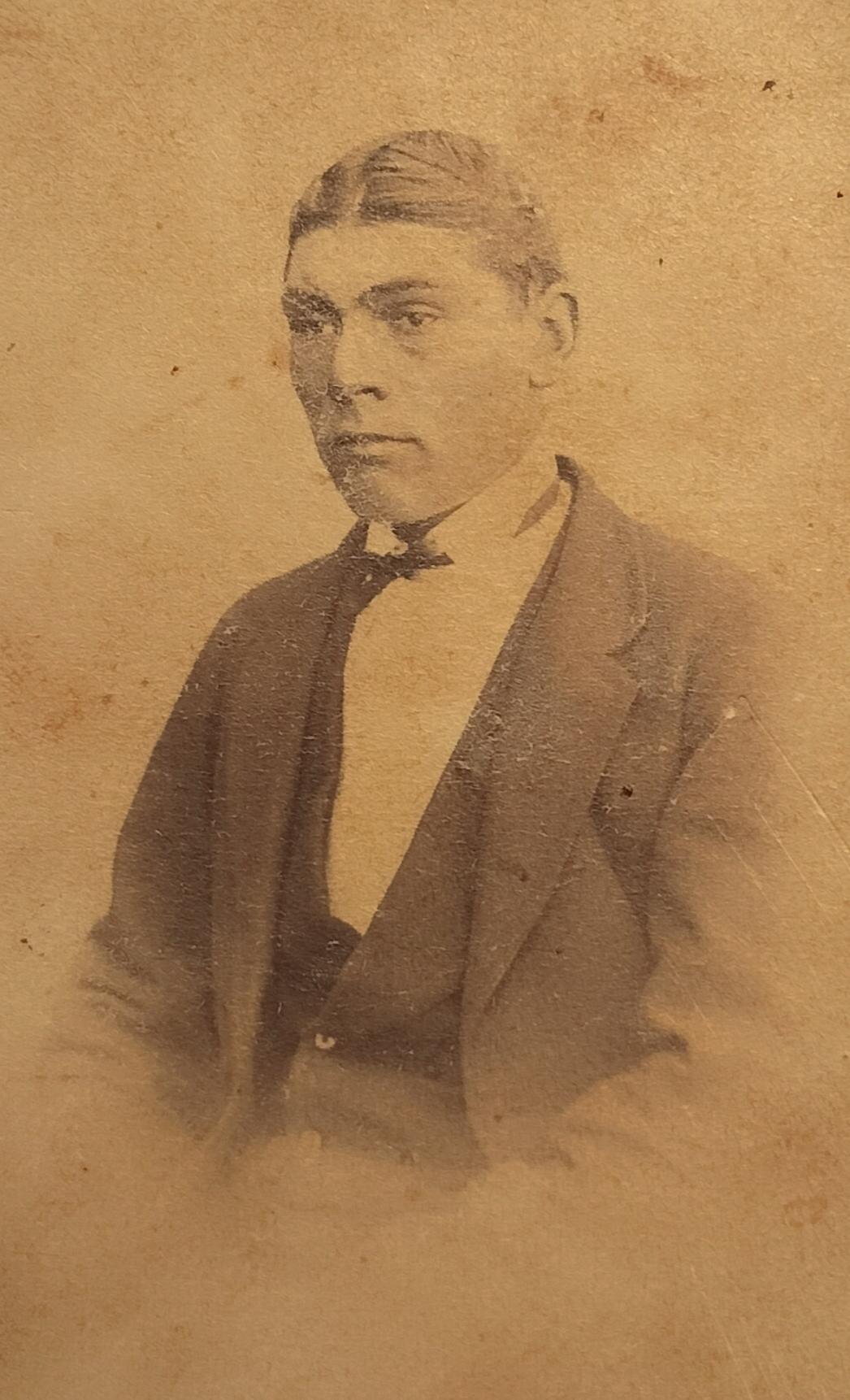
Early Carte-de-Visite format photograph of unknown sitter by Matthew Hale (1872). Hale was a restless photographer who moved around often. Considering that he died young (in 1887, aged 50), photographs by him are generally rare.
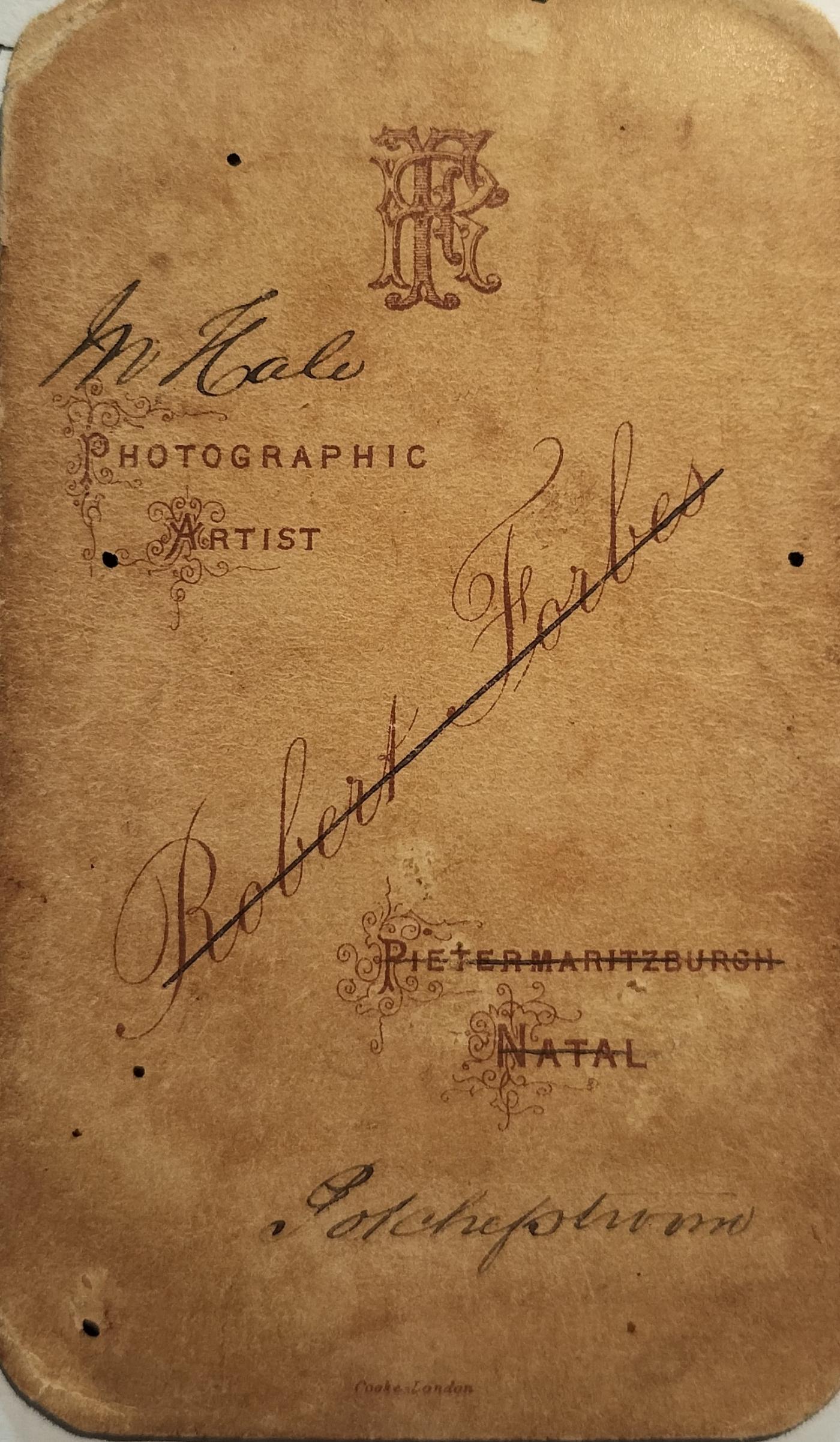
The back of the photograph above. Hale took over the cardstock from the fellow Pietermaritzburg-based photographer Forbes and applied his own details on the back of the card. It was not an uncommon practice for photographers who ceased their activity as photographers to sell their remaining card stock.
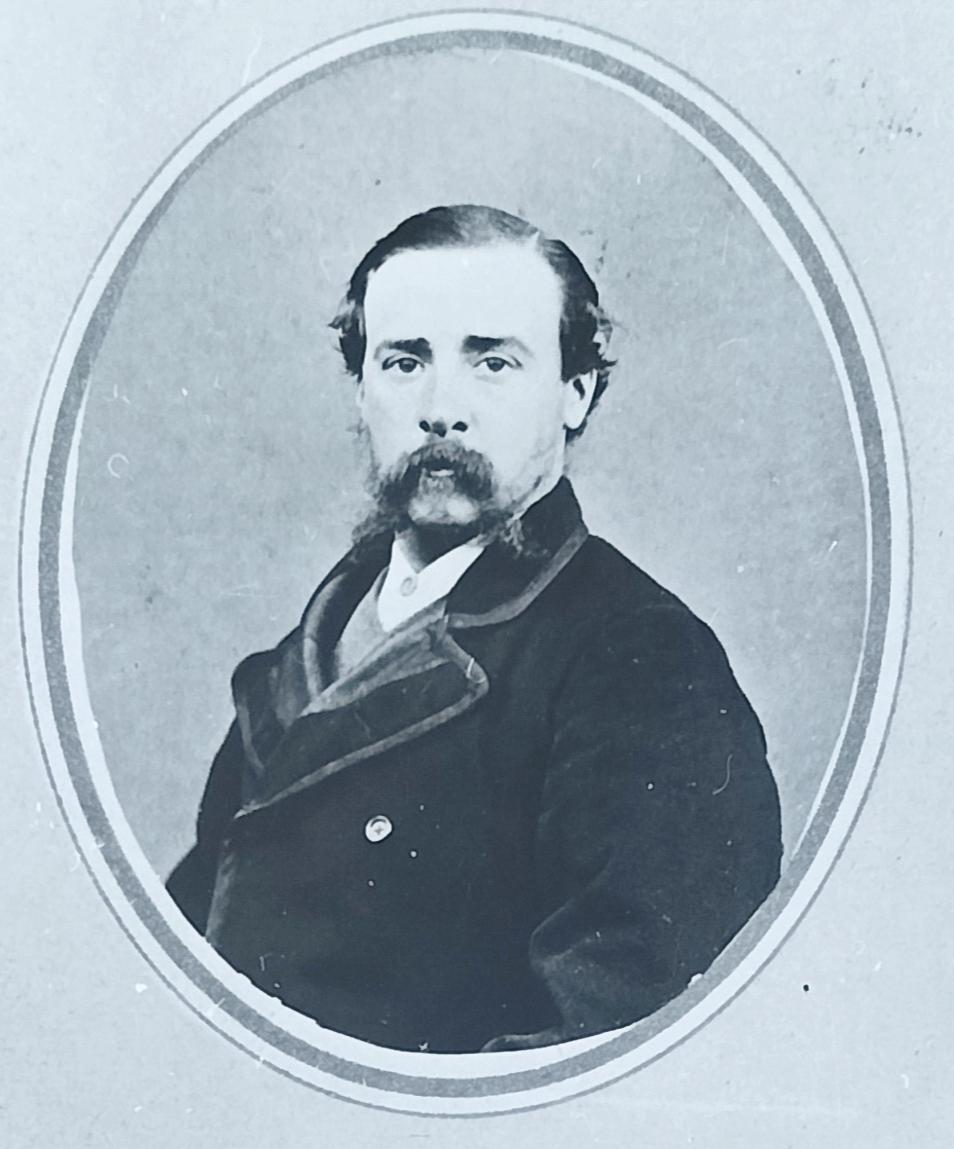
The photographer Matthew Hale (via South African National Archives)
13. Heydenrych Andrew J (Dates of birth and death unknown)
Other than that it is recorded that he was in partnership with the Duffus brothers, little is known about Heydenrych. It could therefore be that he managed their studio in Potchefstroom during the early 1890s.
See the photograph under Duffus Brothers above.
14. Jarman Ambrose Henry John (1863 – 1930)
One record suggests Ambrose Jarman was born in 1863 in Rondebosch, whilst the next suggests he was born in England. The fact that Jarman started his career as a barman in England suggests that he was British-born.
Ambrose Henry Jarman married Cathrine Mary Karl in Claremont in 1887. The couple had ten children.
When he settled in Potchefstroom is not known.
He managed Jarman’s studio in Potchefstroom. The couple resided at King Edward Street in Potchefstroom at the time of his death (17 July 1930).
The Hardijzer Photographic Research Collection also curates a few images captured by Jarman at the Greenpoint Prisoner of War camp during the Anglo-Boer War where he also had a studio on Main Road in Claremont.
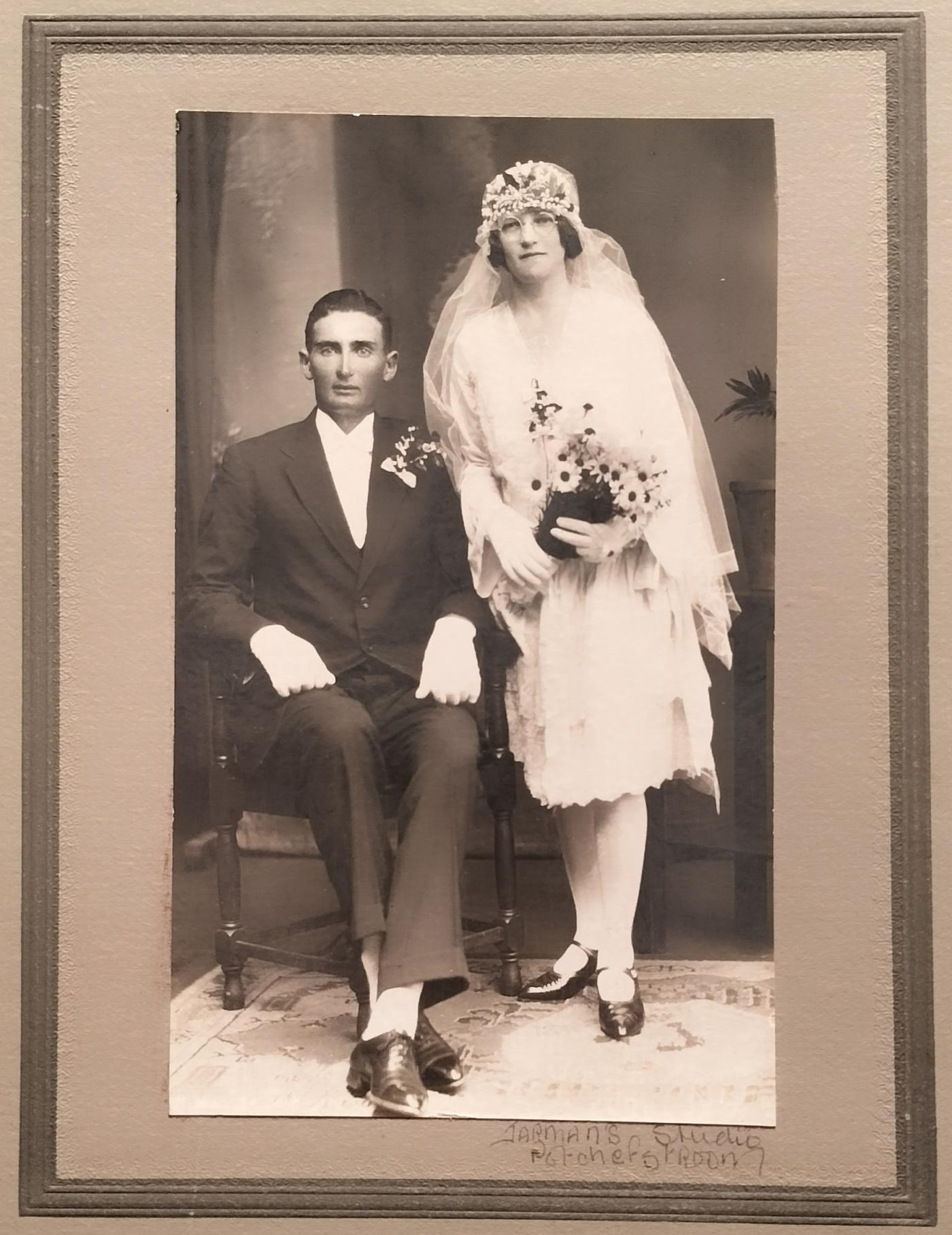
Large format photograph by Ambrose Jarman (Jarman's Studio) of an unknown wedding couple (circa 1918)
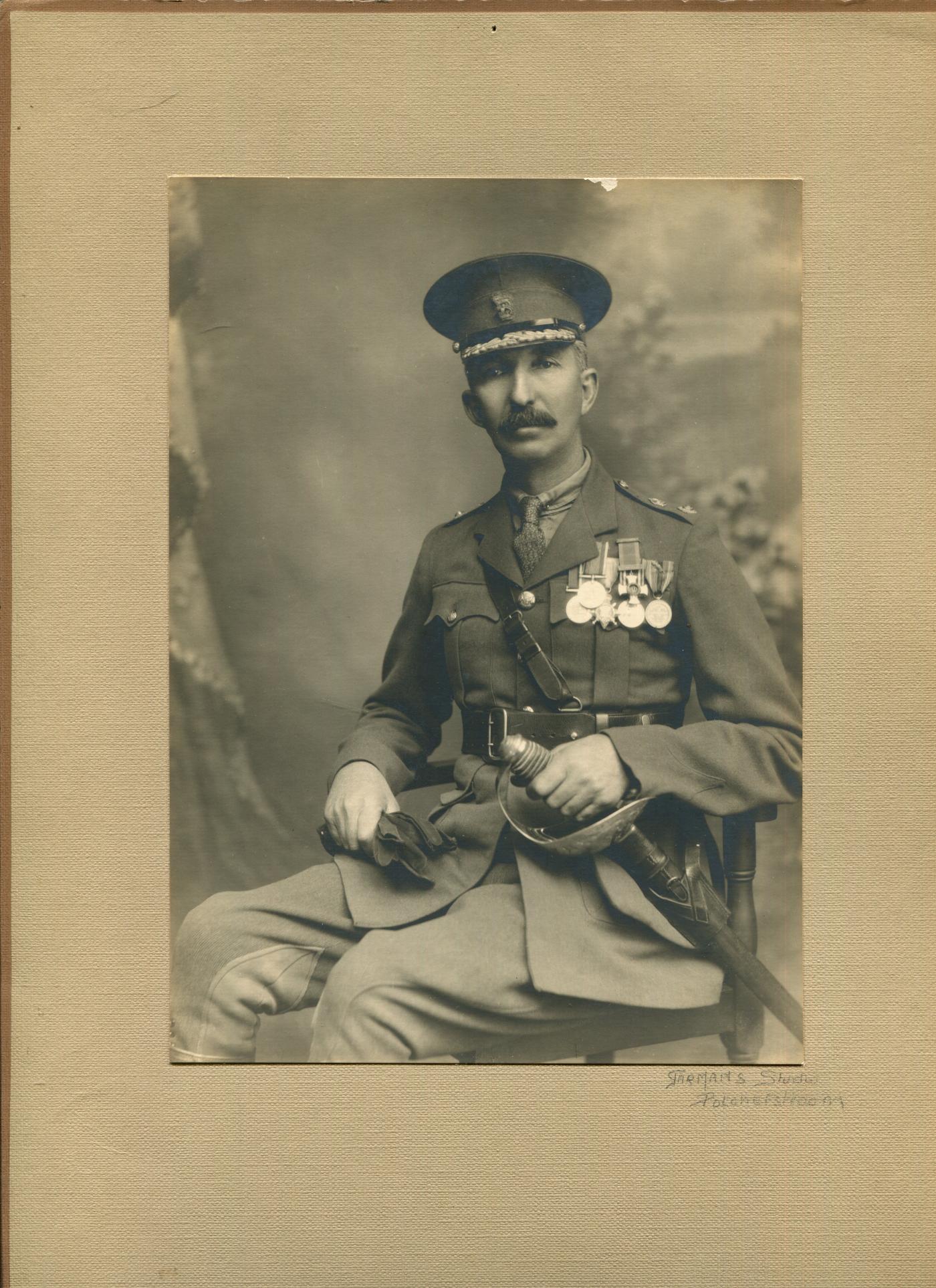
Colonel Izak Meyer (1882 – 1974) photograph by Ambrose Jarman (Jarman’s Studio – circa 1919). Meyer was a grandson of President MW Pretorius. Photograph provided by Potchefstroom Museum.
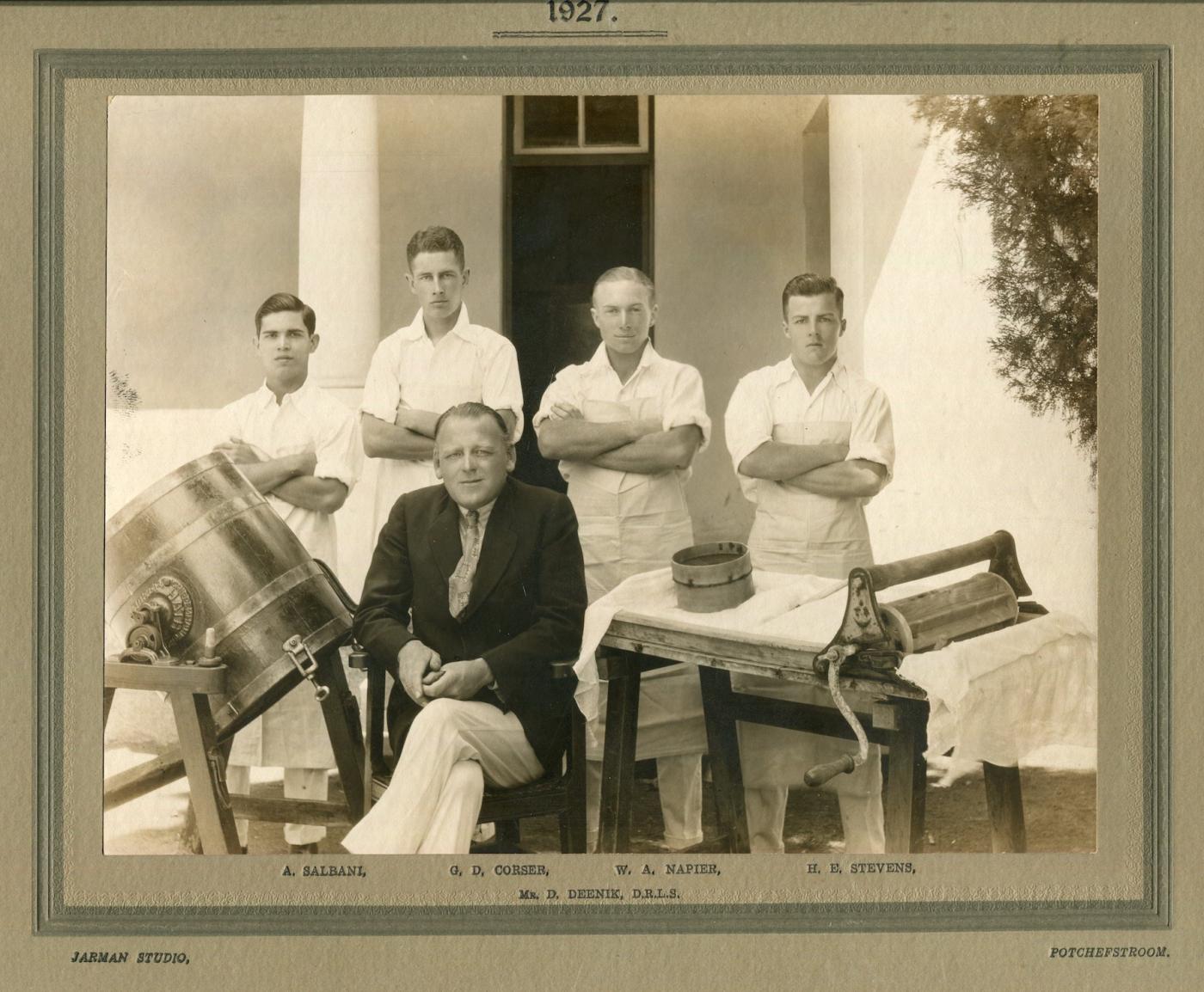
Photograph by Ambrose Jarman of the Agricultural College team in the inter-school butter-making competition in 1927. The sitters are: A. Salbani, GD Corser, WA Napier, HE Stevens & D Deenik (seated). Note the highly collectable butter churn and butter roller. Photograph provided by Potchefstroom Museum
15. Johnson GF (Dates of birth and death unknown)
Without the exact first names, it has not been possible to trace Johnson. It is recorded that a photographer named GF Johnson was based in Potchefstroom in the late 1890s. Another record indicates that Johnson, in partnership with Young, was based in Lombard Street in the early 1900s.
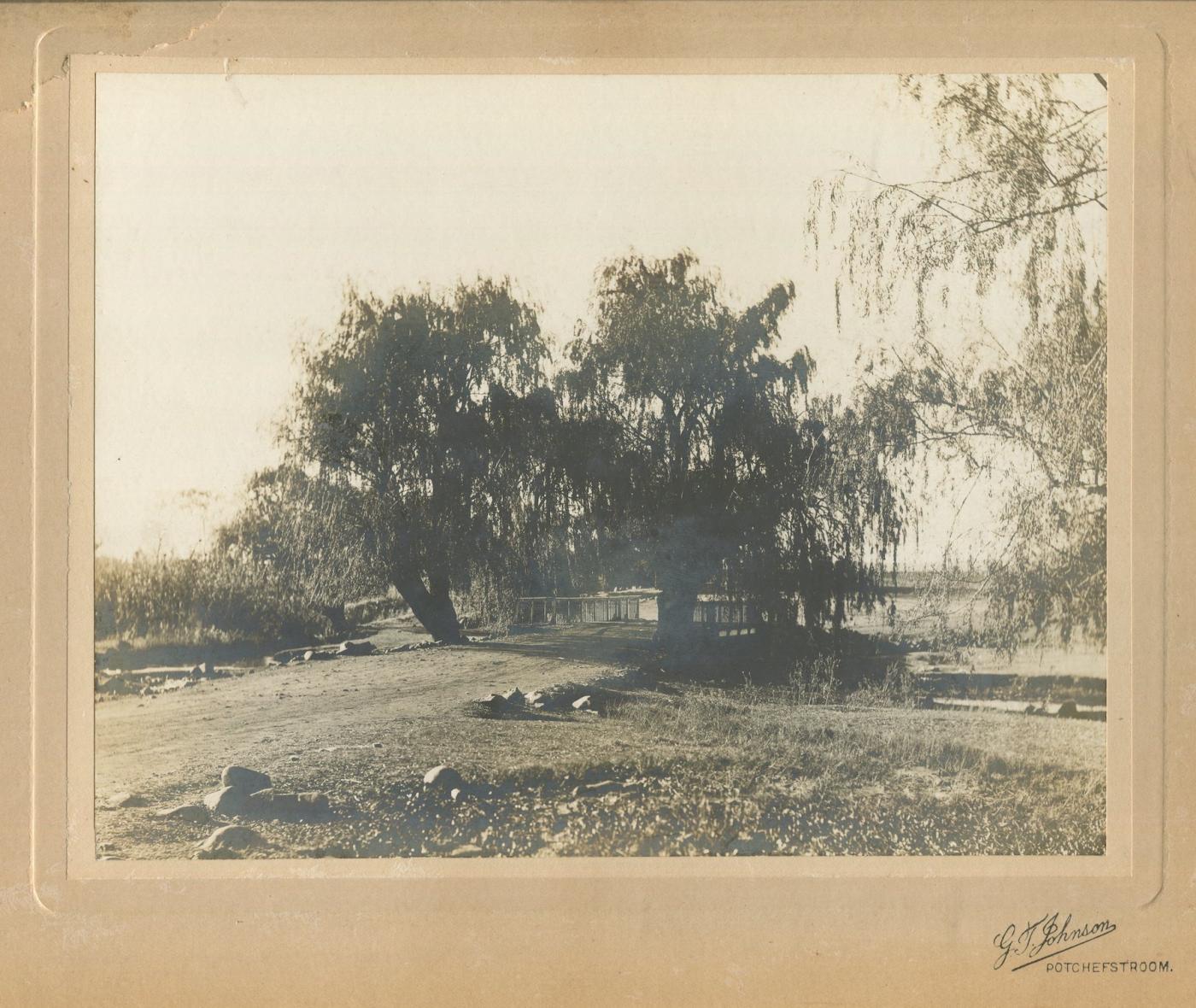
Large format photograph by GF Johnson of Noordbrug (circa 1903). Little is known of GF Johnson. Photograph provided by Potchefstroom Museum.
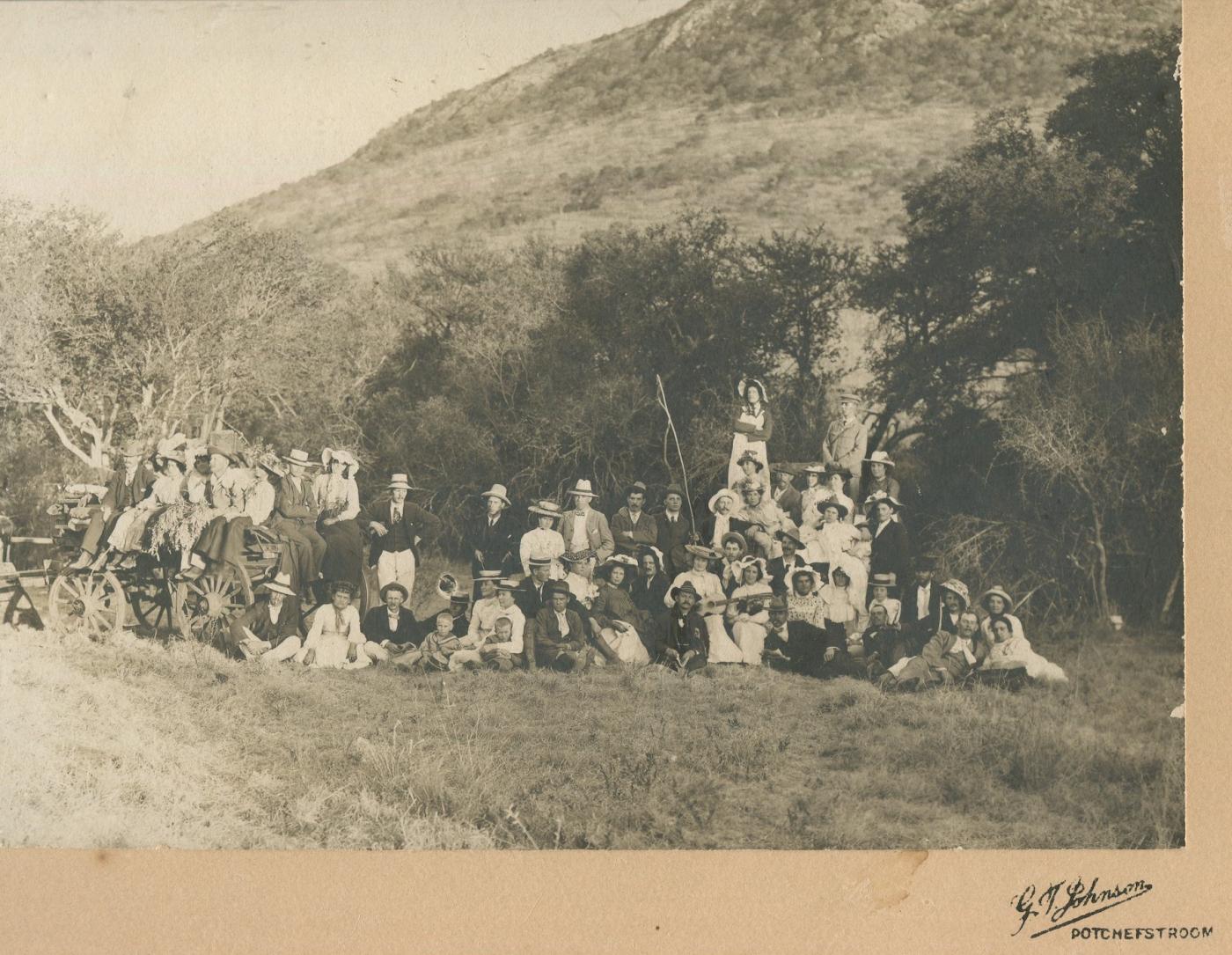
Large format photograph by GF Johnson of a picnic in the veld, thought to be in the Vredefort Dome (circa 1905). Photograph provided by Potchefstroom Museum.
16. Koenig (alias King) Siegmund Heinrich (1855 - 1923)
Koenig was born on 26 June 1855 in Hamburg and arrived in South Africa around 1898, aged forty-three.
Records indicate that Koenig was based in England for 17 years before settling in South Africa.
On arrival in South Africa, he was initially Cape Town-based, where he and his business partner, Muniz, ran a studio named The Crown Photo Company on 38 Caledon Street in Cape Town. Muniz, in all probability, was also German, but no evidence of this could be found.
How long their studio was open is not known as Koenig shows up as a storekeeper at the time of his internment following his arrest in Louis Trichardt on 28 October 1914.
It seems that Koenig was released at some point in 1916 or early 1917, in that during 1917, a letter from the local magistrate in Potchefstroom confirmed that Koenig was one of the Germans in town, whereafter he was reinterned on 18 March 1917.
When he was eventually paroled in July 1919, he provided the address of a boarding house in Potchefstroom.
Koenig passed away in Potchefstroom on 23 May 1923 at the age of 68. His occupation is recorded as that of a photographer on his death certificate, which suggests that he still practised the art of photography after his release. He was single at the time of his death.
Whilst based in Potchefstroom, he went under the name King which initially made the identification of his photographic work challenging.
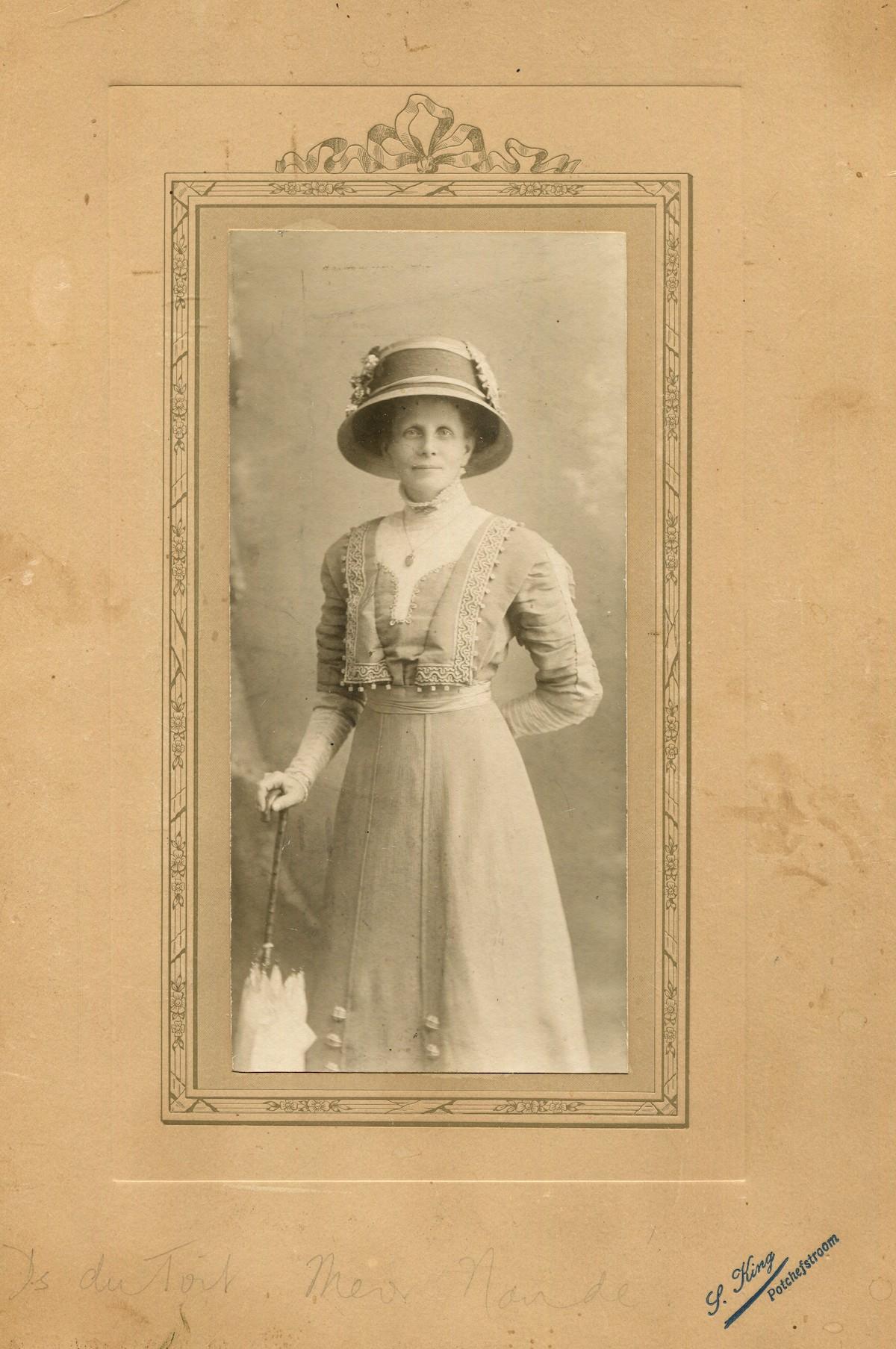
Photograph of Mrs Maurlive by Koening (alias King) (circa 1908). Photograph provided by Potchefstroom Museum.
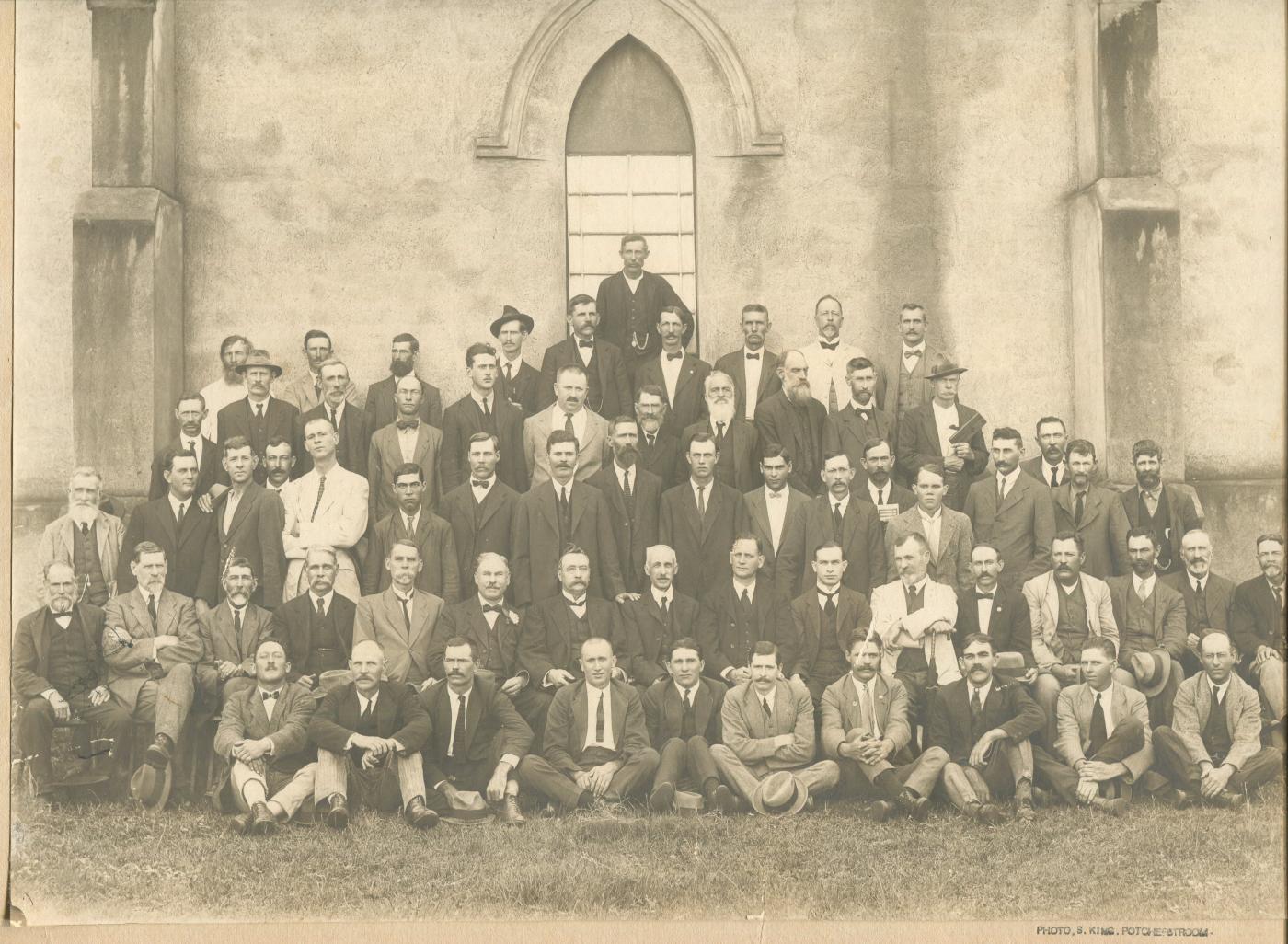
Large format photograph of church gathering by Koening (alias King) (circa 1905). Photograph provided by Potchefstroom Museum
17. Loxton Brothers (James Andrew 1867 – 1947 & Charles Frederick 1868 – 1931)
James Andrew and his brother Charles Frederick, both South African born, were the sons of the photographer Charles Frederick Loxton (+-1843 – 1906).
Loxton senior was born in Cape Town around 1843 and passed away in Aliwal North in January 1906. His first wife was Johanna Jacoba (nee Ferreira) (1845 – 1894). His second wife was Rensche Magdalena Catharina Sussana Myburgh. She was 20 and he was 63 when they got married.
The brothers would have started very young as photographers in the 1880s.
It is not clear whether the two brothers were in partnership whilst in Potchefstroom or whether they worked independently.
Charles junior married Elizabeth Leonora Scholtz in December 1896 at Barclay West, but he became widowed. In March 1919 he married Marcia Elizabeth Schoeman in Kimberley, but she died in November 1920 following pneumonia. Their marriage certificate also indicates that he was a photographer.
At the age of 53, in June 1922, Charles married for the third time when he married Anna Christina Johnson in Douglas. Again, the marriage certificate indicates that he is a widower and that he is a photographer. Charles junior died in Kimberley at the age of 63.
James Andrew, the eldest of the two brothers, is also recorded as being a photographer at the time of his marriage to Alida Barendina Sophia Catharina Kruger (10 years his junior) in Fauresmith in March 1894. Alida predeceased James, and at the age of 72, James married 35-year-old Alitha Elizabeth Francina Swanepoel in January 1939 in Boksburg.
James also seems to have been based in Steynsburg as a photographer. At the time of his death, he was recorded as being a general farmer in Witbank.
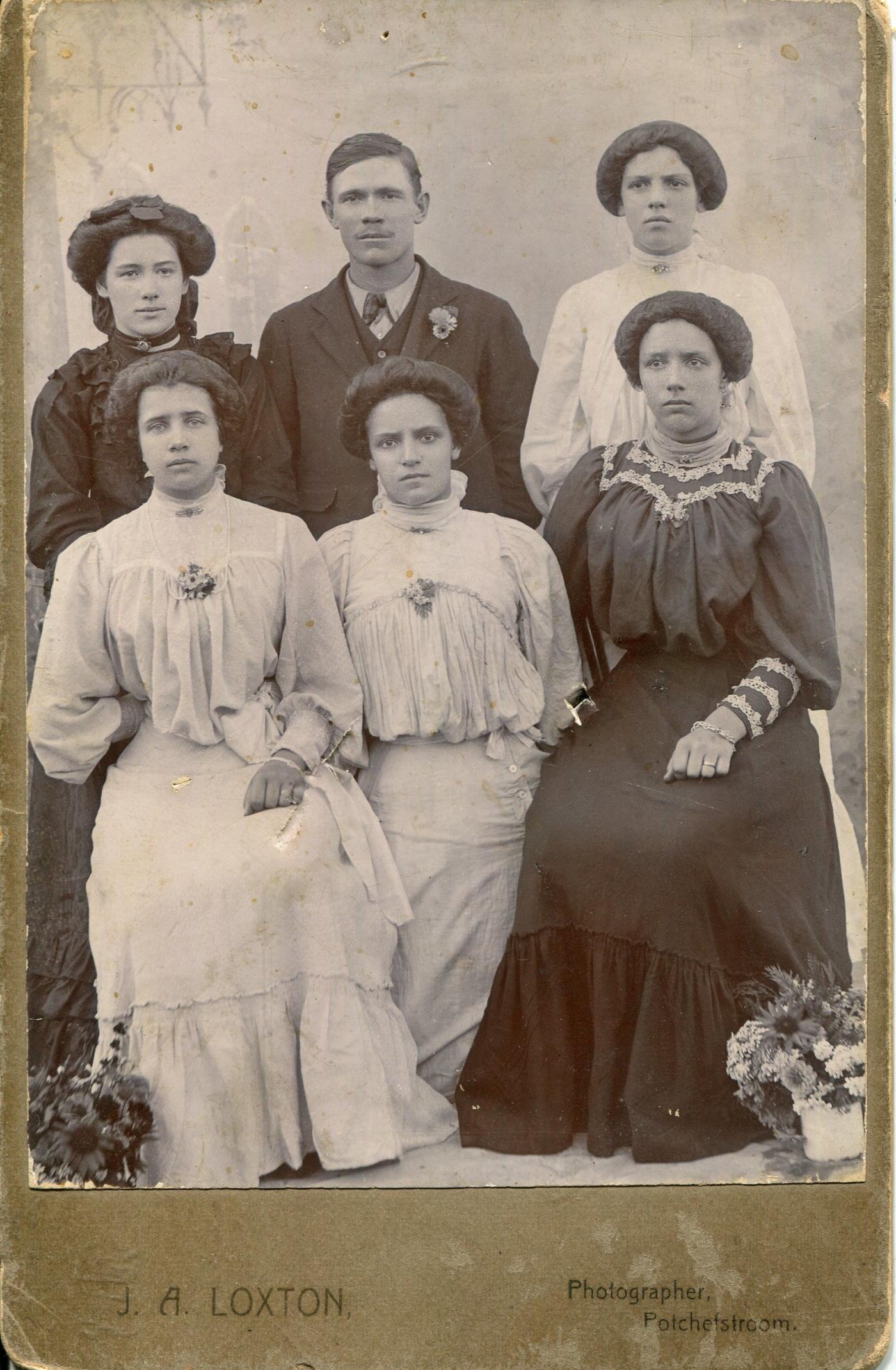
Cabinet card format photograph by James Andrew Loxton (circa 1895). Three of the six sitters are named, namely: Christiena, Jacoba and Anna (surname unknown). Photograph provided by Potchefstroom Museum.
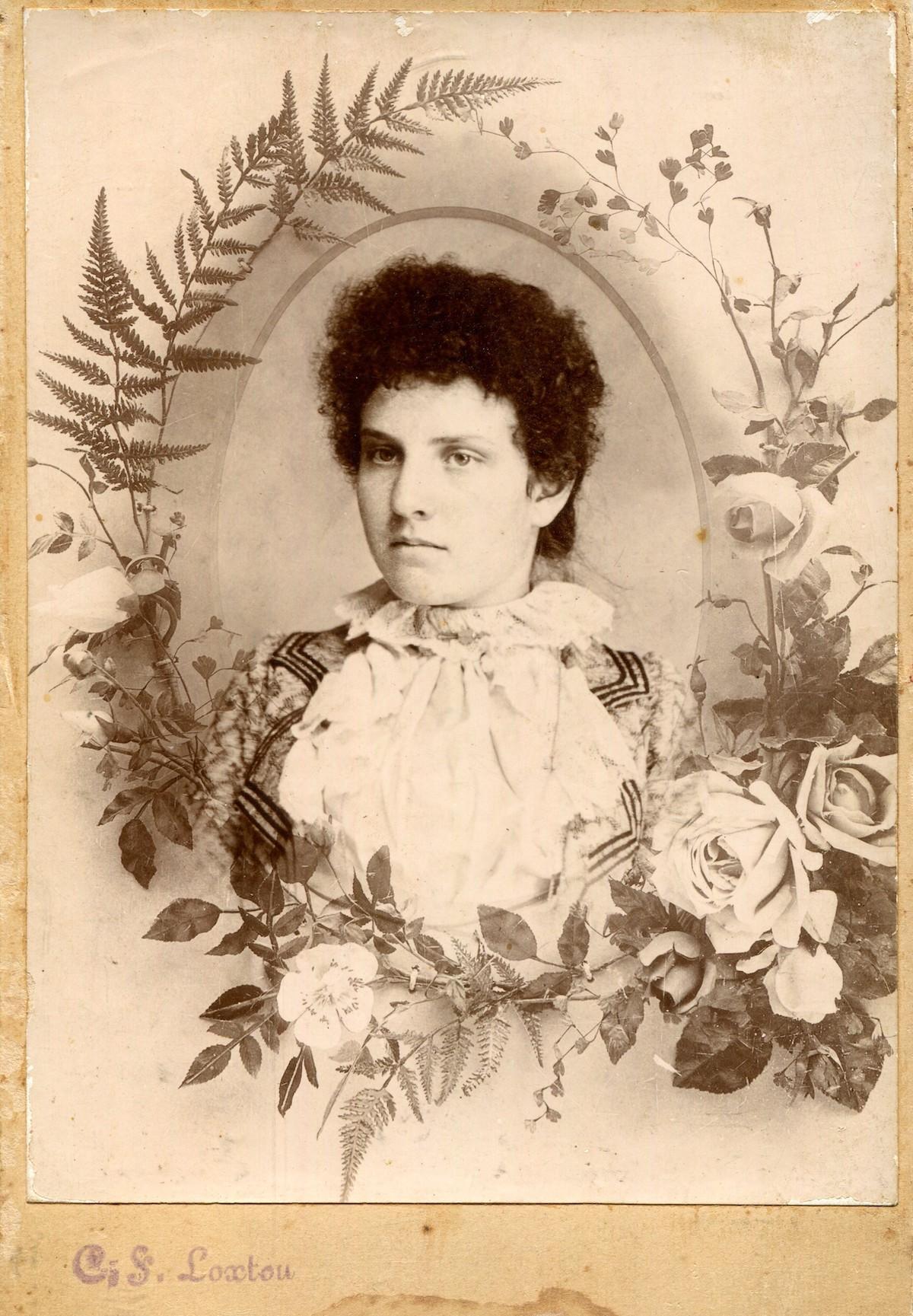
Cabinet Card format photograph of Bettie Loxton by Charles Frederick Loxton (circa 1890). Photograph provided by Potchefstroom Museum.
18. Mähler Carl Bernhard (+- 1839 – date of death unknown)
Van den Berg (2008) points out that Mähler had a studio on the upper level of Jan Schikkerling’s double-storey building in 1880. This, in all probability, was the same studio used by Schikkerling, which he rented out to Mähler.
Mähler was a restless soul, constantly on the move, and would therefore not have occupied the studio for more than a year. The fact that his wife gave birth to twins in Frankfort (Orange Free State) towards the end of 1880, potentially confirms that he already seized the use of the studio in Potchefstroom, unless he had a photographic assistant employed. No evidence of his Potchefstroom studio work has been identified to date.
Biographical information on Mähler remains limited. The exact date and location of his birth and death are not known at this stage.
When Mähler arrived in South Africa is also not known. This would however have been before 1868.
On arrival in the country, he marketed himself as a barkeeper, photographer and medical practitioner. In the same advertisement, he stated that he established himself as early as 1852 in Berlin, Rome and Paris. In South Africa, he was active in Cape Town, the Free State and the Transvaal.
Where and when Mähler obtained his medical qualification is also not known.
What is known is that Mähler (aged 29) married Josephine Maria Litkie (aged 17) on 9 July 1868 in Cape Town. Mähler’s occupation is recorded as a photographer on the marriage register. The couple had an unknown daughter who was born on 13 December 1870 in Cape Town. Ironically, this birth was only registered post-1920s. Other births registered are for Johan Emil on 12 April 1878 (Newcastle) and for twin daughters Albertina Lavinia Catharina and Josephine Christina Harriet on 9 December 1880 in Frankfort (Orange Free State).
His portrait salon in Cape Town was based at 99 Long Market Street between 1868 and 1881. It is possible that he had an assistant managing the studio during his extensive travels in South Africa. Although still around in 1894, his last recorded activity as both photographer and medical practitioner was in Ventersdorp in 1889.
Mähler became known for his medical interventions in the Boer Commando during the conflict with the British, in that he effectively attended to the wounded, and by doing so, built trust within the commando and the burghers. He was also in the service of the Potchefstroom commando in 1882, for which he closed his practice to provide this service at £3.3.0 per day.
In 1883, Mähler addressed a letter to President Paul Kruger stating that he had already been working in the field in Heidelberg and Potchefstroom as a medical practitioner (during the war against Mapoch), using his own medicine. He requested that he be paid a salary for February and March 1883. To this request, he also attached an activity sheet, providing evidence of the medical services provided. Commandant PA Cronje confirms that Mähler has been working as a doctor in the lager at Mapochsberg using his own wagon, oxen and medicine.
In 1894, Mähler addressed a letter to President Paul Kruger. This letter, held at the South African National Archives, is barely readable or understandable and includes references to religious scriptures. It seems to have been written by a madman, including multiple exclamation and question marks. The recipient (on behalf of Pres Kruger) also states that the content of the letter was not understood.
This letter alone could be indicative of either a deterioration in Mähler’s mental health or a possible addiction of some sort.
It is then also from this date, namely 1894, that no further trace could be found of Carl Bernard Mähler, who went by the name of Bernhard Mähler. He would have been 55 at that stage. Did he possibly return to Germany?
19. O’Donoghue Henry (alias Donoghue) (1836 – 1904)
O’Donoghue was born in Ireland in 1836. He would have been 2 years old when he landed in South Africa with his parents.
His father, Richard, was also based in Potchefstroom, where he passed away in 1878.
He married Margaret Mary Kearney (born in 1837 in Fort Beaufort) at the Cape in 1854. The couple had 13 children, born between 1857 and 1884.
During the early 1860s, Donoghue was based in Bloemfontein. He was also active in Fauresmith, Colesberg, and Alice in the 1860s, where he traded in the sale of cameras and photographic chemicals. In Fort Beaufort (1861) & King Williams Town (1870) he also opened a mineral water manufactory. Both the studio and mineral water establishment were later sold to EP Wienand in 1862. Henry then established himself in Macleantown (north-west of East London) between 1862 to 1863. Where he based himself between 1863 and 1867 (before arriving in Potchefstroom) is not known.
Henry's work for the establishment of the Catholic Church in the Transvaal was recognised by a Papal Knighthood conferred by Pope Leo XIII. Between 1847-1853, he lived in Natal. He was instrumental in effecting the rescue of several people on board the 'Hercules' wrecked between Natal and East London.
The couple’s fifth child, John Henry, was born in Alice in 1864. The 8th, Joseph Patrick, was born in Kimberley in 1870, suggesting that Henry partook in the diamond frenzy of the time.
The seventh child, Richard Daniel, was born in 1868 in Potchefstroom, confirming Donoghue’s presence in the town at the time.
In 1895, he was awarded the title Chevalier (Knight of the order of St. Gregory). This honour was conferred on him by Pope Leo for valuable services to the Roman Catholic community, which included the abolition of the old Transvaal law forbidding Roman Catholic priests from carrying out their duties in the Transvaal. The 1st Mass celebrated on the Witwatersrand was in the house of his eldest daughter, Ellen Adcock, at Leeupaardsvlei in 1886.
Henry returned to Johannesburg when the need for better educational facilities for his family rendered it compulsory. Again, he involved himself in local politics and was elected a member of the Johannesburg Sanitary Board in 1889, the forerunner of the Town Council. He represented his ward and town most ably.
Henry was 68 years old when he passed away in his home, Stand 1613, Pritchard St, Johannesburg, on 7 August 1904.
Photography was not a full-time career for Henry. None of his photographic work has been identified to date.
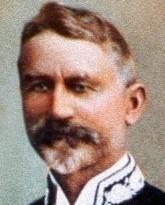
The photographer Henry O'Donoghue (alias Donoghue). None of his photographic work has surfaced to date. Image reproduced from Wikipedia
20. Pavey Edward (1830 – 1901)
Gouws (2021) states that British-born merchant Eduard Pavey (Edward) was the first town resident to have owned a camera. Of interest is that Pavey married Marijan Elizabeth (Marie Isabel) Schikkerling on 30 October 1856, the aunt of John Roland Schikkerling (Jan), a photographer listed above.
Pavey was one of the few English-speaking individuals to have based himself in Potchefstroom in the early 1850s (Child, 1979).
Pavey joined the general dealership of Schikkerling & Reid in 1851, based on Market Square. It has been suggested that he took up the art of photography as early as 1852. How long Pavey was active as a photographer is not known.
Pavey died in Bloemfontein in 1906 – he was a widower in that his wife died in Bloemfontein five year prior (November 1901).
The first paper-based photographic print, the Carte-de-Visite format, was only introduced in South Africa in the early 1860s. This means that Pavey would have produced either Daguerro or Ambro type format photographs. The Ambro type format (on glass) was introduced early 1850s. Both these formats are rare artifacts to find in South Africa, more so where both the sitter and the photographer are known (see two examples of the Ambro types produced by Pavey below).
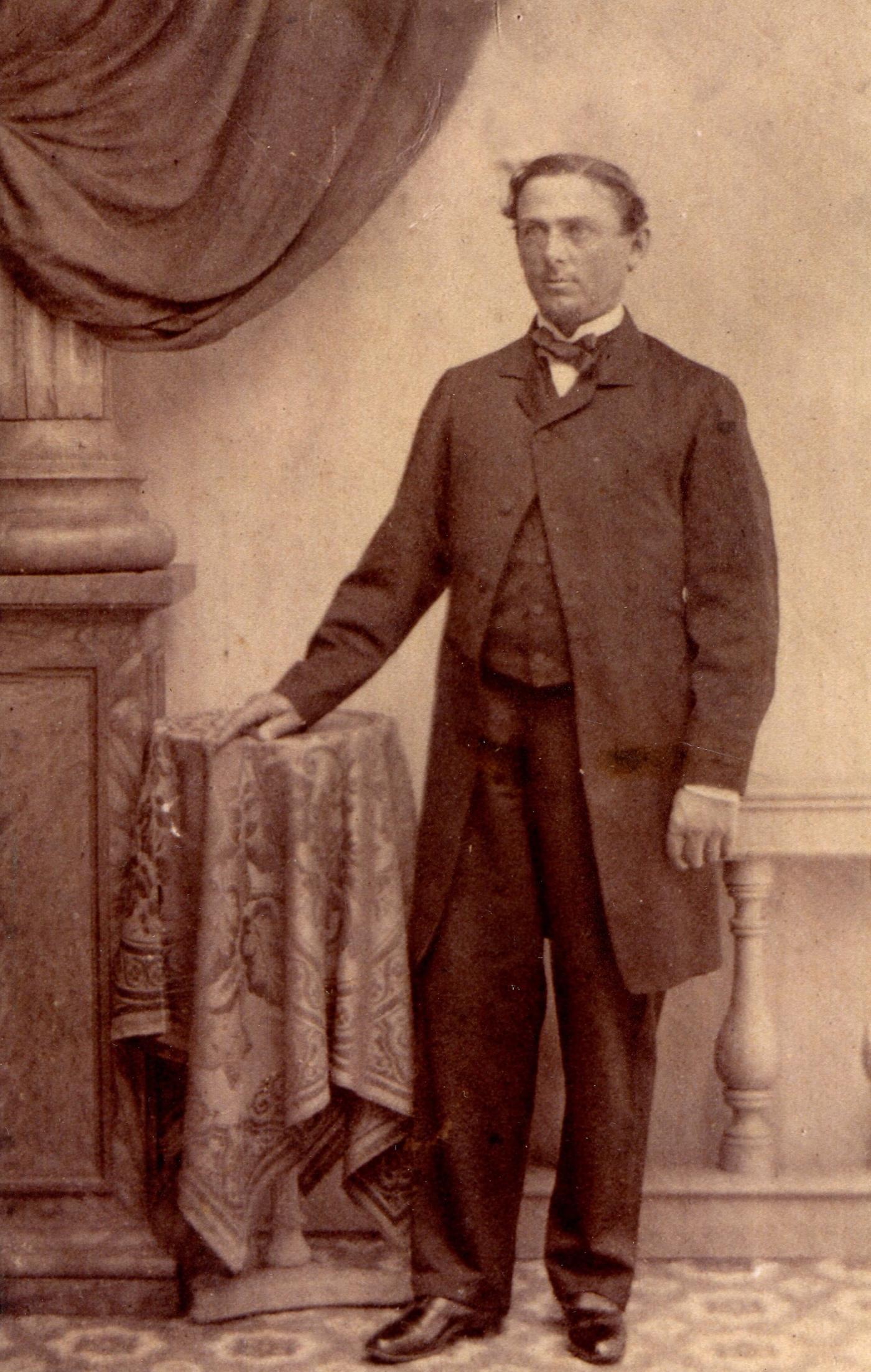
Potchefstroom’s first recorded photographer, Eduard/Edward Pavey (circa 1860). Photograph provided by Potchefstroom Museum.
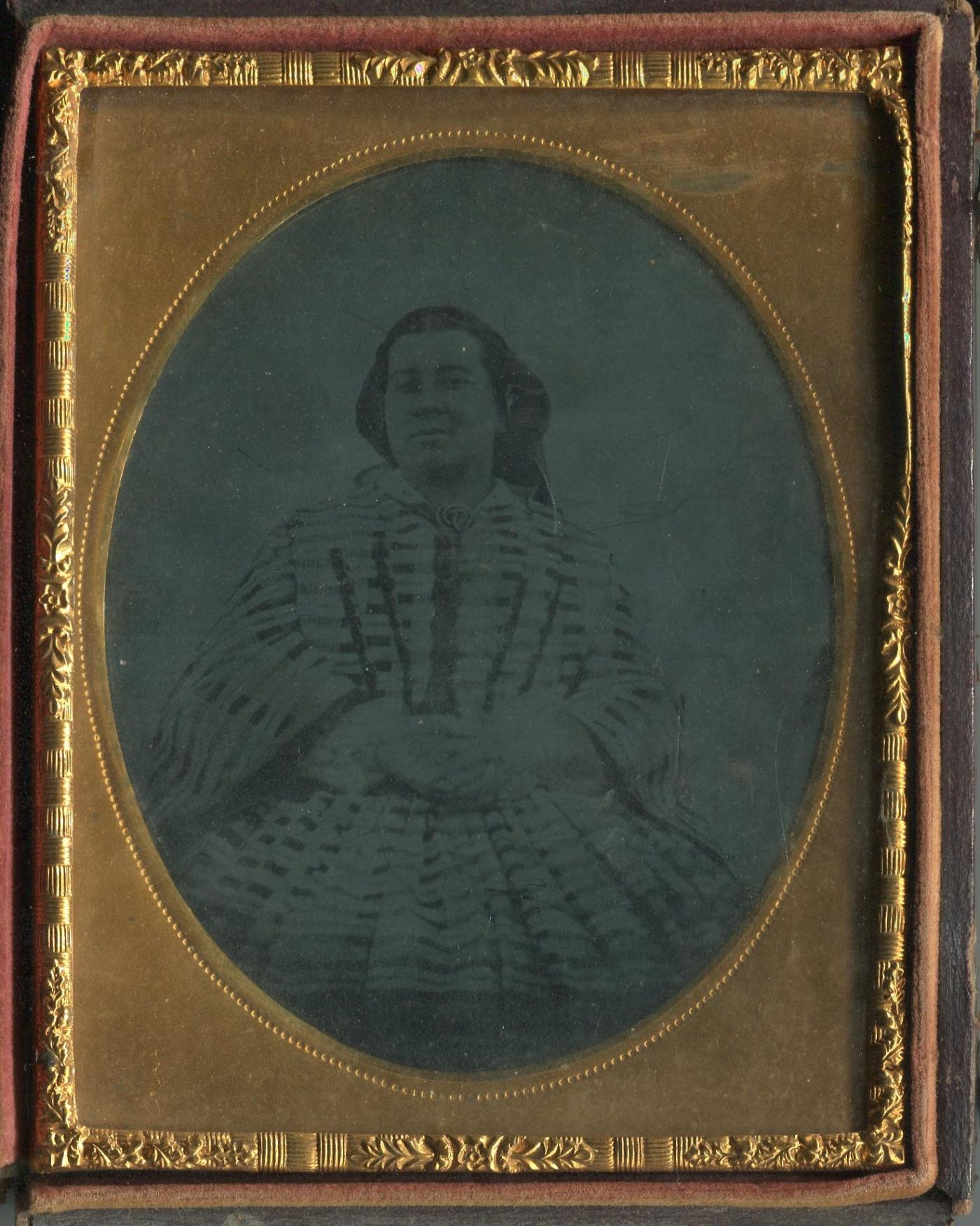
Ambrotype format photograph of Mrs Emelia Forssman by Eduard/Edward Pavey (circa 1858). These photographic formats are glass-based. What makes this photograph unique is that both the sitter and the photographer are known, a rare occurrence for these earlier South African images. Photograph provided by Potchefstroom Museum.
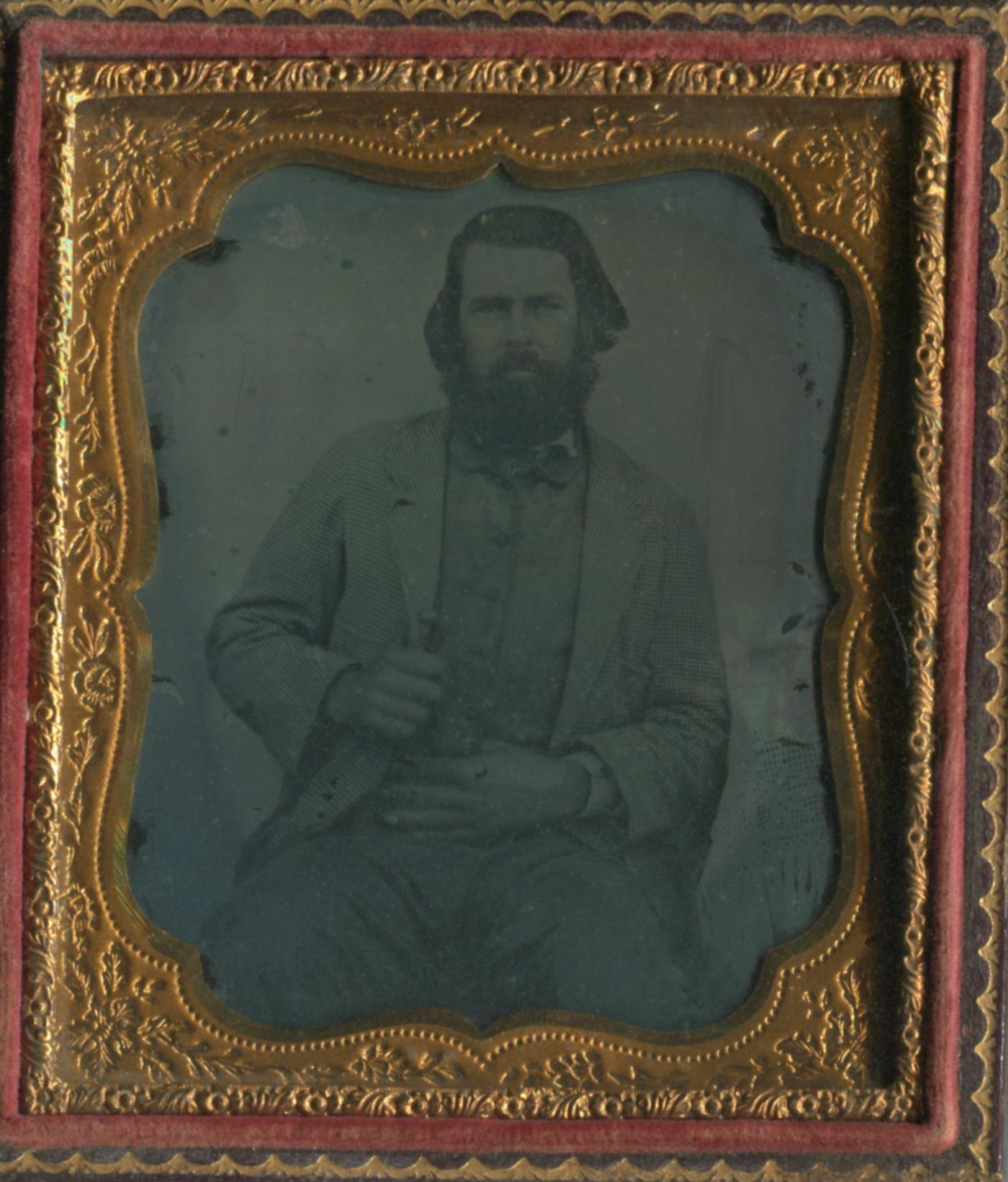
Ambrotype format photograph of JF Laubscher from the Losberg district (circa 1858). What makes this photograph unique is that both the sitter and the photographer are known, a rare occurrence for these earlier South African images. Photograph provided by Potchefstroom Museum.
21. Salmon John (Dates of birth and death unknown)
Salmon is recorded as having offered drawing lessons in town (van den Bergh, 2008). It is also recorded that Salmon was active as a photographer in both Bloemfontein and Pretoria.
Initially based in Potchefstroom, Salmon also attempted to establish himself in Pretoria between 1873 and 1874 by advertising his services. However, during May 1874, he advertised the sale of his photographic equipment in the Pretoria-based Volkstem.
In a written job application directed to the President of the South African Republic (Thomas Burgers), Salmon applied for a role as a draftsperson. In this application, he referred to an arts and agriculture exhibition that the President attended whilst in Potchefstroom. Salmon added that he received an award at this exhibition as well as a fine arts prize whilst in London during 1858.
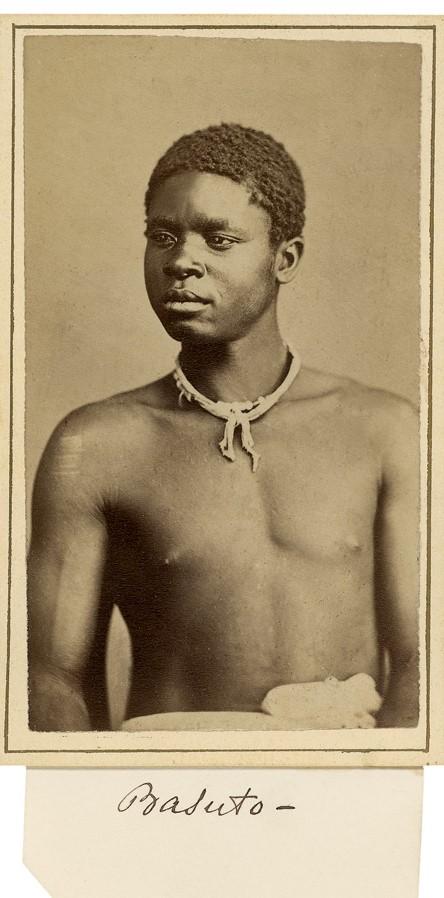
Carte-de-Visite format photograph by the photographer John Salmon (circa 1870s). Photograph reproduced with permission from Marcus Bunyan.
22. Schikkerling John Roland (1854 – 1928)
John Roland Schikkerling was born on 17 August 1854 in Potchefstroom.
Also recorded as Johannis Roeland – he therefore seems to have elected to Anglicise his name.
Schikkerling married Barbara Magdelina Benjamina Daly (1857 – 1920) in Potchefstroom on 14 January 1879 (Schikkerling’s name on the marriage certificate is recorded as Jan Roland). The couple had 7 children, all except the last child, born in Potchefstroom between 1879 and 1892.
Schikkerling is recorded as a Potchefstroom-based general dealer. There was a photography department on the second floor of the same business located on Church Square. It has been suggested that the Schikkerling building was the first double-storey building in town at the time.
Schikkerling also had a studio in Johannesburg (Pritchard and Jeppe Street) during the late 1890s. He was also in partnership with another photographer, namely der Fresner. It could be that der Fresner managed the studio on behalf of Schikkerling in Johannesburg.
Schikkerling passed away on 27 July 1928 in Johannesburg. He was a widower at the time of his death (aged 74) as his wife Barbara passed away in 1920.
The South African National Archives holds several Schikkerling requests where he requested permits to import a significant amount of ammunition and dynamite from Durban and Kimberley, which suggests that he was dealing in the material in Potchefstroom.
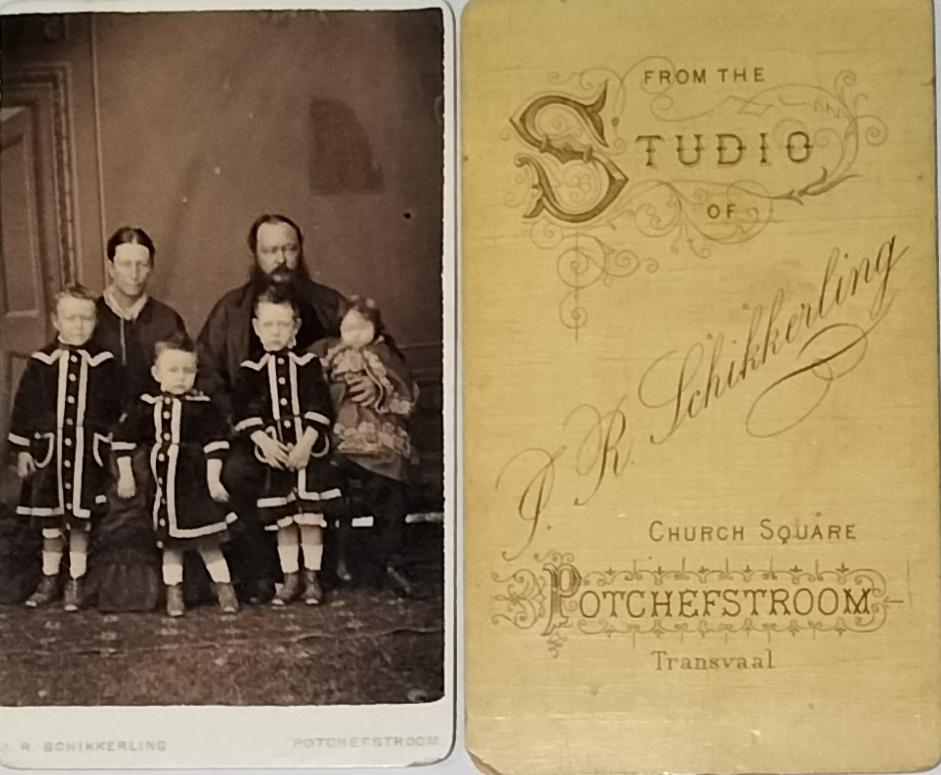
Carte de Visite format photograph of an unknown couple with their three children by JR Schikkerling (1875). His studio was based on the second floor in a building on Church Square. He was also active in Johannesburg, where he passed away in 1928.
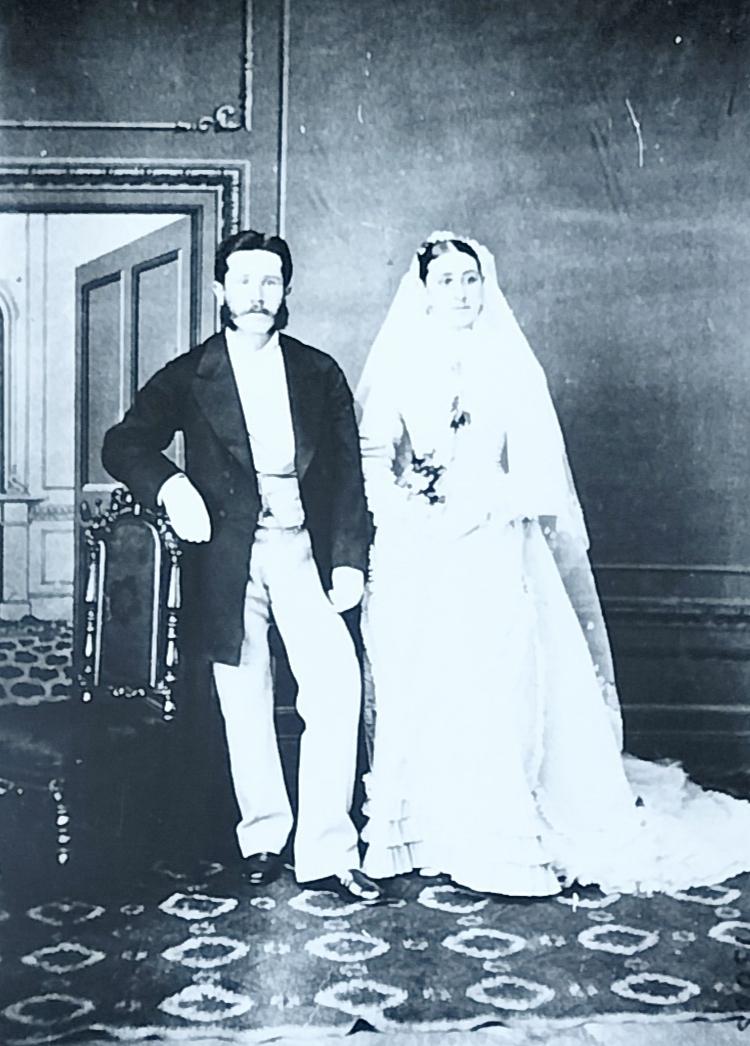
Photograph titled “Jan Schikkerling” (South African National Archives). This photograph, by an unknown photographer, was probably taken on Jan & Barbara’s wedding day in Potchefstroom on 14 January 1879.
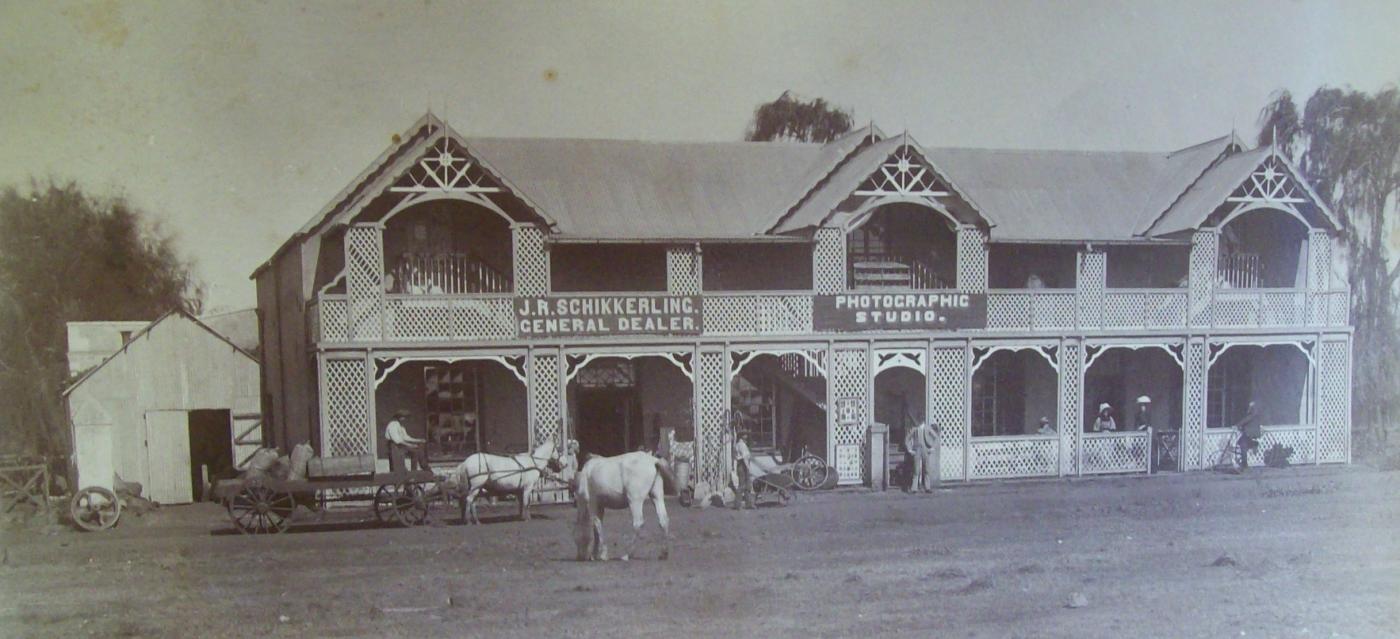
Schikkerling’s shop and photographic studio on Church Square (circa 1900). Schikkerling, in all probability, also captured this photograph. Photograph provided by Potchefstroom Museum.
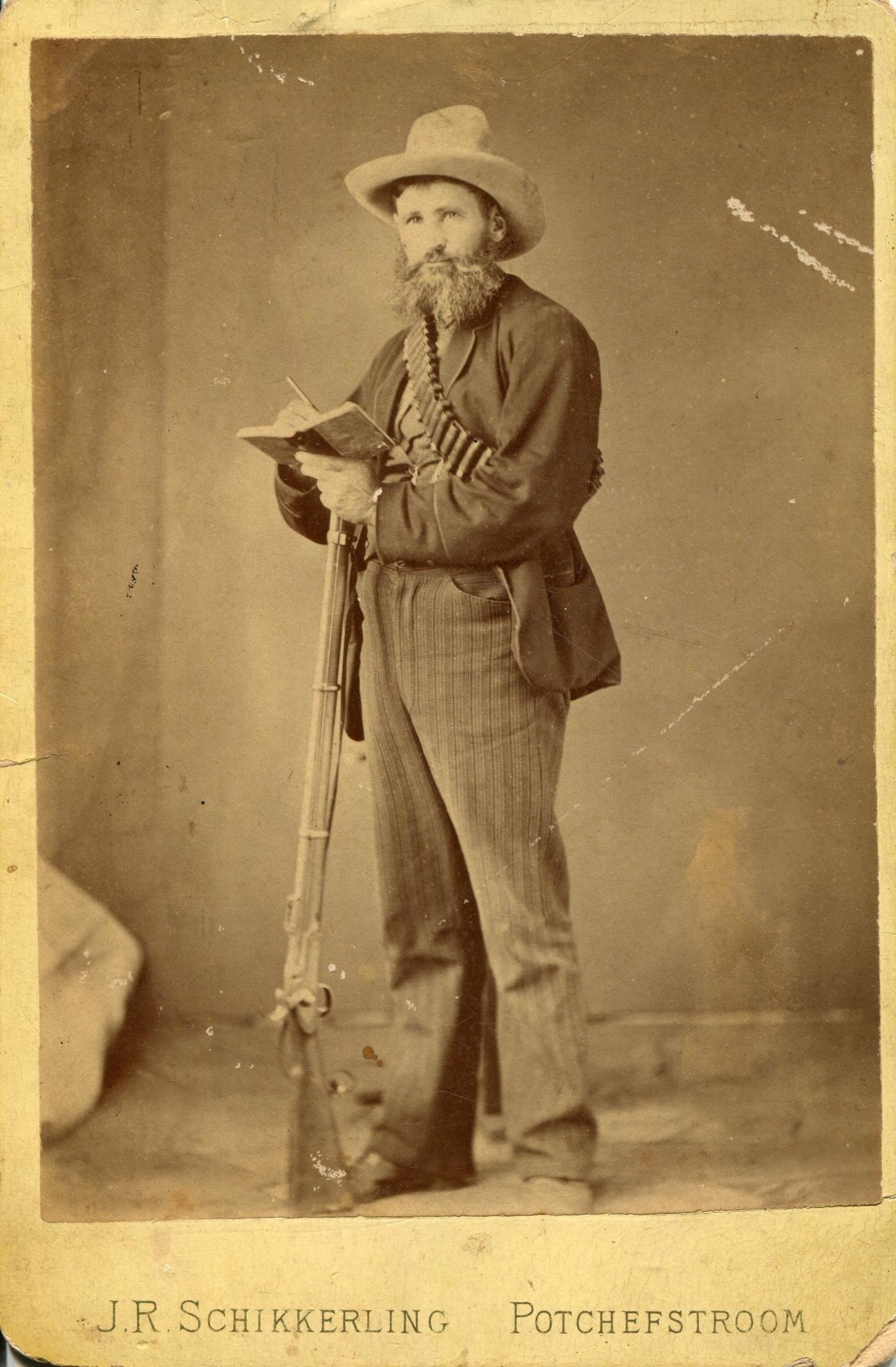
Carte-de-Visite format photograph of CNJ du Plessis, who was an author and the secretary to Commandant Weilbach during the First Anglo-Boer War (circa 1881). Photograph provided by Potchefstroom Museum.
23. Simpson Robert William (1874 - 1951)
When South African-born Simpson arrived in Potchefstroom is not known, but his marriage certificate indicates that he already resided in Potchefstroom in 1898. He married Adelaide Preller in Pretoria in October 1898.
At the time of Adelaide’s death in 1936, the couple already resided in Rustenburg. Robert passed away 15 years later (1951) whilst still residing in Rustenburg. His death certificate confirms that he was a photographer (afnemer).
Other than him being based in Church Street, no further information about his activity in Potchefstroom has surfaced.
Robert was clearly well respected as a photographer in town at the time as he was frequented by well-known individuals to have their images captured.
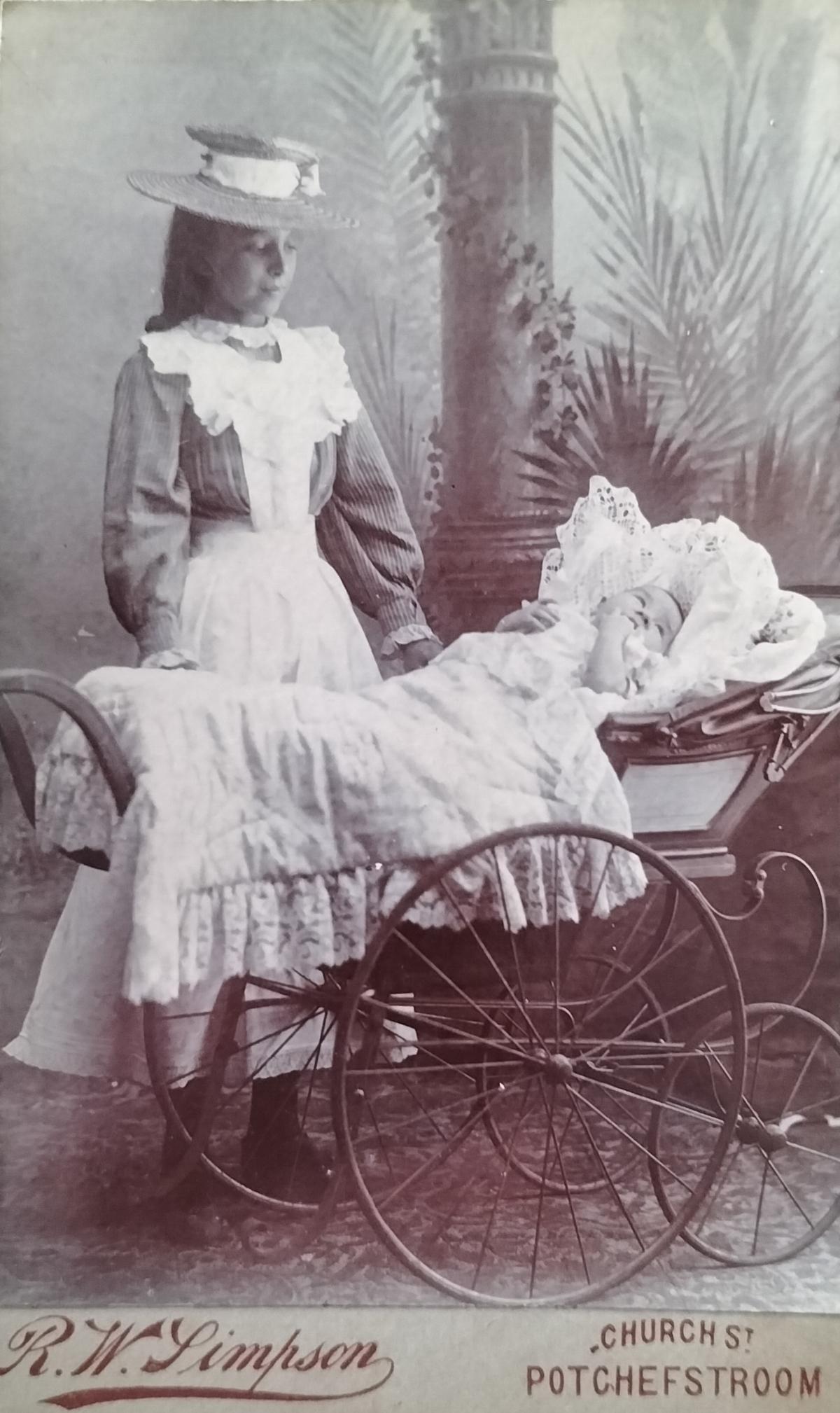
Exceptional Cabinet Card format photograph of unknown children by RW Simpson (circa 1908), who based himself in Church Street. This photograph, taken in a studio, deviates from the stock-standard studio poses in that it includes the high-end valued baby pram, confirming the social standing of the children's parents. It could also be that the young woman standing at the pram is actually a childminder.
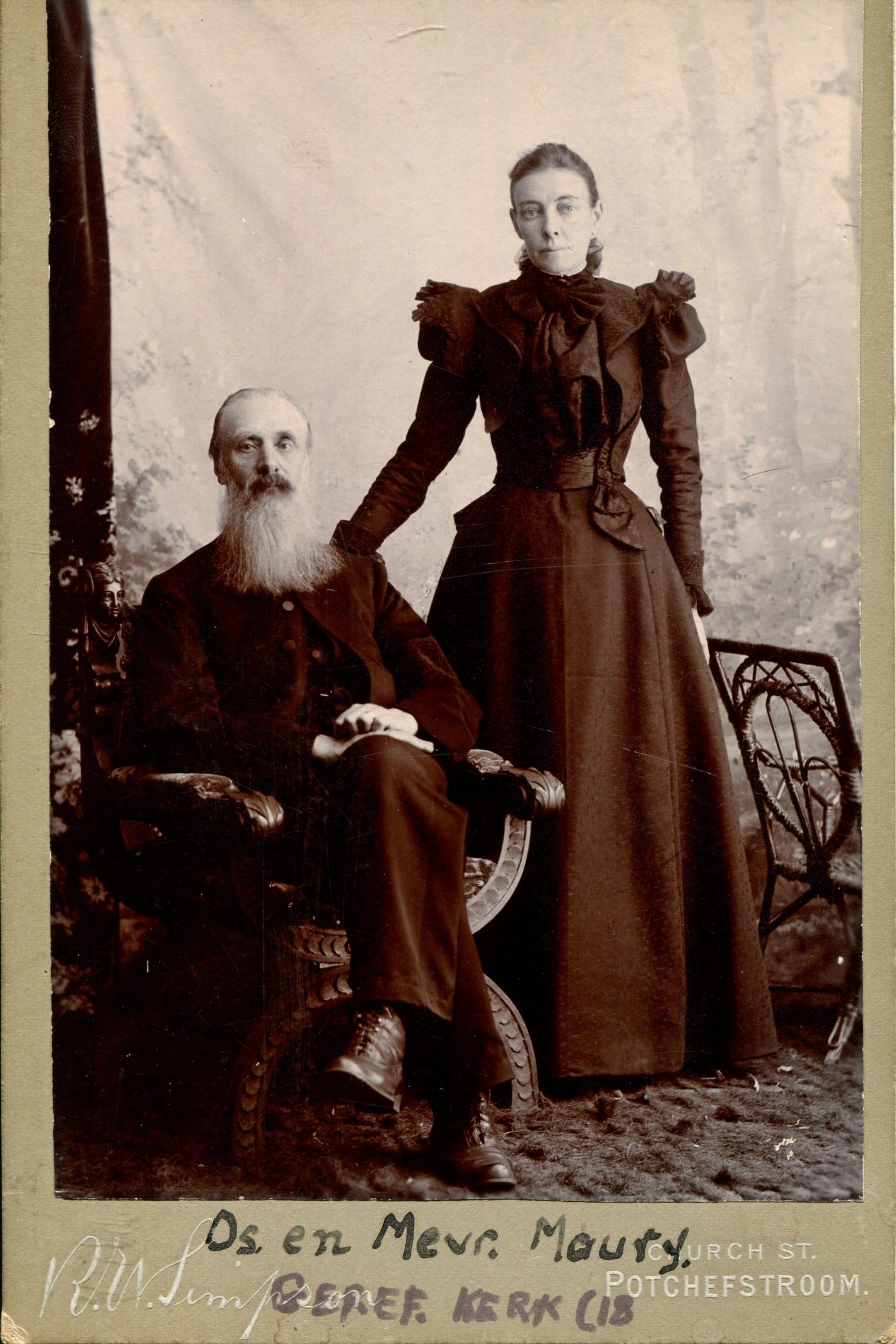
Cabinet Card format photograph of Reverend and Mrs Maury attached to the Reformed Church in Potchefstroom by RW Simpson (circa 1905)
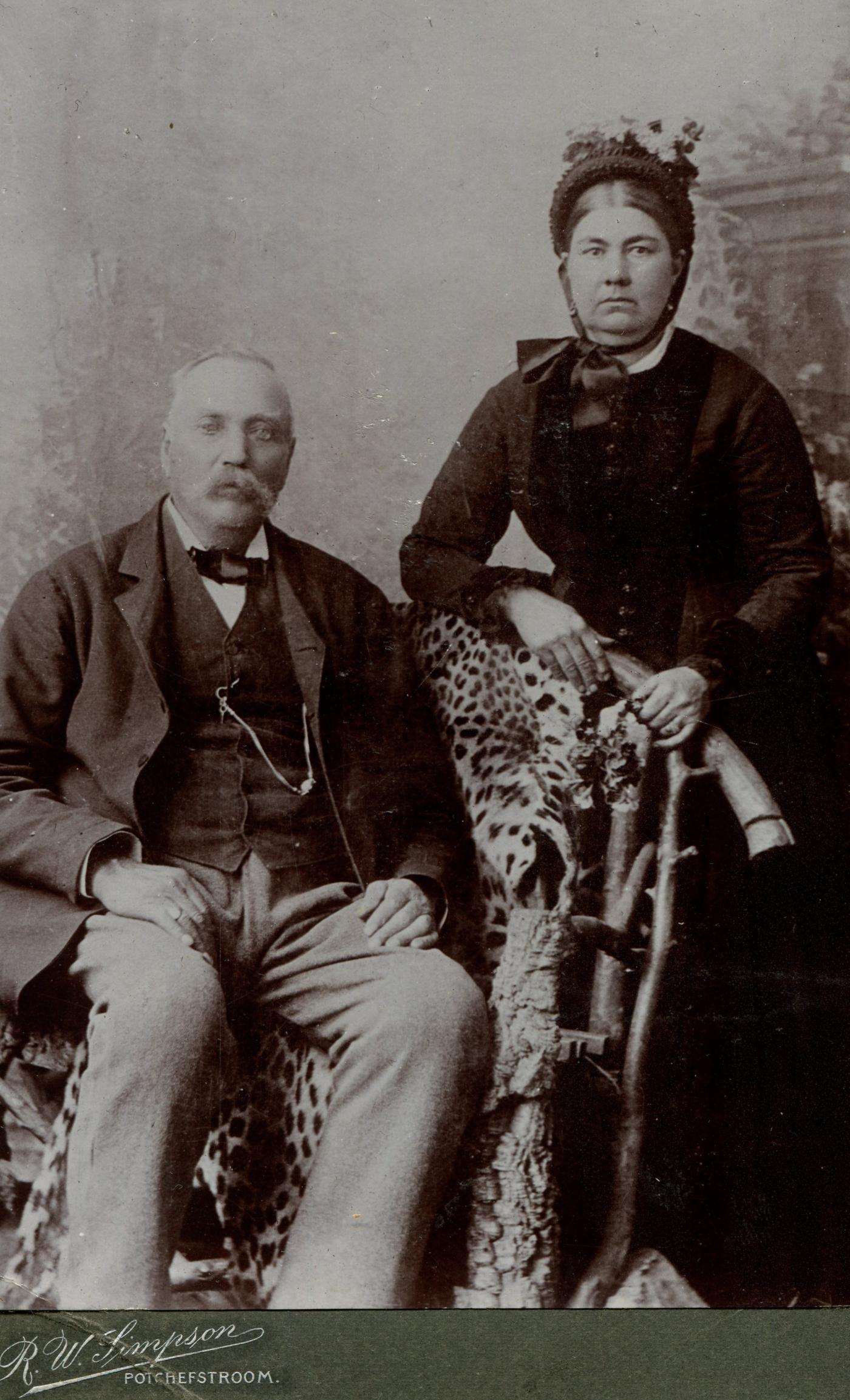
Copy of a Cabinet Card photograph by RW Simpson of President MW Pretorius and his second wife, MC Pretorius (nee Botha) (circa 1884). Photographing key figures such as Pretorius suggests that Simpson was a well-established and respected photographer. Photograph provided by Potchefstroom Museum.
24. Von Harnach Richard Ritter (1853- 1913)
Von Harnach was born in Austria on 28 December 1853. The family of three arrived in South Africa in 1885.
He married Dutch-born Anna Maria Minne in Potchefstroom in May 1897. Minne was 16 years his junior. They resided in Gatsrand. Anna seems to have adopted von Harnach’s son (Austrian born in 1882) who carried his father’s name.
Von Harnach senior became naturalised around 1885/6 and took an oath as a Burgher on 10 January 1898. Dr. Leyds, in a letter dated 22 March 1902, confirms that von Harnach senior took the oath and that he also did commando service during the Jameson raid between December 1895 and January 1896.
At the time of his death in Krugersdorp on 16 August 1913, his occupation was recorded as a speculator and farmer.
The story of von Harnach junior is a fascinating one – one that would make for an interesting retrospective psychological analysis. Being younger than 16 years old when his father naturalised, von Harnach junior would also automatically have become a naturalised Burgher, yet he spent many years in local prisoner-of-war camps (Robert Heights & Fort Napier) between 1914 and 1919. One government letter states that von Harnach junior was not a suitable man to be at large, whether naturalised or not. The official continues by stating that naturalised Germans were far more anti-British compared to Germans who had not naturalised. Further internship was justified at one point due to von Harnach allegedly celebrating the loss of the Lusitania (a British passenger liner sunk by a German U-boat) in May 1915 with German supporters.
Although young von Harnach was re-interned at his own request, his initial arrest was related to his pro-German conduct. He has also been described as obnoxious. Records seem to suggest that von Harnach junior experienced addiction challenges. He also attempted to take his own life by shooting himself through the lungs with a revolver during March 1918. He also allegedly threatened to shoot his mother, who was residing with him in Zeerust at the time. He was described as periodically deranged, resulting in his firearms being seized.
Von Harnach senior is recorded to have owned the Queens Hotel in Church Street during 1878. He also resided in the hotel at the time. It is therefore assumed that he also set up his studio in the hotel.
A van Aarnach has also been recorded as a Potchefstroom-based photographer, but research to date suggests that this may have been a misspelling of the photographer, Richard von Harnach’s surname, something that often occurred in earlier years when photographers had their cardstock card printed abroad (on which photographs were pasted).
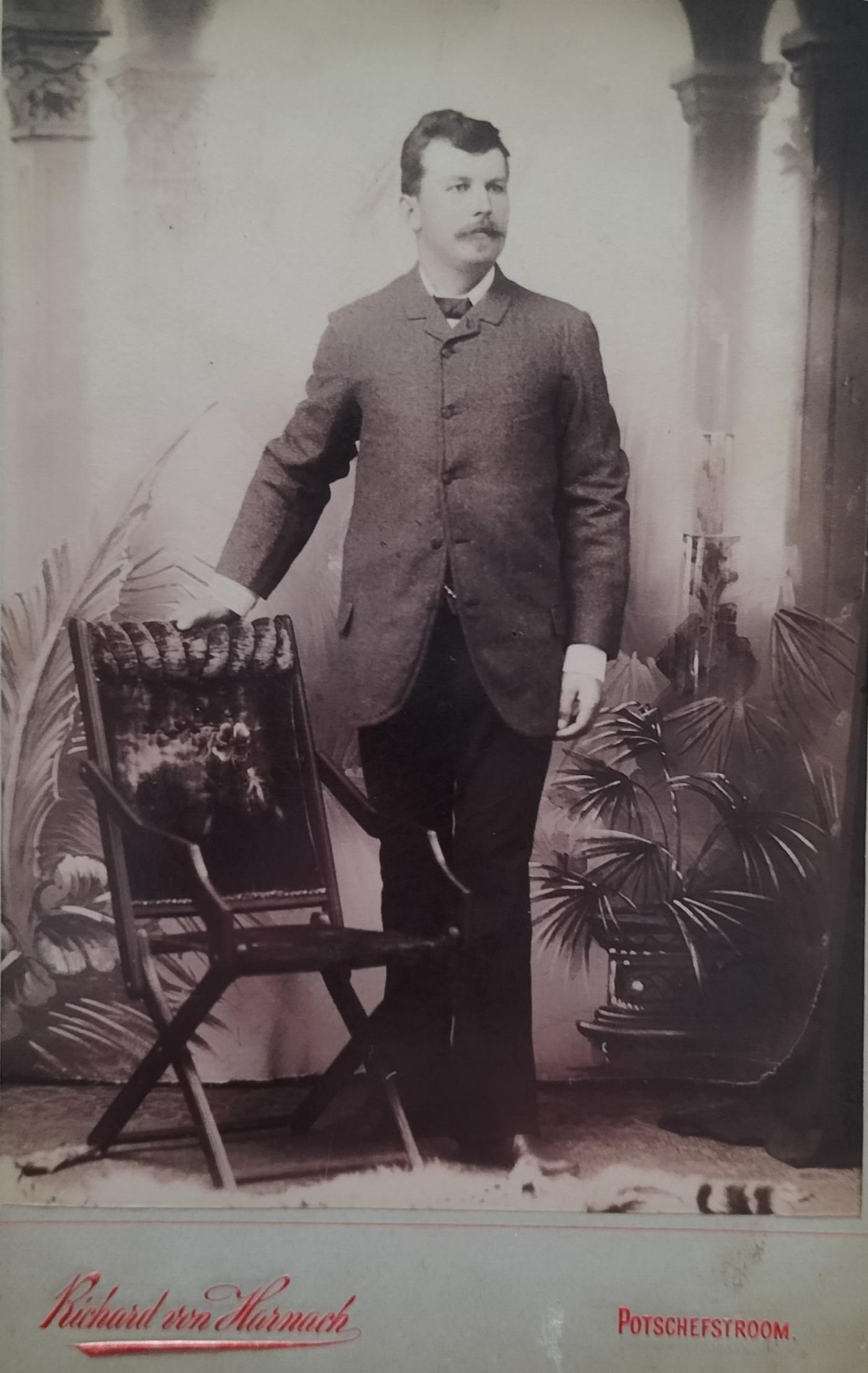
Cabinet Card format photograph of unknown sitter by Richard von Harnach (circa 1905)
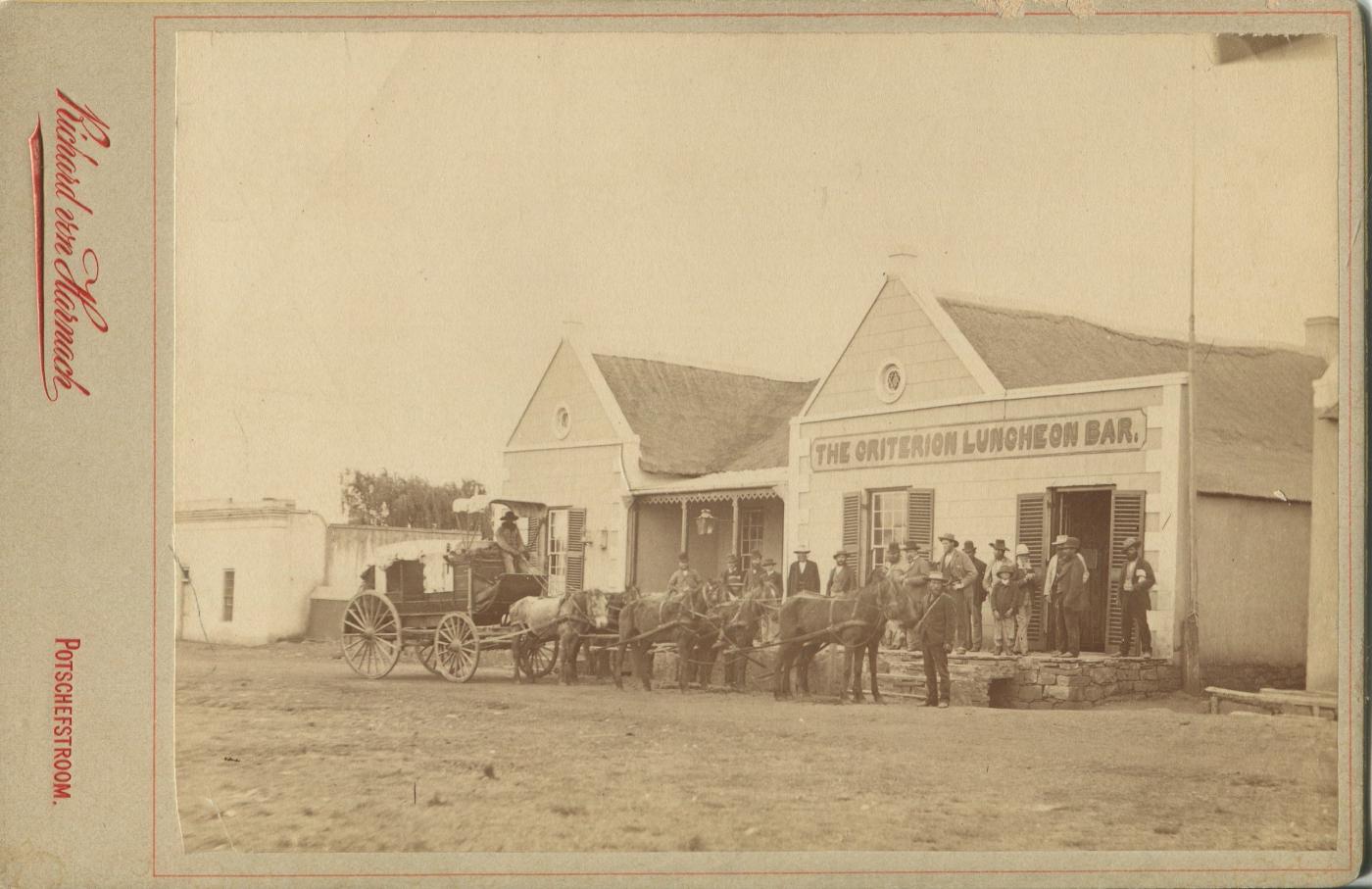
Cabinet Card format photograph by von Harnach showing the Criterion Luncheon Bar (circa 1880). Photograph provided by Potchefstroom Museum
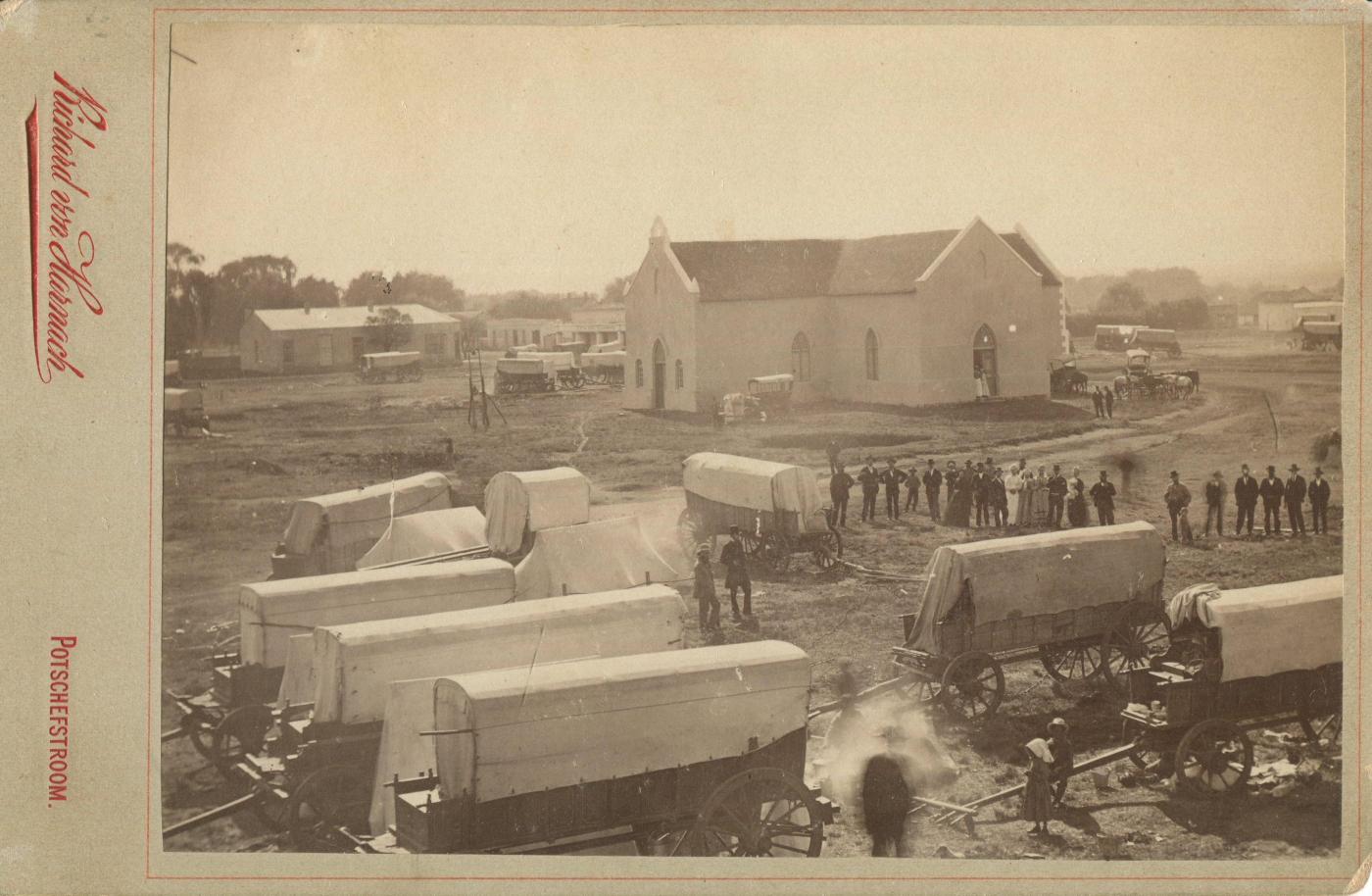
Cabinet Card format photograph by von Harnach showing a gathering at the Reformed Church in town (circa 1880). Photograph provided by Potchefstroom Museum
25. Weeks David John (1875 – 1919)
Weeks was born in Scotland. He died at the young age of 44 in Germiston. His death certificate confirms that he was a photographer at the time. Weeks married Margaret Thompson Walker in Germiston in February 1906, which suggests that he was active as a photographer in Potchefstroom before this date.
None of his photographic work whilst based in Potchefstroom has been identified to date.
Potchefstroom-based Postcard Publishers
As indicated above, both Coop and Chambers published their own postcards.
Publishers and bookstores often bought photographs from photographers to have them published as postcards.
Several publishers throughout South Africa produced picture postcards of Potchefstroom.
It is important to point out that, other than the two photographers who published their own postcards, at least two Potchefstroom-based publishers also produced postcards. The reason for this aspect being included in this article is that these publishers may have bought the photographs from Potchefstroom-based photographers.
To date, the following two publishers of Potchefstroom-based photographic postcards are:
- Cawood & Co Stationers
- The Transvaal Book Store
Closing
Several photographers either travelled to Potchefstroom to photograph the town or its people, for example, Otto Hussemeyer from Pretoria travelled to Potchefstroom in 1868, where he captured a unique image of a church.
One prominent Port Elizabeth-based photographer, Robert Harris, travelled the country and included at least two photographs of Potchefstroom in his 1888 photographic publication. See images below.
Other photographers stated on their photographic cards that they are active in Transvaal – where they resided is unknown.
Again, I acknowledge that research on this topic needs to be expanded.
Special acknowledgement
Dr. Lennie Gouws, renowned Potchefstroom historian, for providing additional insight and images to be included in the article.
Johan Wolfaardt, also passionate about South African heritage photographs, is a museum historian at the Potchefstroom Museum. Johan patiently assisted in adding previously unidentified Potchefstroom photographers and sourcing photographs accordingly.
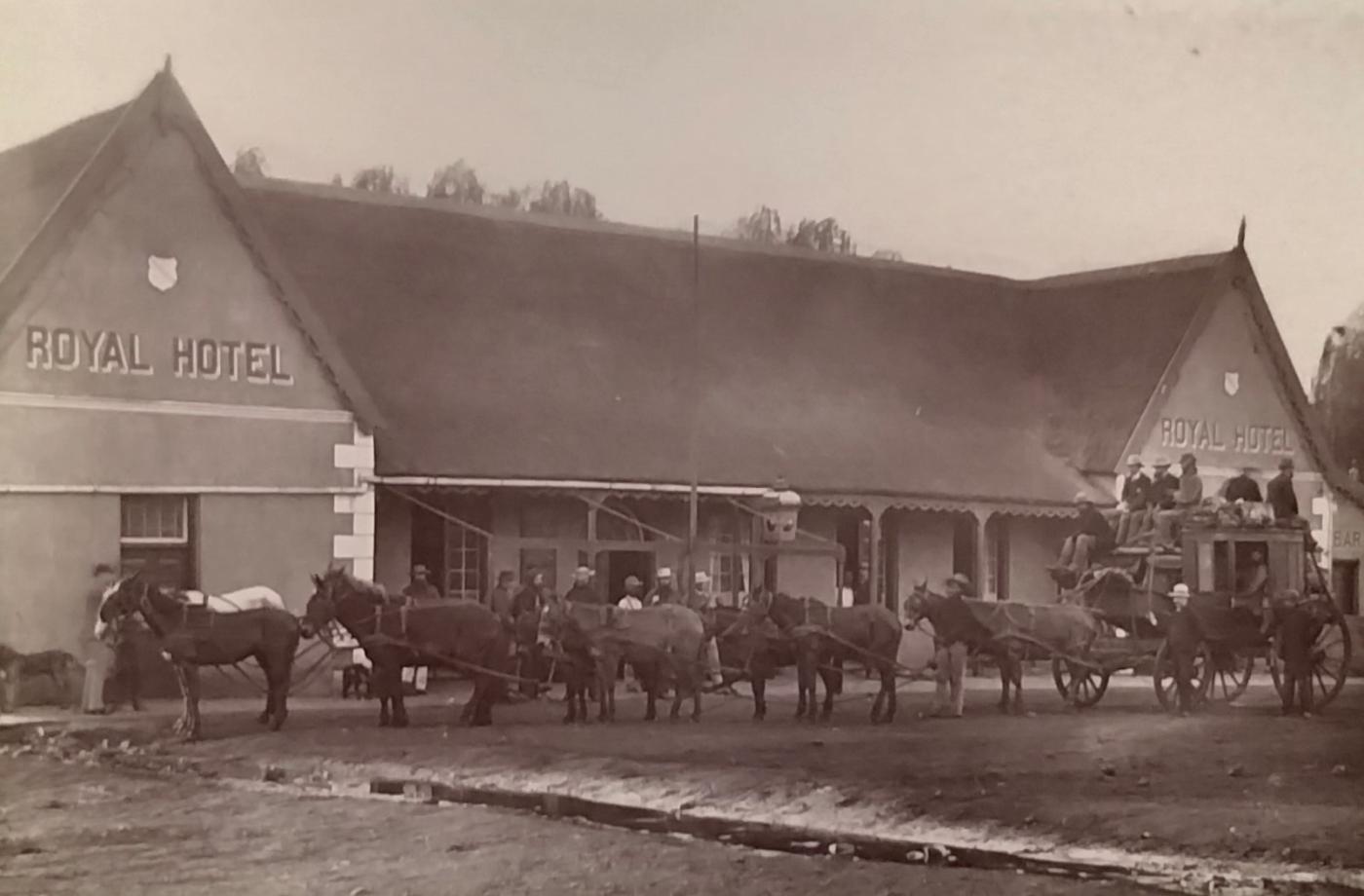
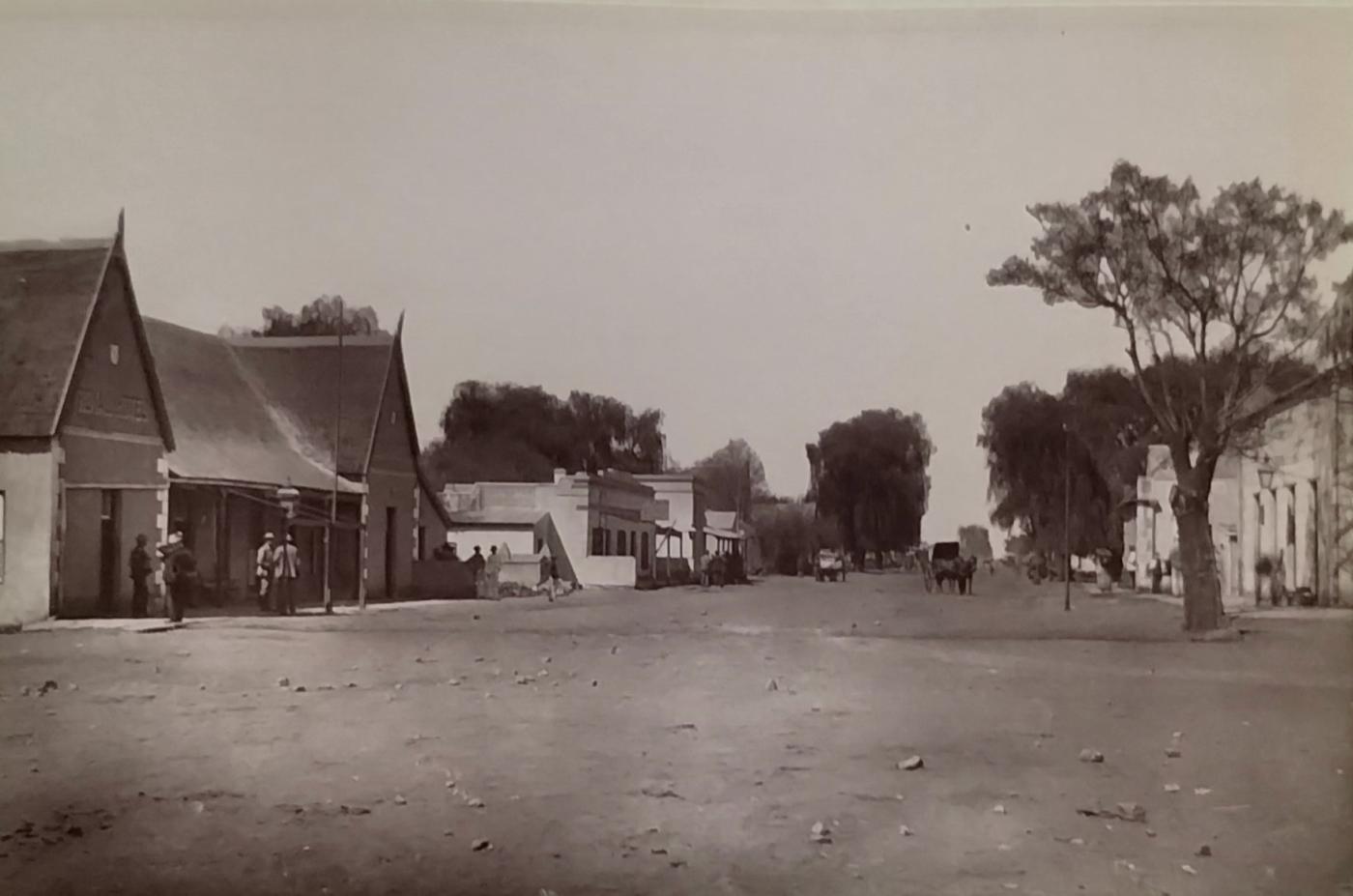
Example of photographs by a photographer from out of town. The Royal Hotel and a street scene as photographed by Port Elizabeth-based photographer Robert Harris, who travelled the country in 1888 and produced a unique photographic album of photographs captured during his journey.
About the author: Carol is passionate about South African Photographica – anything and everything to do with the history of photography. He not only collects anything relating to photography, but also extensively conducts research in this field. He has published a variety of articles on this topic and assisted a publisher and fellow researchers in the field. Of particular interest to Carol are historical South African photographs. He is conducting research on South African based photographers from before 1910. Carol has one of the largest private photographic collections in South Africa.
Sources
- Bunyan, M. (2013) Exhibition: ‘Distance and Desire: Encounters with the African Archive Part III: Poetics and Politics’ at The Walther Collection Project Space, New York: Part 1. Joahn Salmon Basuto photograph (https://artblart.com)
- Child, D. (1979). A merchant family in early Natal: Diaries and letters of Joseph & Marianne Churchill (1850-1880) – with a narrative of pioneering travels to Potchefstroom and the Soutpansberg (with contemporary sketches by M. Churchill). Balkema. Cape Town
- Familysearch.org
- Gouws, L. (2009). Die Potchefstroom Herald: 1908 - 2008 – ’n Mediahistoriese studie. Northwest University
- Gouws, L. (2016). The Economy of Potchefstroom 1838 to 1880 (www.theheritageportal.co.za)
- Gouws, L. (2018). Stories van/of Potchefstroom. Gouws. Noordbrug
- Gouws, L (2021). Potch pets in old pictures. (theheritageportal.co.za)
- Gouws, L. (2021). Street names reflect history 1. Forgotten heroes – streets named (https://lenniegouws.co.za)
- Gouws, L. (2021). Street names reflect history 10 – P (https://lenniegouws.co.za)
- Gouws, L. (2025). Email communication between Gouws and Hardijzer. Schikkerling studio photo (23 May 2025)
- Haasbroek, D.J.P. (2024). Potchefstroom waar kry jy daardie naam. New Contree no 3:4 (www.researchgate.net)
- Hardijzer, C.H. (2018). Photographers active in Pretoria - First 60 years (1855-1915) (www.theheritageportal.co.za)
- Hardijzer, C.H. (2023). Pioneer Diamond Field Photographers: 1869-1915 (www.theheritageportal.co.za)
- Hardijzer, C.H. (2024). Behind the lens – 50 plus German-born photographers active in South Africa between 1846 and 1915. (theheritageportal.co.za)
- Harris, R. (1888). South Africa – A series of one hundred and four permanent photographs. Port Elizabeth. Harris
- Janse van Rensburg, F (2006). The first ‘white’ town north of the Vaal: inequality and apartheid in Potchefstroom. (newcontree.org.za)
- Pelteret, R.M. (2007). Duffus Bros. of Cape Town & Johannesburg. (www.pelteret.co.za)
- Tikkanen, A. (Extracted 2 April 2025). Potchefstroom (https://www.britannica.com)
- Unknown (extracted 2 April 2025). Potchefstroom. (https://en.wikipedia.org)
- Unknown (extracted April 2024). Stories of Daly descendants (http://daly-sa.family/daly-family-tree)
- Unknown (Extracted June 2024). The Potchefstroom Museum (www.wheretostay.co.za)
- van den Bergh, G.N. (2008). ‘n Evolusie van die kern sakebuurt van Potchefstroom in 1880. New Contree no 55. (www.researchgate.net)
- van den Bergh, G.N. (1993). Die watermeulens van Potchefstroom 1874 – 88. Sabinet African Journals (https://journals.co.za)
- Wikitree (extracted February 2025) O’Donoghue photograph (www.wikitree.com)