
Disclaimer: Any views expressed by individuals and organisations are their own and do not in any way represent the views of The Heritage Portal. If you find any mistakes or historical inaccuracies, please contact the editor.
On Sunday, 8 February 2026, Professor Richard Miles (Professor of Roman History and Archaeology at the University of Sydney and a visiting professor at Cambridge) gave a talk at Chedworth Roman Villa in the Cotswolds that had the audience gripped from start to finish. It was a masterclass in unravelling the mystery of a Roman villa that managed to go missing for two centuries by hiding in plain sight.
The story begins in the autumn of 1811, when ploughmen working a field near Withington accidentally struck something beneath the soil. What they'd found turned out to be a Roman villa with stunning mosaic floors. Samuel Lysons, an antiquarian who had already made his name excavating the villa at Woodchester, headed to Withington to investigate. Over the following months, he carefully excavated and documented a tripartite corridor villa with at least fifteen rooms. The mosaics were exceptional. There was an Orpheus mosaic showing the mythical musician surrounded by animals, a sea-creatures panel associated with Oceanus, and fragments showing a bear, a leopard, and a wild boar being chased by hunting dogs.
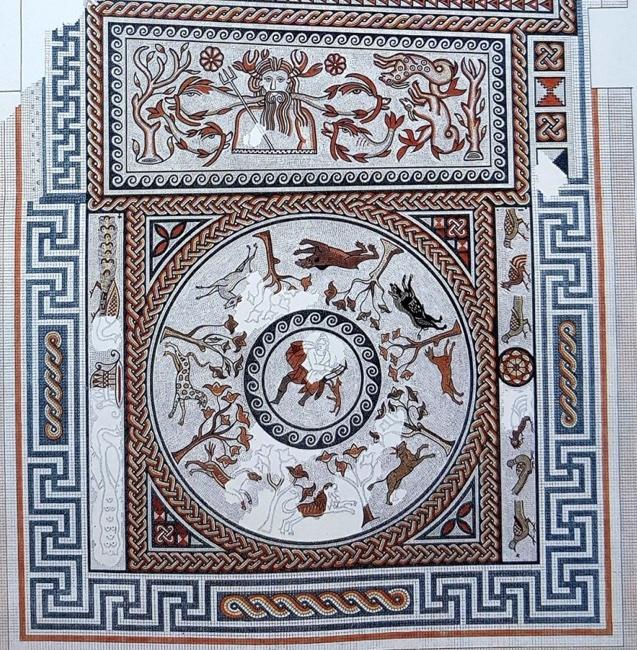
An artist's impression of what the mosaic looks like (via Richard Miles Presentation)
Lysons lifted the best pieces and sent them to the British Museum. A single bear mosaic was gifted to Bristol Museum, where it became the first Roman item in their collection. Several items are now on loan with the Corinium Museum which is a wonderful story in its own right.
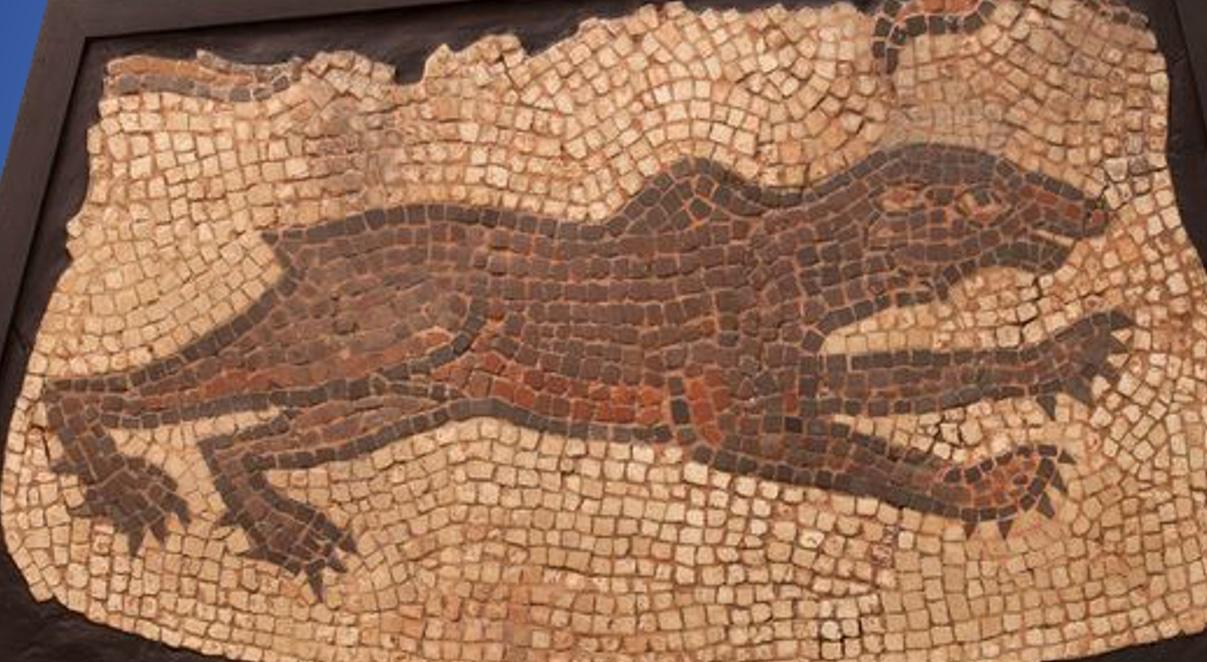
The Bear Mosaic (via Richard Miles Presentation)
Lysons published his findings in 1817, complete with detailed illustrations and a plan of the building. Then, following the practice at the time, the villa was reburied to protect it from the elements and agricultural damage.
Fast forward to modern times, Ordnance Survey maps marked the site with an X, neatly labelling where history said the villa should be. Everyone knew where Withington Villa was. Or so they thought.
Enter Roger Box, a well-known Chedworth Roman Villa volunteer and archaeological enthusiast with an eye for detail. Near his house in Withington, he'd been noticing something interesting emerging from molehills… fragments of Roman material. Roger had a good relationship with the Time Team crew. He brought them up to speed with his finds and they listened.
When Time Team arrived to film an episode, they were working against their famously tight deadlines. They put trenches in where the X marked the spot on the Ordnance Survey map. Almost immediately, they uncovered a mosaic. It appeared to match the descriptions of the Withington Villa. Since this site had already been excavated and published, the team decided to focus their limited time where the real mystery lay… down the hill at Manor Field, where Roger had made his interesting finds. Initial speculation suggested they might have found a bathhouse associated with the villa. The team excavated what they could, but big questions remained. What exactly was this structure?
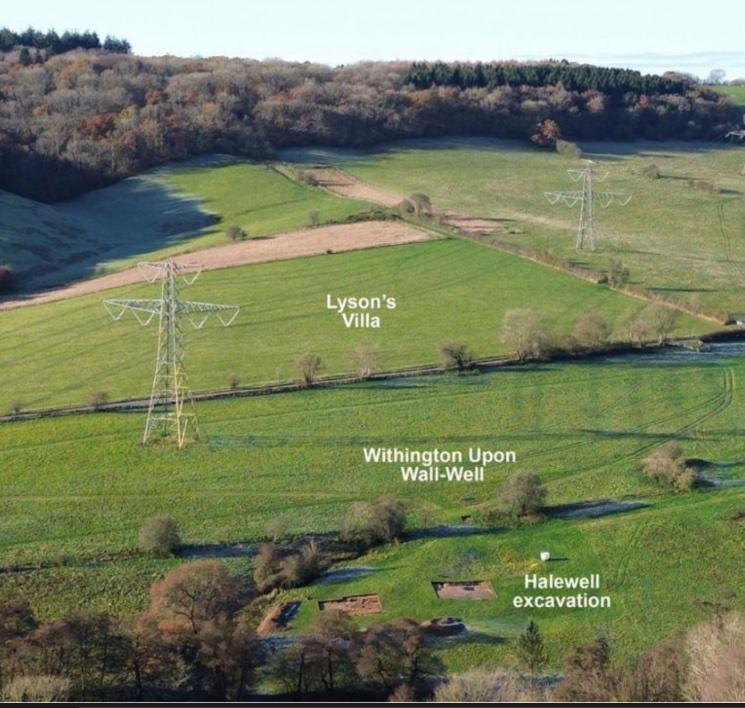
The various dig locations (Richard Miles Presentation)
More recently, the land was acquired and fortunately for us all, the new owners were intrigued as well. They funded a proper investigation to find out what was going on beneath their fields. In the early 2020s, Professor Richard Miles, along with colleagues Simon Greenslade and Sarah Leppard, took on the challenge. They began with geophysical surveys, which revealed extensive structures beneath the soil. Once approvals were secured, they began to excavate. As the dig progressed, they found mosaics, walls, and hypocaust systems. This was no bathhouse. They had a villa on their hands.
Members of the Chedworth community visited the dig, and talks were hosted at Chedworth as the work continued. The theory that emerged was that Withington had two villas, one up the hill where the map said it should be, and one down by the River Coln. It was unusual and had us all scratching our heads. Why would there be two Roman villas so close together?
The team kept excavating and documenting. As more mosaics emerged, they began to notice something. The style matched the Withington Villa mosaics. That wasn't entirely surprising as local mosaic schools produced similar work across the region, but it was curious. Then the patterns started to match more closely. Very closely indeed.
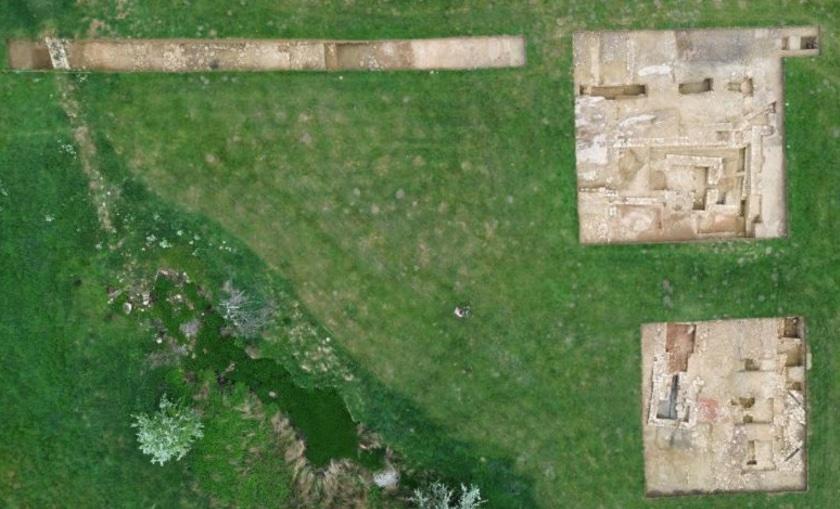
2025 Excavations (Richard Miles Presentation)
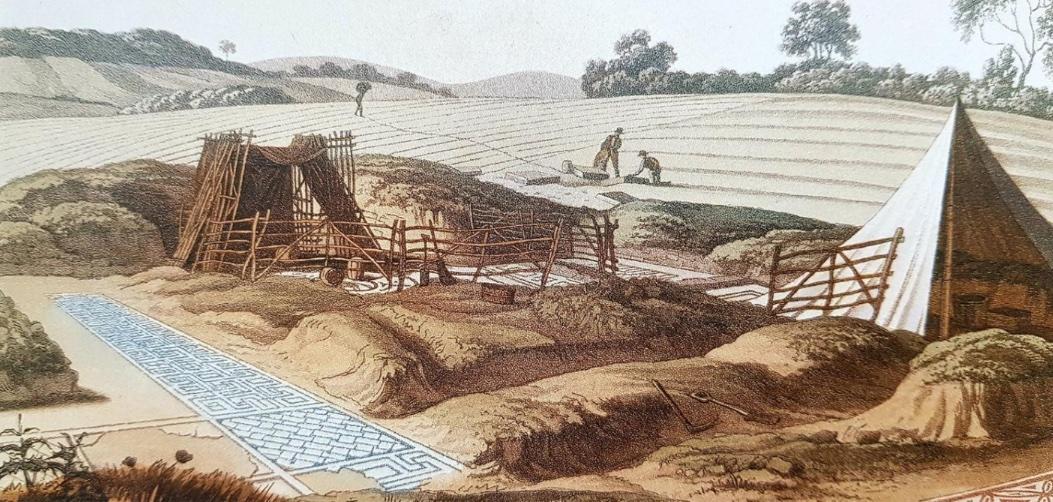
The team went back to Lysons's original publication. Among his notes was a crucial detail. He had written that the villa was 150 yards from the River Coln. This matched with the Villa in Manor Field. They also looked at a watercolour of the site completed during the Lysons excavation. The team compared it to the topography around Manor Field. It was a perfect match!
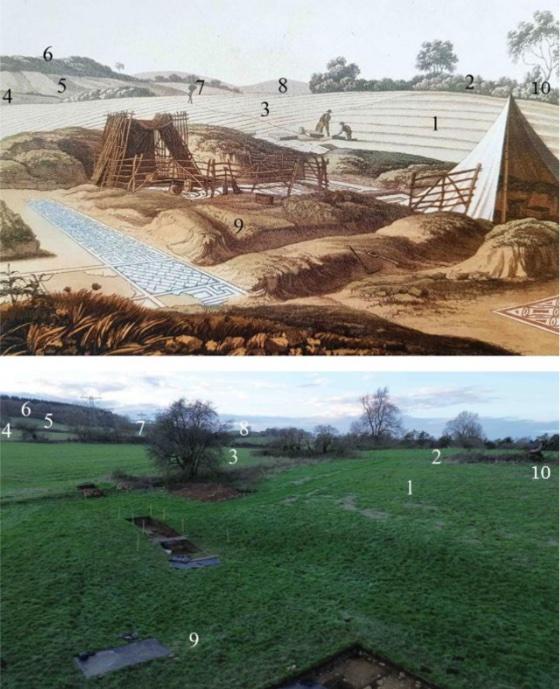
Withington Villa Watercolor and Recent Excavation match (Richard Miles Presentation)
The pieces fell into place. The villa at Manor Field wasn't a second villa at all. It was the original Withington Villa. The X on the Ordnance Survey map was in the wrong place.
Richard emphasised that this was a lesson for archaeologists about the importance of interrogating assumptions when confronted by evidence. Maps can be wrong. Conventional wisdom can be wrong. Sometimes you need to go back to the original sources, read the fine print, and trust what the ground is telling you.
The rediscovery opens several new questions. If the villa everyone thought was Withington Villa up on the hill isn't Withington Villa, what is it? The geophysical surveys suggest substantial Roman structures. There are so many fascinating angles to follow in the years ahead, and the Chedworth community will be watching closely.
James Ball is the founder and editor of The Heritage Portal. He spends his days bringing history alive at Chedworth Roman Villa.
Comments will load below. If for any reason none appear click here for some troubleshooting tips. If you would like to post a comment and need instructions click here.