
Disclaimer: Any views expressed by individuals and organisations are their own and do not in any way represent the views of The Heritage Portal. If you find any mistakes or historical inaccuracies, please contact the editor.
The Lipizzaner’s survival was secured by several rescues that bridged the collapse of war-torn Europe with the birth of a new tradition in the Southern Hemisphere. In April 1945, the breed’s future was famously defended during Operation Cowboy, when American and German forces formed an unlikely alliance to shield imperial bloodlines from the advancing Red Army. While this military intervention protected the foundation of the Spanish Riding School, a similar commitment drove Count Elemer Jancovich-Besan to spirit a private herd from Hungary to the sanctuary of South Africa. As detailed in the article below, these efforts laid the groundwork for a classical school that continues to flourish today.
On April 28th 1945, in the final days of World War 2, American troops from the 42nd Cavalry Reconnaissance Squadron teamed up with German Wehrmacht soldiers in a rare moment of cooperation to rescue Lipizzaner horses from a stud farm in Hostau, Czechoslovakia.
Renowned for their e!egance and lineage dating back some 400 years, these prized horses had been relocated by the Nazis to breed an "Aryan" horse. As the Soviet Red Army advanced, fears grew that the horses would be slaughtered for food, as had happened in Hungary.
The operation liberated over 300 horses held at the farm. The mission was sanctioned by General George S Patton, himself a horse lover.
'Operation Cowboy' was a rare moment when enemies united to preserve heritage amid the chaos of war.
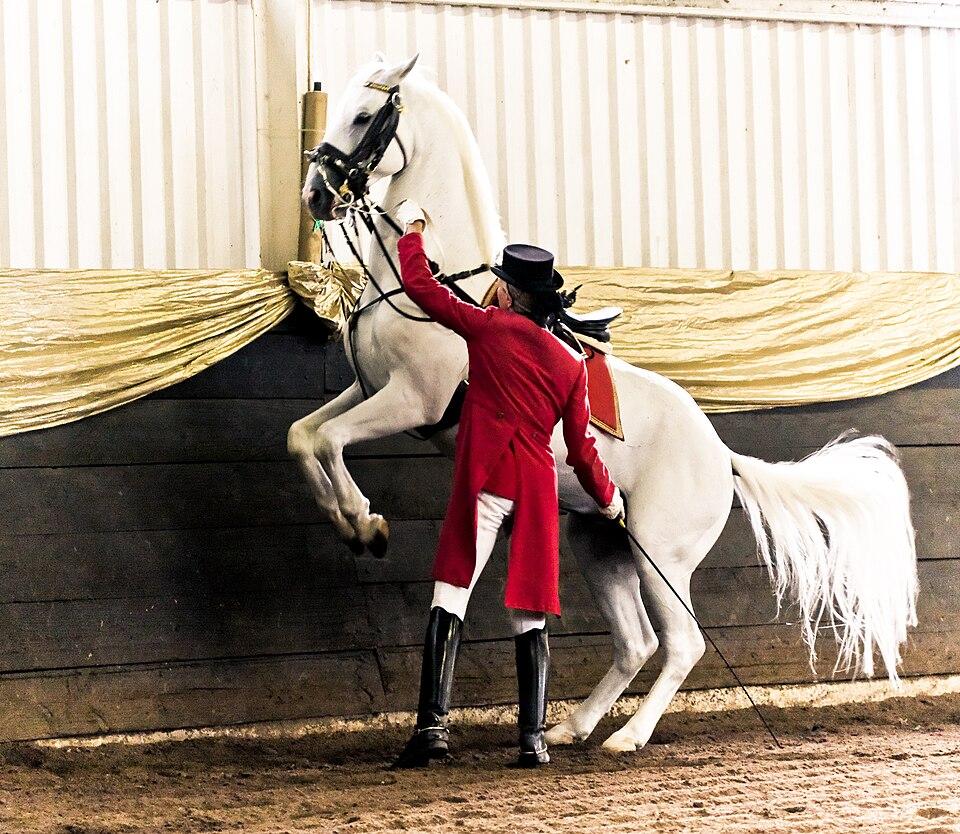
In 1948, the Pietermaritzburg Royal Agricultural Show became the unlikely stage for a moment that would shape South Africa's equestrian legacy. Count Elemer Jancovich-Besan, a Hungarian aristocrat and horse breeder who had fled post-war Europe with a handful of Lipizzaner horses, presented a public dressage display featuring his prized stallion Maestoso Erdem. This performance - elegant, precise and steeped in the classical tradition of haute ecole - was the first public exhibition of Lipizzaner dressage in South Africa. Among the captivated spectators was Major George Iwanovski, a Polish cavalry officer and accomplished horseman who had also found refuge in South Africa after World War 2. The meeting between Jancovich-Besan and Iwanovski at the Royal Show marked the beginning of a partnership that would establish the South African Lipizzaner tradition, one of only a few classical dressage schools outside Europe.
The Pietermaritzburg performance was a cultural seed. From that moment Iwanovski began training the stallions in the style of the Spanish Riding School of Vienna, eventually founding a dedicated training centre in Kyalami, Gauteng. In 2021 the centre moved to a Western Cape winelands location near Paarl. Today the Mistico Equestrian Centre hosts monthly Lipizzaner performances with a program unique in the world that features all-female riders.
That 1948 show in Pietermaritzburg remains a historic milestone: the moment South Africa's Lipizzaner story began.
Comments will load below. If for any reason none appear click here for some troubleshooting tips. If you would like to post a comment and need instructions click here.