
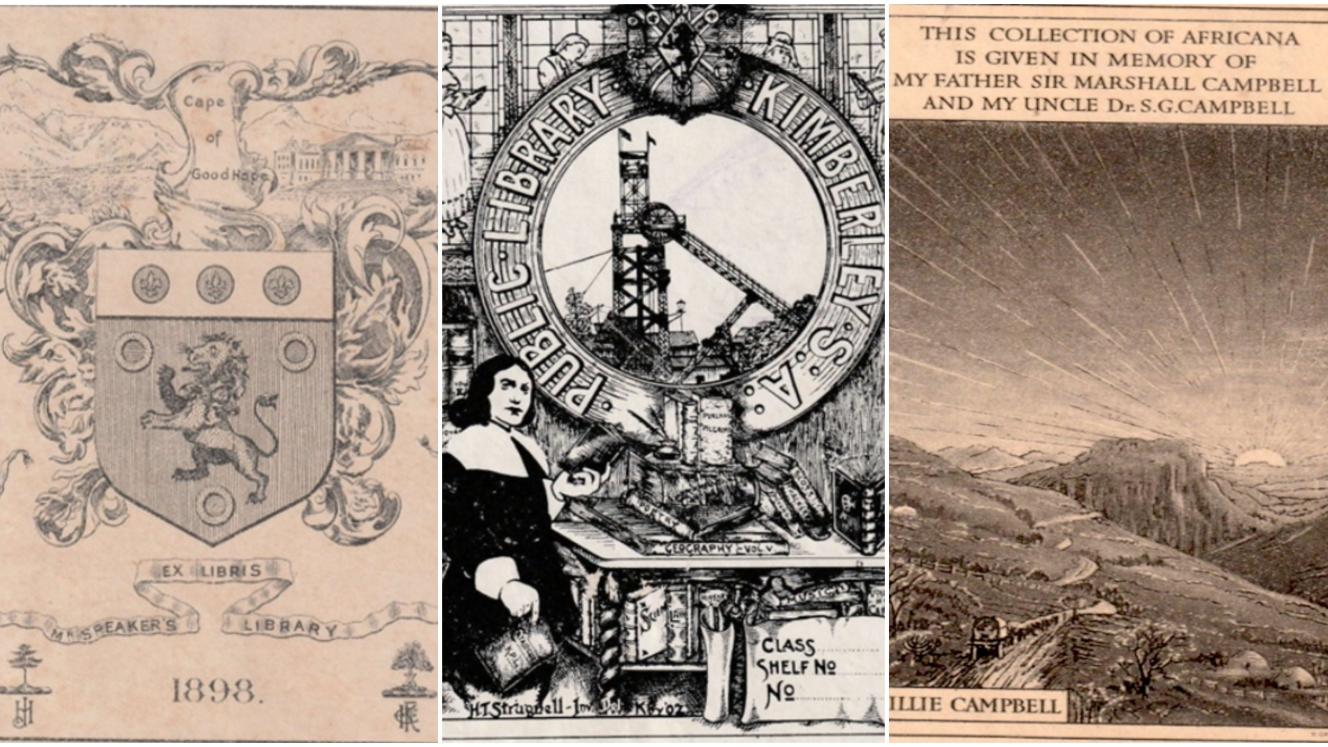
Previous articles on The Heritage Portal explored the origins and some examples of bookplates. The Latin phrase ‘Ex Libris’ (from the library of) often appears on bookplates, followed by the owner’s name. While many bookplates are those of individual collectors, institutions also use them to mark ownership of manuscripts and rare books in their own libraries. In this article, historic bookplates from some of these institutional libraries will be reviewed.
The Central African Archives Library
The nucleus of this library was established in 1935 in Salisbury (now Harare) to preserve the public and judicial records of Southern Rhodesia. In 1946 its scope was expanded to provide archival services for Northern Rhodesia and Nyasaland (now Zambia and Malawi). It then became the Central African Archives Library.
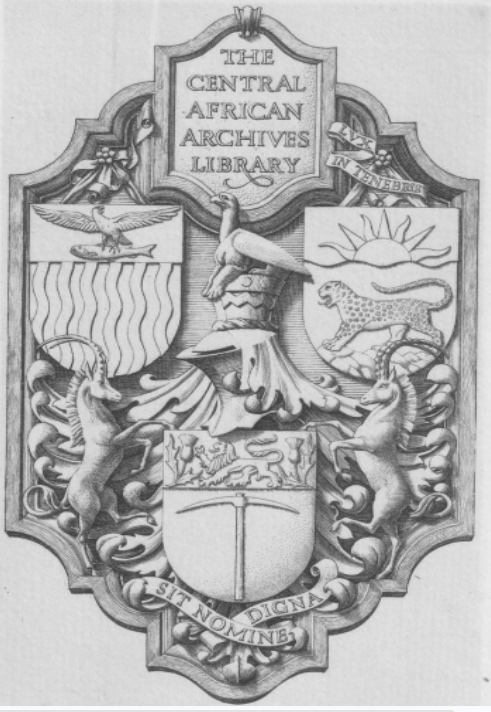
The bookplate dates from 1947, some years before the ill-fated Federation of Rhodesia (both Northern and Southern) and Nyasaland was formed.
The celebrated soapstone Zimbabwe Bird forms the centrepiece of this bookplate.
The shield on the left displays an eagle having caught a fish. The eagle symbolises vision and strength, while the fish signifies fortitude and a common link with the famous Victoria Falls, shared by both Northern and Southern Rhodesia.
The shield on the right depicts the rising sun and a leopard. Two sable antelopes flank a third shield showing a lion with its right paw raised above a pick. The lion symbolises courage and nobility, while the pick represents the agricultural and mining heritage of the region.
The Latin inscription ‘Lux in Tenebris’ means ‘Light into Darkness’, very appropriate for the library of a national archive, while the motto, ‘Sit Nomine Digna’ translates into, ‘May it be Worthy in Name’.
This attractive bookplate in the armorial style was designed by British artist Stephen Gooden (1892-1955) well-known for his design, engraving and illustration of bookplates and banknotes. Gooden’s designs for bookplates completed before 1944 were reproduced in the book authored by Campbell Dodgeson, The Iconography of the bookplates of Stephen Gooden.
The Central African Archives is best known for its Oppenheimer Series, a collection comprising 9-titles and 13-volumes of journals and letters from missionaries and explorers active in the region. They include missionaries such as Robert Moffat and James Stewart (later Principal of Lovedale College), the missionary/explorer David Livingstone, the artist/explorer Thomas Baines, James Stevenson-Hamilton (of Kruger National Park fame) and the hunter/explorer Thomas Leask (who later established the first trading store in Klerksdorp). Substantially funded by Sir Ernest Oppenheimer, this series was published to wide acclaim between 1945 and 1956.
The Cape of Good Hope Parliament
- Joint Library Houses of Parliament
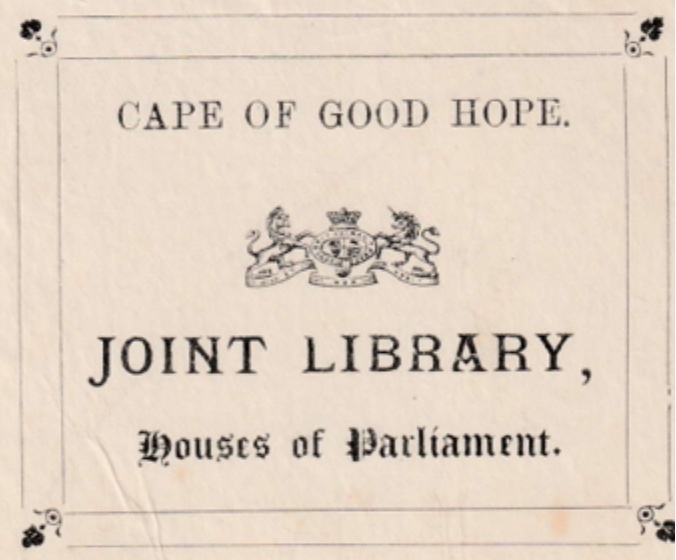
This plate is something of a mystery but hopefully a knowledgeable reader will be able to shed more light on it. It displays the United Kingdom’s Royal Coat of Arms, and therefore likely dates to circa 1885. In that year the newly erected parliamentary precinct in Gardens, for the Houses of Parliament of the Cape of Good Hope, was officially opened. The bookplate might therefore have been a gift from the UK Government or Monarch to commemorate this significant Cape Town event.
- Speaker’s Library - 1898
This historical but rather busy pictorial bookplate displays the coat-of-arms of the Cape Colony crested with a view of the Houses of Parliament and Table Mountain. The small crests and monograms are those of the Speaker Sir Henry Juta (1857 – 1930) and the Clerk of the House Ernest F. Kilpin (1854 - 1931). The designer of the bookplate is not known.
Biographies of Messrs. Juta and Kilpin are detailed in Volumes I and V, respectively, of the Dictionary of the South African Biography (DSAB).
The Killie Campbell Library
The Campbell Collections, of which the above library is but one, are curated in the splendid neo-Cape Dutch manor house, ‘Muckleneuk’, designed by the eminent architect Herbert Baker and completed in 1914 for the sugar magnate and politician Sir Marshall Campbell (1848 – 1917) on the Berea in Durban.
In 1955 the house was presented to the City of Durban by Sir Marshall’s son, William Alfred Campbell.
Muckleneuk now contains two museums and one library. There is the Mashu Museum of Ethnology, named after Sir Marshall, after which the township of Kwa-Mashu is also named, meaning ‘the place of Marshall’. The William Campbell Furniture Museum displays 18th and 19th century furniture.
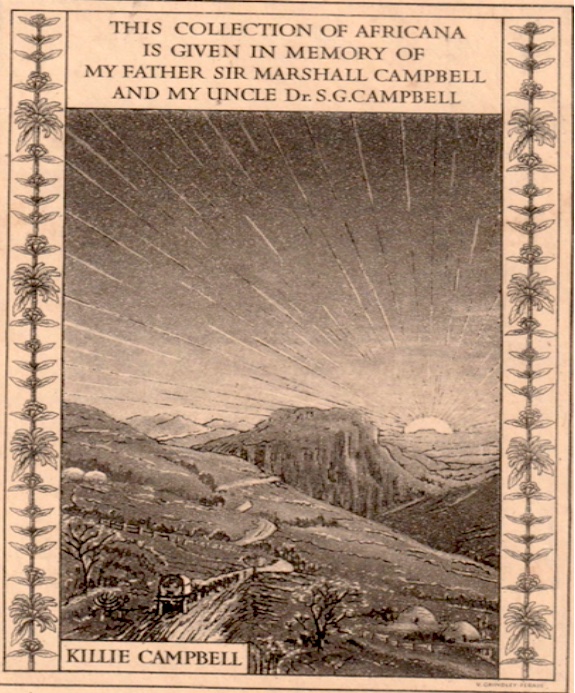
The third collection is the Killie Campbell Library. Margaret Roach (Killie) Campbell (1881 – 1965), a daughter of Sir Marshall, was a prolific South African book collector and antiquarian who bequeathed her vast collection of approximately 35 000 manuscripts, books and documents to the then University of Natal, together with a trust fund to maintain it.
Killie Campbell described her above bookplate as follows:
"It was done to illustrate my idea that the path of knowledge is long and slow just like the pace of the ox-wagon. The sun is shining on the mountain, but it is only the great who can scale the mountain top of knowledge, while we ordinaries slowly tread the long winding path, but we see glimpses of sunshine and happiness in the knowledge we strive for. The huts are expressing the specialised African part of the library which I am striving to build up. … The flower round the edge is Leonotis. … It emphasizes my hobby of gardening."
Leonotis ocymifolia, also known as the Minaret Flower or Rooidagga, is widespread across southern and eastern South Africa.
This pictorial book plate was designed by Vivyan Grindley-Ferris, South African mining engineer and Fellow of the Royal Etching Society.
Biographies of Sir Marshall Campbell and Killie Campbell are detailed in Volumes II and III, respectively, of the DSAB.
University College of Fort Hare Library
This historic centre of learning in the Eastern Cape was established in 1916, as the South African Native College, under the auspices of Christian missionaries. It was the first college established for the higher education of African people in southern Africa.
Over the decades it established an enviable reputation as many of its past students and graduates achieved considerable prominence in diverse fields such as academia, business, education, government, journalism, law, medicine and religion in South and southern Africa. They include well-known political leaders such as Nelson Mandela, Sir Seretse Khama, Julius Nyerere, Robert Mugabe, Oliver Thambo, Mangosuthu Buthelezi and Robert Sobukwe.
Amongst some of the lesser known alumni are Ernest Moloto (educationist), Griffiths Mxenge (civil rights lawyer and educationist), Fabian Ribeiro (medical doctor and community worker), Alpheus Zulu (Anglican Bishop), James Jolobe (Xhosa author, poet and clergyman), Archibald Jordan (academic), Arthur Letele (medical doctor and politician), Moses Mabida (educationist), ZK Matthews (academic, politician and ambassador), Duma Nokwe (1st African advocate of the Supreme Court of Transvaal and politician), etc. Their biographies are detailed in Volumes l and ll of the New Dictionary of South African Biography.
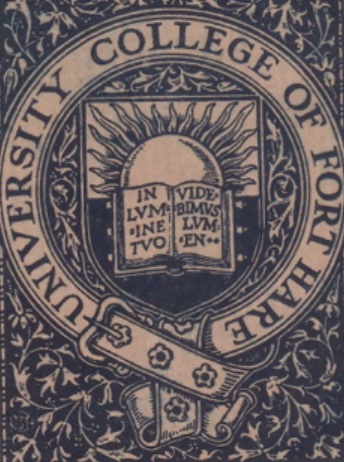
The bookplate dates from circa 1951 when the College was affiliated with Rhodes University and renamed the University College of Fort Hare. It features the university’s original coat of arms, that includes the lamp of knowledge and an open book - the universal symbol for knowledge and learning. The motto, ‘In Lumine Tuo Videbimus Lumen’, translates into, ‘In Thy Light we shall see light.’ This is also the official motto of Columbia University and appears on the crests of various other academic and religious institutions. The designer of this bookplate is not known.
Public Library of Kimberley
This public library was established in 1887 at 63 Dutoitspan Road. The original building was designed by architect Richard E. Wright with the 1899 enhancements by the well-known Kimberley architect Daniel E. Greatbatch.
Presently, the city’s Africana Research Library is situated in this historic building, housing approximately 14 000 rare books, 640 manuscripts, local maps and more than 12 000 important photographs.
Harry Thomas Strugnell designed this attractive pictorial bookplate, shortly after the conclusion of the Anglo Boer War.
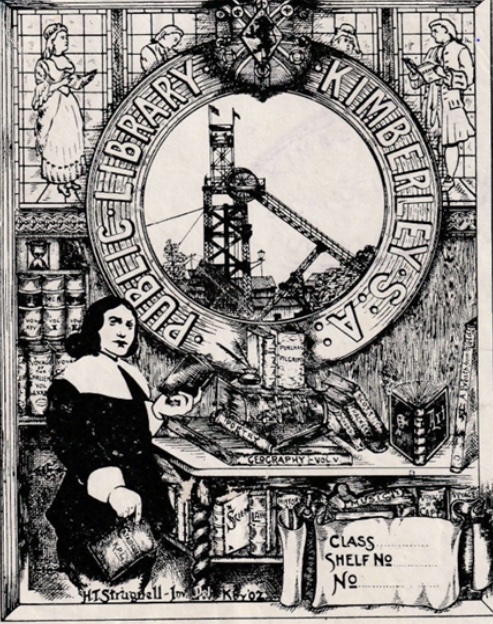
The headgear symbolises Kimberley’s diamond mining heritage while the ubiquitous figure of Jan van Riebeeck holds a book in his left hand and a catalogue of the Kimberley Public Library in the other.
Biographical details of architects RE Wright and DE Greatbatch are available on the built environment website Artefacts.
The bookplates are part of the author's private collection.
SJ de Klerk is a retired human resources practitioner. Since retirement he has been writing articles on various aspects of South African history for The Heritage Portal. He is a committee member and previous Chair of the Northern Branch of the Archaeological Society.
Sources
- Africana Notes and News. December 1956 Vol. 12, No. 4. Africana Society, Africana Museum. Johannesburg.
- Bishop P. J. G. 1955. South African Bookplates from the Percival J. G. Bishop Collection. A. A. Balkema. Amsterdam, Cape Town.
- Brownell F. G. 1994. Some Bookplates in the Brenthurst Library in Brenthurst Archives: Footnotes to History from The Brenthurst Library, Johannesburg, the Private
- Africana Collection of Mr. H. F. Oppenheimer. Volume I Number I 1994. The Brenthurst Press, Johannesburg.
- Built Environment Artefacts website – https://www.artefacts.co.za
- Chapman M. B., ‘Bookplates of South Africa and South-West Africa’, in Anna H. Smith, ed., Africana Byways. 1976. Ad Donker, Johannesburg.
- Dictionary of South African Biography Vol. ll. 1983. Tafelberg Publishers, Cape Town.
- Dictionary of South African Biography Vol V. 1987. Creda Press.
- Fransen H. Guide to the museums of southern Africa. 1978. Galvin & Sales (Pty) Ltd., Cape Town.
- New Dictionary of South African Biography Vol. l. 1995. HSRCC Publishers, Pretoria.
- New Dictionary of South African Biography Vol ll. 1999. Vista University, Pretoria.
- Suid–Afrikaanse Biografiese Woordeboek Vol. I. 1976. Tafelberg-Uitgewersbeperk, Kaapstad.
- Suid-Afrikaanse Biografiese Woordeboek Vol lll. 1977. Tafelberg-Uitgewers Bpk., Kaapstad.