
It is appropriate to begin with a declaration of interest: I contributed a chapter on Prynnsberg and supported the publication of this book. That proximity, however, also allows for a fuller appreciation of both its achievements and its limitations.
Jackie Kalley, publishing under her Otterley Press imprint, has established a reputation for producing beautifully crafted, large-format books that bridge architectural history and accessible storytelling. Her earlier works on Natal farmhouses and Pietermaritzburg’s heritage homes have demonstrated her ability to combine visual richness with a light but informed narrative touch—qualities that are again evident here.
In her Prelude, Kalley offers a personal entry point, describing how she came to love the eastern Free State and restored a cottage in Fouriesburg, naming it Otterley after Lady Ottoline Morrell. This personal engagement with place informs the tone of the book throughout. Although she does not explicitly foreground herself as editor, Kalley is clearly the convenor and guiding force behind a complex, multi-authored project involving some 22 contributors.
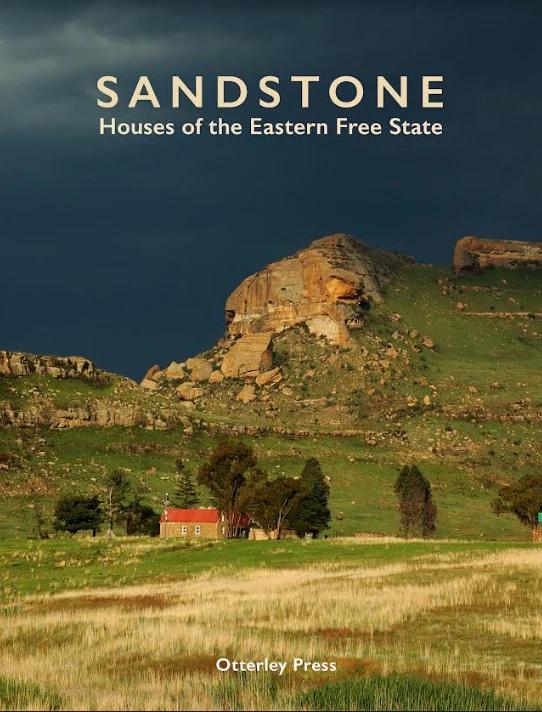
Book Cover
The book is structured geographically—a deliberate and important choice. A useful map grounds the reader in the terrain, allowing one to situate farms, estates, and towns within the broader landscape. This spatial framework is essential, for the eastern Free State is not simply a collection of buildings but a region shaped by geology, settlement, and distance. The sandstone itself provides both material cohesion and visual identity, giving rise to a distinctive vernacular architecture rooted in local conditions.
The historical context situates this architecture along the former frontier of Basutoland, now Lesotho, a region shaped by contestation, consolidation, and the aftermath of the South African War (Anglo-Boer War). Contributions by Gideon Groenewald anchor the narrative in geology, while Kobus du Preez and Kalley sketch the evolution of settlement and early building traditions. As du Preez notes, one can trace a progression from earlier, more rudimentary stone structures to later buildings exhibiting increasing refinement and standardisation in stone cutting—evidence of a maturing building craft and growing architectural confidence in the region.
At the heart of the book lies the country estate and the farm—these were not merely houses, but the working core of an agricultural economy. The Free State “country house” emerges as a complex ecology: a central dwelling surrounded by barns, workshops, and outbuildings, often accompanied by a school, a church, or even a gamekeeper’s lodge. At Prynnsberg, notably, there are two churches—an indication of both ambition and social structure. These estates functioned as self-contained worlds, shaping both landscape and community.
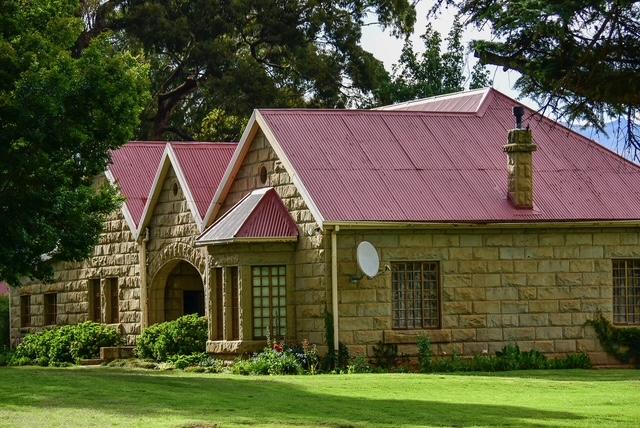
St Fort Farm (Sandstone Houses of the Eastern Free State)
The chapter on Prynnsberg, the creation of Charles Newberry, stands as one of the book’s most substantial case studies of a working estate. For this reviewer, it also carries a deeply personal resonance: Prynnsberg is remembered as nestled beneath, almost enveloped by looming golden sandstone cliffs—an architectural and natural composition of remarkable power and beauty. A number of the most significant estates, including Prynnsberg and the Old Pastorie at Fouriesburg, were established before the South African War and subsequently reshaped by it, marking a clear transition between pre-war settlement and the reconfiguration of towns and rural life in its aftermath.
If Prynnsberg represents the estate at its most fully realised, then the town of Rosendal provides the clearest urban case study. The chapter by Douglas Mason offers a nuanced account of decline and revival, positioning Rosendal as an example of how small rural towns can be reimagined and reinvigorated. Other towns—Ficksburg, Bethlehem, Paul Roux and others—are also included, prompting reflection on what constitutes a town in this landscape: a church, a school, a store, a post office, a service hub for surrounding farms. Some farmsteads, such as Schoonzicht, occupy land once contested between Basotho polities and Boer settlement, reflecting the layered and often turbulent history of this frontier region.
Yet here we encounter one of the book’s central challenges. Its ambition to cover a wide geographical area inevitably results in unevenness. Some towns and buildings are treated briefly, while others receive more sustained attention. There is, for example, more to be said about places such as Ficksburg or Senegal than is possible within the book’s scope. By contrast, Rosendal is explored in depth.
This unevenness is not simply an editorial shortcoming but also reflects practical realities. Kalley has indicated that she would have liked to include additional houses and significant sandstone buildings within certain towns, but despite outreach efforts, some property owners did not respond. An editor must ultimately work with the material—written contributions and photographic records—that are available. The resulting selection is therefore shaped as much by circumstance as by intention.
There is also an inherent tension between breadth and depth. The book seeks to capture both the sweep of the landscape—the textures and colours of sandstone, the vastness of the Free State—and the intimate detail of houses and family histories. At times, this results in a necessarily rapid survey. Yet when the narrative settles, particularly in the telling of generational family stories, it becomes deeply engaging. These accounts of endurance, adaptation, and attachment to land are among the book’s most compelling contributions.
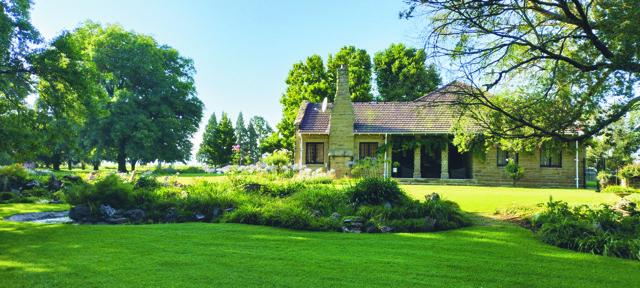
Deveron (Sandstone Houses of the Eastern Free State)
A more substantive critique lies in perspective. The book presents, predominantly, the imprint of white settler architecture on the landscape. This is a valid and well-rendered narrative, but it is not a complete one. The histories of Black families, the development of townships, and the dynamics of rural village life remain largely outside its scope. One is left with the sense that this volume opens the door to a further, necessary study—one that would more fully reflect the diversity of experiences that have shaped the region.
Equally pressing are questions of sustainability and future use. These large sandstone houses, often set within expansive properties, represent a way of life that may be increasingly difficult to sustain. How can such buildings be preserved and maintained? What models of adaptive reuse might ensure their continued relevance—whether as hospitality venues, cultural spaces, or reimagined rural homes? These are critical questions for the 21st century, and while the book hints at them, they remain largely unexplored.
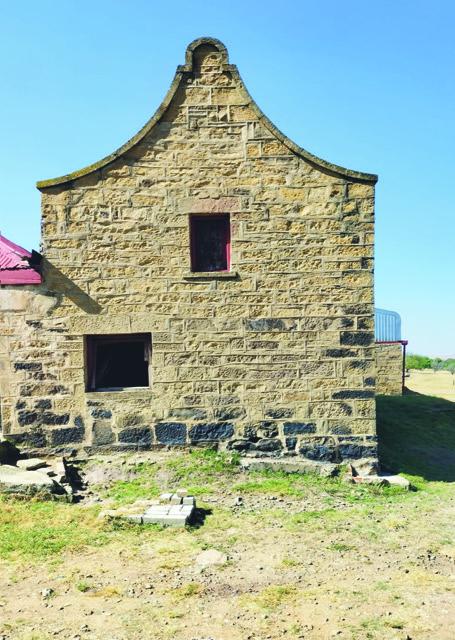
Buckland Downs (Sandstone Houses of the Eastern Free State)
Despite these criticisms, Sandstone Houses of the Eastern Free State succeeds admirably in its primary aim: to evoke a sense of place. The photography is outstanding, particularly in capturing the texture and craftsmanship of sandstone construction. One is drawn into the materiality of the buildings—the warmth of the stone, the skill of the mason, the interplay of light and shadow.
This is a book to return to, not only for information but for atmosphere. It offers the reader the enduring pleasure of taking something intangible away—the feel of the landscape, the presence of history, and the quiet dignity of architecture shaped by time.
It leaves us with both appreciation and anticipation: appreciation for what has been so beautifully documented, and anticipation for the stories that remain to be told.
Long may this landscape of stone and memory be celebrated—and more fully explored.
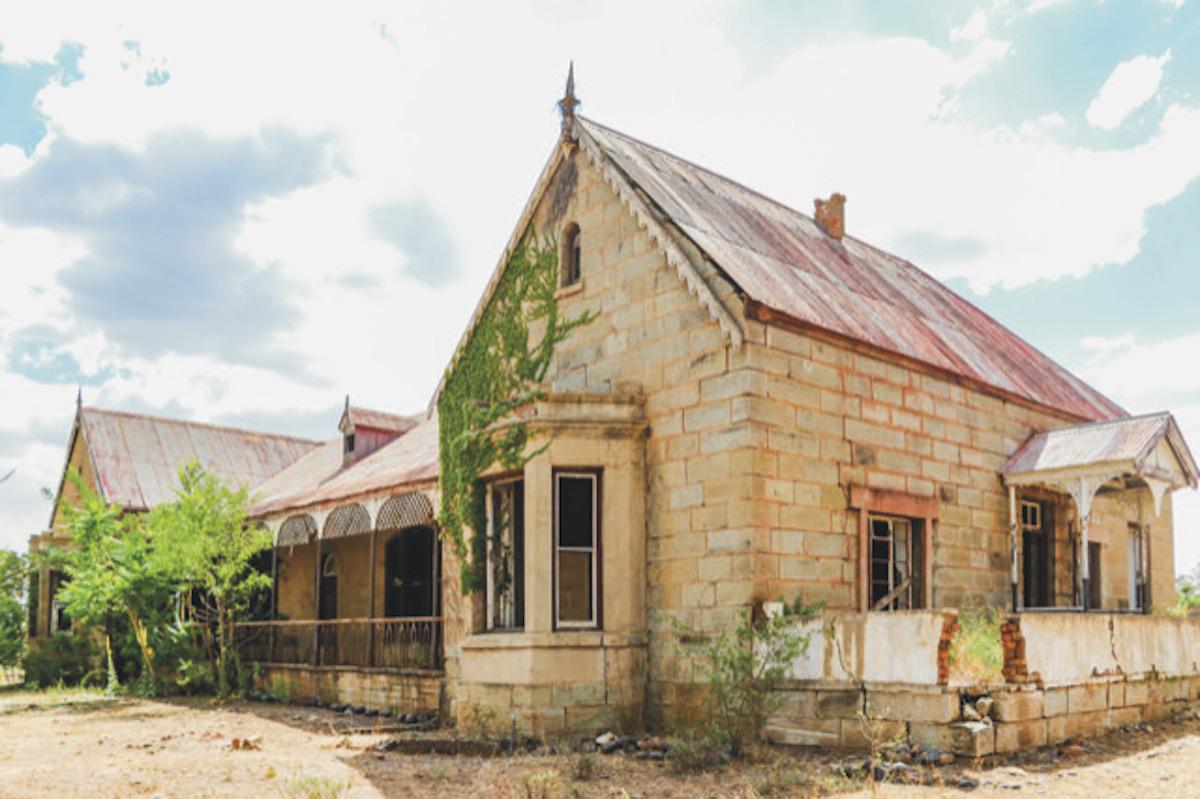
Main image: Struan House
Kathy Munro is an Honorary Associate Professor in the School of Architecture and Planning at the University of the Witwatersrand. She enjoyed a long career as an academic and in management at Wits University. She trained as an economic historian. She is an enthusiastic book person and has built her own somewhat eclectic book collection over 40 years. Her interests cover Africana, Johannesburg history, history, art history, travel, business and banking histories. She researches and writes on historical architecture and heritage matters. She is a member of the Board of the Johannesburg Heritage Foundation and is a docent at the Wits Arts Museum. She is currently working on a couple of projects on Johannesburg architects and is researching South African architects, war cemeteries and memorials. Kathy is a member of the online book community the Library thing and recommends this cataloging website and worldwide network as a book lover's haven. She is also a previous Chairperson of HASA.