
Disclaimer: Any views expressed by individuals and organisations are their own and do not in any way represent the views of The Heritage Portal. If you find any mistakes or historical inaccuracies, please contact the editor.
The multinational naval exercise WILL FOR PEACE, hosted by the South African Navy in Simon’s Town, brought the navies of China, Russia, Iran and the United Arab Emirates to Cape waters in January 2026. The Islamic Republic of Iran Navy (IRIN) was represented by three vessels, the Bayandor-class corvette IRIS Naghdi (F82), the forward base ship IRIS Makran (K441) and the converted oil tanker, IRIS Shahid Mahdavi (L110-3) of the Navy of the Islamic Revolutionary Guard Corps of Iran.
The focus of this article is not on the exercise or current political affairs, but rather to shed light on previous naval interactions, between Iran and South Africa during the 1970s – more than fifty years ago.
‘In the 1970s the governments of South Africa and Iran, neither democratically legitimated, embarked on a policy of cooperation, aimed at furthering national interest and maintaining the domestic political status quo.’ (Chehabi, 2016, 707). The South African government, led by JB Vorster, was an apartheid state characterised by growing militarisation and international pressure, with internal mass resistance developing rapidly. In turn, the Iranian government of the 1970s was an autocratic monarchy led by Shah Mohammad Reza Pahlavi, characterised by swift modernisation, economic growth, westernisation, and increased internal political repression. Growing opposition eventually culminated in the 1979 Islamic Revolution that overthrew the Pahlavi monarchy to establish an Islamic Republic under the Ayatollah Khomeini. The Imperial Iranian Navy (IIN) of the Pahlavi era subsequently became the Islamic Republic of Iran Navy (IRIN), of the present day.
The Shah of Iran, and JB Vorster, the South African Prime Minister from 1966 to 1978, maintained close political and economic ties. This relationship was largely driven by a mutual anti-communist ideology and Iran's role as the main oil supplier to South Africa, which was hard hit by economic sanctions. The Shah of Iran, had historic and strong sentimental ties with South Africa. During the Second World War British-Russian occupation of Iran, his father, Reza Shah Pahlavi found refuge in South Africa. He spent the last years of his life in the leafy suburb of Mountain View (Johannesburg) where he died, in exile, of a heart ailment at the age of 66 on 26 July 1944.
Personal relationships provided further assistance to build closer relations between the two countries. South Africa and Iran’s foreign ministers of the early 1970s, Dr Hilgard Muller and Ardeshir Zahedi were personal friends – both represented their respective countries as ambassadors in London in the early 1960s. In October 1971 the South African state president, Jim Fouché, accompanied by Muller and his wife, attended the lavish 2,500th anniversary of the founding of the Persian Empire in Iran. They were hospitably received and treated by the Shah, with the royalty and heads of state of 69 other countries, confirming the goodwill between South Africa and Iran.
One priority for Mohammad Reza Pahlavi was to secure the Indian Ocean region against communist infiltration, which he regarded as the artery of Iranian oil exports. He sought to achieve this, with the modernisation of his Imperial Iranian Navy (IIN) and developing bilateral naval cooperation with (amongst others) South Africa. Such considerations corresponded with South Africa’s own military aspirations, to expand its naval footprint in the area with the reactivation of its naval base at Durban on the east coast and efforts to modernise its fleet. In mid-1972 a cooperation agreement was signed between the South African and the Iranian navies and thereafter a representative of the Iranian Navy was stationed in Cape Town, while South Africa had a representative in Tehran.
Artemiz: The first Iranian warship to call at the Cape
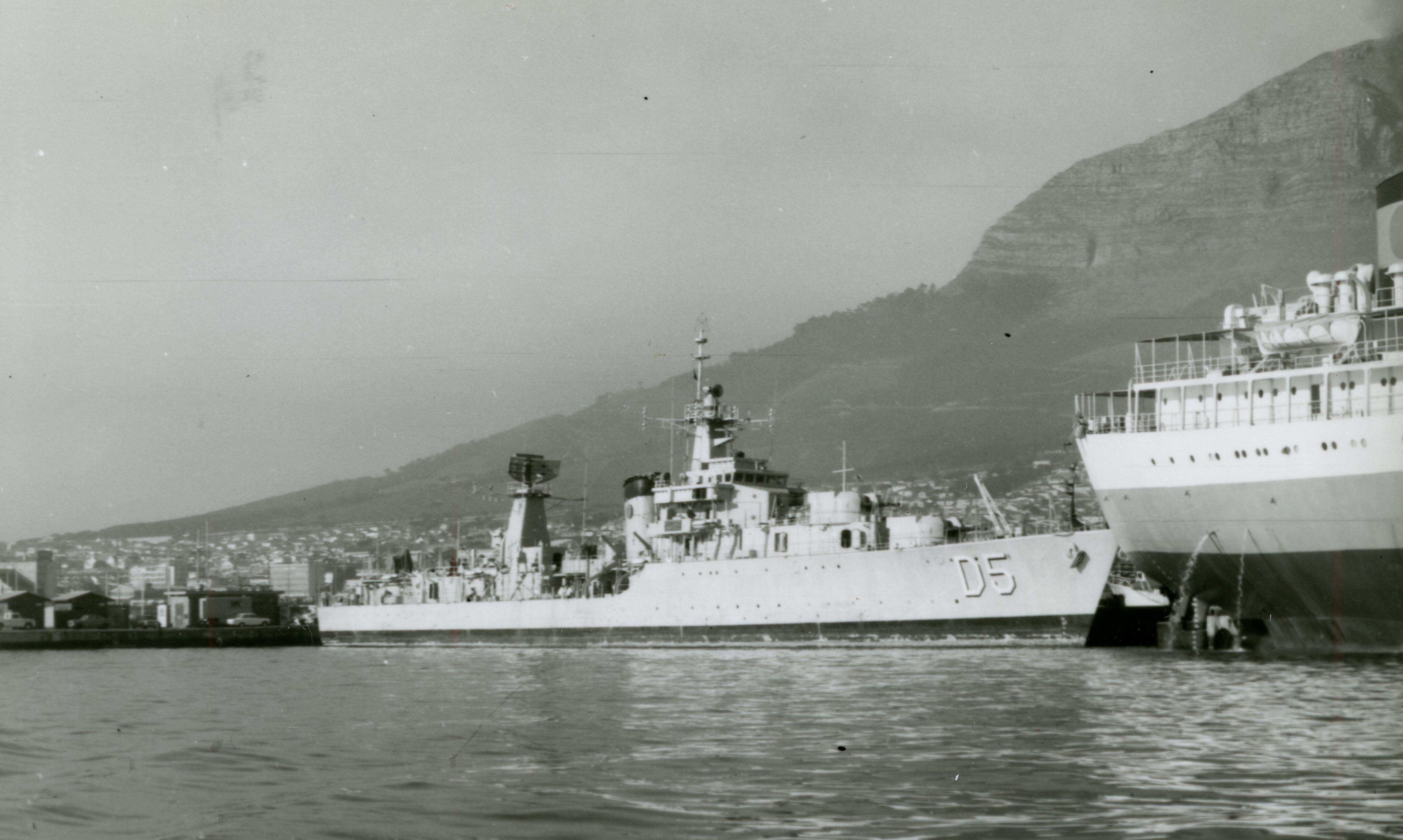
During the early 1970s, the Imperial Iranian Navy (IIN) maintained a sizable fleet that consisted of three destroyers, four fast frigates, four corvettes, four coastal minesweepers, two inshore minesweepers, sixteen patrol boats and twelve hovercraft. Its personnel component of approximately 13,000 officers and men, was significantly larger than the 4,500 of the South African Navy. The flagship of the IIN was a former Royal Navy Battle-class destroyer of Second World War vintage, HMS Sluys (3,350-tons). It had served the Royal Navy for only seven years (1946–1953) before it became surplus to requirements and was placed in reserve. The destroyer was transferred to Iran on 26 January 1967 and over a period of three years it was extensively refitted and modernised in the United Kingdom (UK). Its profile was radically altered with the addition of a new plated mast to mount the Plessey AWS 1 long range search radar, while a fully enclosed bridge replaced the old open deck above the forward superstructure. The two twin 4.5 inch guns were retained, but were now controlled by a modern radar and fire control system. Anti-aircraft armament was improved with the addition of four single 40/60 mm guns and a quadruple Sea Cat missile launcher on the after end of a new deckhouse.
The modernised destroyer was commissioned on 21 January 1970 as the IIS Artemiz and after a series of sea and acceptance trials in the UK, sailed for the Persian Gulf via the Cape of Good Hope in June the same year. Under the command of Lieutenant Commander Parvis Shilati, the Artemiz called at Simon’s Town on its delivery voyage, to take on supplies, but also to afford the Iranian crew a few days of shore leave. The Chief of the South African Navy, Vice Admiral H.H. Biermann and Rear Admiral James Johnson – who succeeded Biermann two years later – were hosted on board the Artemiz on 18 June 1970. This first visit by an Iranian warship proved to be quite a novelty, as the Commando (the official SADF) magazine later reported that ‘… a lot of foreign seamen [were] observed in the cape peninsula [‘daar was heelwat vreemde seemane in die kaapse skiereiland te sien’], referring to the 230 strong Iranian ship’s company who enjoyed Cape Town’s hospitality. The Artemiz also made a port of call at Durban, before continuing her homeward passage to the Persian Gulf. The destroyer would return to Cape waters four years later (see section below).
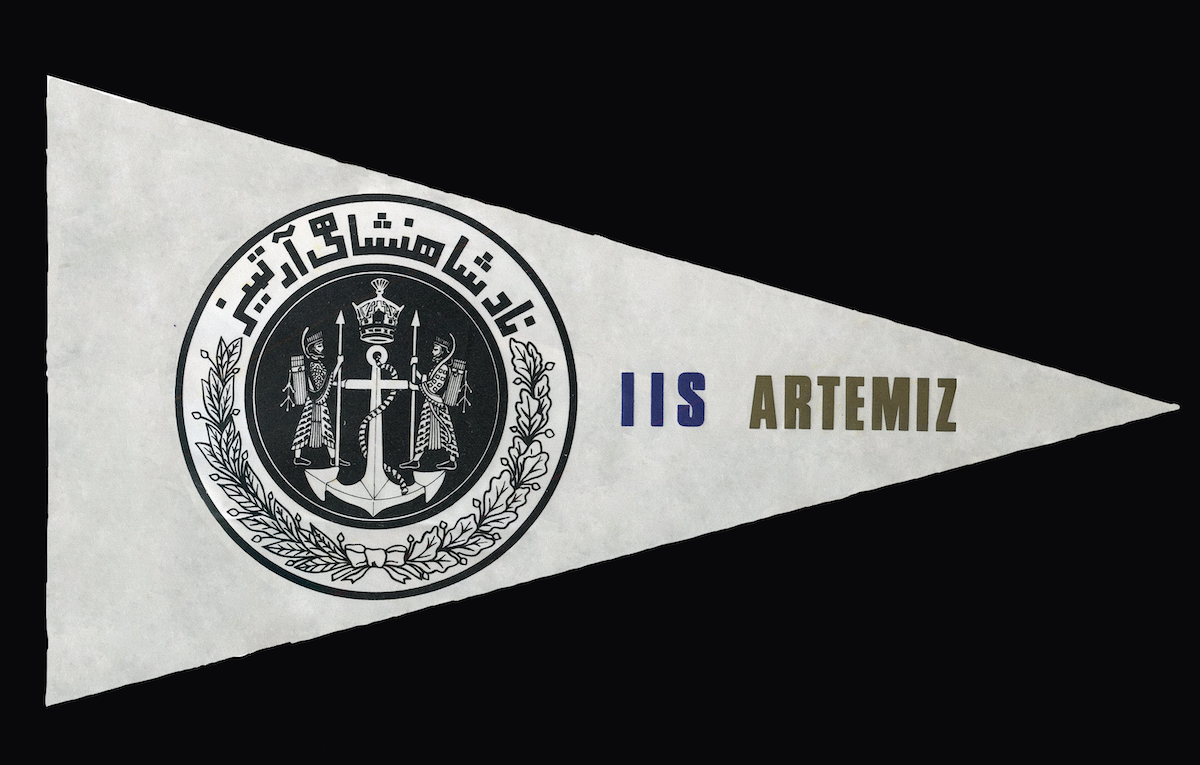
IIS Artemiz pennant/flag
More South African support: Four frigates
The modernisation of its fleet continued and in 1971/72 the IIN took delivery of four Saam/Alvand-class guided missile-armed frigates from Vosper-Thorneycroft and Vickers-Armstrong shipyards in the UK. It was agreed that the four vessels would call at Simon’s Town on their delivery voyages and would be placed in drydock for their guarantee inspection and rectification of any latent defects attributable to the builders. The first pair, IIS Saam and Zaal, drydocked in the Selborne Graving Dock at the Simon’s Town naval base in July 1972 and the sister ships IIS Faramarz and Rostam followed in March 1974.
As was the case with Artemiz, the Iranian crews of the four frigates were entertained as guests of the Chief of the Navy, toured the Western Cape and went up Table Mountain, courtesy of the Cape Town City Council. The Commander-in-Chief of the Imperial Iranian Navy, Admiral Farajollah Rasaei and the Iranian Consul-General Dr. Ahmed Tehrani were in Simon’s Town on 28 June 1972, as guests of the Chief of the South African Navy, Vice Admiral James Johnson, to witness the arrival of the first two frigates.
The South African Navy provided further logistical support when, in April 1974 the large replenishment vessel SAS Tafelberg was tasked to escort the second pair of frigates, Faramarz and Rostam as far north as the equator, on their homeward passage to the Persian Gulf.
Michael Wainwright, a Dockyard apprentice in Simon’s Town at the time, recalls a narrow escape:
True story - I was an “appie” in the Dockyard and these ships were due to sail after they had been worked on as part of some agreement with Britain to carry out maintenance as these were new ships. I was sent down to complete a small job, or so we thought, in the tiller flat to replace wire guards on rod-gearing. While working I felt the ship moving but I still had to finish, but then I thought maybe the tug was just moving the ship. Anyhow on completion of the job I came up and we were far out [in False Bay], overcome with panic, thinking I will end up in Iran! I was making my way to the bridge when I came upon Captain Jack Netterberg [the Naval Harbourmaster] who was leaving and all he said was: "You can catch a lift with me if you want". I could have kissed him! We got onto a tug and went back to Simon's Town.
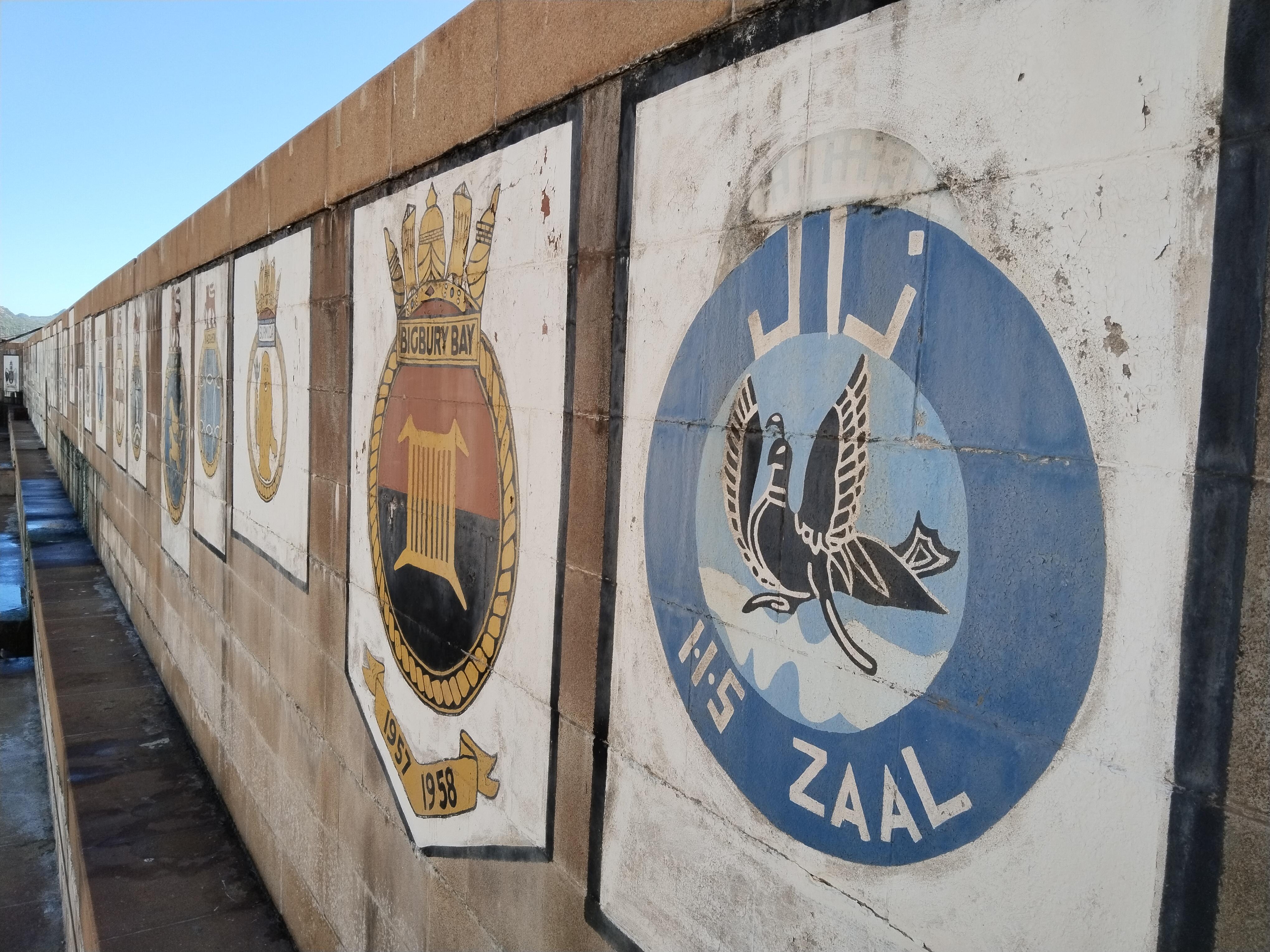
The IIS Zaal ship badge adorns the historic dry dock wall of the Selborne Graving Dock in Simon’s Town – a historic reminder of the Iranian frigate’s southern sojourn in July 1972.
Following the 1979 Iranian Revolution, the four frigates were renamed, Alvand, Alborz, Sabalan and Sahand. Three of the four frigates remain in service with the Islamic Republic of Iran Navy (IRIN) today. Sahand was sunk by the US Navy on 18 April 1988, during the Iran-Iraq War.
Artemiz returns: A local refit
During 1974 the flagship of the Imperial Iranian Navy, the destroyer Artemiz was refitted in Cape Town by Globe Engineering Works, a long-established company in Cape Town, which specialised in marine and industrial engineering, ship repair, and mechanical services. The work was done in conjunction with Plessey, an electronics and defence telecommunications company. South African Navy Dockyard contract supervisors oversaw the work on behalf of the Imperial Iranian Navy.
The decision to send the Artemiz to Cape Town was informed by the local industry’s capacity to refurbish the vessel on a standard similar to what the British shipyards could offer at the time. The capacity of local shipbuilding and repair companies had expanded steadily during the 1960s and 1970s. The Naval Dockyard in Simon’s Town had converted two destroyers and three frigates for the South African Navy during this time, while private shipyards like Globe in Cape Town, Dorman Long, James Brown and Sandock Austral in Durban built, repaired and converted ships, both for the navy and the merchant marine. Furthermore, the terms of the contract involved ‘minimal transfer of South African foreign currency and proved advantageous to both parties.’ (Young, 1979, 21)
The modified Battle-class destroyer IIS Artemiz alongside at Globe Engineering in Cape Town harbour in 1974. (Bill Rice)
In August 1974, on completion of the work in Cape Town IIS Artemiz sailed to Simon’s Town to conduct tilt tests afloat in the graving dock, so that her weapons systems could be aligned with the gun directors. This was followed by a ten day dry-docking period to repair paintwork and prepare the destroyer for the voyage home to Iran.
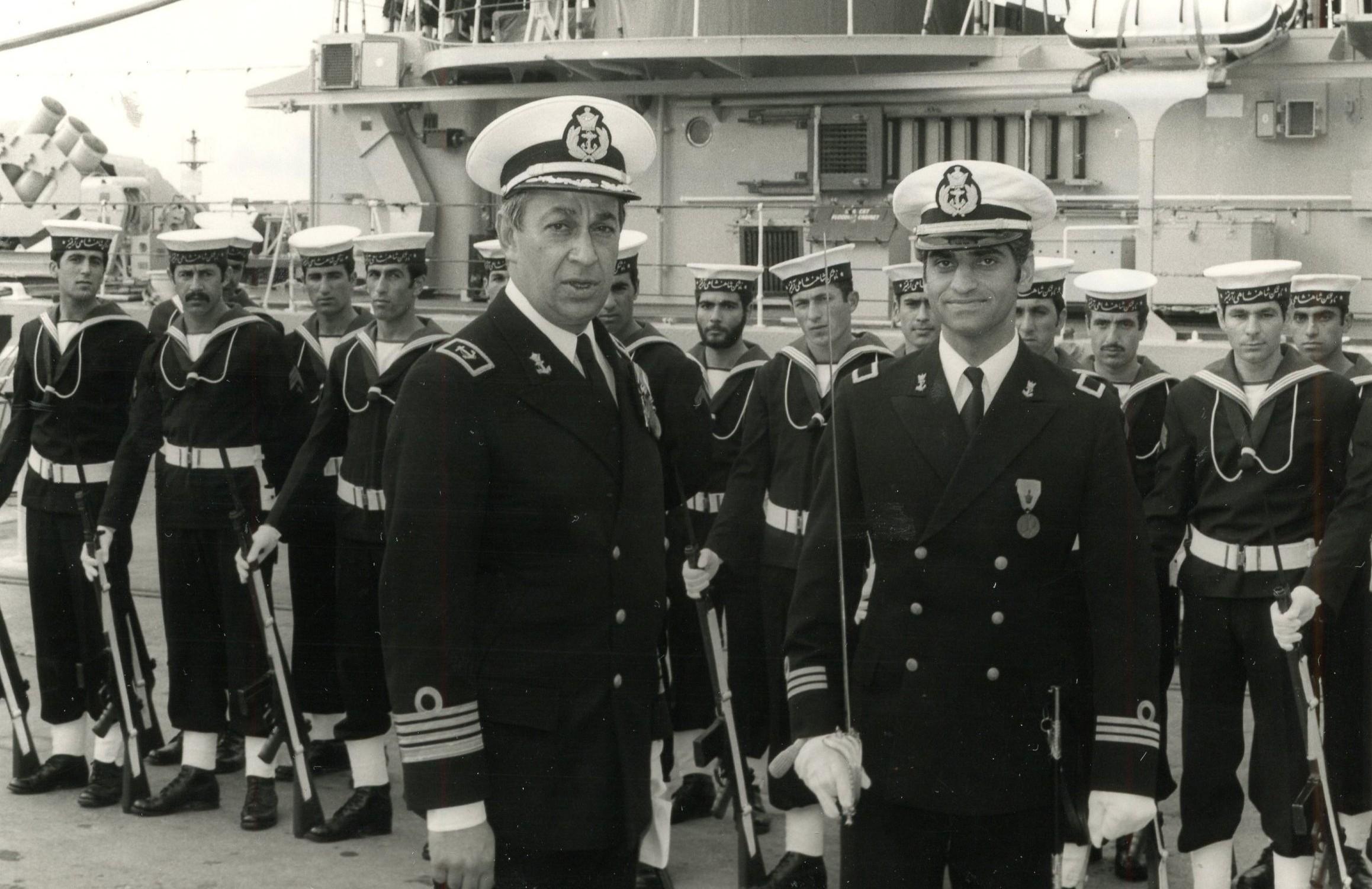
The Commanding Officer of the Artemiz, Captain Nasser Pourzand and the IIN Guard of Honour, awaiting the arrival of the Chief of the South African Navy on 2 October 1974, at Simon’s Town.
On 2 October 1974 the Artemiz was re-commissioned at Simon’s Town. The speech, by Chief of the South African Navy, Vice Admiral James Johnson is included in this article to show the details of the project and the extent and nature of relations which existed at the time:
Dr. Tehrani, Captain Pourzand, Admiral Biermann, Admiral Nortier, representatives of the armed forces of other countries, ladies and gentlemen. I am greatly honoured to-day to be present with Dr. Tehrani, the Consul General for Iran Captain Pourzand on this momentous occasion – an occasion for considerable pride both for Iran and South Africa.
The South African Navy and local industry were greatly privileged when the Imperial Iranian Navy entrusted them with the major refit of one of their most important units. The contract for the refit of the IIS Artemiz was signed on 11th June 1973 by Rear-Admiral Iraj Sepehri on behalf of the Imperial Government of Iran and Mr Harry Smith, Managing Director of Messrs. Globe Engineering who were the main contractors. The South African Navy acted as agents, advisors and co-ordinators under the direction of my Chief of Logistics, Rear-Admiral Nortier. This was the beginning of a period of most fruitful co-operation between the Imperial Iranian Navy, the South African Navy and local industry.
The refit and modernisation of a modern warship is a most complex matter and to give our visitors an idea of the extent of this, I would like to mention that no less than 24 sub-contractors have been involved. I hope that they will forgive me for not mentioning them all by name, except to refer to the very involved electronic work carried out by Plessey (UK) and the cleaning, painting and preservation by Nautilus Marine.
A wide variety of specialisations were involved such an insulation, boats, and liferafts, air-conditioning, cordage, instruments of all sorts, canvas, teleprinters, upholstery, batteries, mattresses, tiles, fire extinguishers and many, many others. It would be invidious to mention the civilian gentlemen concerned, but I would like to thank Messrs. J.H. Collins, E.C. Hastings, R.G. Langley, J. Fryatt, and Mr D.C. Nel for their particular contribution.
Similarly in the case of my friend Captain Pourzand and his team Senior Lieutenant Seyednejad, and Lieutenants Mofidi, Behnouzi and Dezfoulien did particularly well.
In the case of my own staff I would like to express my personal thanks and appreciation to Rear-Admiral Nortier, Commodore Kleinschmidt, Captain Nash, Commander Walker, Lieutenant Commanders Dowsett, Cook and Studwell and if they don’t mind me referring to them as such, the backroom boys, Commanders Clarke and Voss. Mr J. Dennis assisted by Warrant Officers Alexander, and Brushett and Chief Petty Officer Baxter, carried out excellent work as overseers. To the many others, naval and civilian, my sincerest appreciation.
So far I have referred to the main refit itself, but when Artemiz came round to Simon’s Town, certain specialist work was carried out by the Dockyard, the trials period involved considerable co-operation between our two navies and the South African Air Force.
Quite apart from the refit we in the South African Navy have been privileged to assist our Iranian colleagues with certain training programmes, and as a result we have come to develop a very high regard for the Imperial Iranian Navy and Captain Pourzand, his officers and ships’ company in particular.
Captain Pourzand, as you are aware, we see representatives of many navies come and go, and I want to say this to you in the presence of Dr. Tehrani, your officers, and ships company. It is that the behaviour, good manners, and appearance of your men are exemplary. The appearance of your sailors is quite exceptional, and must be a subject of great pride to you and certainly of satisfaction to me.
Dr. Tehrani, ladies and gentlemen, I now have the great honour of handing over the Imperial Iranian Ship Artemiz to her Commanding Officer, Captain Nasser Pourzand, and wish him and his officers and ships company a very happy and most successful commission.
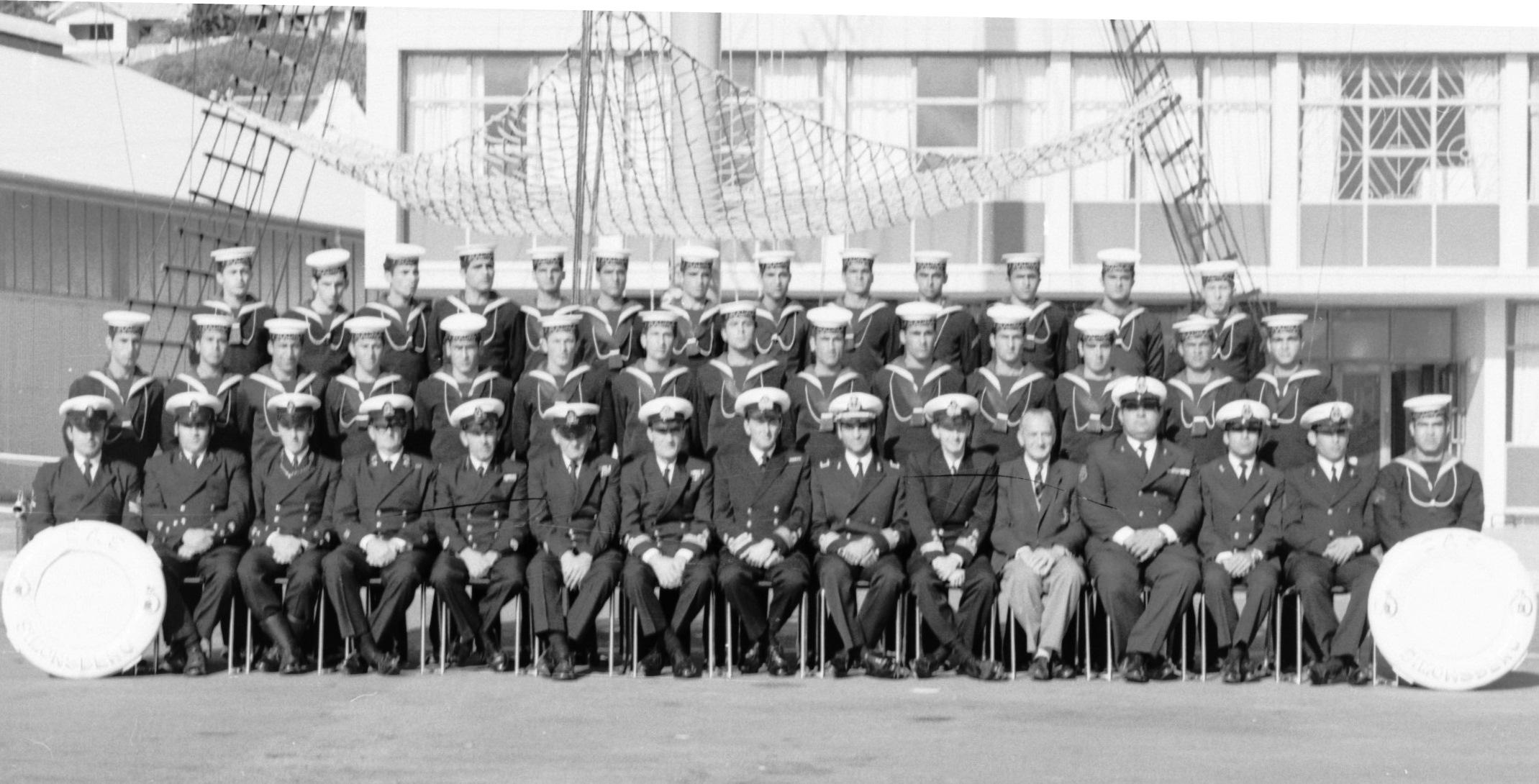
Twenty-seven gunnery ratings of the Imperial Iranian Navy underwent training at the New Entry Training School at SAS Simonsberg while their ship, the Artemiz was in refit. The group was divided into three classes of 9 men each, with instruction carried out by SAN instructors and 3 Iranian instructors, as translators. The course ran for 10 weeks and covered subjects such as rigging, boatwork and anchors & cables. The Iranians achieved an aggregate of 83%.
In October 1974, the South African Navy provided more logistical support by way of its large replenishment vessel SAS Tafelberg, to accompany the Artemiz on its return voyage to Bandar Abass in Iran. The frigate SAS President Steyn joined the two ships, and sailed in company as far as the equator, before returning to Simon’s Town.
The Artemiz continued to serve the Imperial Iranian Navy until the 1979 Iranian Revolution, after which it was renamed Damavand, in service of the new Islamic Republic of Iran Navy (IRIN). After the events of 1979 the United States imposed an arms embargo, which hampered Iran's ability to maintain its fleet, but in 1985 the aging destroyer was refitted with Russian assistance. Its distinctive twin 4.5 inch guns were retained, but the main gunnery radar and control systems were modernised. The British Sea Cat system was also replaced with a modern Russian surface-to-air missile system. The Damavand became non-operational in the early 1990s, and was scrapped in 1992.
Conclusion
Documentation at the South African Naval Museum suggests that the last Imperial Iranian Navy vessel called at Simon’s Town in February 1975. It was the Hengam-class landing ship IIS Hengam (2 581 tons), on its delivery voyage from Yarrow Shipbuilders in Scotland. The ship badge still graces the wall of the Selborne Graving Dock in Simon’s Town, 51 years later.
The 1979 Iranian Revolution had immediate and severe consequences for the South African apartheid government. Iran severed its ties, and shifted from being the regime's most critical strategic partner to becoming a vocal opponent and supporter of the liberation movement. It was only in 1994, when South Africa underwent a watershed transition from the apartheid system of racial segregation to a multiracial democracy that full diplomatic relations were re-established.
Subsequently, ships of the Islamic Republic of Iran Navy have visited South African ports. The frigate IRIS Alvand (which visited Simon’s Town in 1972 as the IIS Saam) and the replenishment vessel IRIS Boushehr visited Durban in November 2016, while the forward base ship IRIS Makran and frigate IRIS Dena called at Cape Town in April 2023.
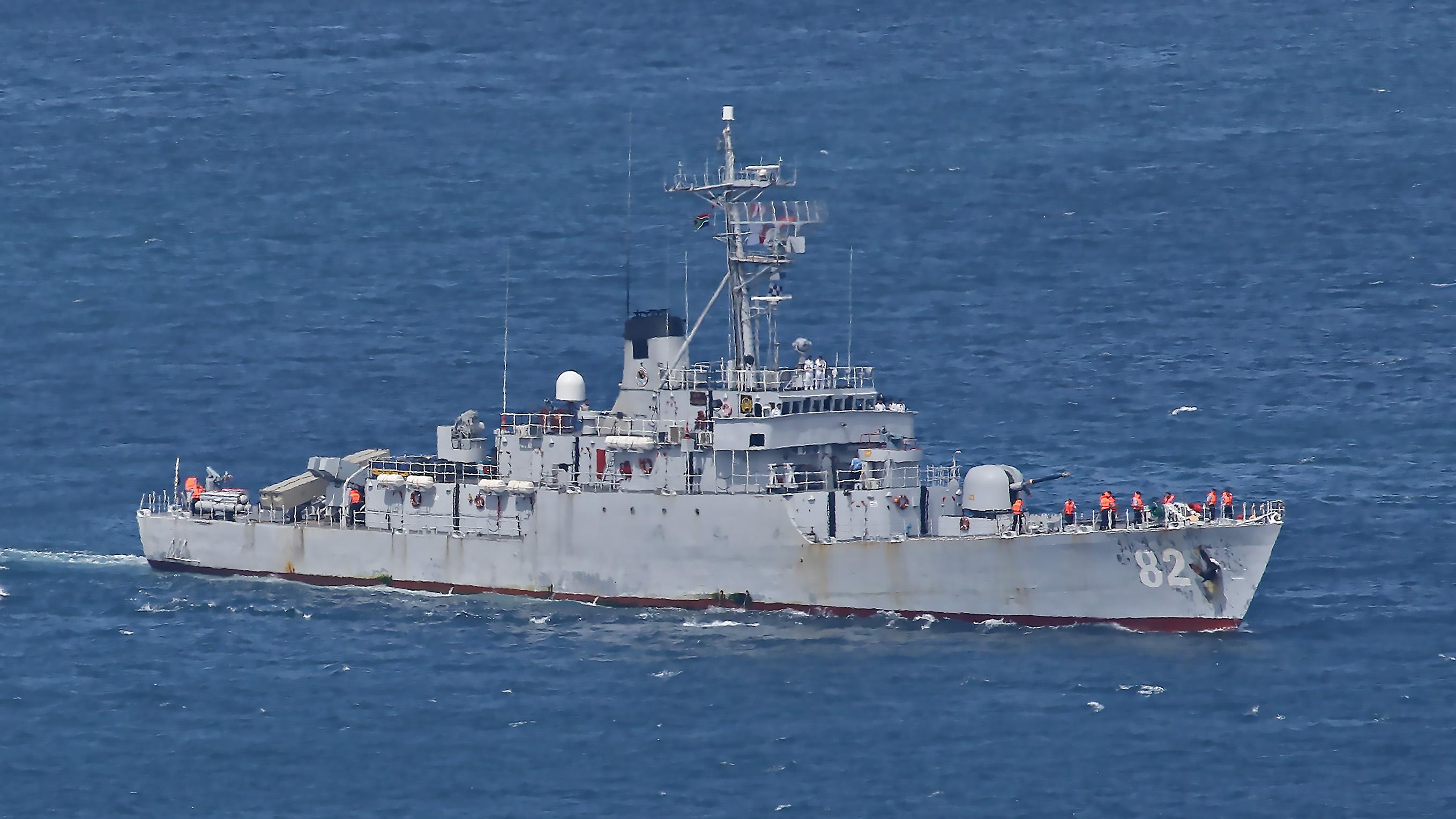
The Bayandor-class corvette IRIS Naghdi (1 135 tons) in Simon’s Town, January 2026. The corvette was built in the USA and commissioned into the Imperial Iranian Navy in 1964 and with the Islamic Republic of Iran Navy from 1979. Regular refits have kept the old corvette in service for a remarkable 62 years, although her general appearance suggests that she is due for another soon. To put the Naghdi’s longevity into perspective – the last Type 12 frigate in service with the South African Navy, SAS President Pretorius commissioned in the same year (1964), but was withdrawn from service in 1985, after (only) 21 years of service. (Louis Vosloo)
Commander Leon Steyn is the historian for the South African Naval Museum.
Bibliography
- Anon., ‘Besoek van die ISS Artemiz’, Commando, September 1970, 48-49.
- Anon., ‘Proud moment’, Cape Times, 29 June 1972, np.
- Blackman, RVB (ed.), Jane’s Fighting Ships 1972-73, (London: Sampson Low, Marston & Co, 1972), 167, 280.
- Bredenkamp, PR, A Bit of South African Naval History, Navy News, Nov-Dec 1996, 20-21.
- Chehabi, HE, ‘South Africa and Iran in the Apartheid Era’, Journal of Southern African Studies, 42, 4 (2016), 707.
- du Pisani, K, ‘Making the Best of a Setback: The Fuel Conservation Programme of the Vorster Government in the 1970s’, Journal of Southern African Studies, (2025), 1-20.
- du Toit, A, South Africa’s Fighting Ships: Past and Present (Rivonia: Ashanti, 1993), 242.
- Military Reporter, ‘Iran Sailors Would Like Longer Stay’, Cape Times, 19 June 1970, np.
- Rice, B, Simon’s Town Dockyard: The First 100 Years (Simon’s Town: Naval Heritage Trust and Simon’s Town Historical Society, 2010), 152-153.
- South African Naval Museum Archive, File: Iran - Artemiz, 2 October 1974 programme.
- Wainwright, JF, The Ships’ Badges of Simon’s Town Drydock (Simon’s Town: Naval Heritage Trust, 2001).
- Wainwright, Michael, Facebook comment, SA Naval Museum, 1 December 2015.
- Young, G, ‘SA Renovated Iranian flagship’, The Cape Times, 10 November 1979, 21.
Comments will load below. If for any reason none appear click here for some troubleshooting tips. If you would like to post a comment and need instructions click here.