
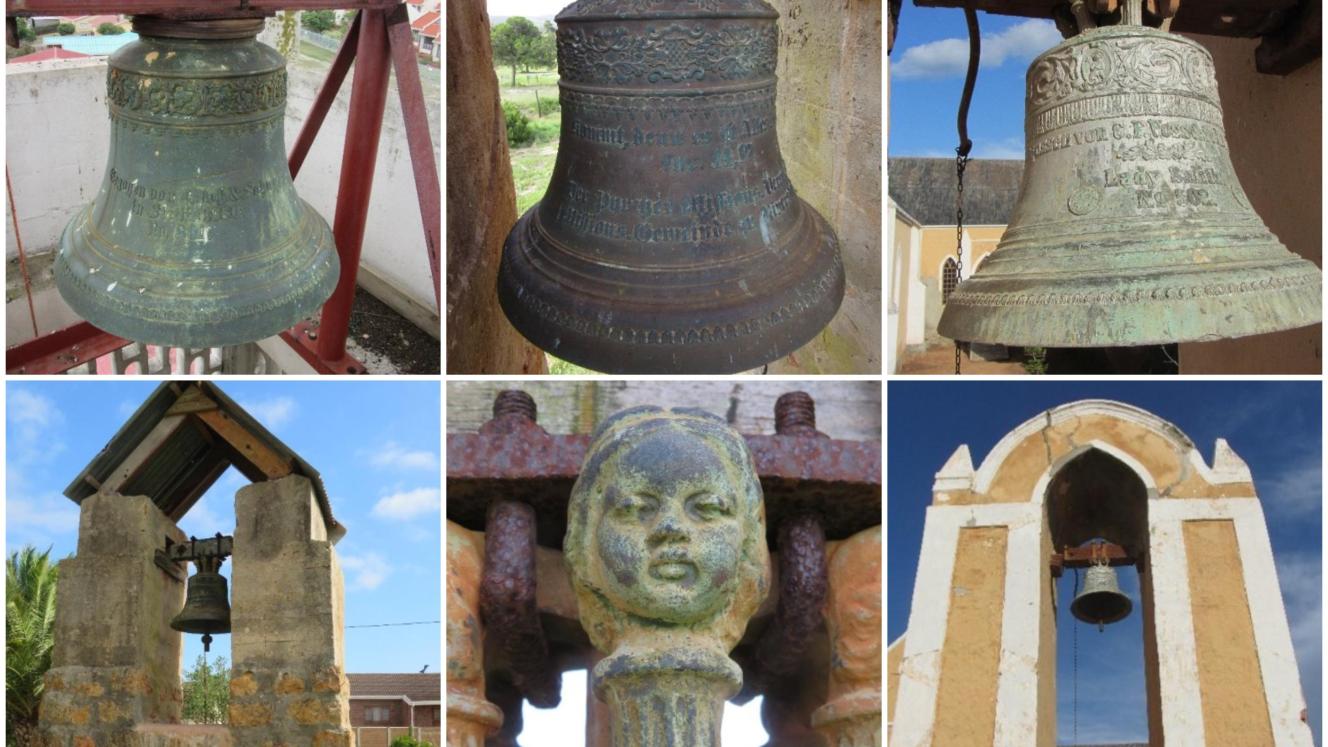
In the article below, Tertius De Wet, Jef L. Teugels, and Pieta Van Deventer trace seven church bells back to the C. Voss & Sohn foundry in Stettin, now Szczecin in Poland. All seven still hang in Lutheran and Dutch Reformed churches in South Africa's Eden district. Most arrived through the Berliner Missionsgesellschaft, the German missionary society active in the region. The authors visited each bell in person, measuring and photographing them, and traced their origins through foundry records and the inscriptions cast into the bronze itself. Along the way they map three generations of the Voss family, from 1868 to 1881, and uncover small human stories behind the bells, like one that arrived thanks to a missionary's personal ties to his hometown. The result is part technical record, with careful notes on each bell's size, weight, and tone, and part rescue of a fragile piece of regional history.
1. Introduction
The foundry of Carl Voss was located in Stettin, formerly a city in Germany, but now in Poland with the name Szczecin. This foundry has made more than 3500 bells over the period 1847-1933. While most bells were for local use somewhere in Europe, a few dozen were made for mission stations spread over Africa. We select from the entire list the seven bells that have been found in the Eden district of South Africa: Four are listed as for specific places in South Africa (Amalienstein, Albertinia, Ladismith and Herbertsdale), two for South Africa (Mossel Bay and Heidelberg) and one for Africa (Kleinplaas). We have been able to locate and visit all of them and in what follows we will describe them in detail and to show their beauty by pictures.
2. Some Voss Genealogy
Stettin (Szczecin) is a harbour city that had a large tradition in founding. Apart from church bells, ship bells and other heavy machinery for ships were produced by a large number of founders. The VOSS-family is in some sense the last in a long list since after their foundry was closed down in 1929, all bell founding in Stettin had been stopped. The information below on the family is taken out of the paper.
The first in the list is Christian Gottlieb Voss (1781 – 1847) who was a distiller in Stettin. He married Anna Sophia Langen. From their marriage came a number of children, two of which got involved in bell founding. From the hand of the younger boy, Johann Theodor Voss (1817 – 1895) few bells are known. Most of the bell founding happened through the older boy and his pedigree.
Carl Friedrich Wilhelm Voss (1805 – 1879) was born in Stettin and died there. Carl started his own “Glockengiesserei und Metallfabrik” on 1 September 1829 in the Breitestrasse 386, Stettin. He quickly got into bell casting even when the factory also specialised in equipment for farms and ships. The numbering of bells started however in 1835 and continued during his entire life. The last bell that carries only his name has the number 463 and dates from 1874.
Two of Carl’s sons became involved in founding.
- The older son Emil Johann Christian Voss (1852 – 1915) decided in 1871 to work for a number of years in the foundry of Gustav Collier in Berlin. He later returned to Stettin, but it is highly improbable that there are any bells from him in South Africa. On the other hand we found a number of bells from the period 1883 to 1899 in South Africa that have been founded by Collier.
- The younger son Ernst Johann Carl Voss (1852 – 1915) stayed in Stettin. From 1874 he took part in the bells that were made in his father’s foundry by the addition of & SOHN to his father’s name. The numbering of bells continued and the name of the founders was kept, even after the death of the father in 1879. Bells from 1880 onwards and with numbers above 792 are definitely made by Ernst only. The last bell from his hands that we have found so far dates from 1914 with the number 2085.
We need to remark that over the period 1887 to 1896 Ernst made 27 bells for the foundry in Berlin of Hugo Collier, brother of Gustav Collier. This should explain why the decorations on the bells of the Collier foundry are very similar to those of the Voss factory.
It is also worth mentioning that until 1912 Ernst shipped 75 bells to other countries, 32 of them to Africa, 25 to India, 10 to China, 5 to Australia and 3 to the US.
One of the sons, Erich Georg Albert Voss (1881 – 1955) continued to make bells. The youngest bell that we could find dates from 1933 and carries the number 3462. Erich continued working under the logo of C. VOSS & SOHN until 1933 and the last bell that we could find has number 3517.
Due to the bad situation in Germany in the late twenties of the last century (especially in the sea harbours there), Erich found it more opportune to change the location of the foundry. He closed the foundry in Stettin, ending a century long tradition in that city, and moved to Hennickendorf to start his “Märkische Glockengiesserei”. The first bell that we could find with the changed inscription dates from 1933 and carries the number 3540. The foundry stopped working in 1948 and the latest number that we found is 3657.
Of the seven Voss bells that we found in the Eden region, the oldest two (Amalienstein and Albertinia) have been made by Carl Voss alone, the next two (Ladismith and Herbertsdale) by Carl and his son Ernst, the youngest three bells (Mossel Bay, Heidelberg and Kerkplaas) by Ernst. What is clear is that all of these bells have been ordered through the Berliner Missionsgesellschaft (BMG) that was very active in the Eden region till about the middle of last century. We therefore continue our paper with some background information on the BMG. After that we deal with each of the seven locations in more detail. After discussing some technical data we finish our contribution with a number of acknowledgments / observations / comments.
3. On the Berliner Missiongesellschaft
This section gives a brief introduction to the work of the Berliner Missionsgesellschaft (BMG) in South Africa and in particular its first missionary activities in the Eden District.
The BMG was founded on 29 February 1824 at a private gathering in Berlin by ten devout men as the Gesellschaft zur Beförderung der Evangelischen Missionen den Heiden (Society for the Promotion of Protestant Missions among the Heathen). The founding of the BMG occurred at a period of spiritual awakening after the French occupation and the wars against Napoleon.
The activities of the BMG lasted less than 150 years during which time a major part of its work was conducted in present-day South Africa. The first BMG missionaries, i.e. August Gebel, Johann Schmidt, Reinhold Gregorowski, Gustav Kraut, and August F. Lange arrived in Cape Town on 17 April 1834, ten years after it was founded. They arrived without a properly laid out strategy from the BMG, only with a vague order to go north to Bechuanaland, which they did not reach due to tribal unrest. Instead, the first station was established in 1834 at Bethanien (or Bethany) in today’s Free State Province. Their move into the area of interest of this paper, the Eden District in today’s Western Cape Province, came about from a request from the South African Missionary Society (SAMS) to provide a missionary for their station at Zoar, close to Ladismith. For this, BMG entered into a contract with SAMS and Gregorowski, one of the original five missionaries, was entrusted with this task, starting in 1838. The work there flourished and in 1845 the BMG bought an adjacent farm to set up its own mission station called Amalienstein (see the next section). This was followed by the founding of several BMG stations and outstations in Eden relevant to the discussion in this paper and discussed in more detail in the following sections.
In 1961, the year in which South Africa became a republic and the Berlin wall was erected, the BMG, together with the two other German Lutheran missionary societies, the Moravian Brethren and the Rhenish Missionary Society, amalgamated to form the Evangelical Lutheran Church of South Africa (ELCSA) and the work of the BMG in South Africa came to an end.
4. 1868. Amalienstein, Lutheran Church
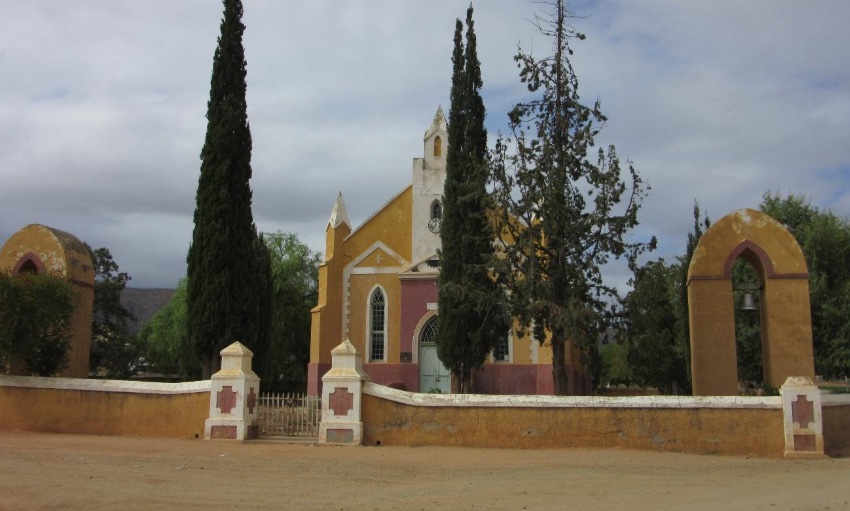
The BMG bought the land adjacent to Zoar from the South African Missionary Society to set up its own station and named it "Amalienstein", after its benefactress, Frau Amalie von Stein. In 1853 a church was built, followed by a school in 1859. There are two free standing bell towers, at the left and the right side in front of the church. Both are in a horseshoe construction. On page 37 of the book by Ed. Kratzenheim is a picture with a sketch of the church in Amalienstein where on the left of the entrance stands a wooden structure with a bell. This creates the suspicion that one of the two current bells might be substantially older than the other. Indeed, the bell on the left reveals its secrets.
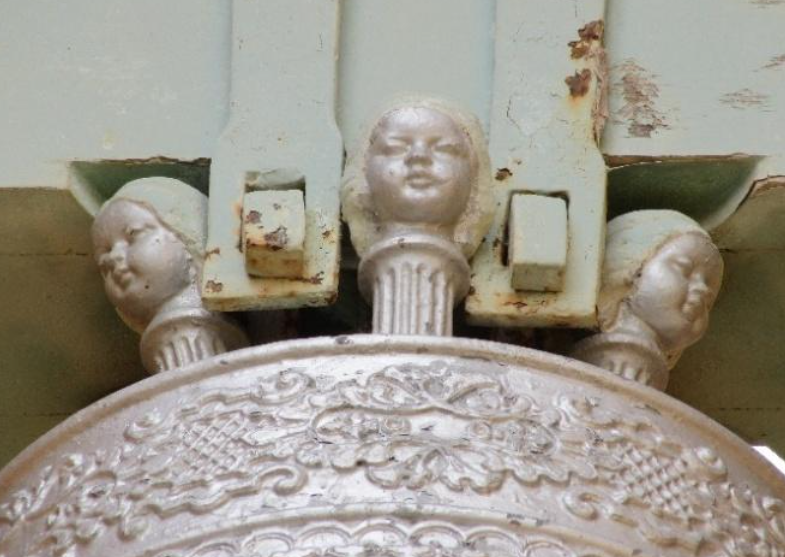
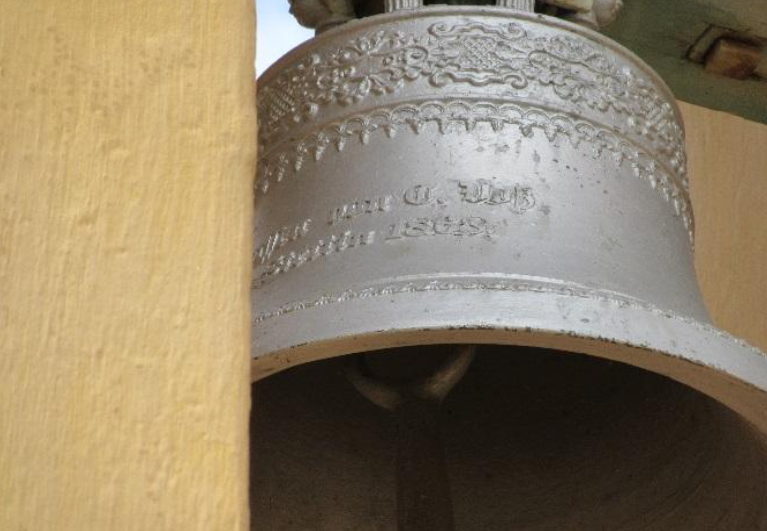
The bell is nicely decorated. The canon consists of six carefully carved angel heads, similarly to those of Gruhl bells like in Genadendal. Below the crown is a broad decorated band, and below that a moulding ring with a band of drops pointing downwards. On the waist we see that the bell has been made in the foundry of Carl Voss. It reads:
Gegossen von C.Voss
in Stettin 1868
On the reverse waist we read:
No.397.
Above the sound bow are four moulding wires, the top two close together. On the lip one finds a decorative freeze made up of leaflike figures, pointing upwards.
5. 1869. Albertinia, Lutheran Church
The church in Albertinia was originally an outstation of the Riversdale mission of the Berlin Missionary Society. That mission was established in 1868 and became the most important one in the Eden region. After the inauguration of the church in Riversdale, a large bell was given by the Pyritzer Missionsfreunde. It is that bell that ended up in Albertinia, probably around 1908 when Riversdale got a new and even larger bell from the Korfhage foundry, also in Germany.
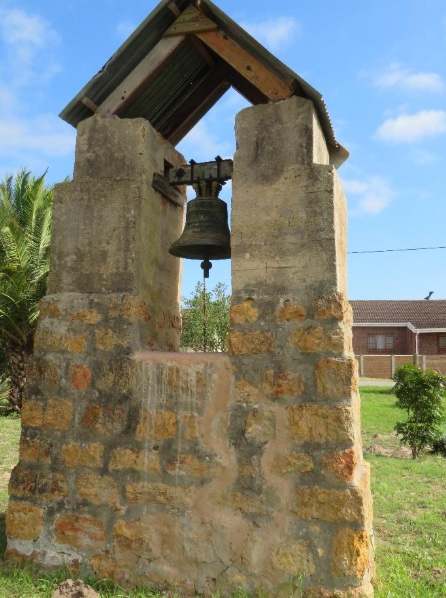
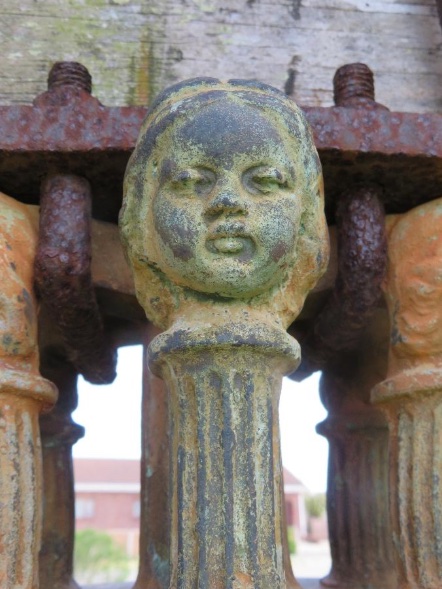
The bell hangs in a nice stone construction to the side of the church, built with similar stones. Having a closer look at the bell reveals a beautiful bell that is rather well preserved. The canon consists of six carefully carved angel heads. Below the crown is a broad decorated band followed by a moulding ring and a band of drops pointing downwards. On a visible waist one reads:
Gegossen von C.Voss
in Stettin 1869
No. 409
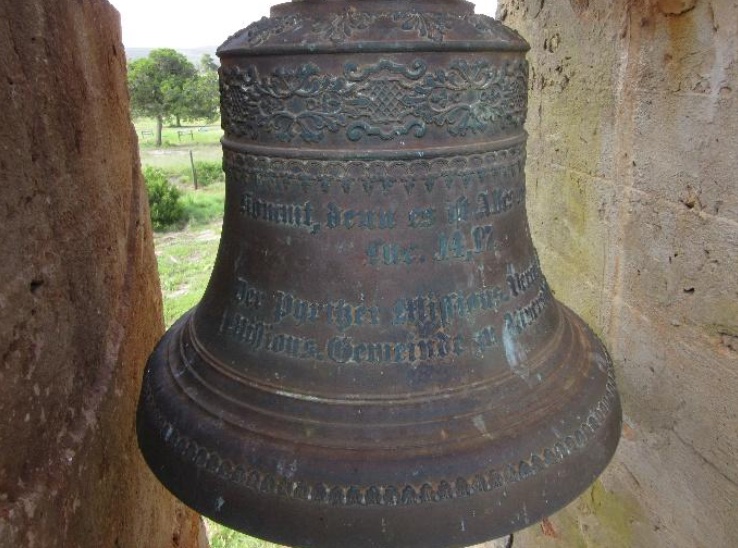
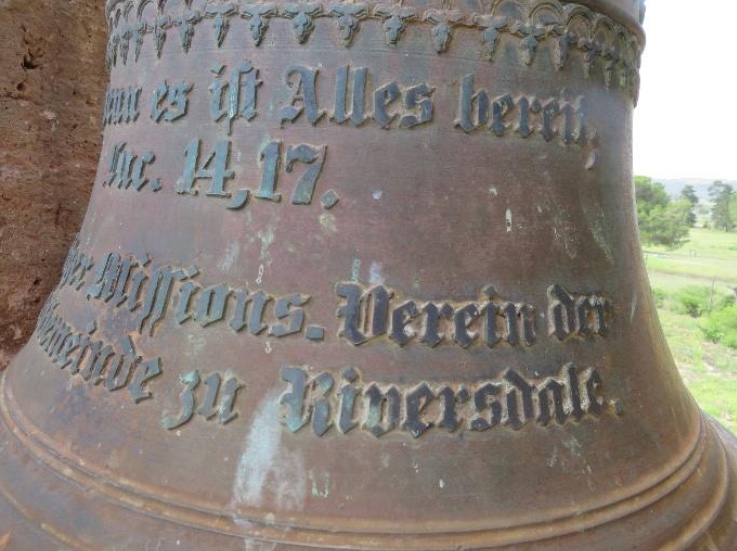
On the reverse waist stands an important text that illustrates the dedication of the bell and its origin:
Kommt, denn es ist Alles bereit,
Luc. 14, 17.
Der Pyritzer Missions. Verein der
Missions. Gemeinde zu Riversdale.
Below that we find the same decorations as on the bell from Amalienstein.
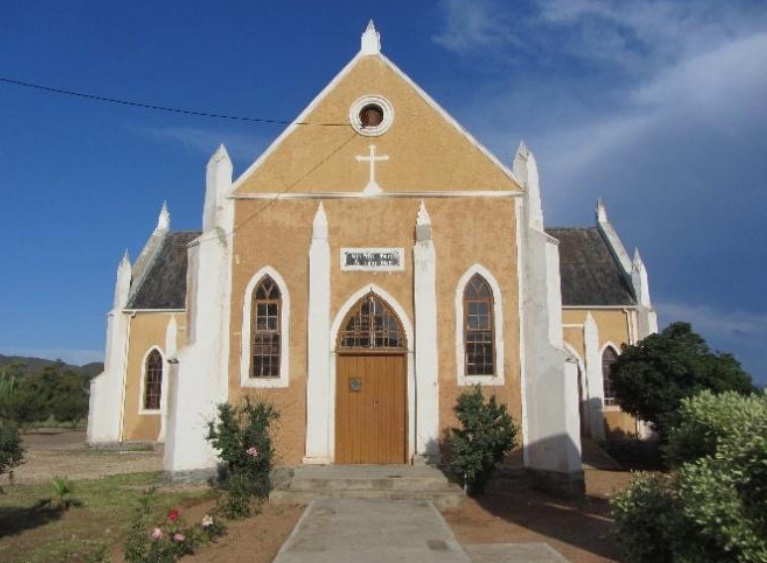
6. 1873. Ladismith, Lutheran Church
The church in Ladismith is a very neat building with a bell tower that, according to information from the Jahresberichte, acquired a bell in 1882.
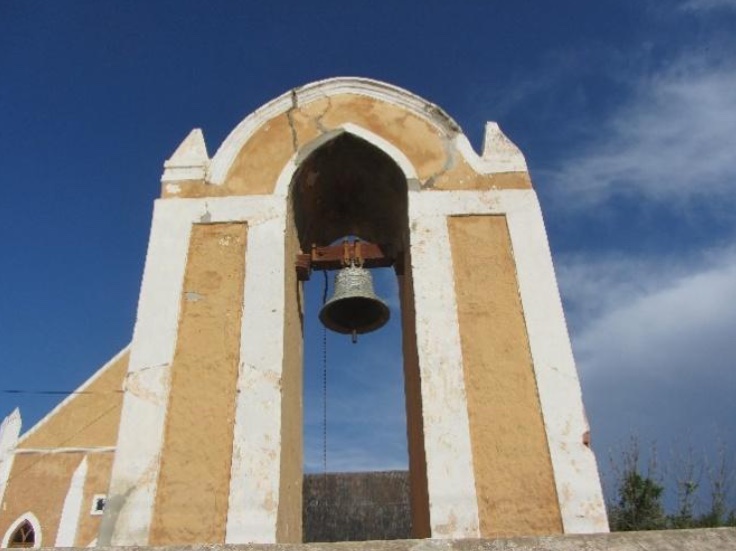
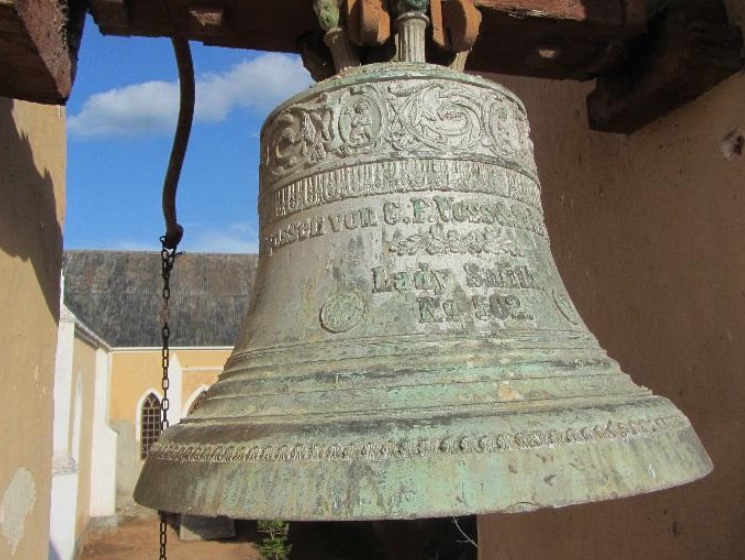
Below a decorative band with flowers and effigees of St John the Baptist as a child with a lamb, there is a text which reads as follows:
Gegossen von C.F. Voss & Sohn in Stettin
(palm decoration)
Lady Smith.
No 502.
To the left of the word Lady Smith sits a copy of a prize medal that the company won in Stettin in 1889. On the right is an effigee of Friedrich Wilhelm Kronprins von Preussen. The text is followed by another set of moulding wires and a decorative band on the knee.
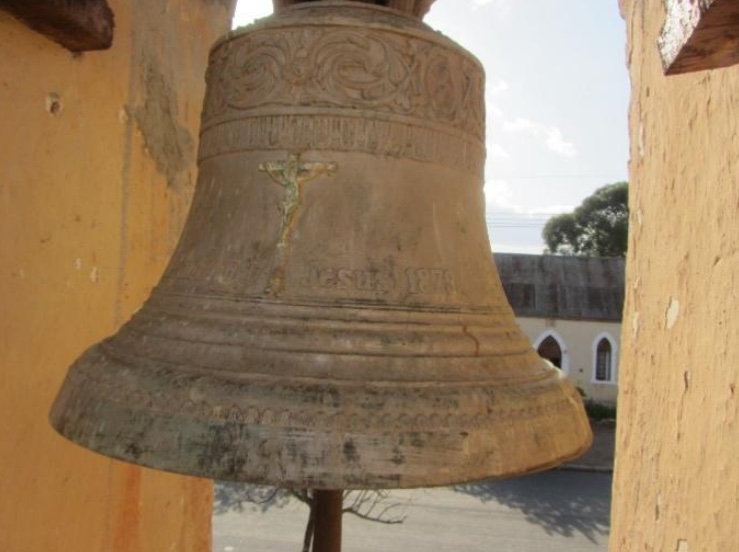
On the reverse side appears a figure of Jesus on the cross followed by the inscription
Komt tot Jezus! 1873
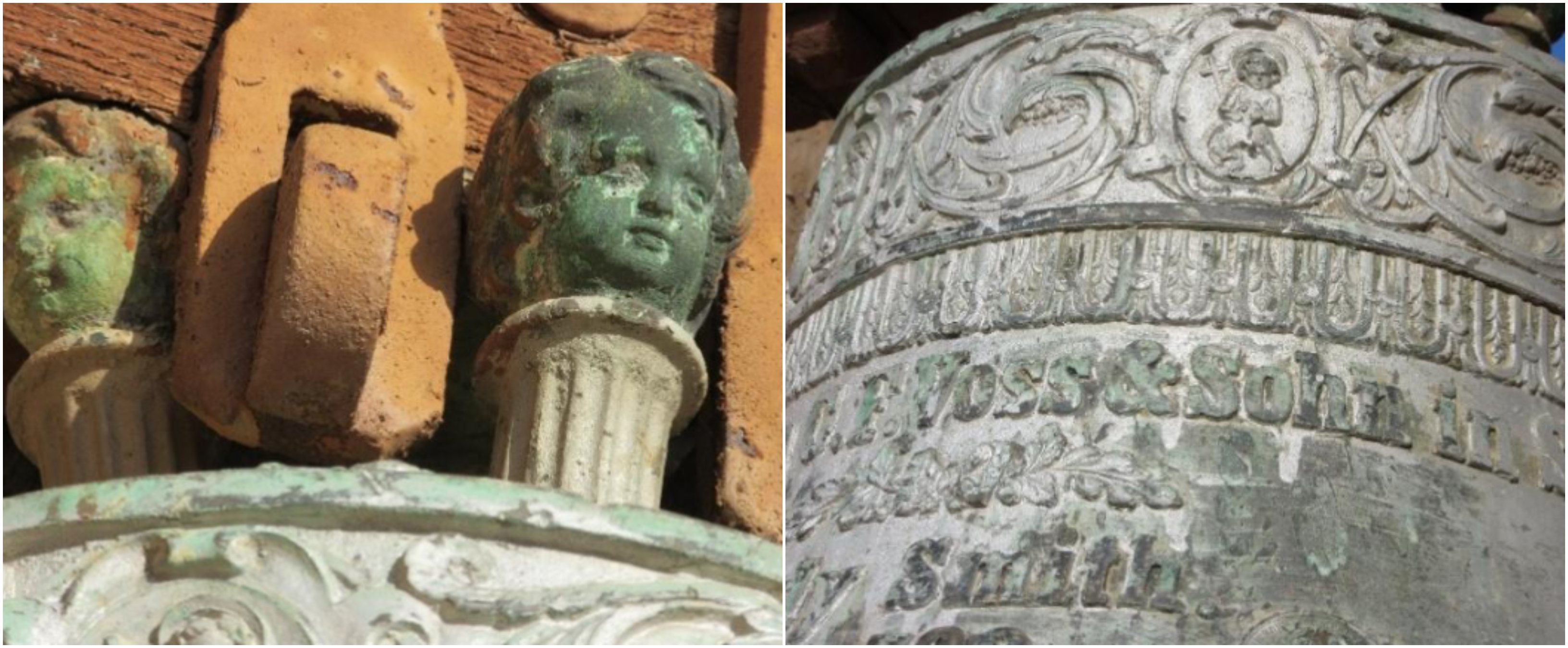
The canon of the bell reminds us of that in Amalienstein. However, the six angel heads are slightly more elaborate, even when they have been painted green. Also, the decorative band on the crown is fancier than on the other bell. A remarkable feature on the bell is the reference to Ladismith which indicates that the bell has been specially made for this church.
7. 1875. Herbertsdale, Lutheran Church
Mission work in Herbertsdale already started in 1863 by the South African Missionary Society but the station was taken over by the BMG in 1872. Later on, the mission was taken over by the Lutheran church. On the rear end of the church stands a tower which is surmounted by a niche in which a historical bell is hanging.
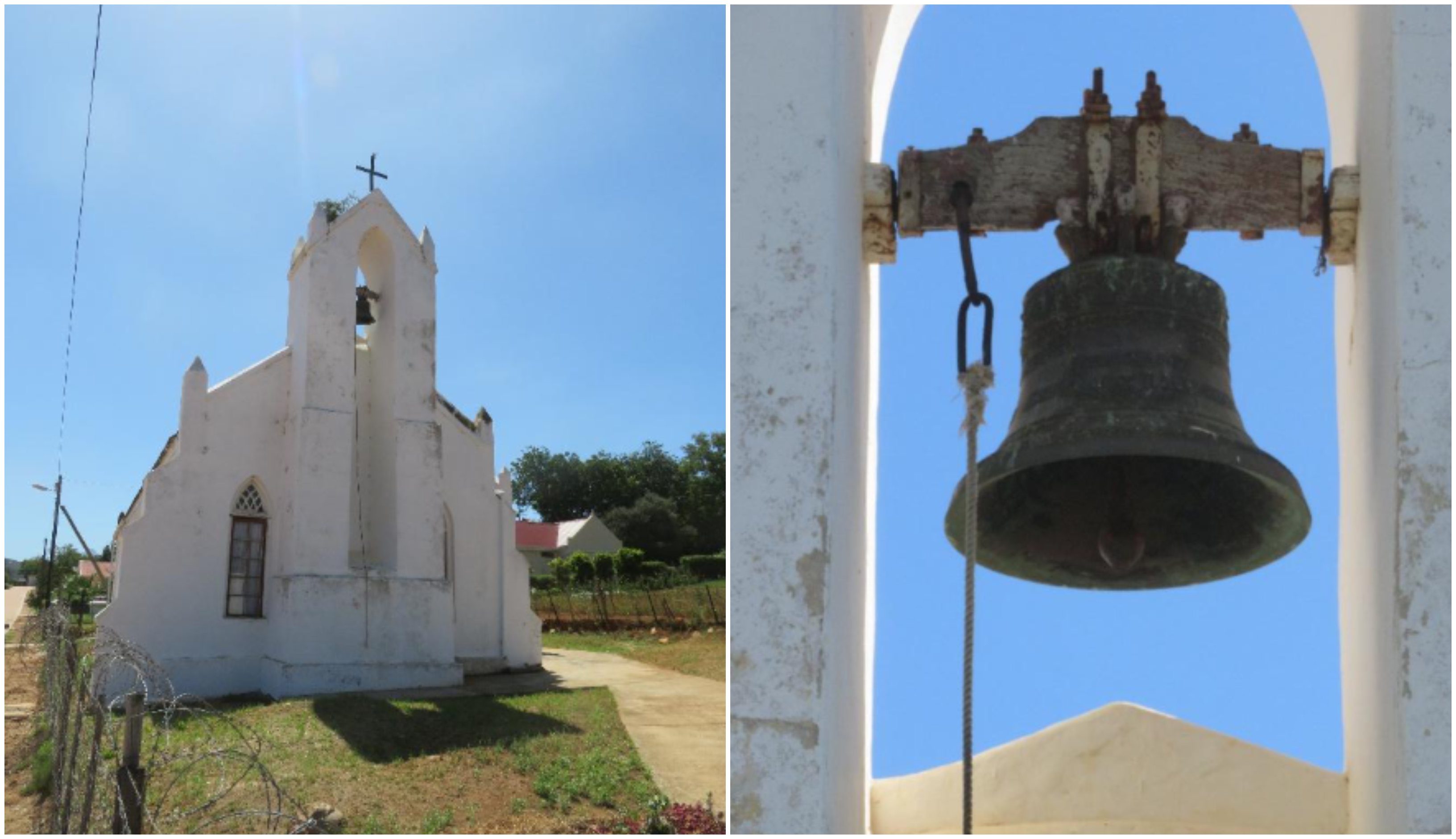
The canon of the bell consists of six angel heads. Below the crown is a broad decorative band. Below it is a moulding ring and a band of drops pointing downwards. There is a text on both sides of the bell but only one side can be seen from the ground level. Thanks to the help of the custodian we have been able to reconstruct the entire text. On the top line is written:
Gabe von Christen in Pyritz an die Gemeinde zu Herbersdale.
Then follows a decoration with floral motifs. The second line mentions on one side
Gegossen von C.F.Voss & Sohn in Stettin in 1875
No. 608
and on the other side
Lucae 14 v 17.
Kommt, denn es ist Alles bereit
This is again followed by a decoration with palms.
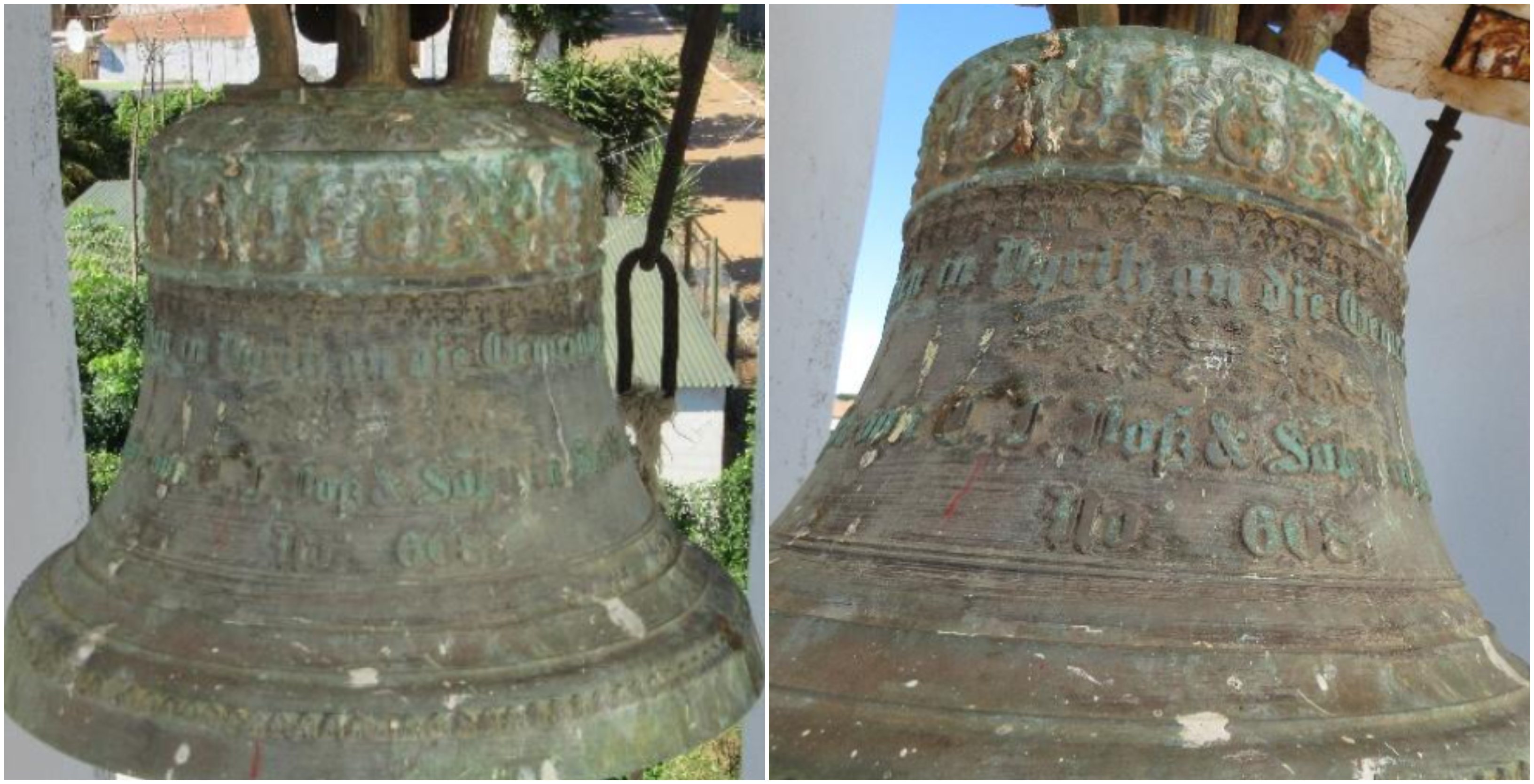
Above the sound bow are again four moulding wires with the top two close together. Below that we find a decorative freeze made up of leaf like figures, pointing upwards.
8. 1880. Mossel Bay, Lutheran Church
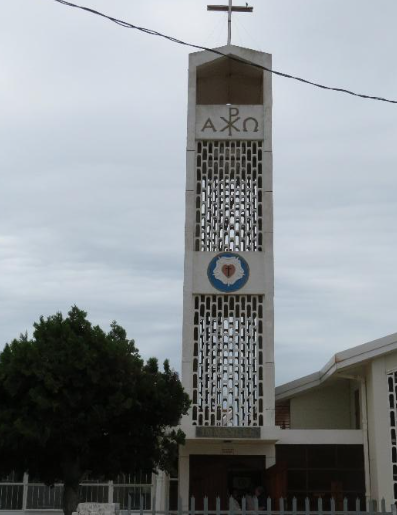
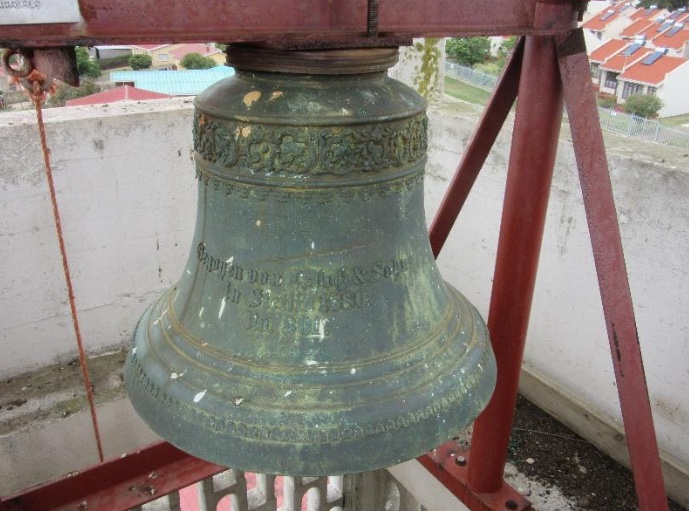
The Evangelical Lutheran Church in Mossel Bay originated as a mission of the BMG and was established in 1879. Soon after its installation the location built a church and a tower in which a bell was hanging. The mission was transferred to the Evangelical-Lutheran Church that replaced the older church by the current new one whose founding stone was laid on 9 April 1967. The church Immanuel has a light tower that is constructed with open bricks. On the top layer of the tower hangs a bell.
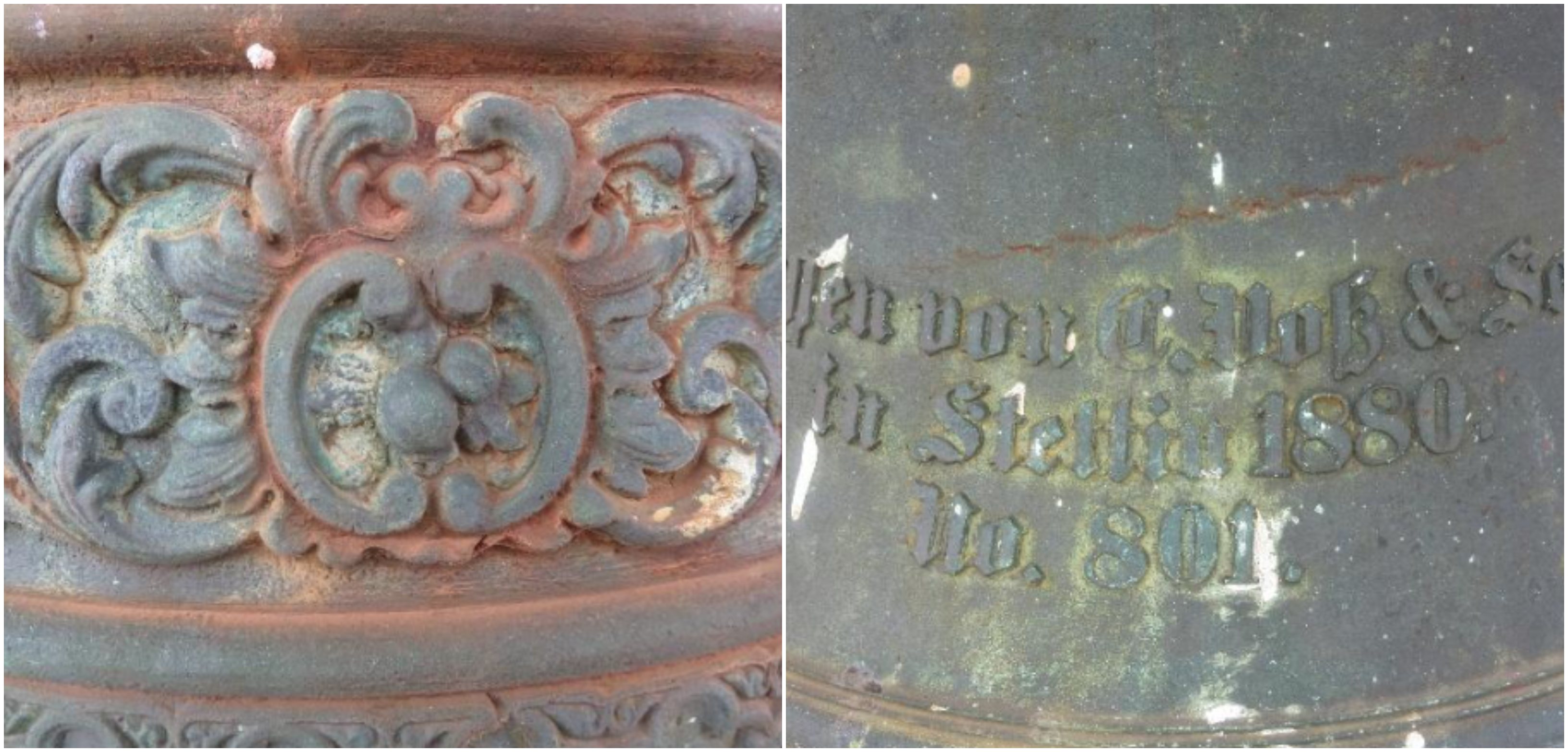
On the shoulder in between two moulding wires figures a band of flowers that are surrounded by branches. Underneath is a small freeze with drops pointing downwards. On one waist of the bell stands the following text:
Lobet den Herrn alle Heiden,
Preiset ihn alle Völker.
On the reverse side stands a reference to the foundry
Gegossen von C. Voss & Sohn
in Stettin 1880
No. 801.
Above the sound bow are four moulding wires, the top two close together. On the lip one finds a decorative freeze made up of leaf like figures, pointing upwards.
The bell has been hanging outside in the open air in a region near the ocean. It is therefore not surprising that the bell has severely suffered from corrosion. In 2017 it was decided to remove the crown of the bell that probably was constituted of angel heads. However, the crown was rusted and it became dangerous to use the bell. The bell now hangs without a crown, hopefully for years to come.
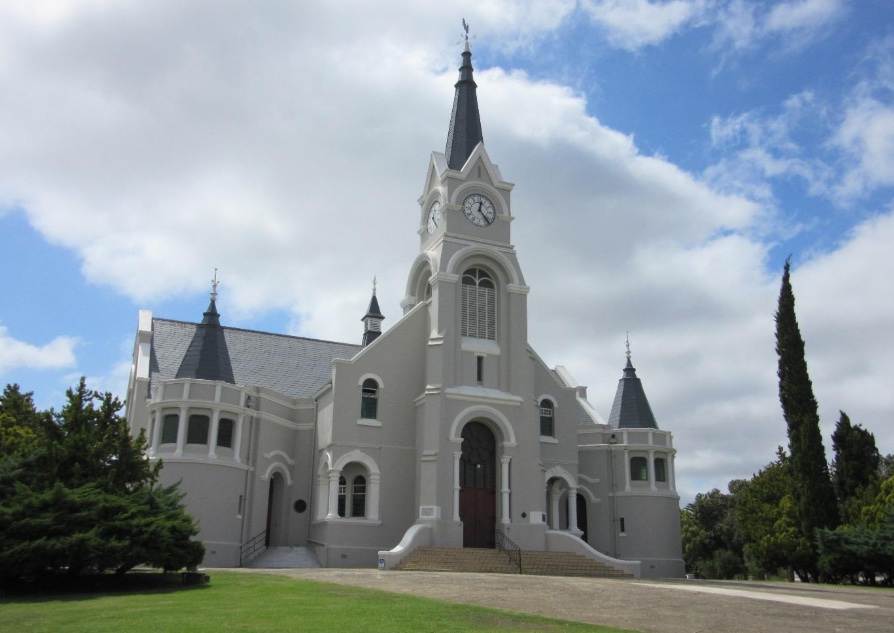
9. 1880. Heidelberg, Nederduits Gereformeede Kerk
The Nederduits Gereformeerde Kerk in Heidelberg is the only non-ex-BMG station in Eden having a Voss bell. Nevertheless, the bell was obtained with the help of Heese, the missionary at the nearby Riversdale BMG station.
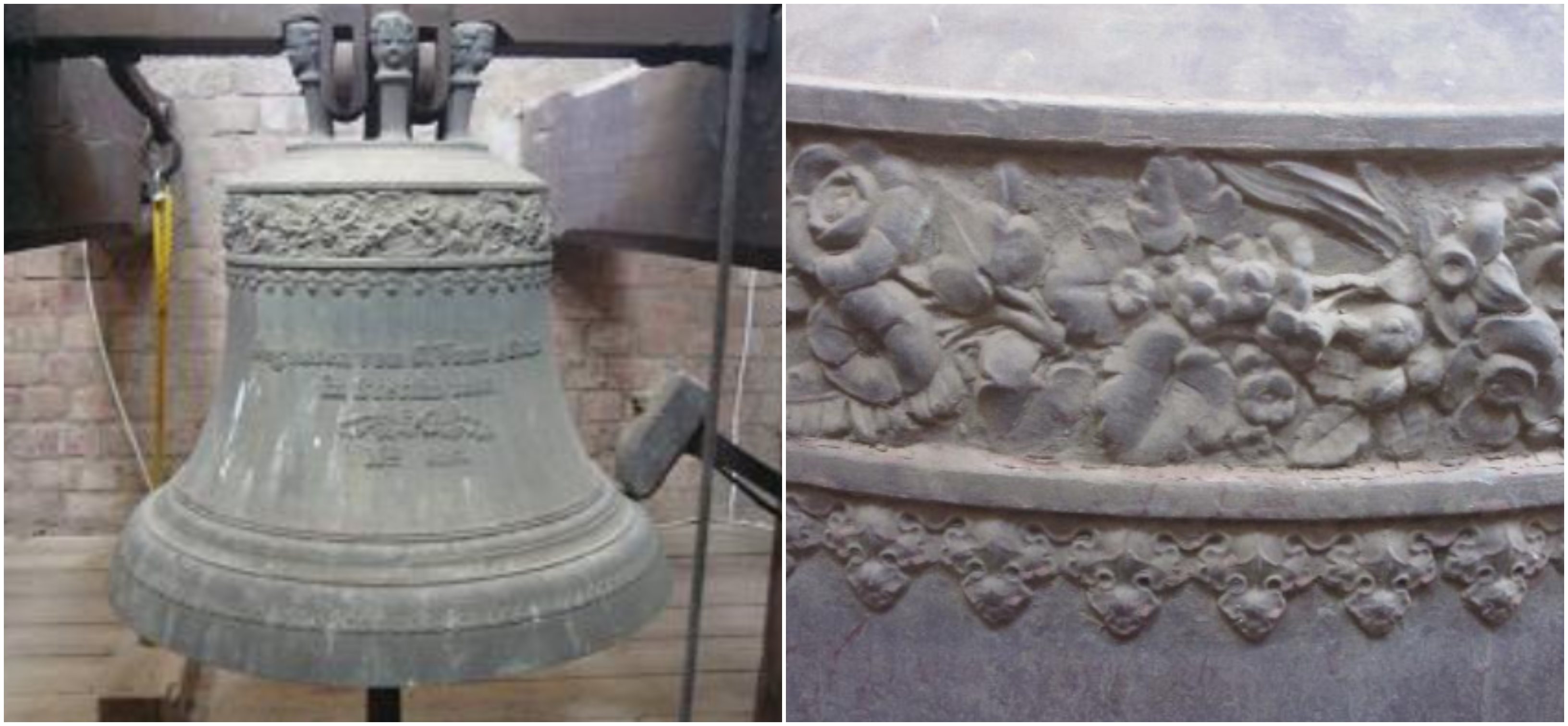
The remarkable building houses a beautiful and historic bell. The canons consist of six angels, similar to the canons of the other bells above. Below the shoulder is a wide band of laurels. Underneath this frame another narrow laurel band, followed by the inscription on the front side
Gegossen von C. Voss & Sohn
In Stettin 1880.
No 806.
In between the date and the numbering figures another laurel. Five more moulding wires and a small laurel belt are found on the sound bow.
The other side of the bell carries a text in Dutch, the language used by the church:
De Nederduitsch - Gereformeerde
Gemeente te Heidelberg
Het Woord des Heeren blyft in der Eeuwigheid.
Petr. 1. v. 25
In the 150-year anniversary book the following references are made on pages 43 and 44. On page 43 it is mentioned that J.D. Beyers of Klapmuts gave a bell that originated from the Stellenbosch Moederkerk. On page 44 one reads that Reverend D. Heese of the BMG in Riversdale took contact with Germany to find a bell with a fitting tone. The bell foundry Voss & Sons from Stettin was asked to found the bell and to send it to Heidelberg by freight for the cost of £30.
The bell was installed in an open frame on the right hand side of the C.O. Hager church. Later in 1913 the bell was transported from the frame into the tower. At the same time a clock was installed. The clock has been manufactured by A. Fischer from Port Elizabeth.
10. 1881. Kerkplaas, Lutheran Church
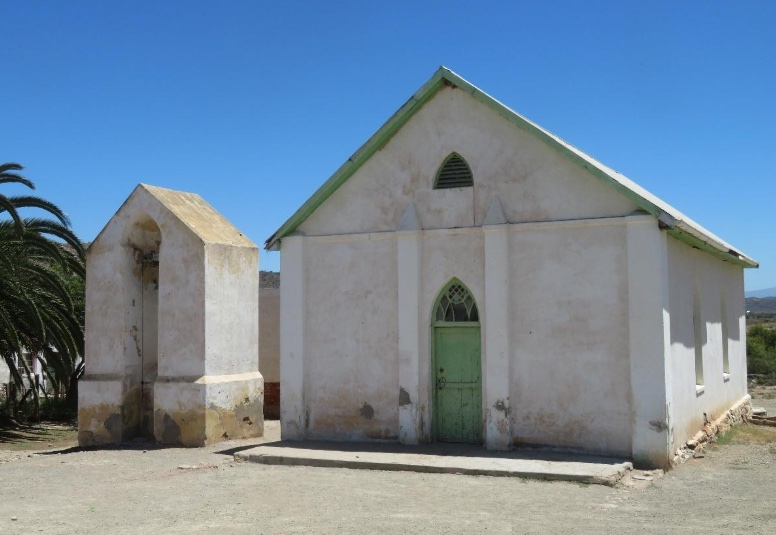
The church of Kerkplaas used to be a mission church belonging to the BMG. We have been able to get useful information on this fourth outstation of the mission in Laingsburg. The station was originally called Grootrivier but later changed its name to Kerkplaas.
The outstation in Grootrivier saw its church inaugurated in 1880. The pastor Johann Prozesky had a good relationship with the local farmers. He succeeded not only to build the new church, but also to receive a harmonium, a bell and outfits for the altar. The bell was installed in 1882 under Jac Magalie in a 19 feet high bell tower. The horseshoe tower is in a questionable condition, given it has to carry the weight of the magnificent and heavy bell. As in the other churches, the canon of the bell consists of six carefully carved angel heads. Below the crown is a broad decorative band filled with garlands, different types of angel heads and effigies of St John the Baptist as a child and with a lamb. Below it figures a moulding ring and a band of drops pointing downwards.
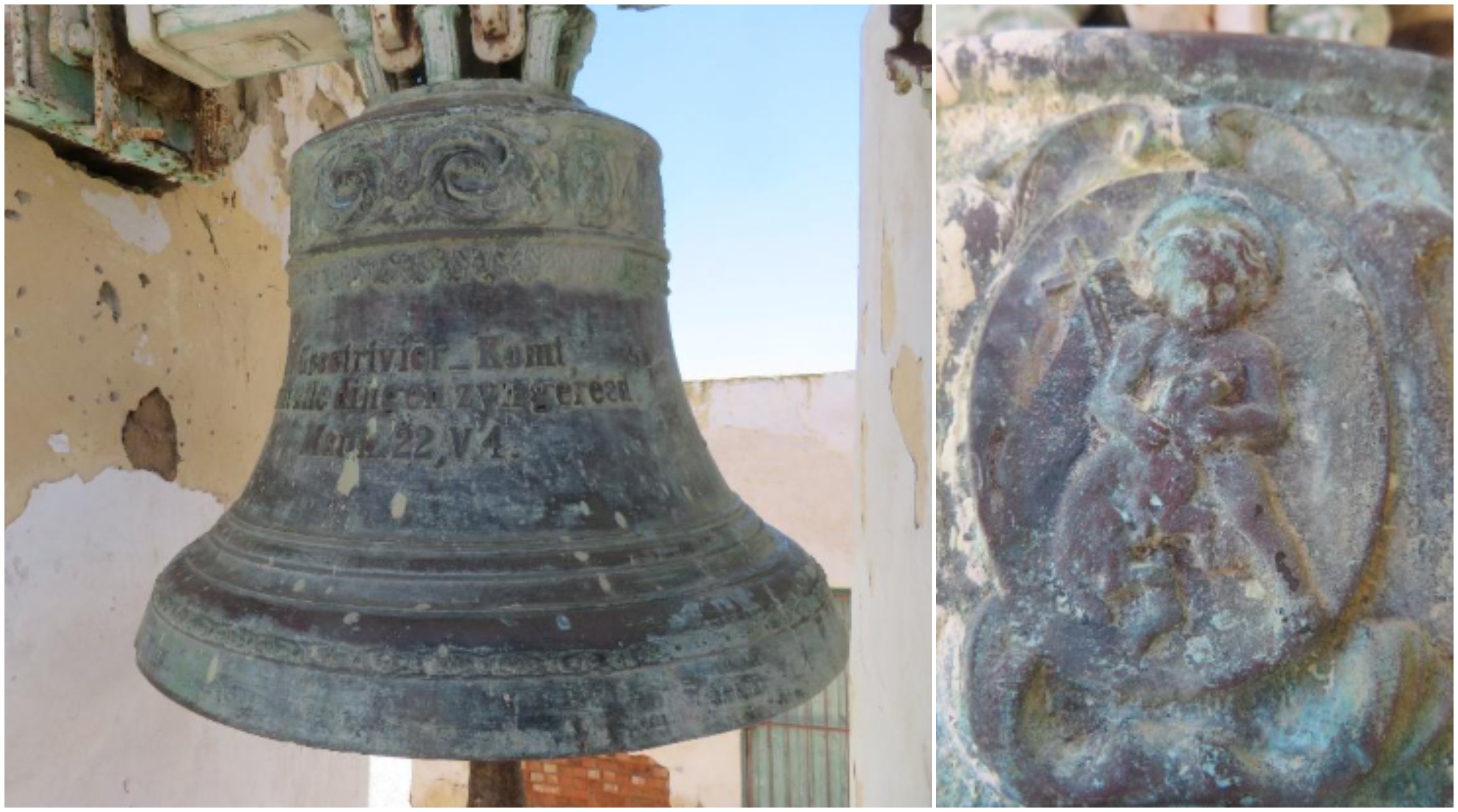
On one side of the bell, one reads a text over five lines:
Gegossen
von
C.F. Voss & Sohn
in Stettin 1881
No. 843.
Like the bell in Heidelberg, also the bell of Kerkplaas has a Dutch side where one can read:
Grootrivier – Komt
want alle dingen zyn gereed
Matth. 22, V. 4.
Was Dutch chosen at the time of the ordering of the bell to please the local farmers? Above the sound bow are four moulding wires, the top two close together. On the lip one finds a decorative freeze made up of leaf like figures, pointing upwards. It remains remarkable how this large bell ended up in such a remote location.
11. Technical Data
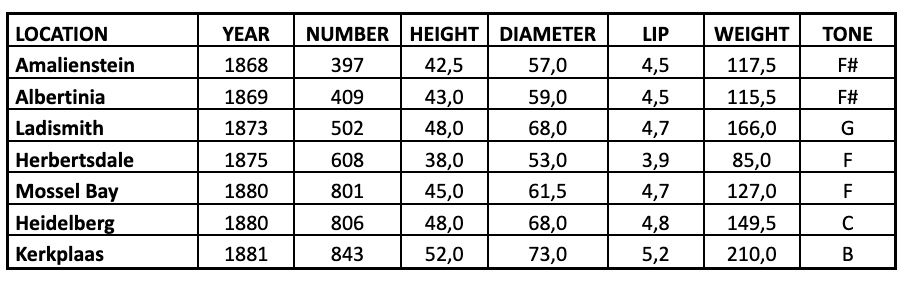
The data above give the most essential information on the bells. The second column gives the founding year of the bell. This appears on all of the Voss bells. The next column gives the production number as it appears on the bells. This number can also be found in the list of Voss bells. The latter list contains the weights of the bells and we included them in the last but one column. The height of a bell is the distance from the lip of the bell to the corner below the crown. The diameter is measured at the lip. Thickness is measured in centimeter on the place where the clapper hits te bell. These measures are characteristic for a bell and have a direct connection with its tone. The latter has been included in the last column.
12. Closing Remarks
12.1 Other Voss Bells in South Africa
In the order book of Voss bells, 14 bells are listed for South Africa while 32 are listed for Africa. However, three bells listed for Africa, are in South Africa:
- bell number 307, listed for Bethel in Africa; Bethel is a previous BMG mission station in the Eastern Cape; the bell is now on display at the Stutterheim Museum,
- bell 413, hanging at the Adamshoop Lutheran Church in the Free State, and
- bell 843 at Kerkplaas.
Of the 14 bells listed for South Africa, 6 are discussed in this paper. We have knowledge of one further bell in South Africa, viz., bell 582 (weight 65 kg.), hanging at the Lutheran Church in Bloemfontein.
Therefore, there are still 7 bells listed for South Africa which we have not been able to trace. These are:
- bell number 327, cast in the period 1863 – 1867,
- bell number 892, listed for Wartburg, Süd-Afrika, cast in approximately 1883. This could either refer to Wartburg in Kwazulu-Natal or the BMG mission station called Wartburg in the Eastern-Cape near Stutterheim; this station was founded in 1843 as Possel’s or Posselt’s, burnt down in 1845, rebuilt in 1855 and named Wartburg. Enquiries at the Lutheran churches in Wartburg, Kwazulu-Natal produced no information on a possible Voss bell while, to date, no information could be obtained about a possible Voss bell at the Eastern-Cape Wartburg,
- bell numbers 913 – 915, cast in the period 1883 – 1884, and
bell numbers 1599 – 1600, cast in the period 1898 – 1903.
Given that the bells at Bethel, Kerkplaas and Adamshoop were listed with Africa as destination, it might well be that more of the bells listed for Africa could have been for South Africa.
12.2 Pyritz Link
Interestingly, two of the Voss bells were gifts from the Christians in Pyritz, a town in Pomerania, north-western Poland (Pyrzyce in Polish), previously part of Prussia and later of a unified Germany. These two bells are in Albertinia, originally housed in Riversdale (bell dated 1869) and Herbertsdale (bell dated 1875), and have the inscriptions
- Der Pyritzer Missions. Verein der Missions. Gemeinde zu Riversdale and
- Gabe von Christen in Pyritz an die Gemeinde zu Herbersdale.
The reason for these gifts seems to be the missionary Daniel Friedrich Siegfried Heese. Heese was the first missionary of Riversdale, from 1868 to 1905 and missionary of Herbertsdale in 1872, the year it started. Not only were he and his father born in Lessenthin (Lesięcin in Polish), Pomerania, close to Pyritz, but he was also trained as a teacher at the Ottostift in Pyritz and married a girl, Emma Pauline Kindermann, from Pyritz.
Therefore, due to his deep and long-standing connections to the Pyritz area, Heese could very well have been the link to the Pyritz Christians.
12.3 Further Research
This report forms part of an ongoing research project. The authors have been doing research on bells in the Western-Cape Province in South Africa since 2008. Our approach is to locate and then visit bells, measure and analyse their physical and acoustic properties and photograph them as well as the location where they are housed. We try to find as much information as possible about the bells, their history and about the location where or wherein they are housed.
The information is inventorised and stored in a database as part of the Stellenbosch University digital database (click here to view).
As new information becomes available, the information is loaded onto the database.
The database has been used as a basis of information to write academic and popular papers on specific topics related to bells. Further papers are in progress.
Although, for practical reasons, we currently restrict our research to the Western-Cape, we see bells as part of South Africa’s, often forgotten and often vulnerable, heritage, and would welcome and gladly support similar actions elsewhere in the country.
13.Acknowledgement
During our research on bells at Lutheran Churches and Berlin Mission Society stations, many Lutheran pastors have assisted us with information. We acknowledge in particular the assistance of Pastors Jacques Grispe (Riversdale), Newton Brandt (retired) and Earl Frans (retired). The authors also want to thank Stanley Kiewit for his assistance with obtaining good pictures of the bell at the Herbertsdale Lutheran Church.