
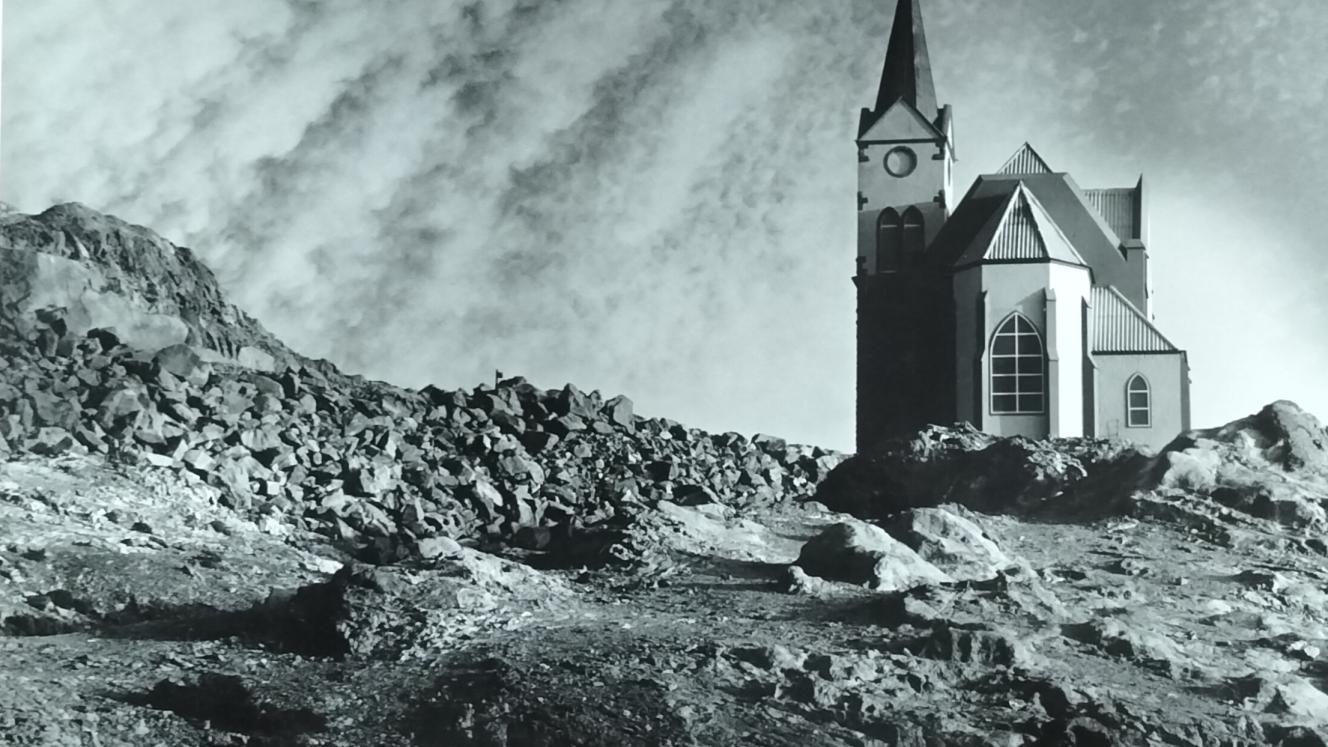
The concept found photographs has become an accepted term amongst local photo historians and genealogists alike.
Found photographs encompass lost, unwanted, discarded, or unclaimed images in the form of both professional and amateur photographs (snapshots), as well as vintage prints, typically sourced from flea markets, charity stores, auctions, car boot sales or even recycling depots.
Today accepted as historical artifacts, these discarded nostalgic art objects are often used by researchers and historians to reconstruct a variety of historical narratives.
They represent a form of photographic archaeology, shifting the focus from the original, often unknown creator to the new curator's interpretation of the image's mystery, emotion, or aesthetic value.
The category of found photographs primarily under discussion in this article are those of relinquished photo salon or photo competition entries, mainly by amateur photographers.
Due to their size, salon entry photographs seem to be less likely to be destroyed compared to the omnipresent black and white snapshots. It would either be the photographer or family members, or even photographic clubs, that discarded these earlier proud salon submissions.
In tandem, this blended article not only presents some of these fairly contemporary found salon entry photographs (from 1950 to 2000), but also briefly reflects on the history of photographic clubs in South Africa as well as pre-1905 photo exhibitions, often combined with art exhibitions.
The article therefore subtly explores the historical influence of South African photographic exhibitions on modern salon entries.
Many of these larger format photographs, neatly mounted on hard board, contain the entrants details and potentially the competition’s details on the back.
The latter became a criteria for inclusion in this article – without the information on the back, the photograph contains little provenance as it relates to photographic salon entries.
What makes these salon entries even more significant is that the results or judges’ ratings are recorded on the back of the photograph.
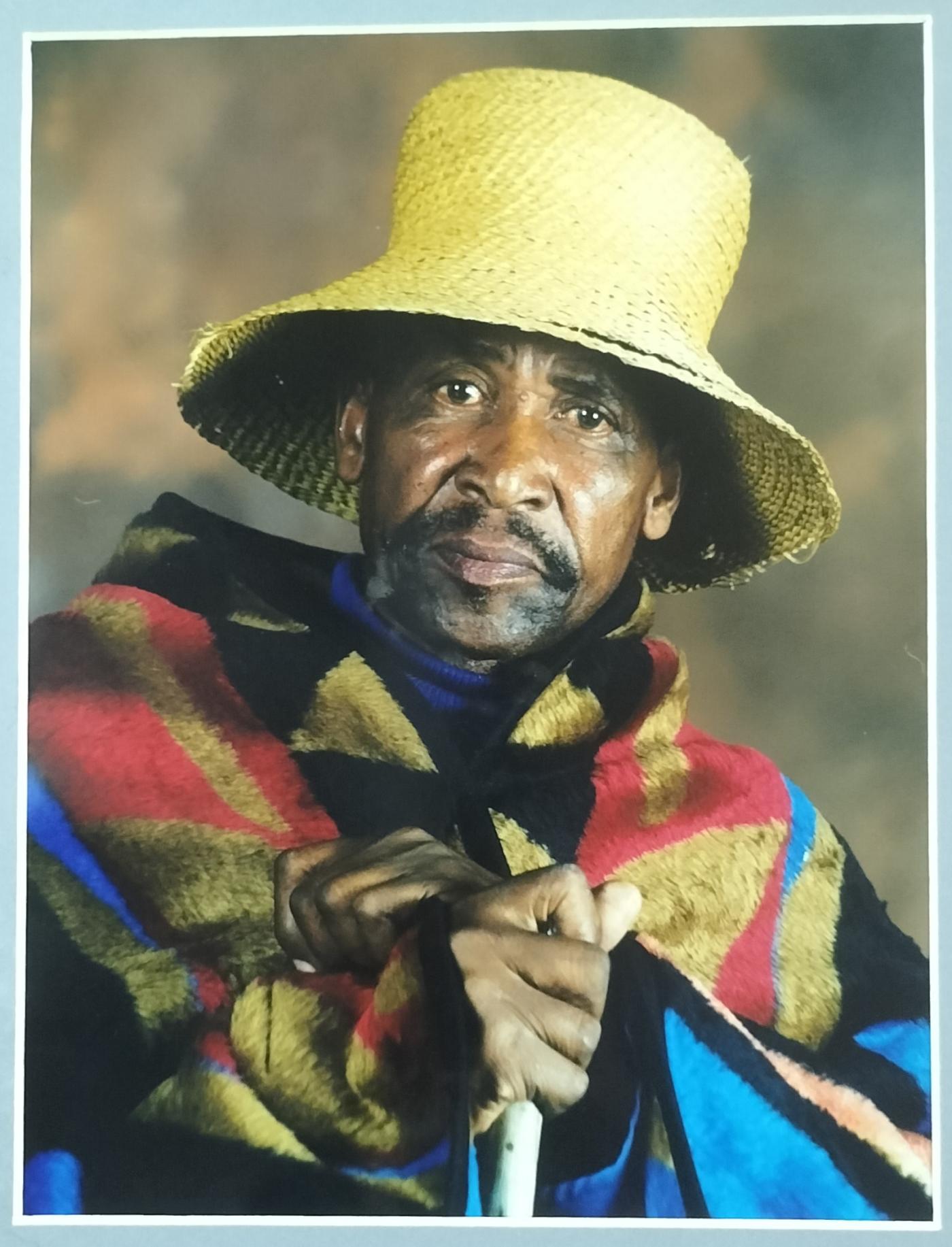
“Madala” by Nelson Lopes first exhibited at the F-Stop National Print Salon in 2002 where he was awarded a score of 12. The photograph was subsequently entered into the 2003 Benoni Salon and the 2003 Southern Suburbs Camera Club 3rd National Print Salon where it was awarded a score of 12 and 9 respectively.
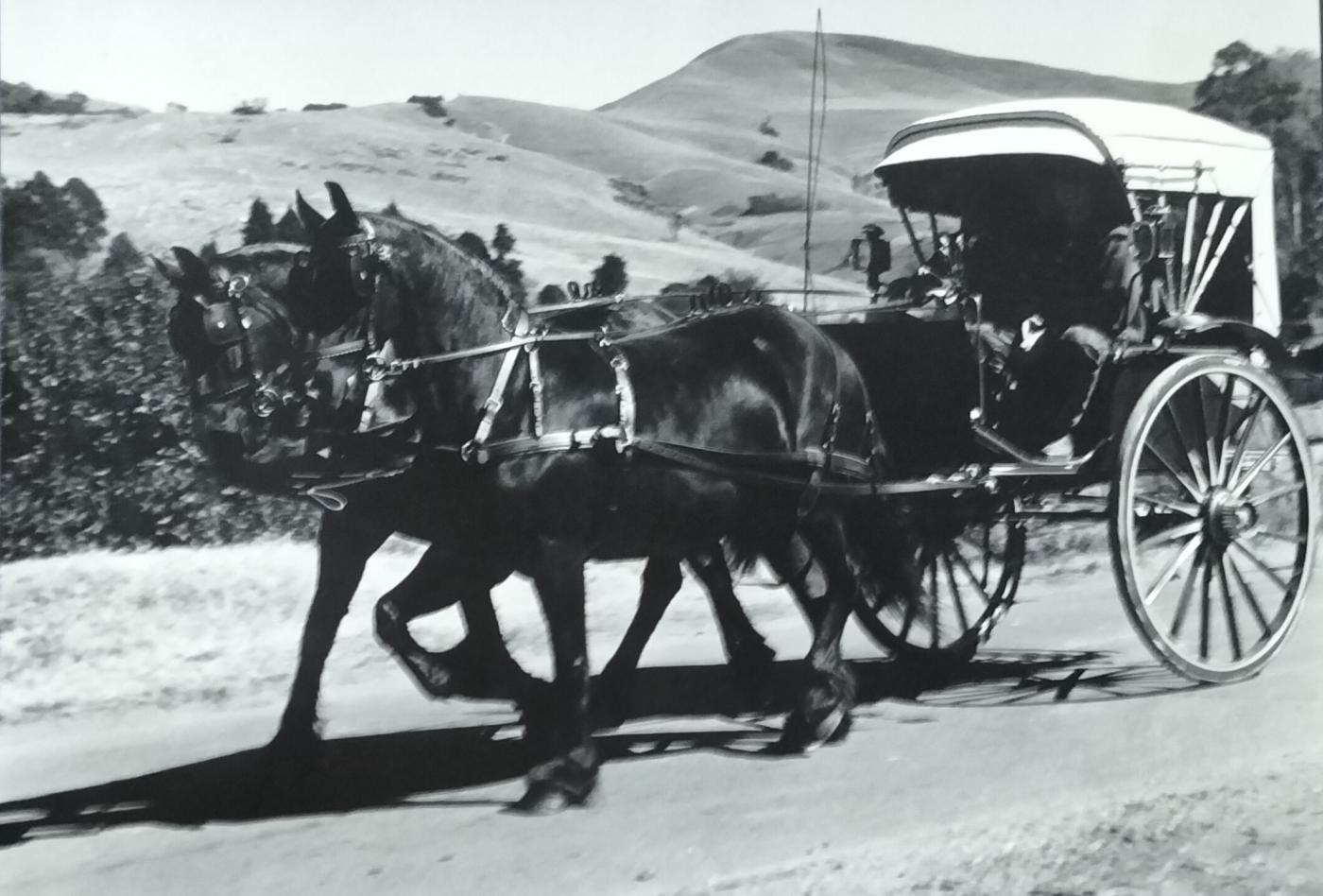
“Huis Toe” by Randall Stewart (1989) with 2* rating. Back of print without any score allocation from this exhibition.
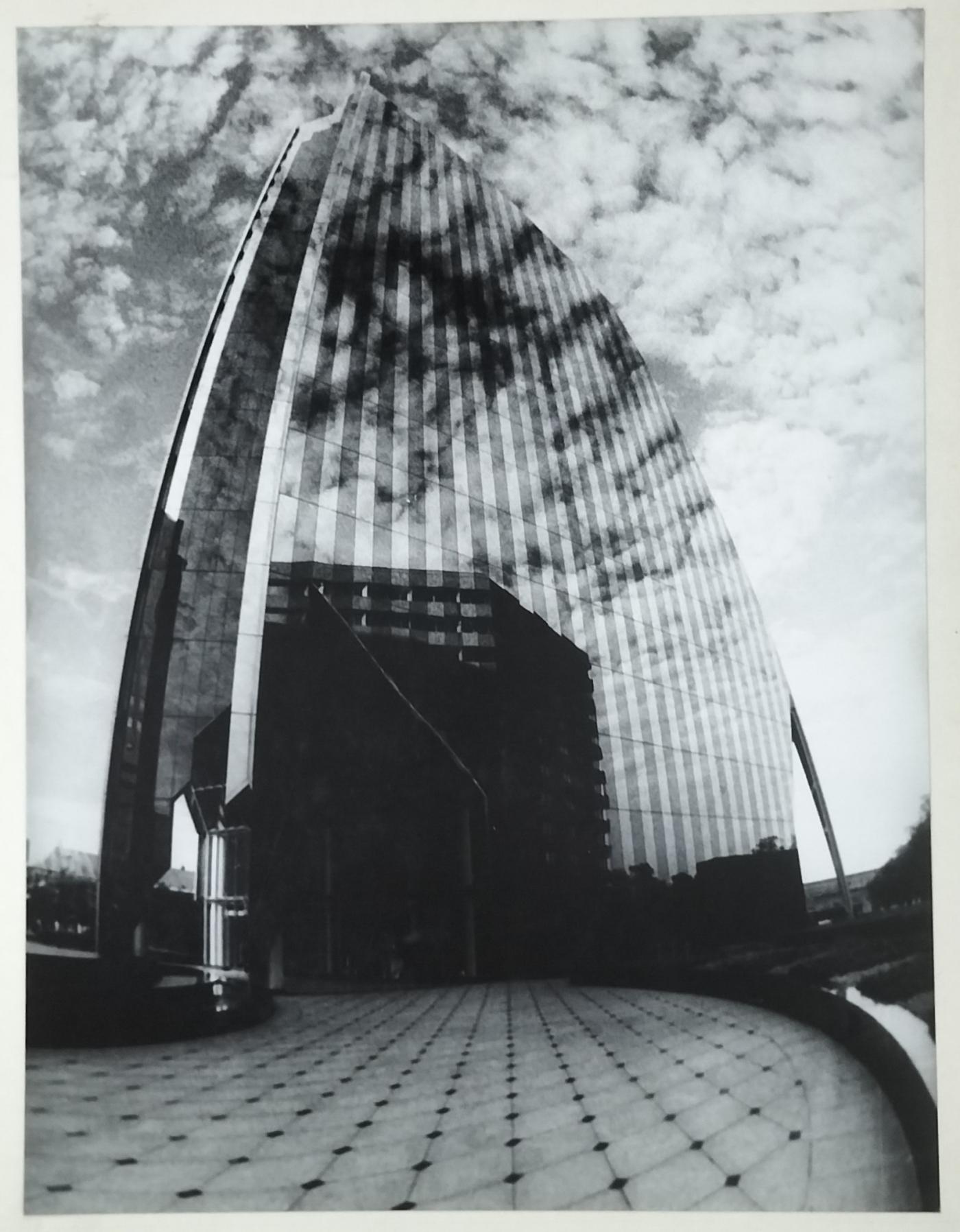
“11 Diagonal Street” by Randall Stewart (1990). Exhibited during the 1990 F.C.C./S.S.C.C. interclub competition. Back of print without any score allocation from this exhibition.
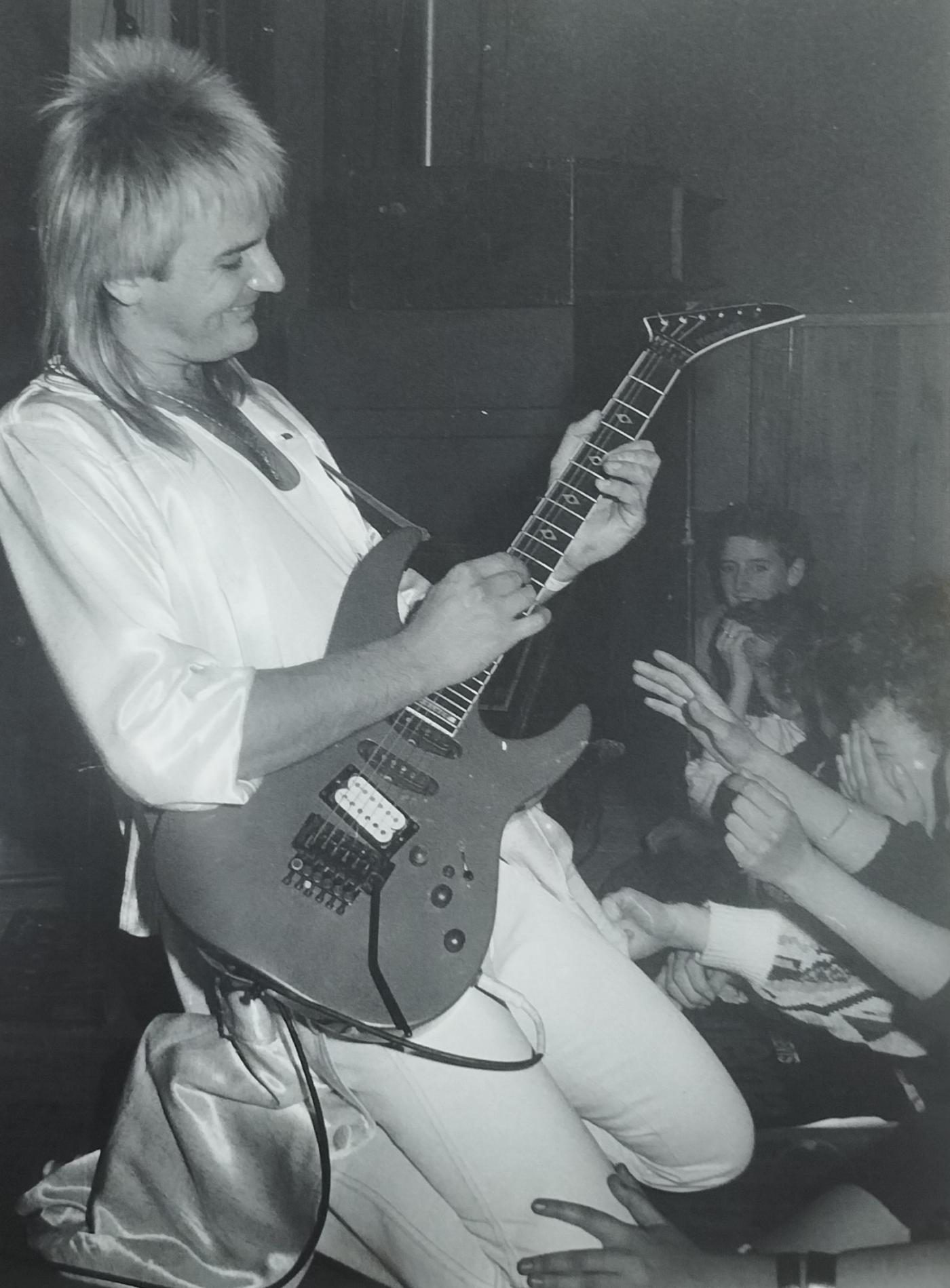
“Mike’s Glory” by Randall Stewart (1989) from Southern Suburbs Camera Club with 2* rating. This image was first exhibited at the 1990 F.C.C./S.S.C.C. interclub competition where photograph was allocated best beginners and best portrait award. Also exhibited in the special section at the 1991 West Rand Salon where Stewart was awarded a score of 10.
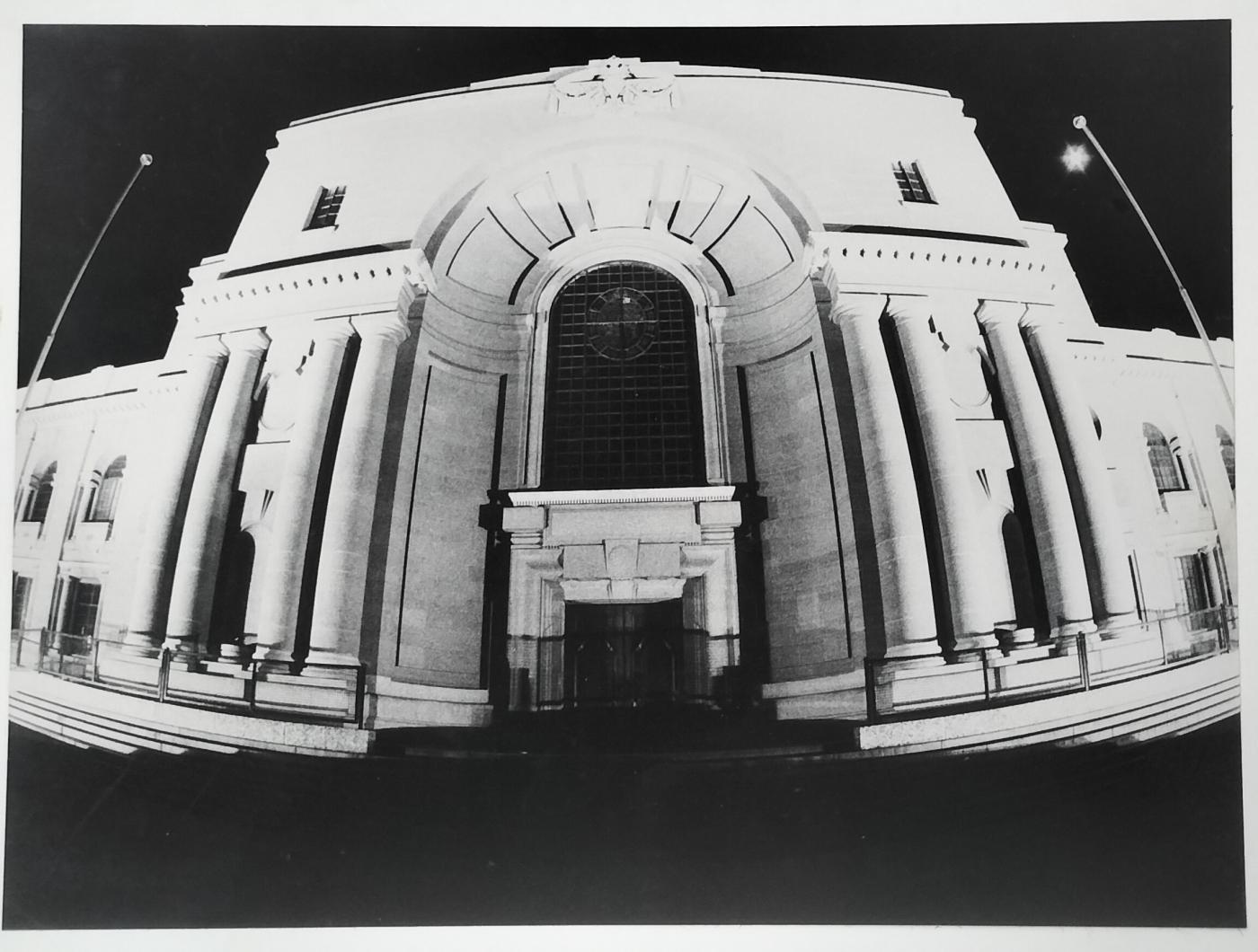
“House of Law” by Randall Stewart (1990) with 3* rating. Back of print without any score allocation from this exhibition.
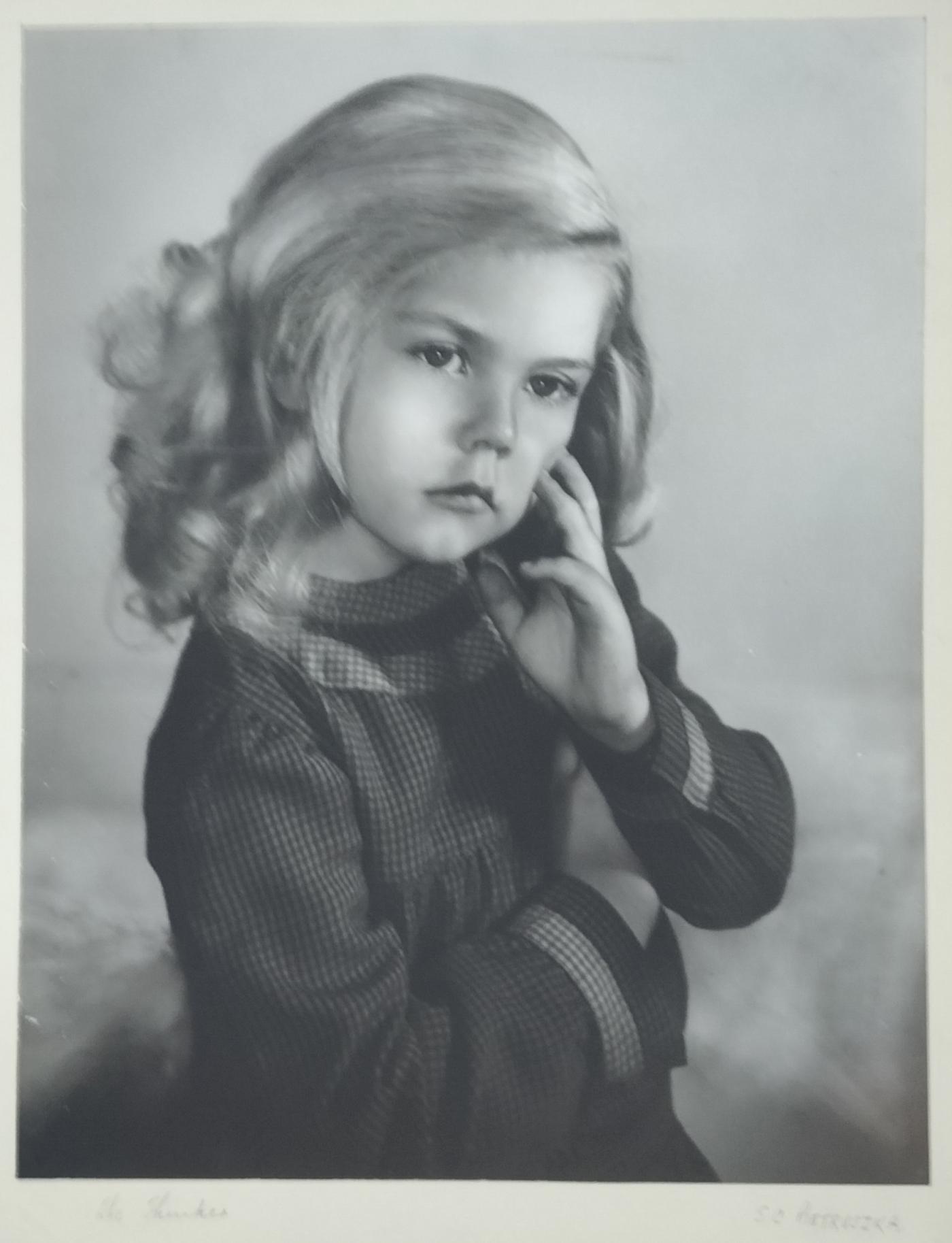
"The Thinker” by SC Pietruszka. This bromide print was entered into the first Pretoria National Salon of Photography in 1953.
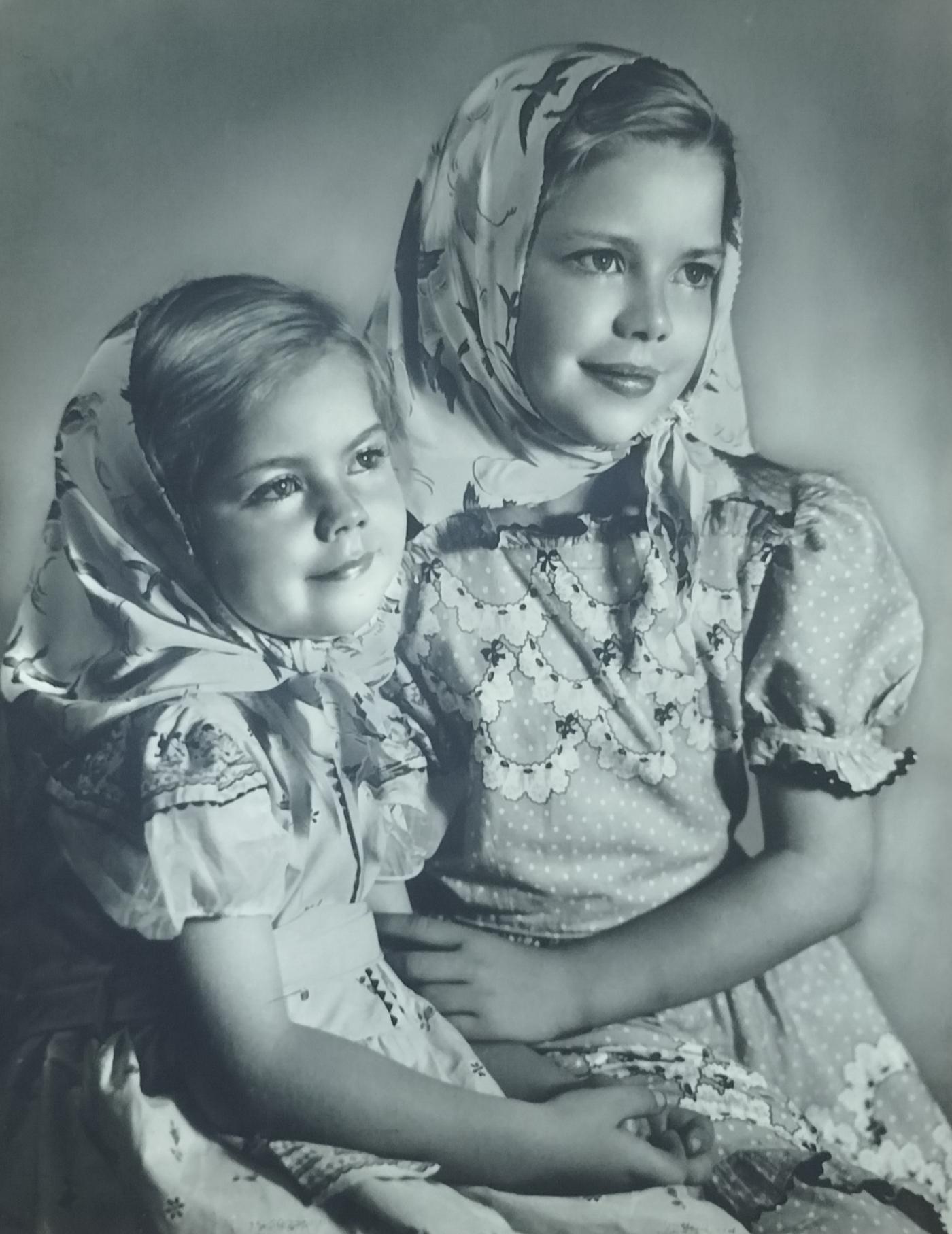
“Sisters” by SC Pietruszka. This bromide print was entered into 3 international competitions, namely Cuba/Habana (1952 - where a gold award seems to have been awarded); Mozambique (1954) and London Amateur Photographer Annual Overseas Competition (1950 - Silver plaque awarded).

“Maestro”, renamed from “The Master” bromide print by SC Pietruszka. This image was entered into two overseas competitions, namely, “Amateur Photographer” Annual Overseas Competition (awarded a certificate of merit – 1951), Cuba/Habana (1952) and Mozambique Salon (1954), as well as two local salons, namely The First Pretoria National Salon (1953) and The Johannesburg Photographic and Cine Society where he seems to have been allocated a score of 14.

“Beata” by SC Pietruszka. This bromide print was exhibited at the London Salon in 1950 and Warsaw in 1957. This same image was also accepted into the Port Elizabeth Diamond Jubilee Salon. At which salon the B+ rating captured in red on the back of the photograph was awarded is unknown.
Photographic Salons
Never having entered a photographic competition myself, I approach this article with caution in that first I had to determine whether there is a difference between photographic competition and photographic salon entries.
The term salon originates from 17th-century France, where artistic academies organised official exhibitions ("salons") for artists to display their work and receive critique and recognition. Today, the term is primarily used within organised amateur photography circles, distinguishing it from commercial competitions.
In reality, there is no difference - a photographic salon is a type of photographic competition or exhibition.
A salon is a type of photographic competition where photographers submit their best images to be judged and critiqued by experts in the field.
Unlike commercial competitions, photo salons are usually patronised by photographic bodies and tend to be more for prestige and recognition rather than for prize gains.
There are a multitude of salons and exhibitions worldwide where entering them can bring awards and distinctions.
Photographers are invited to submit their images in various categories for possible inclusion in the salon exhibition. A panel of judges scores all the submitted images and choose approximately 20% for exhibition.
Acceptances and awards (certificates of merit, medals, judge’s and patronage award or ribbons and honourable mentions) count towards a photographer's star ratings and honours within photographic societies.
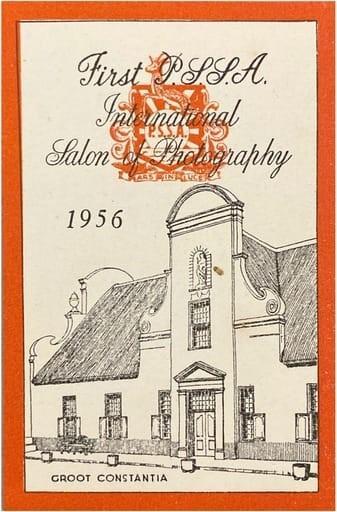
Label of the 1st PSSA International Photographic Salon held at Groot Constantia in 1956.
Unlike some commercial competitions run by companies that may aim to profit from entry fees or collect images for commercial use, salons are usually non-profit and geared towards the advancement of the art and its practitioners.
Salons can be hosted by clubs, which is a possible source of revenue for the club. It can also be hosted by photographic associations, like the Photographic Society of South Africa (PSSA) founded in 1954.
There are national and international salons. In local national salons, only photographers from South Africa may compete (as well as photographers worldwide who are members of the PSSA). At international salons, photographers from all over the world may enter and compete.
But where did it all start?
Interestingly, early photo exhibitions were not linked to photographic clubs in that art exhibitions were in existence long before the establishment of the first photographic club in South Africa.
From this point onward, a brief history is presented, first of photographic clubs in South Africa, and then of earlier South African exhibitions.

“Early Morning” by Stan W Jones which was entered into the Welkom National Salon where a score of 6 was allocated.
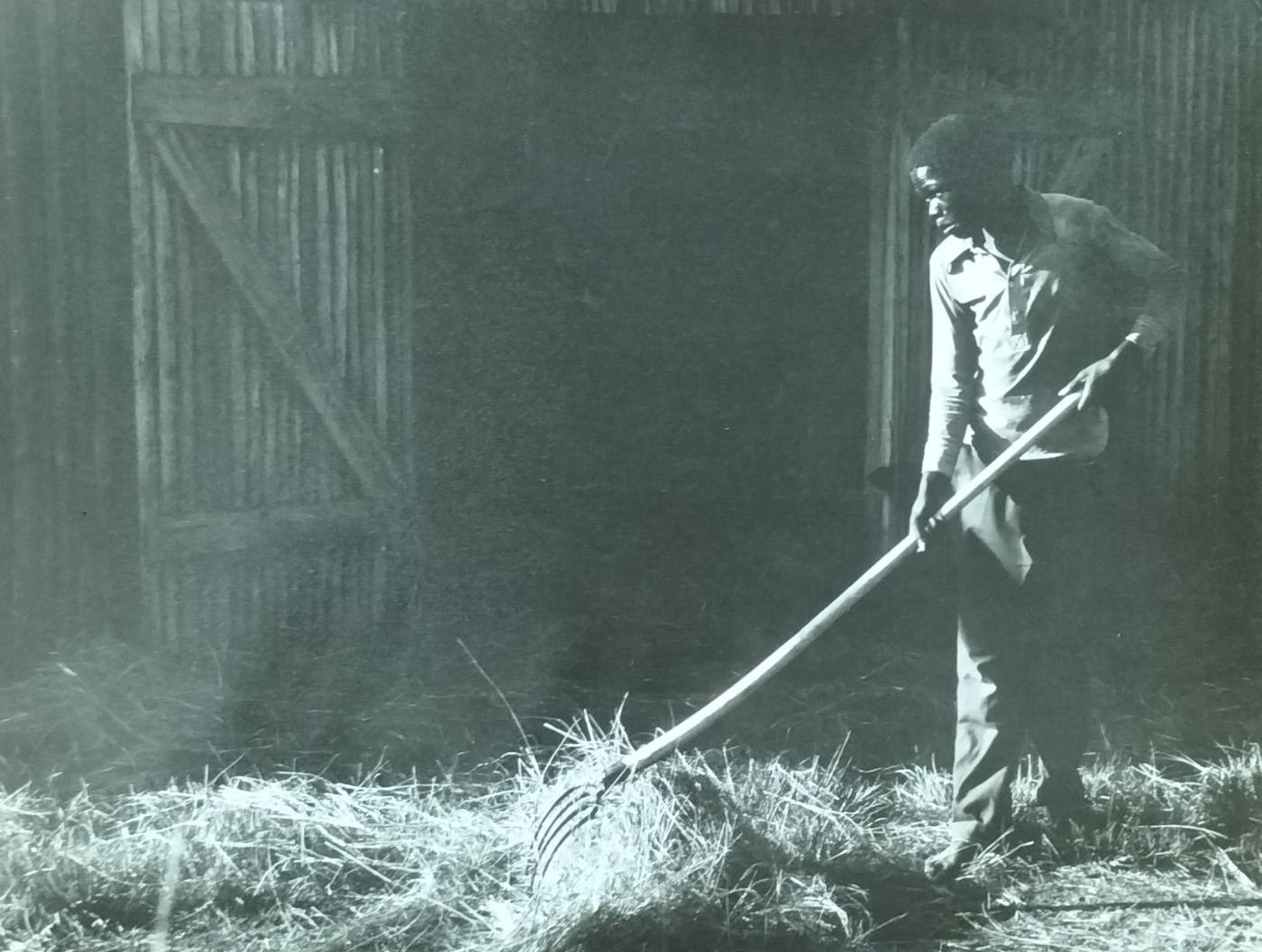
Photo without title by Stan W Jones (1978). This image was entered into an American Salon where a score of 9 was awarded.
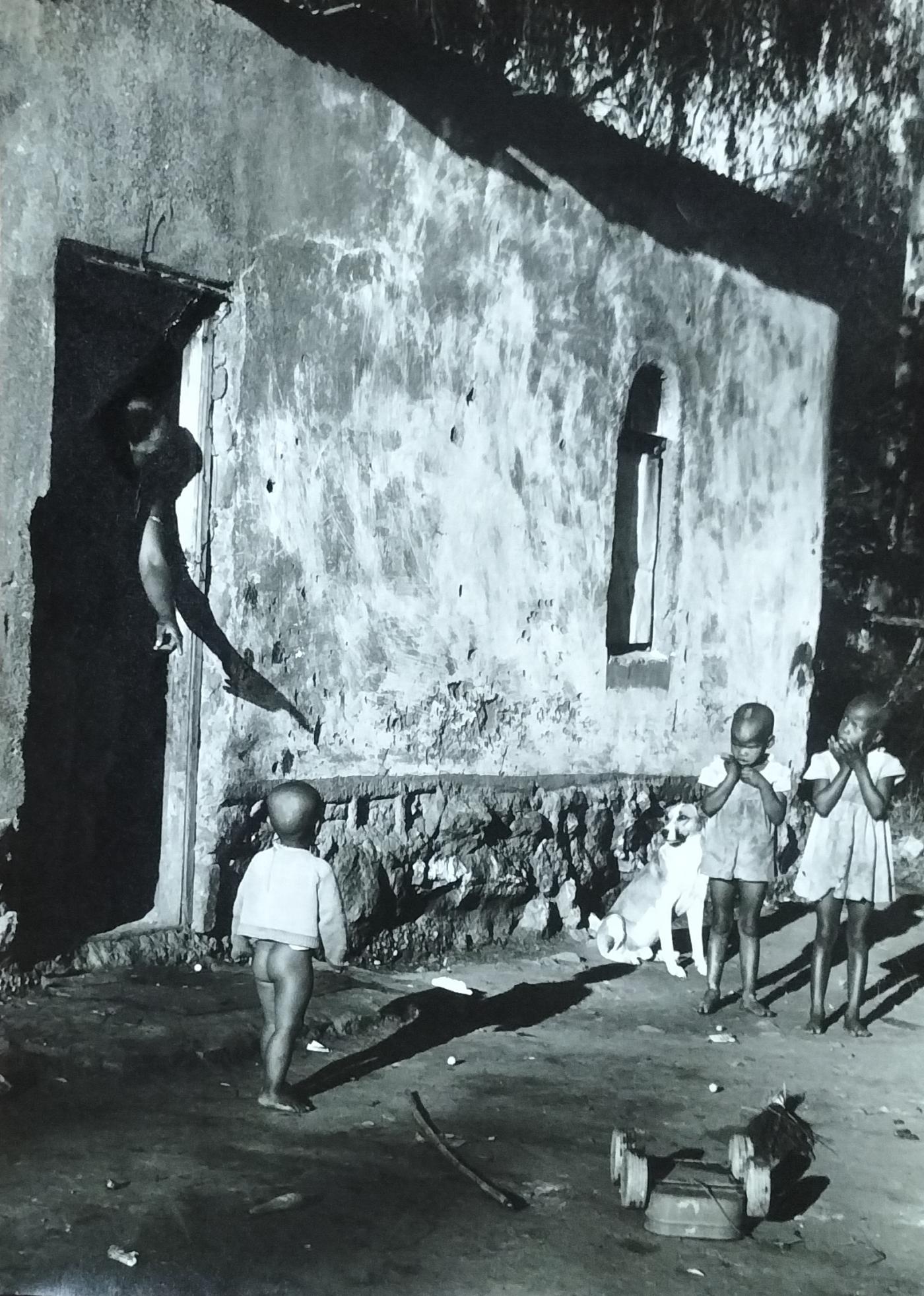
“The scolding” by Stan W Jones (1978). This print was entered into 2 American Salons and 1 Irish Salon where scores of between 2 and 8 were allocated.
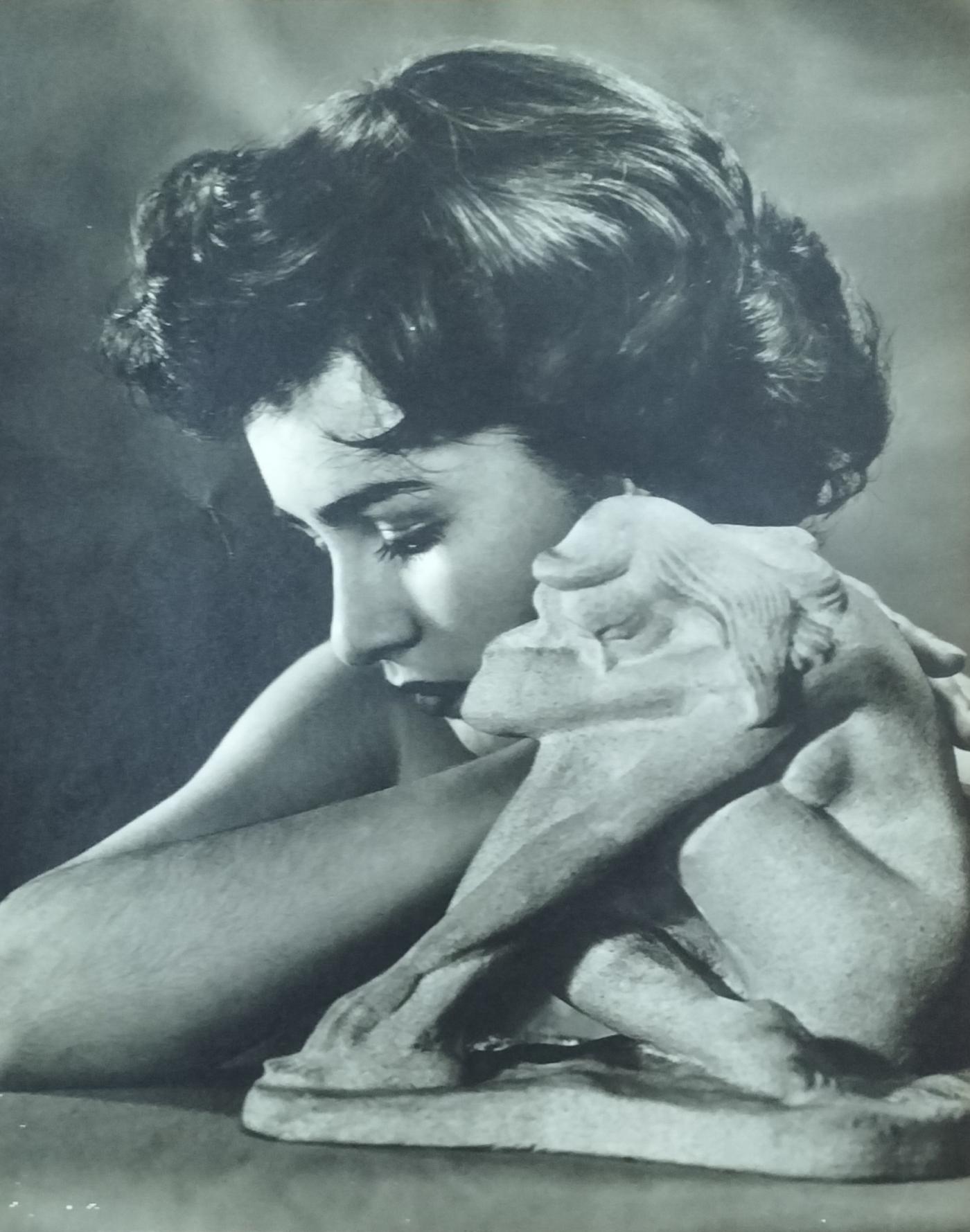
“Two models” by SC Pietruszka. This bromide print contains no provenance of any salon entries.
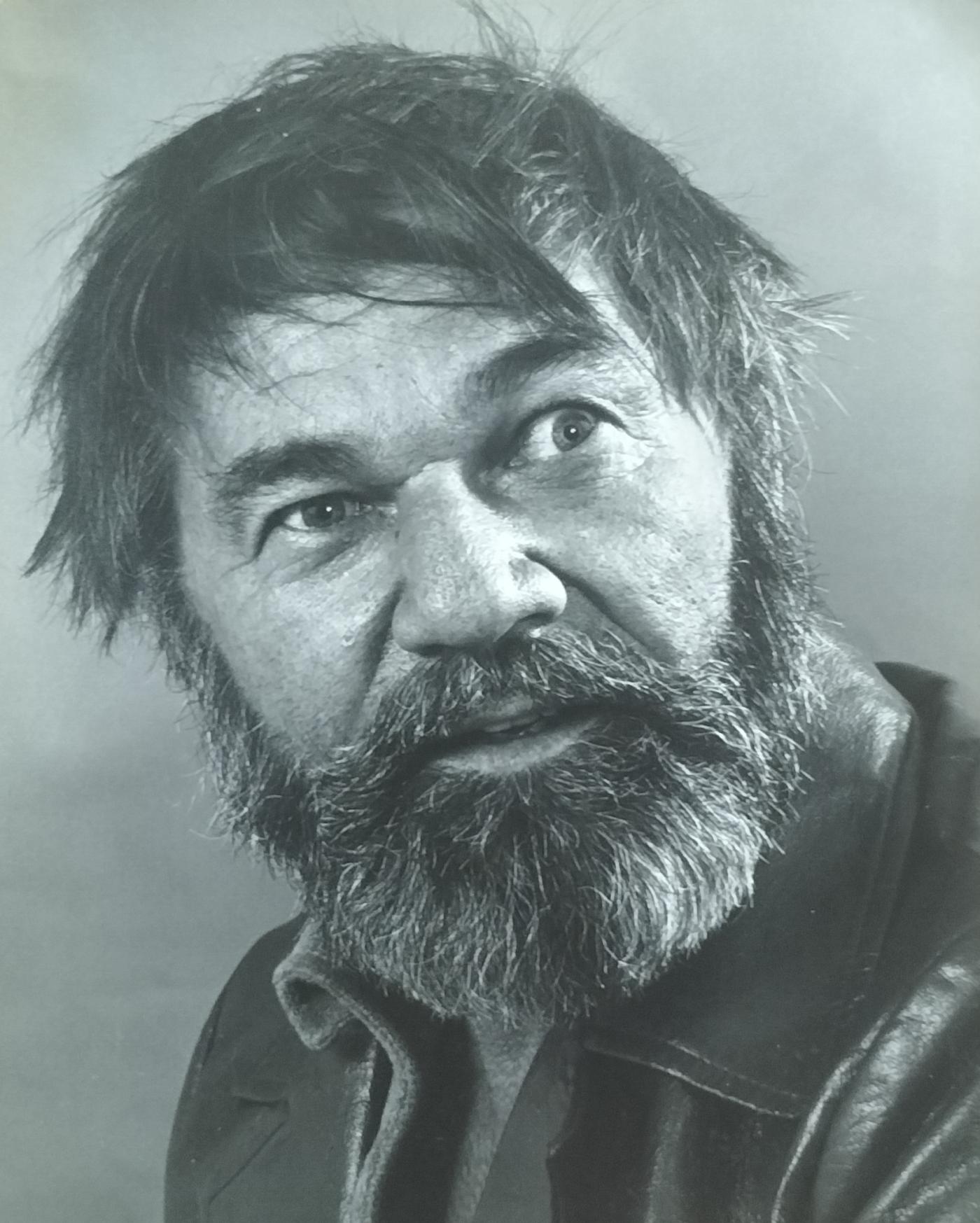
Photo Salon entry without title by Shane Cloete. This photograph was exhibited at both the 17th Welkom Salon (1974) and East Cape International Salon (1975).

A salon entry by Sara Buijskes – Johannesburg’s first recorded female photographer. It is recorded that Sara was awarded a bronze medal for this photograph.
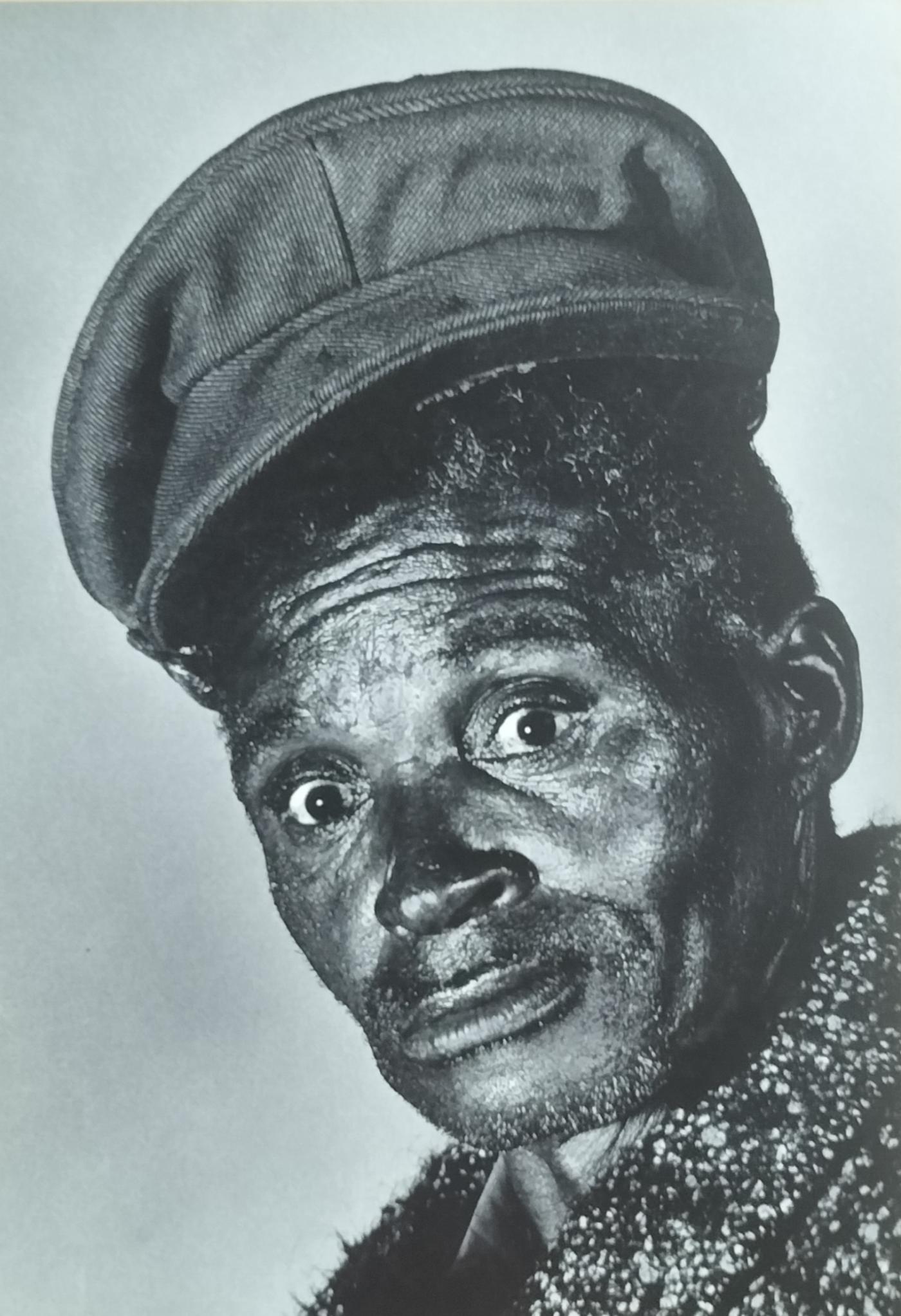
“Klaas Soldaat” by Louis Marais. Submitted to the West Rand Exhibition where a score of 10 was allocated.
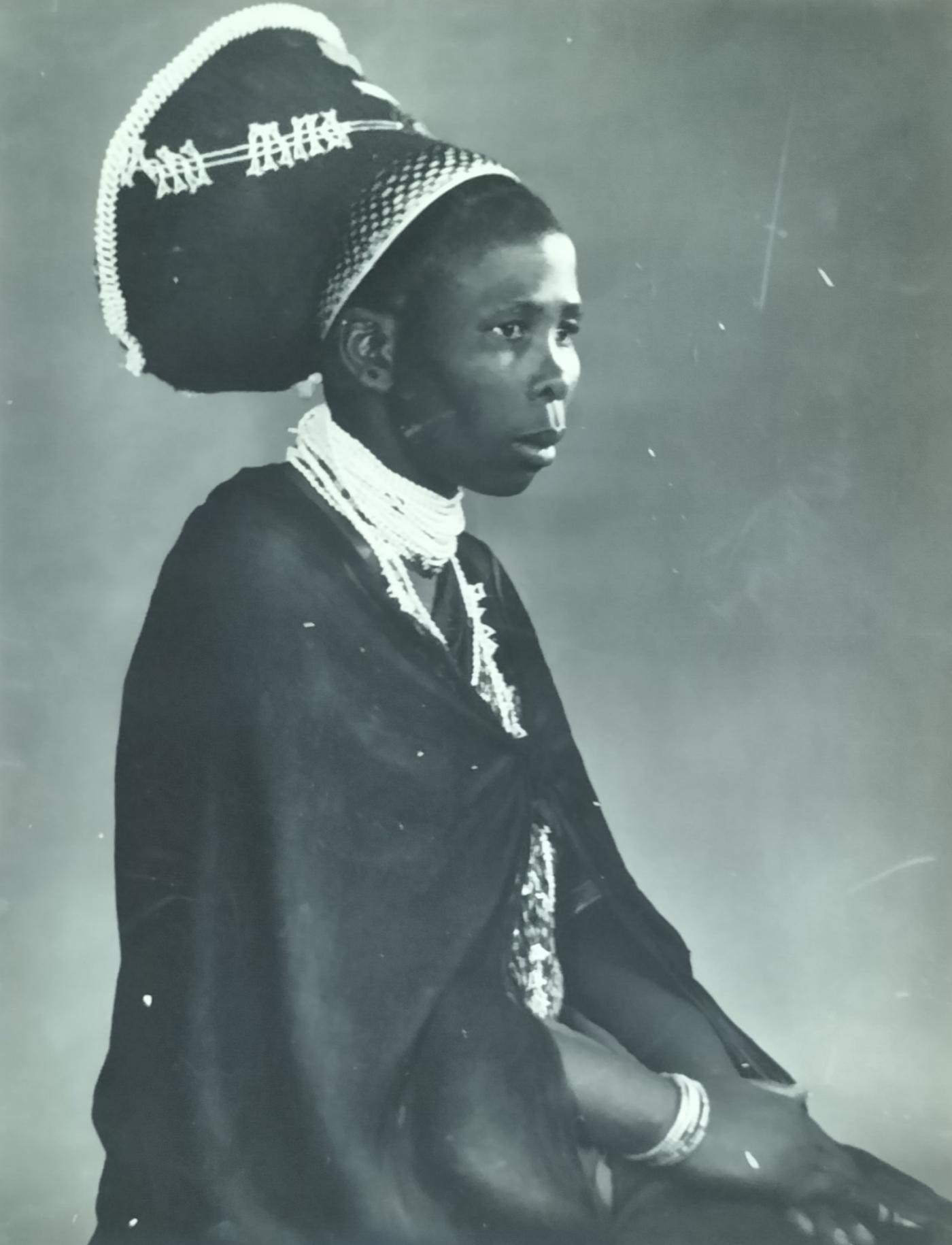
“Zulu Girl” by SC Pietruszka. This bromide print contains no provenance of any salon entries.
South African photographic clubs – a brief historical overview
Amateur enthusiasts have been responsible for the notable developments and contributions to the field of photography.
Bull & Denfield (1970) found evidence of an attempt to establish a photographic club in Cape Town as early as 1863. Whether this materialised they have not been able to confirm.
Bensusan (1966) suggests the earliest camera club meeting in South Africa took place at the Gresham Hotel in Kimberley on 9 May 1890 followed by the Cape Town Photographic Club, some 5 months later on 30 October 1890, followed by Port Elizabeth in July 1891.
A club was also established in Johannesburg in February 1894. By 1895 there were eleven photographic societies in South Africa.
South African photographic exhibitions/competitions – a brief historical overview
Although it has been suggested that the first photographic competition held in South Africa was in 1930 (Krugersdorp), this is improbable in that Bensusan (1966) has it recorded that a national salon was held in 1896 under the auspices of the Cape Town Society. This became an annual event, and the following year Cecil John Rhodes donated medals for the competition in those classes which were open to South Africans.
The Kimberley Society in turn took the lead in organising a photographic convention in 1898 (also referred to in historical records as the South African Photographic Convention), a landmark event for amateur photography in South Africa. It was organised primarily by the Kimberley Camera Club, which was the first amateur camera club in sub-Saharan Africa, founded on 9 May 1890.
Bensusan (1966) states that this 1898 gathering was one of the earliest efforts to unify the various fledgling photographic societies across the region, including clubs from Cape Town, Port Elizabeth, and Grahamstown.
Even before these photographic clubs started organising themselves, a variety of exhibitions were held in South Africa where photographers would have exhibited some of their work.
A number of professional, or studio photographers, took the opportunity to advertise successes obtained at these earlier exhibitions on the back of their Cabinet Card format photographs (dating roughly from between the 1870s and 1910s).
This approach also confirmed the photographers financial standing in that the print design was a costly exercise. The pre-printed card stock was then ordered in bulk from either France or England.
Below is a list of identified exhibitions that took place in South Africa between 1858 and 1905 in which local amateur and professional photographers may have exhibited their work and received awards accordingly.
Exhibition catalogues may assist in expanding the information provided below.
South African Exhibitions between 1858 and 1866
Although exhibitions by early individual photographer’s work does not form part of this article, it is recorded that South Africa’s first professional/studio photographer, Jules Léger, exhibited specimens of his work in Grahamstown as early as November 1846, and possibly even a month earlier in Port Elizabeth.
The first recorded open South African exhibition took place in Grahamstown as early as July 1858. A significant contributor to this art exhibition was Dr. William Guybon Atherstone (an amateur photographer).
At this exhibition, the first general photographic display in the Cape was also held. It is not known whether any local professional photographers entered some of their work at this exhibition (Bull & Denfield, 1970).
From 1858 onwards, photographic sections were included in the fine arts exhibition sections. The early photographers, wishing to solicit general patronage, would often arrange for selected specimens of their work to be exhibited in this category.
The very next art exhibition was held in Cape Town a month later (November 1858). Anyone possessing photographs of any description could submit them to the selection committee.
Consequently the public was able to see a collection of miscellaneous photographs by local and overseas photographers, both amateur and professional.
Three Cape Town professionals are recorded to have exhibited at this exhibition, namely Frederick Arlington Viler York, William Frederick Walter and Michael Crowly. At this same exhibition, the best photographic portrait was awarded to an amateur photographer, Mrs. Aston (Bull & Denfield, 1970), about whom little is known. This was a significant milestone for an amateur photographer in a male-dominated field, at a time when early photographic processes such as the daguerreotype and glass positives were becoming popular in the Cape.
Although not an art exhibition, the next recorded exhibition that included photographs was the “Conversazione” held in Port Elizabeth in July 1861 (Bull & Denfield, 1970).
The next recorded Fine Arts Exhibition took place in Cape Town in October 1866 followed by the British Settlers’ Jubilee Agricultural and Fine Arts Exhibition held in Grahamstown in May 1870.
Between this exhibition and the next recorded exhibition, featuring photographs, there seems to have been a drought of some 7 years in that the next recorded exhibition only took place again in Cape Town in 1877.
For this period, no awards have been recorded or have been announced by professional photographers. It was only from the early 1870s that the cabinet card format photograph came into use. It was then also on this format that some photographers announced their achievements.
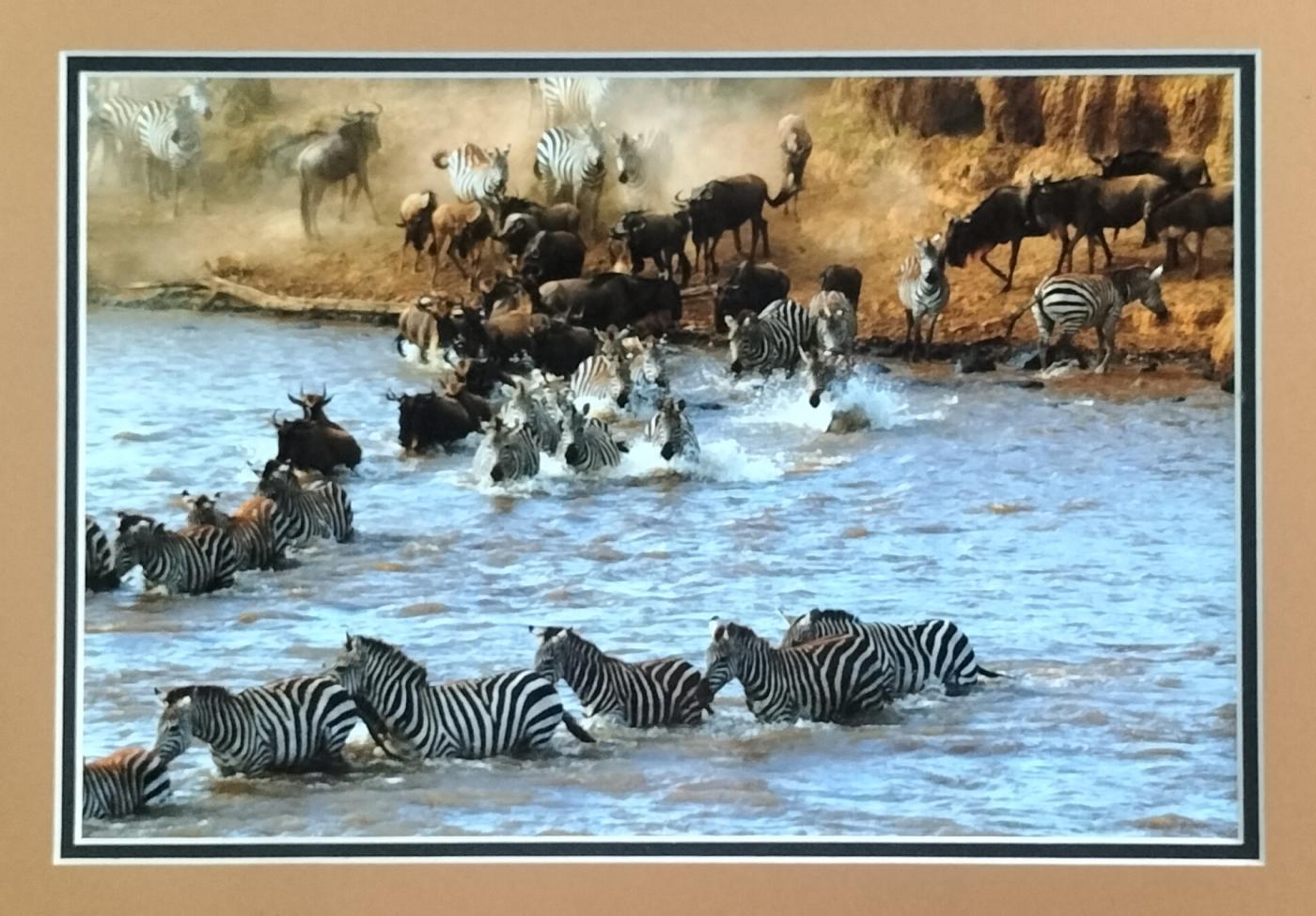
“The Crossing” by unknown photographer. This photograph was entered into the 2005 Benoni Salon where it scored 13 points.
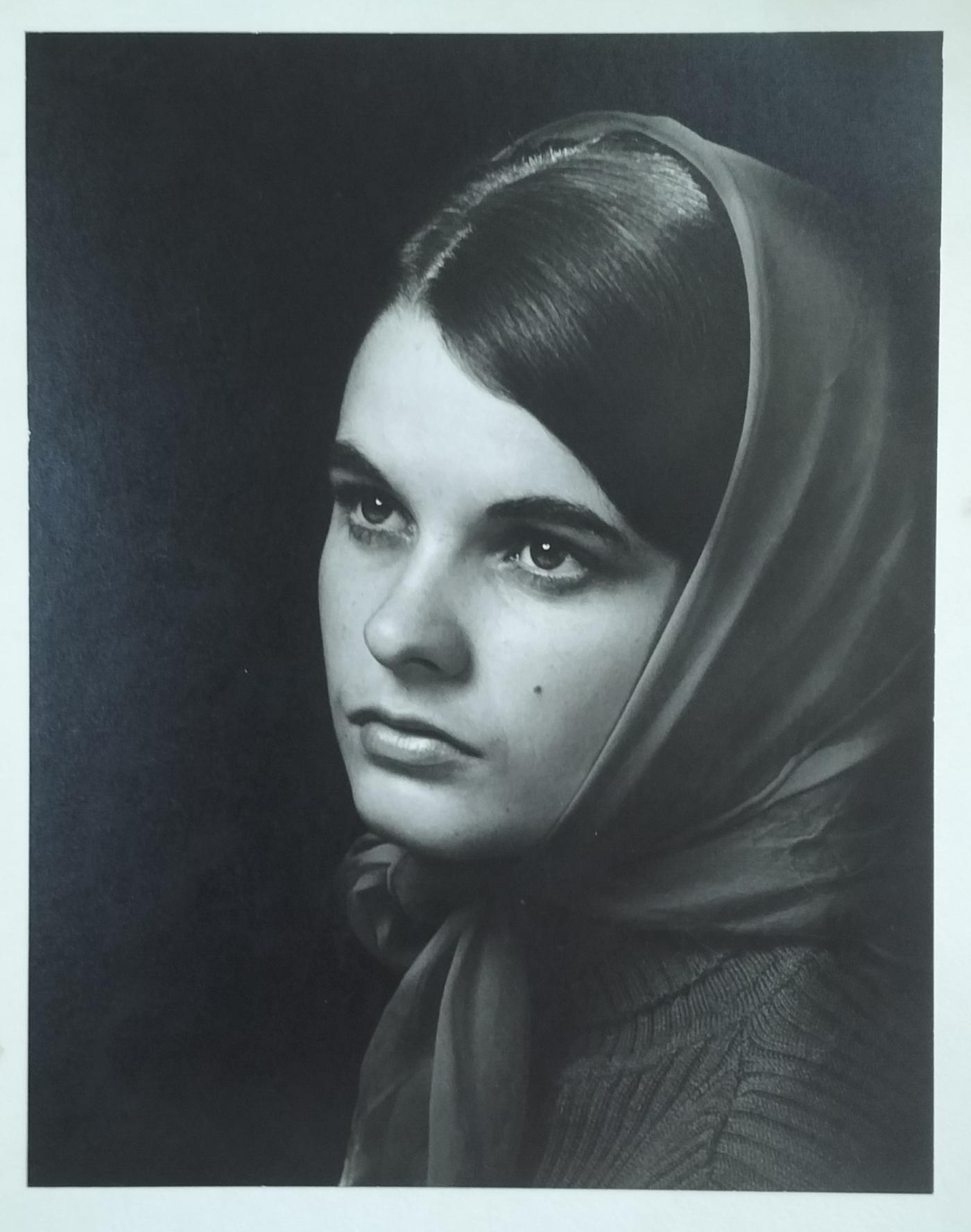
“Cora” by Louis Marais (1970). This image was entered into the 13th Durban National Salon, Border International Salon, and Witwatersrand International Exhibition.
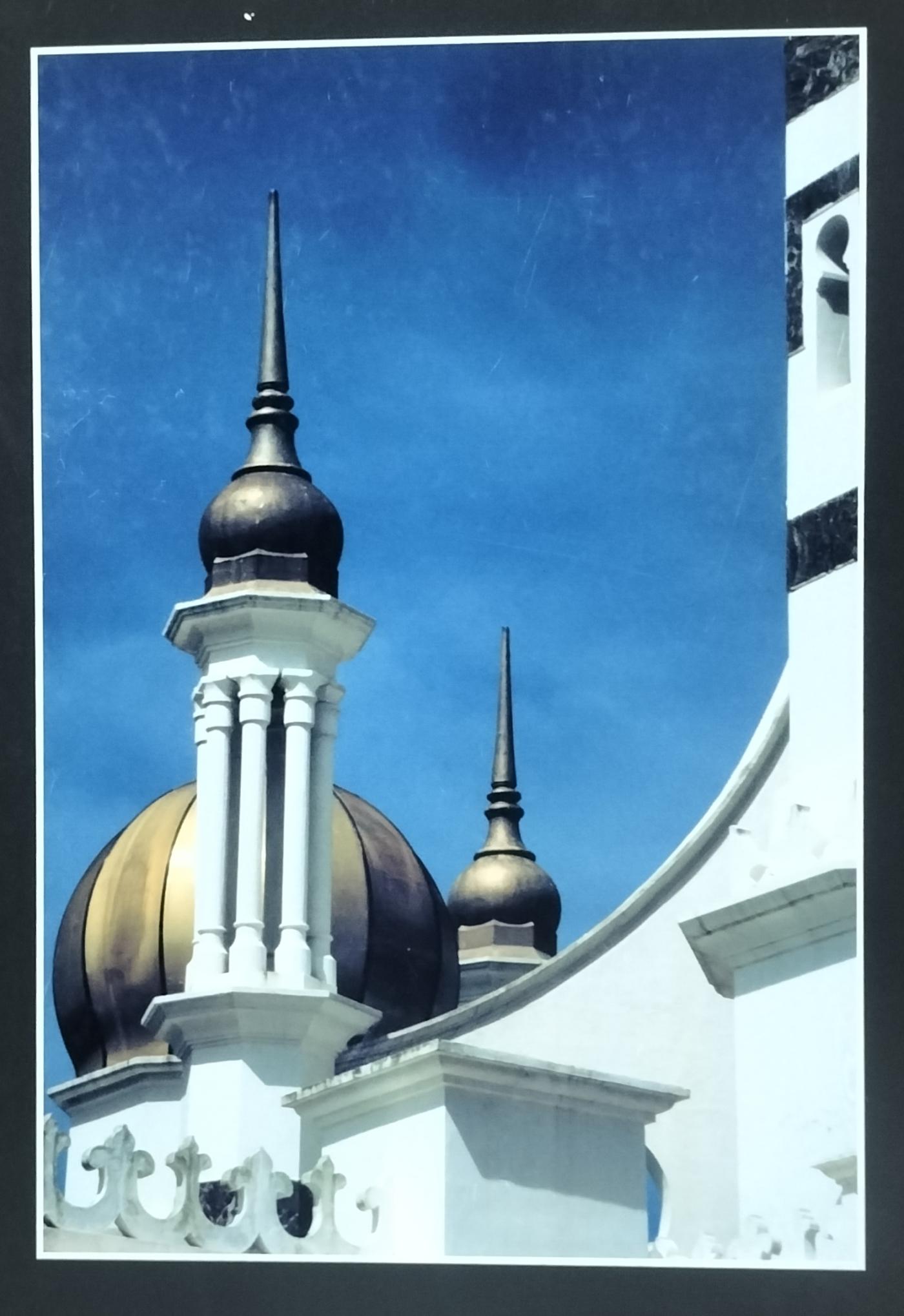
“Princes Palace” by Max Arenson. This photograph was entered into two salons, namely Southern Suburbs Camera Club Print Challenge (2000 – score of 12) and Benoni Salon (2001 – score of 11).
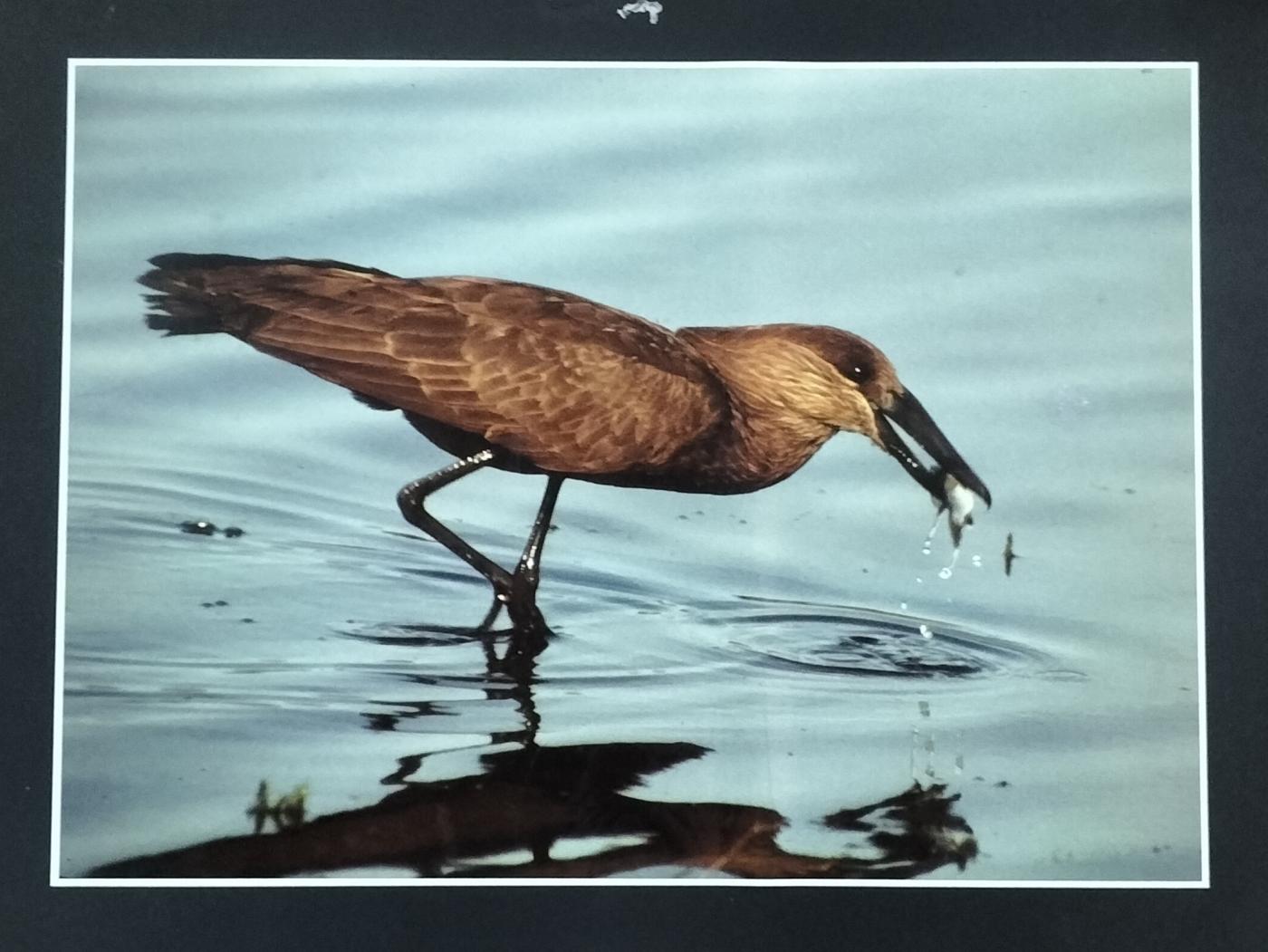
“Hammerkop” by Freda Arenson from Jabula Camera Club. With this entry, the photographer received a gold award from her own club. Other Salon entries include the 46th SA International Salon (1997 – score of 12), 15th Pretoria International Exhibition (1999 – score of 13), Benoni Salon (1998), 25th East Cape Salon (1999) and Witbank National Salon (1997 – score of 12).
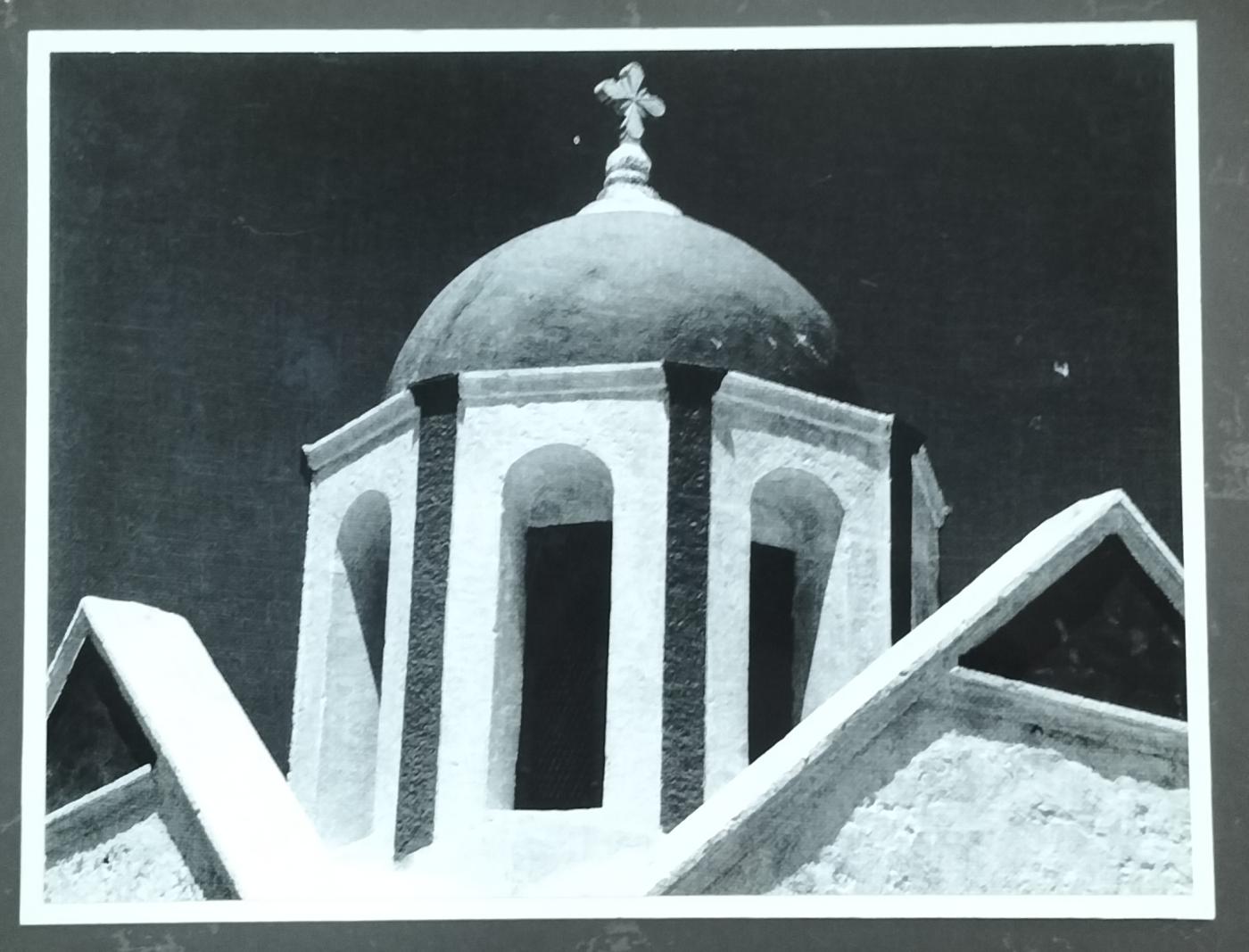
“Monastery" by Freda Arenson from Jabula Camera Club. This photograph was entered into at least 13 Salons between the period 1990 and 1998. In one instance she was awarded a Gold award whilst in another a bronze medal. See the back of this photograph below.

Back of photograph above showing the multiple Salon entries of this photograph
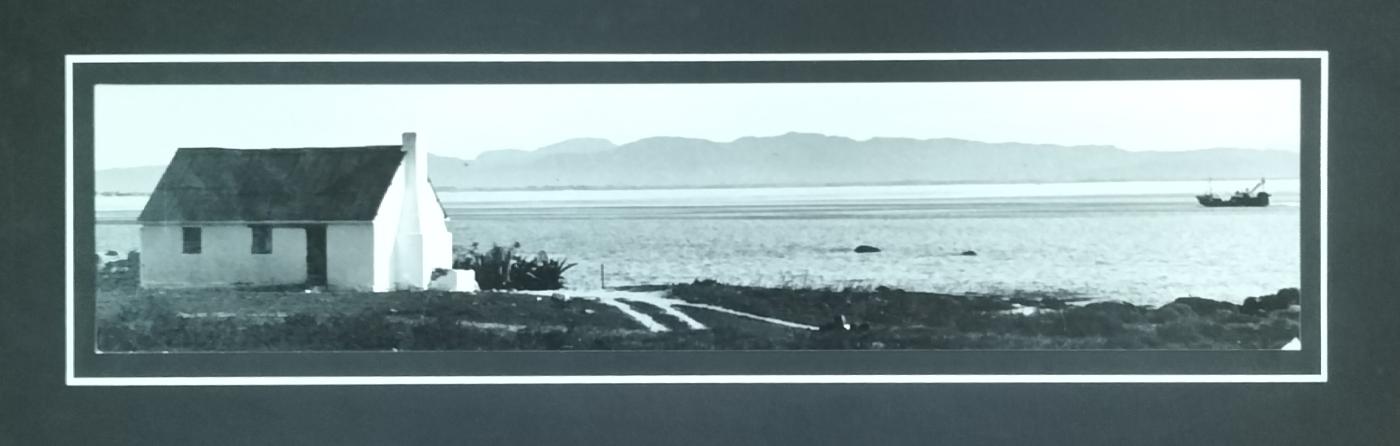
“Saint Helena” by Freda Arenson from the Jabula Camera Club. This photograph was entered into multiple salons. These included Border Salon (1995 – score of 10), Benoni Print Salon (1996 & 1998– score of 10), 9th East Rand National Salon (1995, score of 11), PIEP International Salon (1997 – score of 9), 45th SA International Salon (1996 – score of 12), AFO Salon (Score of 12) and East Cape International Salon (1999 – ribbon awarded).
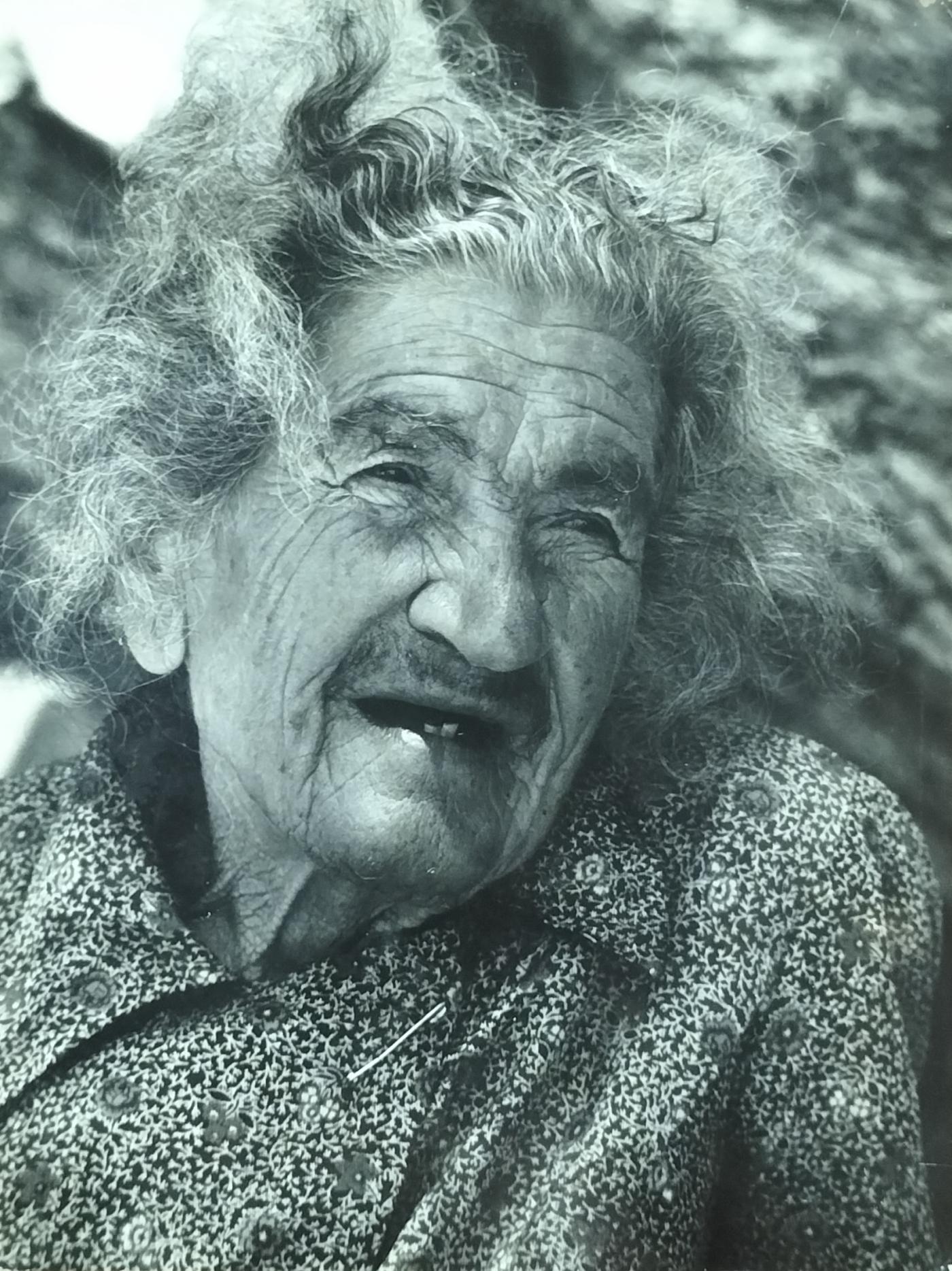
“Ou vrou in die skadu” (Old lady in the shade) by Heila Groenewald (1983). This image was awarded three stars.
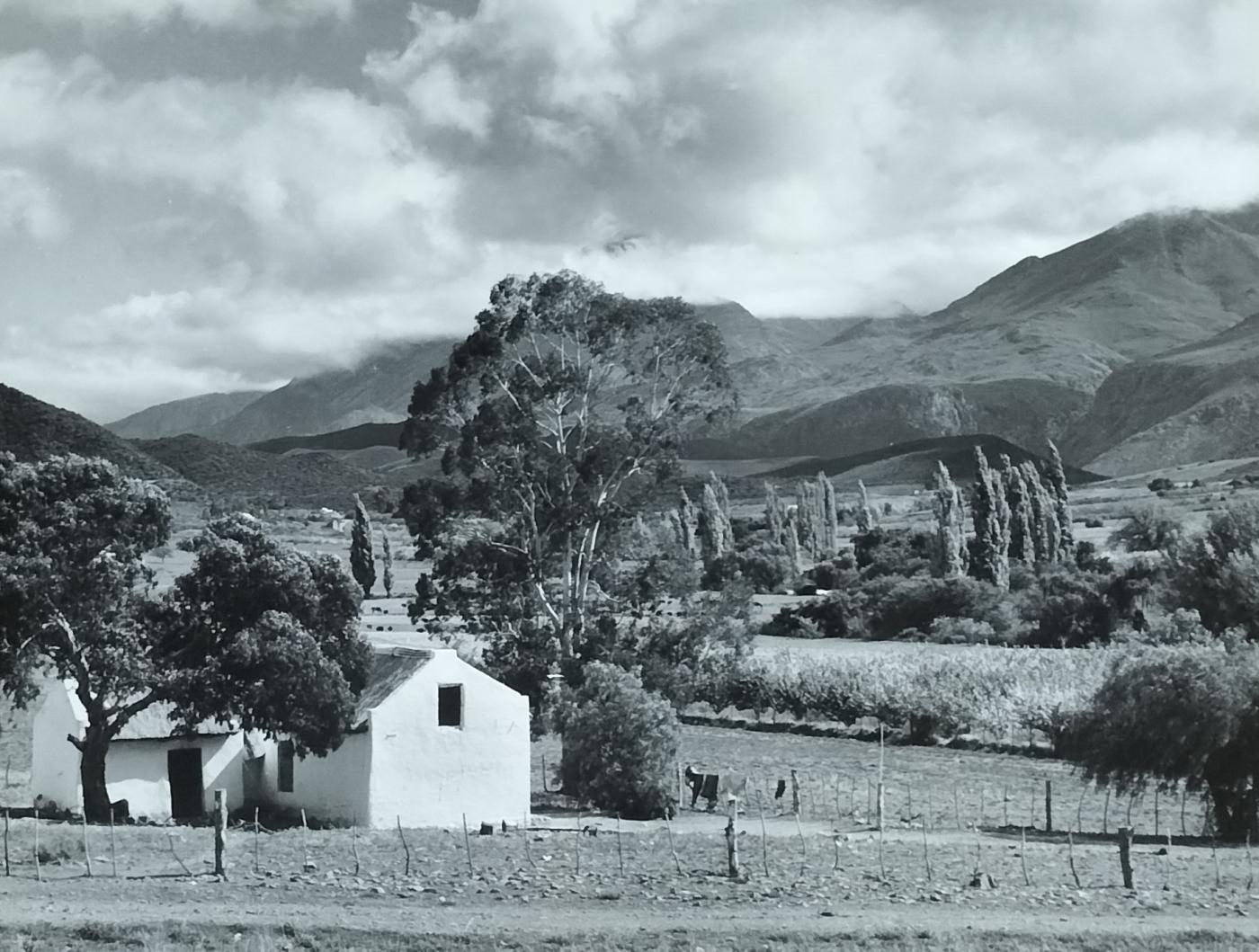
Photographic Salon entry without any provenance
South African Exhibitions between 1877 and 1905
The list below largely relied on information included on the back of cabinet card format photographs, a format entrenched in South Africa from between 1872 and 1915, preprinted by the photographers concerned.
1. 1877 - Cape Town - South African International Exhibition
Opened by Sir Henry Bartle Frere, this was a significant international fair. Although Cape Town-based photographers would have participated, no evidence of awards allocated in the photography section have been identified to date.
2. 1884 - Durban - Natal Agricultural, Horticultural, Industrial and Art Exhibition
Although there would have been more award winners in the photographic section, only one set of photographers advertised their success, namely the Kisch Brothers from Durban. On the back of their preprinted cabinet cards they advertise that they have won the gold medal and two silver medals.
3. 1884 - Cape Town - South African Industrial Exhibition
Whilst this specific exhibition was seemingly less famous compared to the 1877 Cape Town International Exhibition, one of the most significant photographic achievements was a large-scale panorama of Cape Town captured from Signal Hill by William Frederick Henry Pocock (1857–1922), a leading amateur photographer (a pharmacist by profession).
4. 1885 - Port Elizabeth – The South African Exhibition
The South African Exhibition of 1885 was a seminal event in South African history, showcasing the industrial, agricultural, and cultural achievements of the region.
In the photography section, the following photographers advertised their successes on the back of their preprinted cabinet cards:
- Robert Harris – 1st prize and two silver medal - his enlargements, panoramic scenery and instantaneous studies were commended as particularly good specimens of the respective classes of work.
- Kisch Brothers from Durban - Highest award
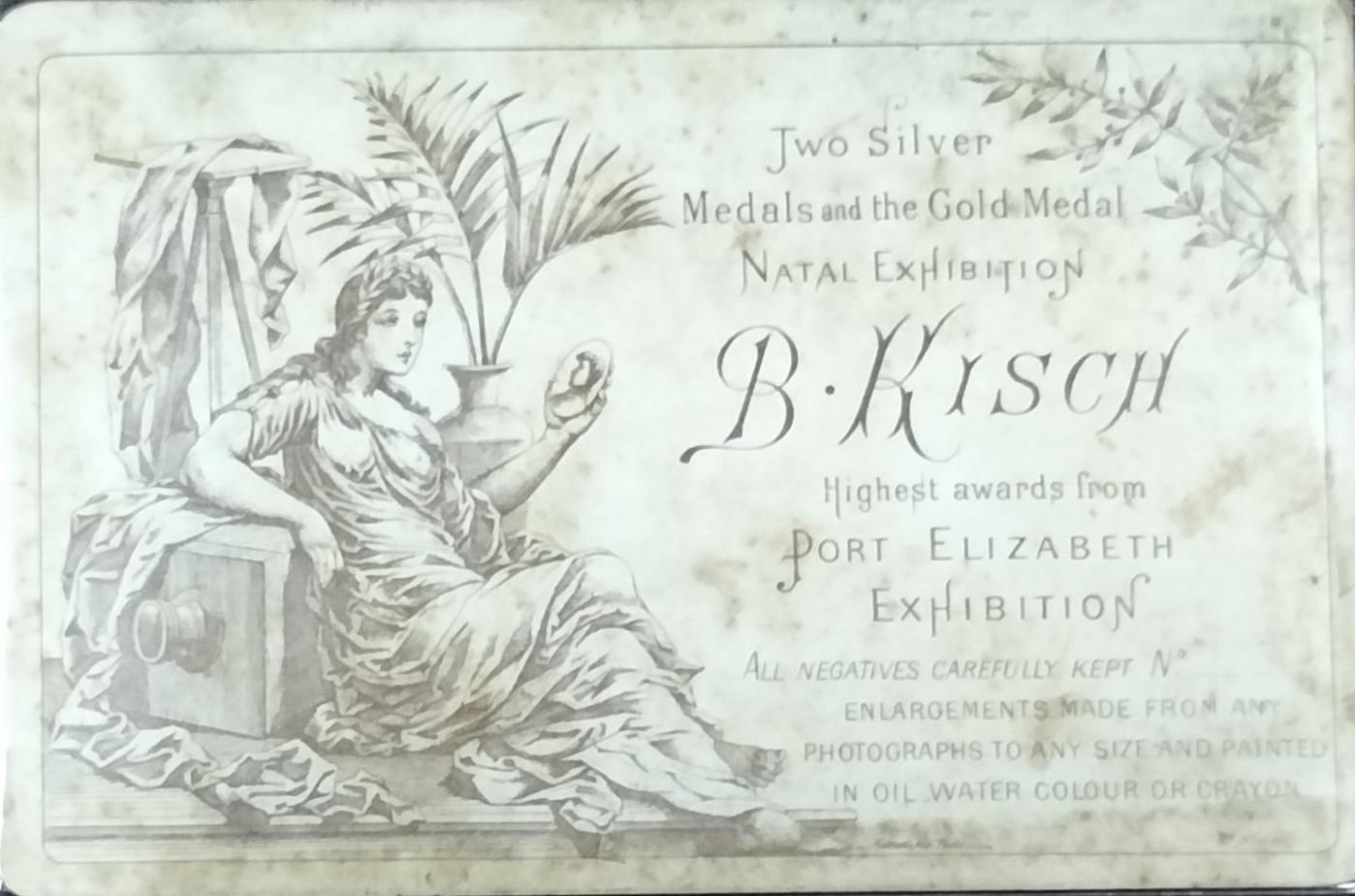
Back of a Cabinet Card format photograph by Durban- based B. Kisch proudly announcing that he was awarded one gold and two silver medals at the Natal Exhibition (1884).
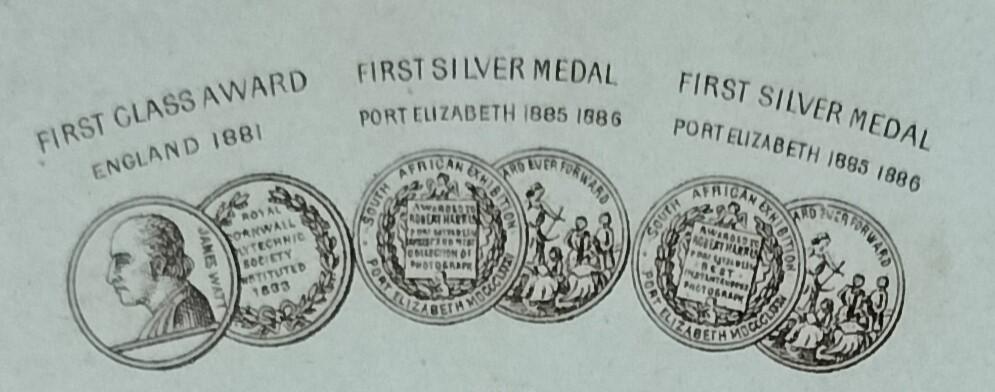
Back of Cabinet Card format photograph by Port Elizabeth-based photographer Robert Harris on which he advertises awards received at exhibitions in England (1881) and Port Elizabeth (1885/6)
5. 1887/8 - Grahamstown – The Queens Jubilee South Africa Exhibition
Held in 1887–1888 to celebrate Queen Victoria's Golden Jubilee (50 years on the throne), the event highlighted Grahamstown as a key centre in the British Cape Colony.
In the photography section, the following photographers advertised their successes on the back of their preprinted cabinet cards:
- Hepburn FW from Grahamstown – 1st order of merit for enlargements and 2nd order of merit for portraits
- Hepburn & Jeannes from Grahamstown – Medals awarded for enlargements and artistic photography
- Otto Battenhausen – 1st prize and silver medal
- Robert Harris – some awards

The back of Hepburn and Jeannes cabinet card format photographs. They have made the effort to advertise the awards received at various local exhibitions. The awards, often difficult to read, are represented in medal form on the back of the card.
6. 1892 - Kimberley - South African and International Exhibition
Designed to showcase industries and boost economic confidence in the region following a recession, a major industrial fair held in the public gardens was opened on 8 September 1892 by Sir Henry Loch.
Initiated by Cecil Rhodes during a period of economic depression in Kimberley, the exhibition was intended to foster investment and highlight technological advancements of mining equipment, among other developments.
In the photography section, the following photographers advertised their successes on the back of their preprinted cabinet cards:
- Hepburn & Jeannes – Medals awarded for enlargements and artistic photography
- JE Middlebrook from Kimberley – Gold medal

Back of a Cabinet Card format photograph by Durban and Kimberley-based James Edward Middlebrook photographer proudly advertising that he was awarded a gold medal at the 1892 Kimberley exhibition.
7. 1894 - Grahamstown – Industrial and Arts Exhibition
The prominent photographer, James Edward Middlebrook specifically published his "South African Souvenir" album in the same year to coincide with the exhibition period. His work documenting South African towns was a central feature of the photographic displays.
8. 1904/1905 - Cape Town – South African and Industrial (International) Exhibition
The Cape Town Industrial (International) Exhibition was a major showcase of industrial, technical, and colonial advancement, including international participation. It highlighted new technologies like electric motors and turbines. A significant philatelic exhibition was held alongside it, featuring exhibits from various British colonies and showcasing rare stamps.
In the photography section, only one South African photographer advertised his successes on the back of their preprinted cabinet cards, namely James Edward Middlebrook from Kimberley (Gold medal).
Not all award winners provided clear evidence on their preprinted cards as to when or where awards were received. One such example is of the Durban-based photographer Sherwood who advertised (circa 1890s) that he was a gold medallist in portraiture.
International entries by pre-1900 South African-based photographers
Pre-1900, South African-based photographers also entered international exhibitions. Some of these included:
- GF Robertson, based in Kimberley at the time, advertises on the back of his cabinet card that he was awarded a silver medal during the Paris 1892 Exhibition.
- Battenhausen silver medal in Berlin 1876
- Pretoria-based CF Robertson who was a prized medallist in Paris 1889.
- Ferneyhough from Natal Stereo & Photographic Co was a gold medallist at the Society of Science, letters and arts in London (1885).
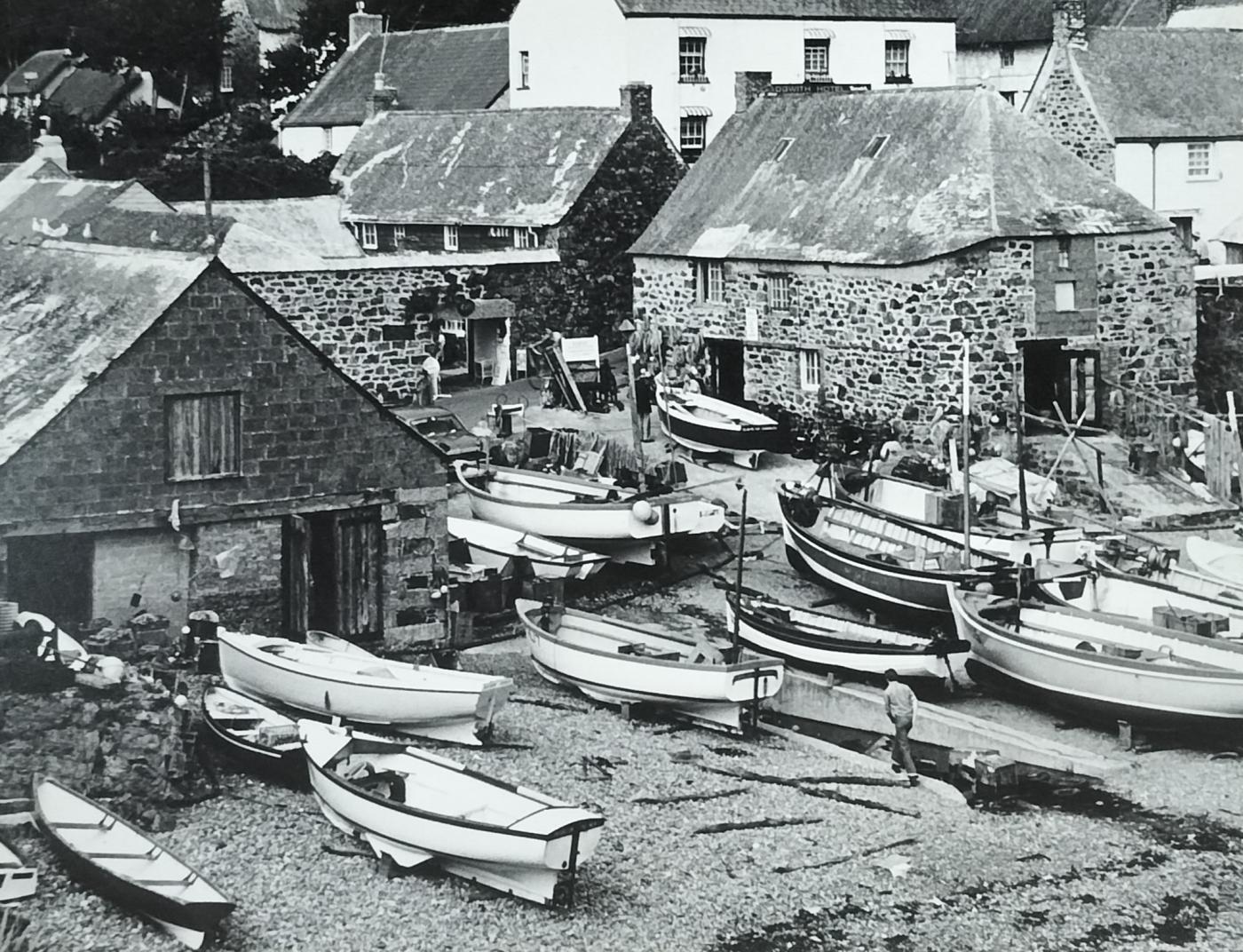
A photographic entry by Robin C Knight from the Florida Camera Club with a two star rating
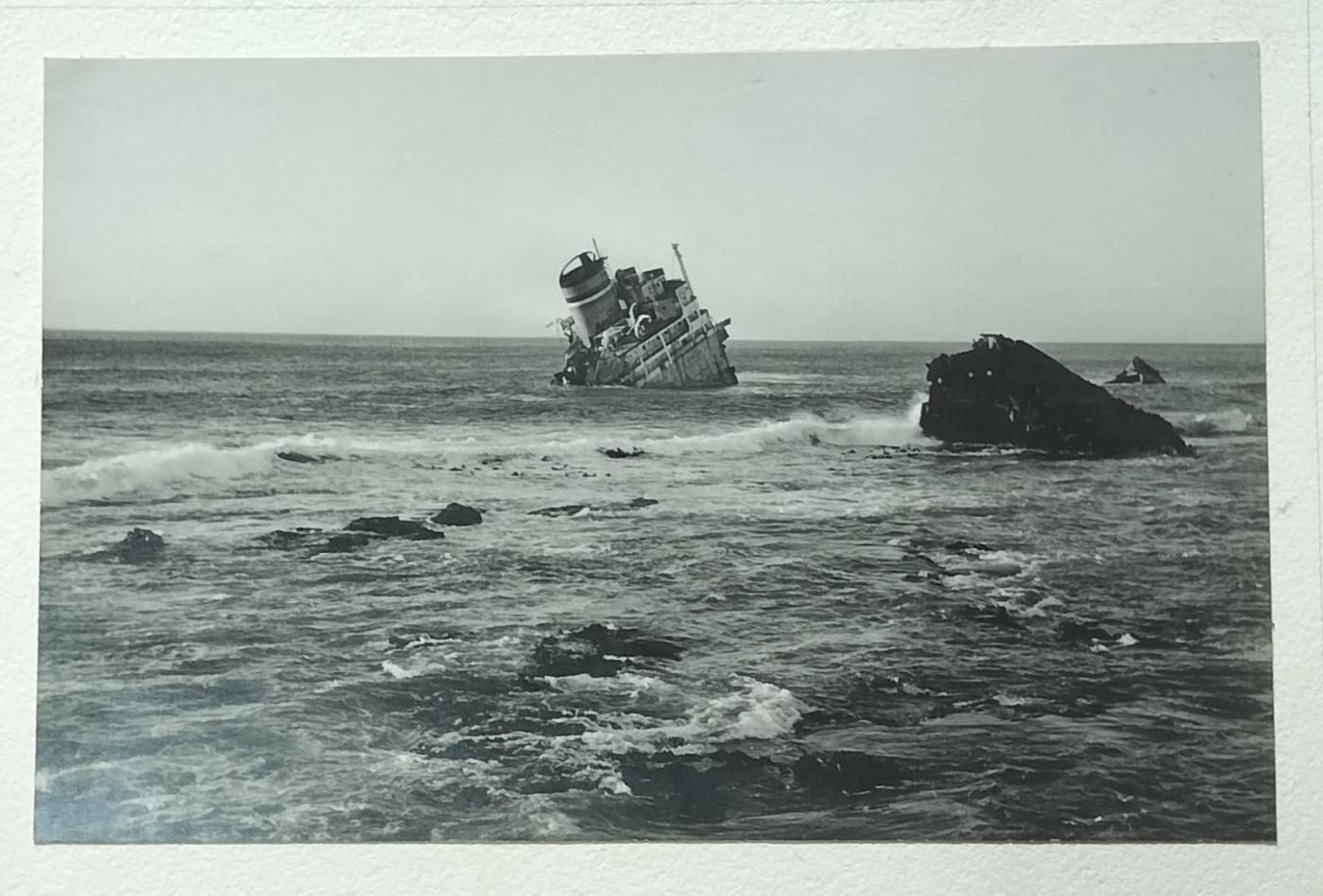
“Captains Mistake” by Edwin Field (1967). This photograph gained a gold at The Camera Club of Johannesburg

“Morning Stroll” by Max Arenson from the Jabula Camera Club where he was awarded a gold award for this photograph. Other salon entries included: Benoni National Salon (1996), 46th SA International Salon (score of 12), Swartland National Salon (1998), 25th Border Salon (1995), Witbank National Salon (1997 – score of 12), Bethlehem Photographic Club (1999 – certificate of merit), Benoni Print Salon (1996 – score of 12) and Bloemfontein Salon. See back of this image below.
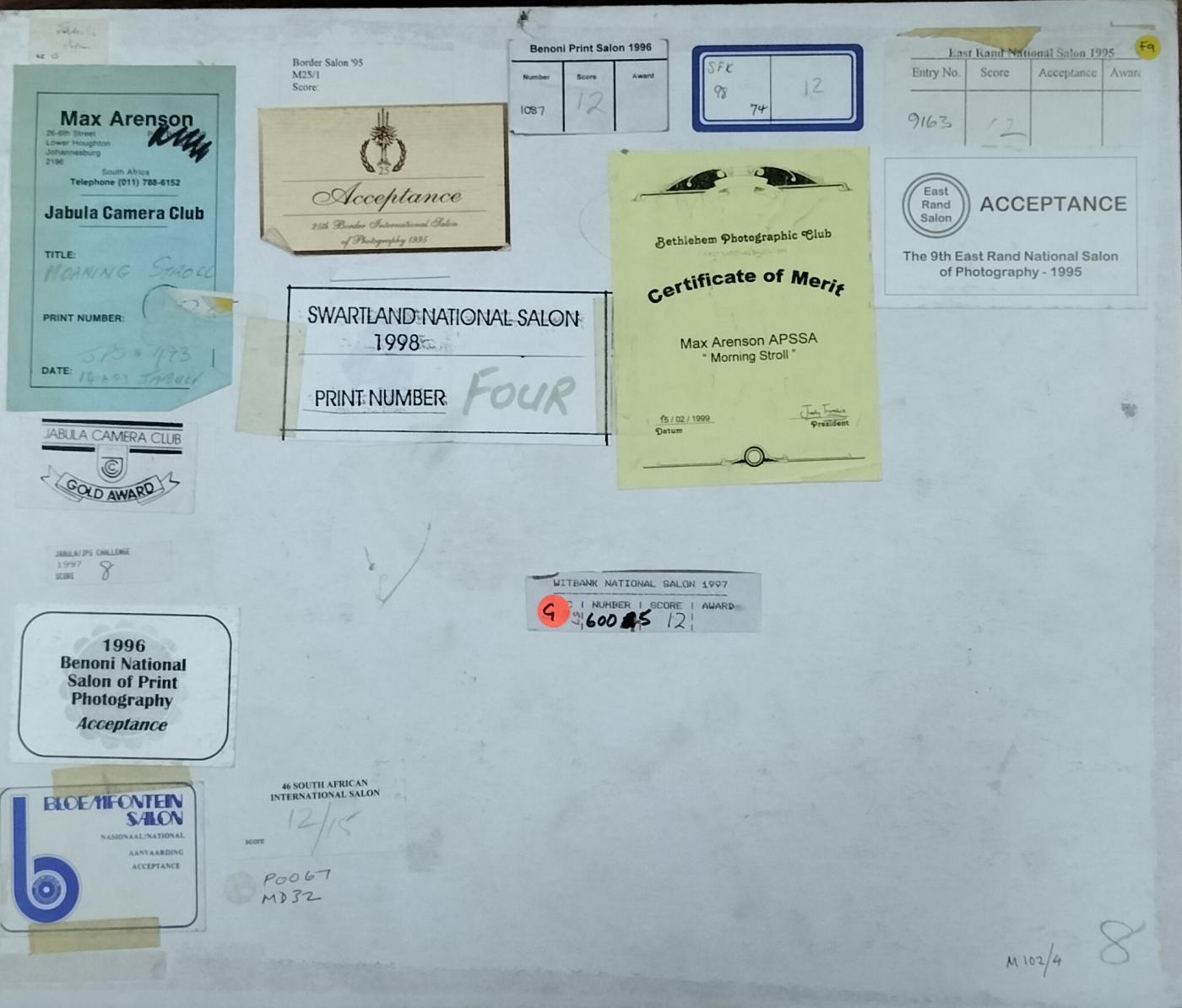
The back of the photograph above confirming the number of salon entries
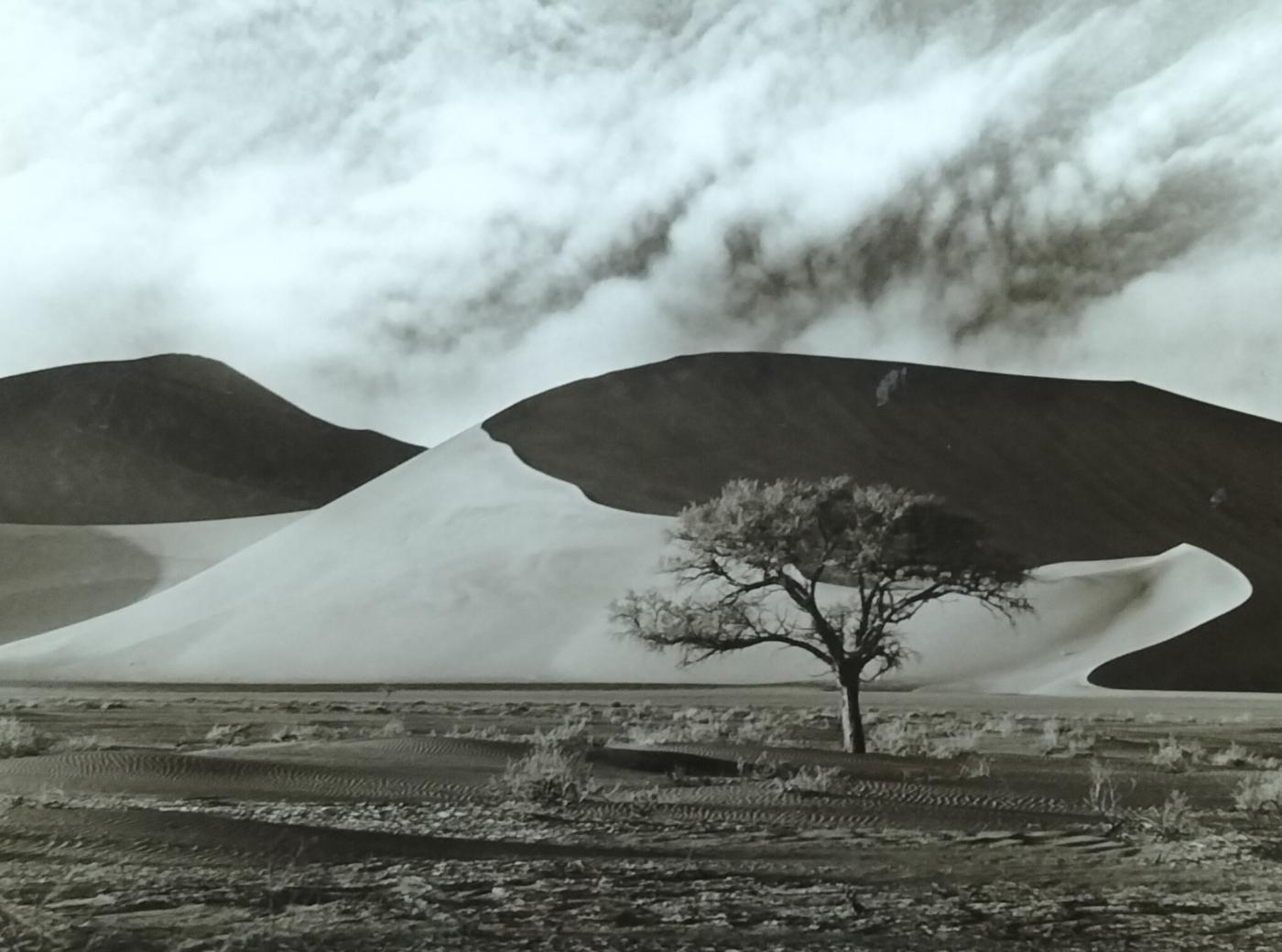
“Namib Desert” by Max Arenson. This photograph was entered into multiple salons, namely Pretoria International Salon (1993 – score of 10; 1995 – score of 11), Westville National Salon, Benoni National Salon (1996 – score of 12), Bluff National Salon and West Rand National Exhibition (1993 – score of 11).
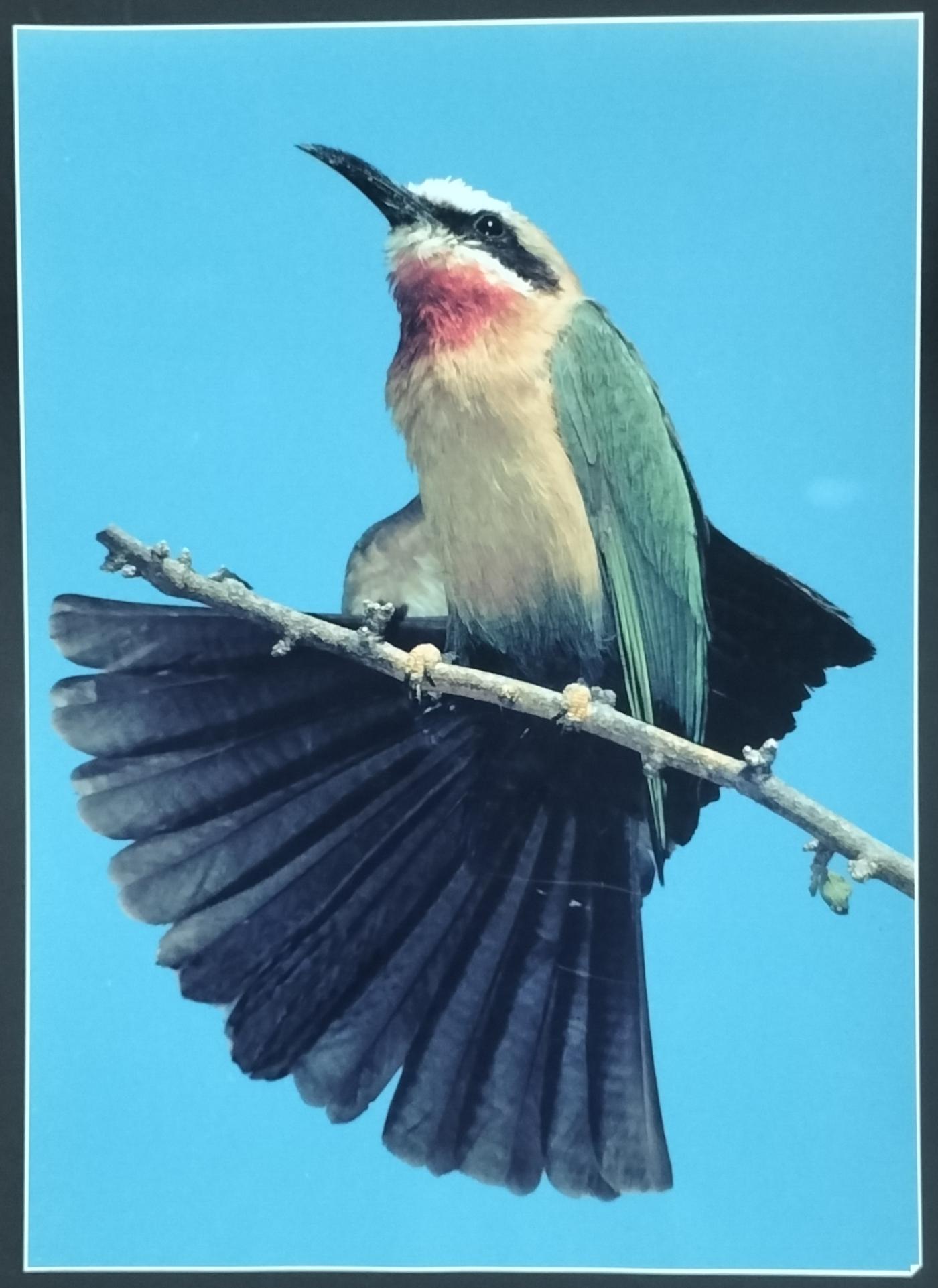
“Spreading Wing” by Max Arenson for which he was awarded a silver medal during one of the exhibits. This photograph was also exhibited at the Pretoria Salon (1998), 15th Pretoria International Exhibit (1999), 26th East Cape International Salon (1999), Benoni National Salon (2001 – score of 12) and Edenvale 2nd National Print Salon (2001 – score of 13). See the back of the image below.
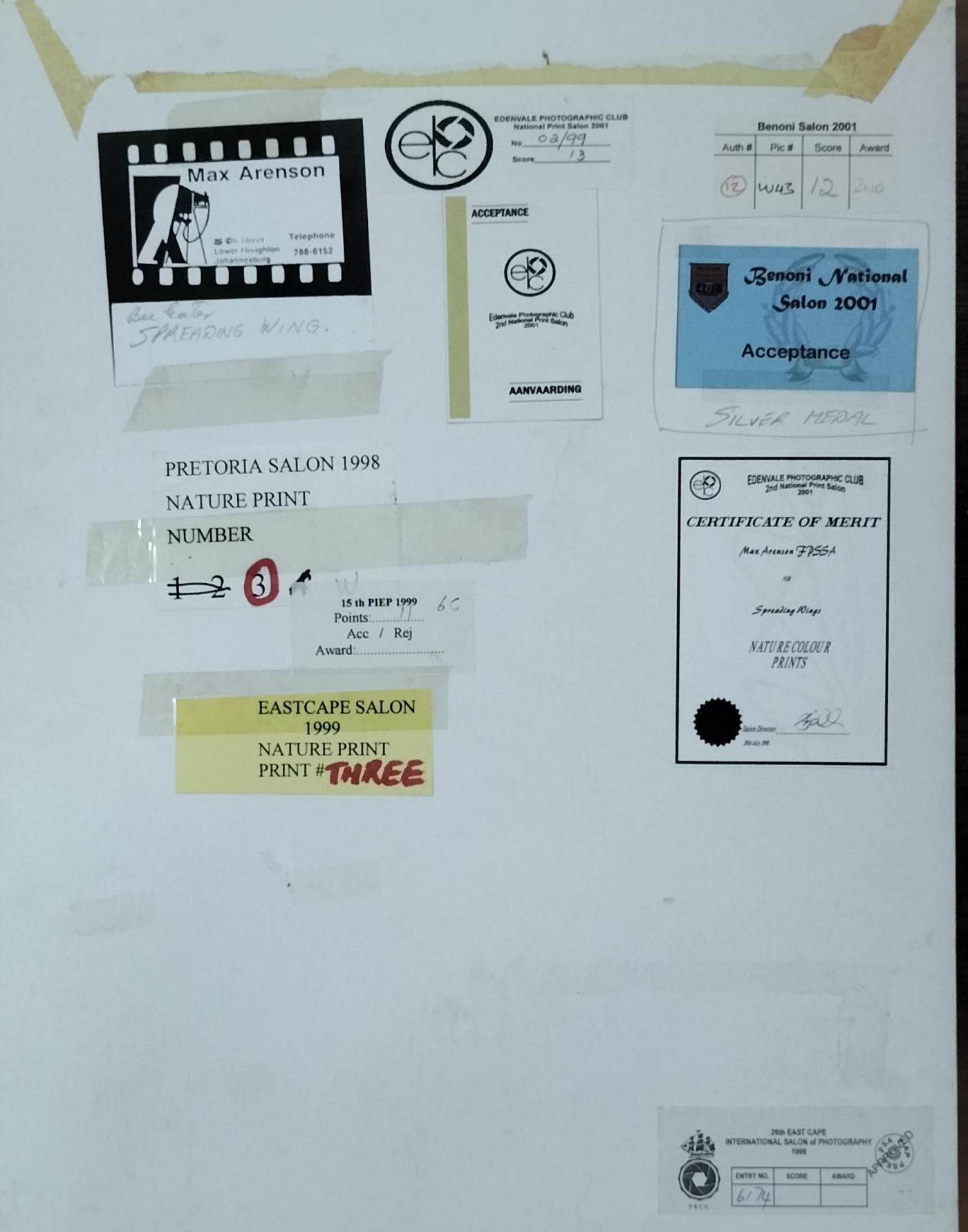
The back of the photograph above showing the different Salons the photograph was entered into
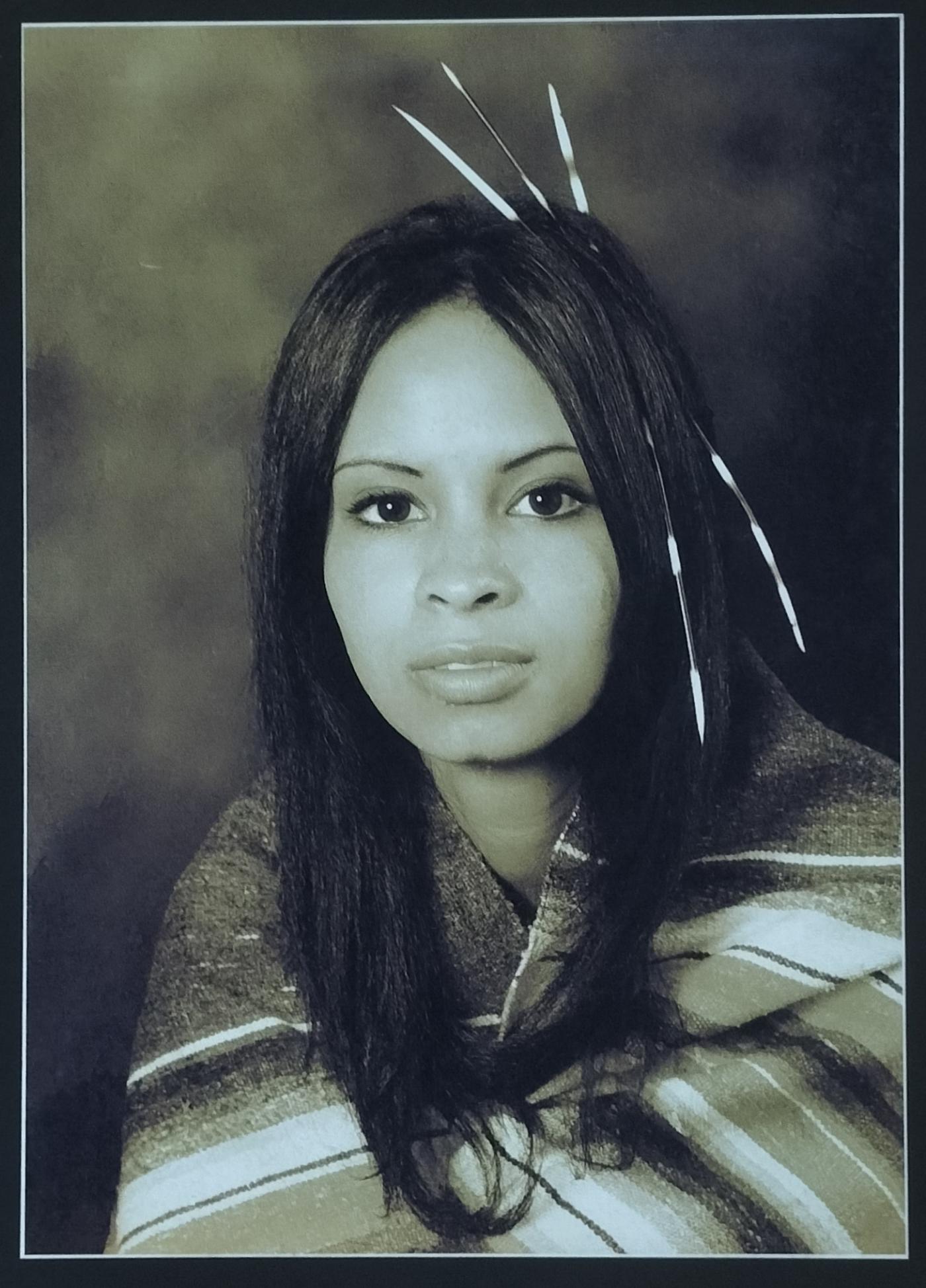
The label on the back of this photograph indicates that Max Arenson was an FPSSA (Dux). For this photograph of the unknown sitter, Max received a gold award from his own club. This image was also entered into the 16th Pretoria International Exhibition (2001) and Benoni Salon (2003 – score 11).
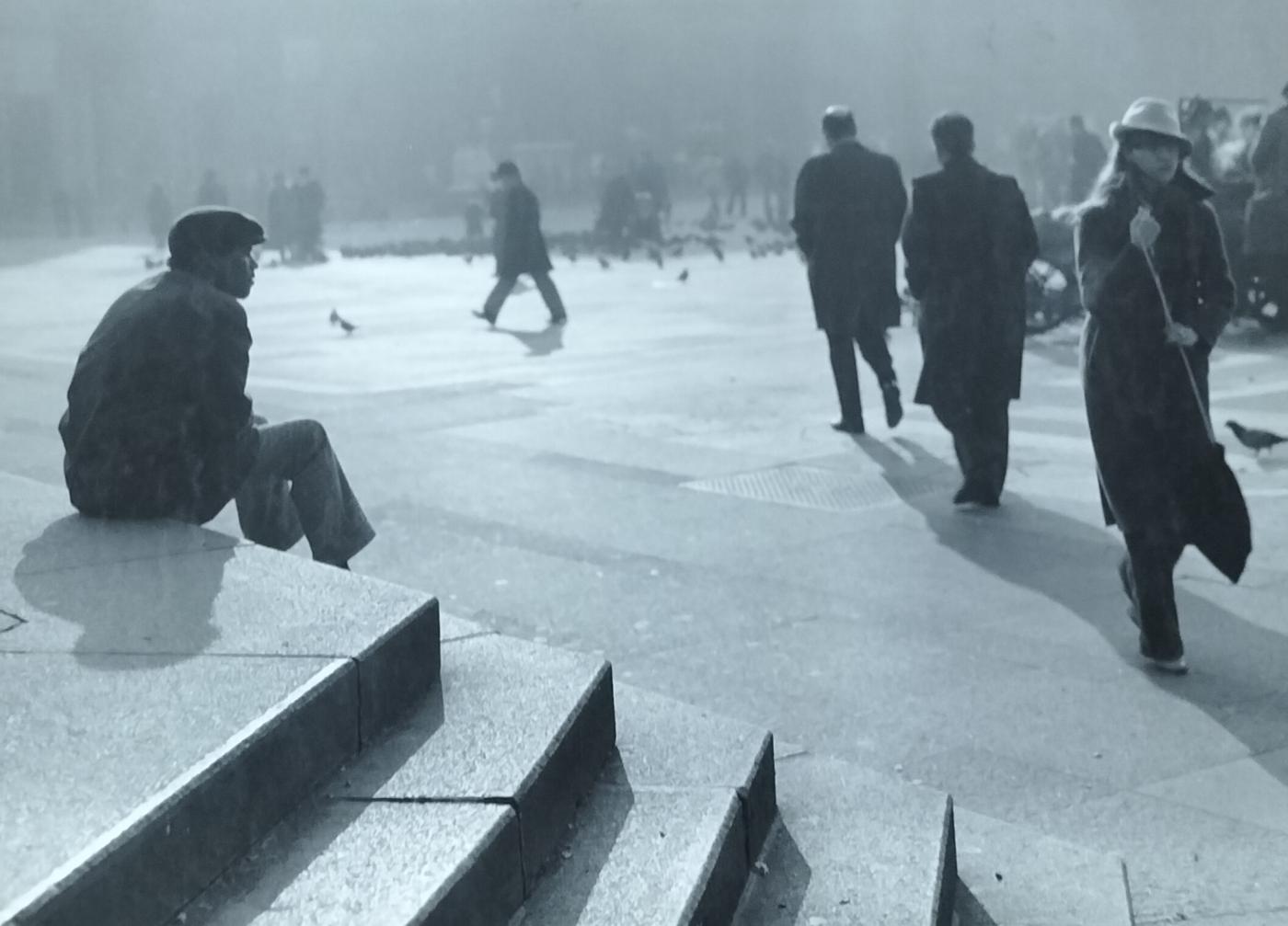
“Early morning” by Max Arenson from the Jabula Camera Club (1998). For this photograph the photographer was awarded a gold award by his own club. The image was also entered into at least 4 different salons.
Conclusion
The research on earlier South African award-winning photographers (pre-1900) needs to continue. Some of this information may be found in exhibition catalogues, which I did not have under eye.
Permission to publish the few photographs from post 1976, where copyright will still reside with the photographer, who may still be alive, was not obtained in that all the images are viewed as discarded – copyright in this instance then has expired (in my view).
The salon entry images contained in this article were sourced from locations as far afield as Johannesburg, Cape Town and Mosselbay.
It may well be that some of these images, justifiably so, have been taken up in photographic publications before.
I was recently informed by a keen amateur photographer that photographic salon entries are now submitted digitally – this in itself then places an additional heritage value on the older print format entries.
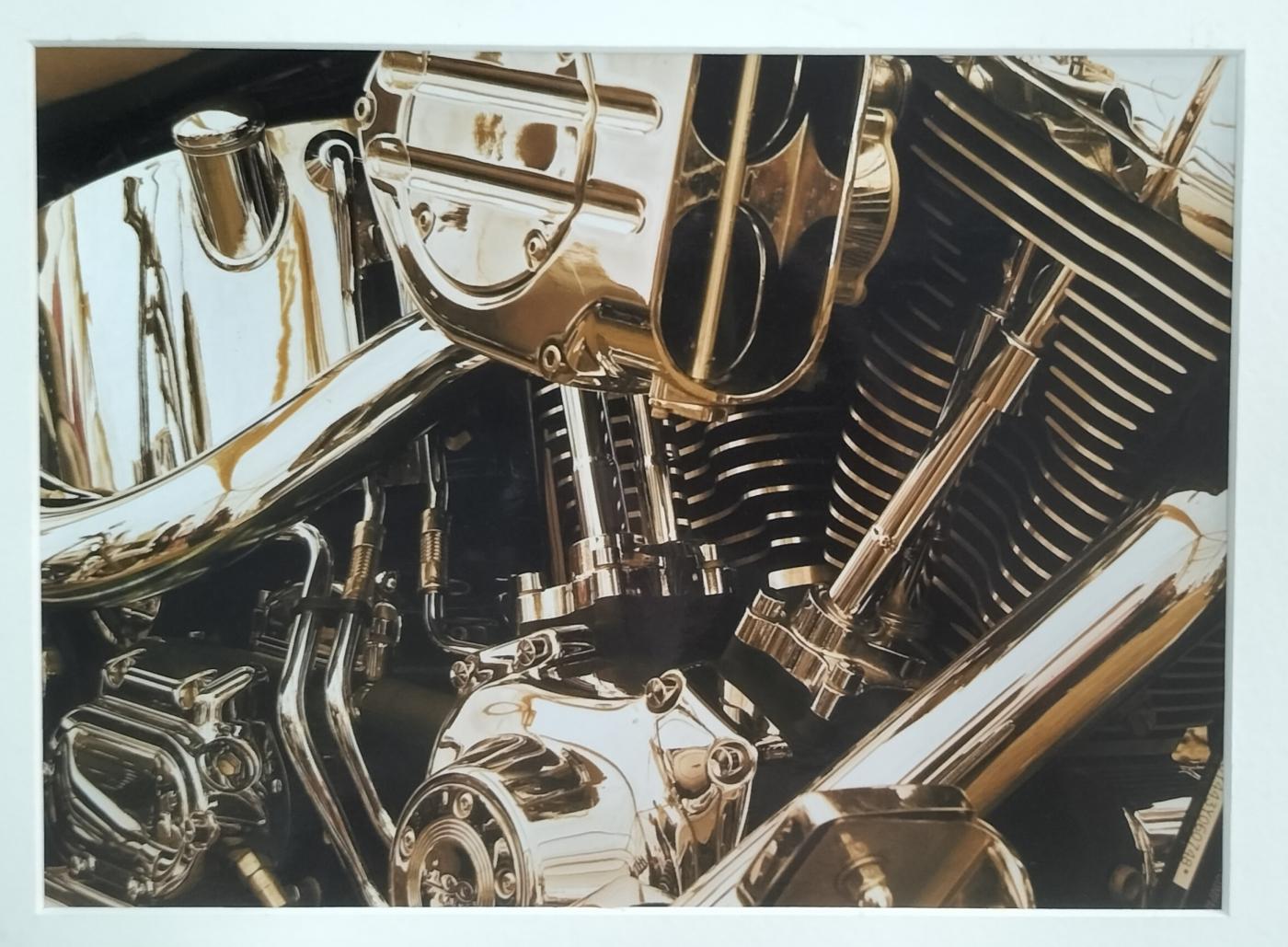
Although this abstract and untitled photograph seems to have been mounted for a photographic salon, it contains no provenance.
Main image: “St Luder” by Max Arenson from the Jabula Camera Club (1997). This photograph contains no further provenance as to when or where it was exhibited.
About the author: Carol is passionate about South African Photographica – anything and everything to do with the history of photography. He not only collects anything relating to photography, but also extensively conducts research in this field. He has published a variety of articles on this topic and assisted a publisher and fellow researchers in the field. Of particular interest to Carol are historical South African photographs. He is conducting research on South African based photographers from before 1910. Carol has one of the largest private photographic collections in South Africa.
Sources
- Bensusan, A.D. (1966). Silver Images. History of Photography in Africa. Howard Timmins. Cape Town
- Bull, M. & Denfield, J. (1970). Secure the shadow – the story of Cape Photography from its beginnings to the end of 1870. Terence McNally. Cape Town
- Hallsworth, J. (2021). Unknown (extracted 15 March 2026). Photo Salons and Exhibitions: Post 1 – What is a salon and why bother. (https://www.gloucestercameraclub.co.uk)
- Unknown (extracted 19 February 2026). Salons/circuits - Frequent asked questions (https://pixoroo.com/clubwebsites)
- Unknown (Extracted 26 February 2026). What is a photography salon and why you should participate (https://centurioncameraclub.co.za)
- Unknown (extracted 15 March 2026). PSSA club advanced guidelines version 2023-07-15 (https://pssa.co.za)
- Wikipedia (extracted 15 February 2026). List of world fairs (Wikipedia.org)
- Wikipedia (extracted 19 February 2026). Empire Exhibition South Africa. (Wikipedia.org)