
The use or reproduction of images from this article for heritage purposes on social media platforms is welcomed, provided that the source is duly acknowledged, namely The Heritage Portal and the Hardijzer Photographic Research Collection.
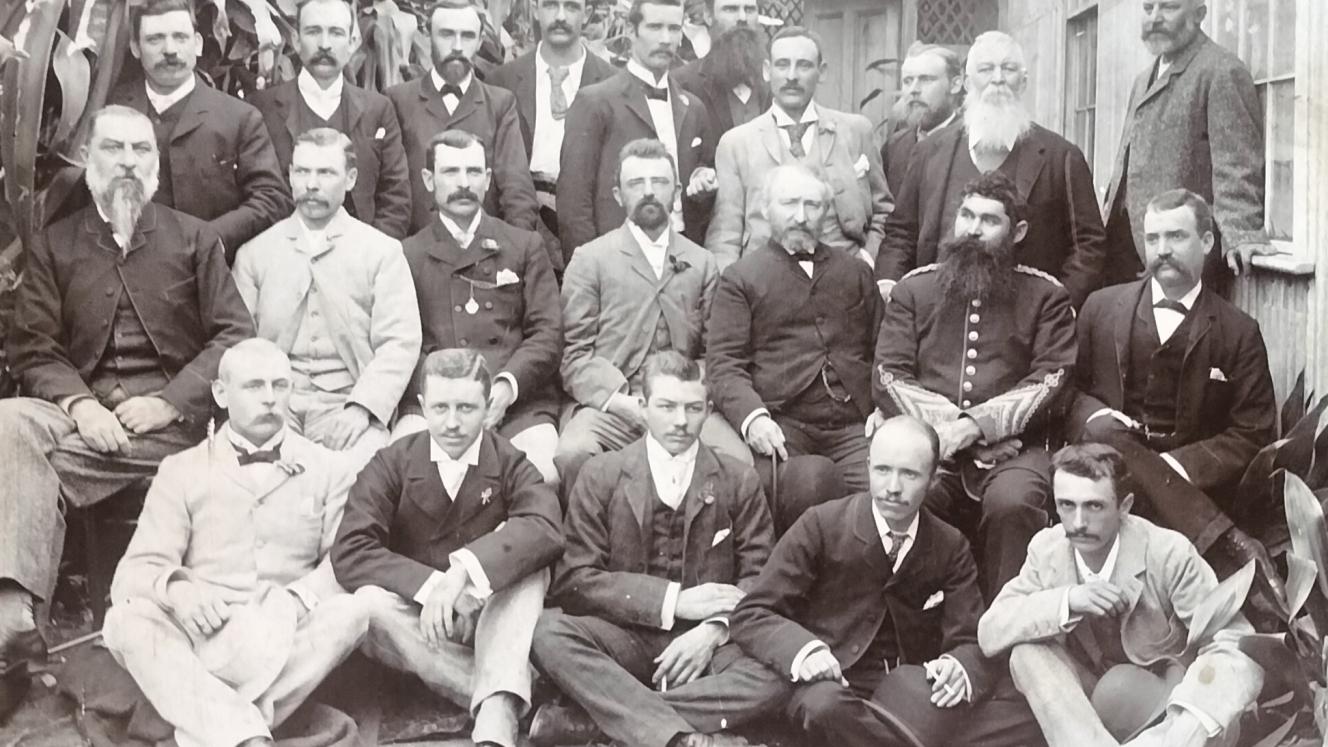
In Swakopmund, Namibia, of all places, I came across and bought a Barberton-related photograph of Zuid-Afrikaansche Republiek (ZAR) government employees. One immediate question is how the photograph came to be in Namibia. This article, however, focuses not on its journey, but on the 22 men depicted in the photograph, as well as the photographer who captured it.
More than one copy of this photograph must once have existed, as the photographer would likely have profited by offering prints for sale to the sitters. Even so, photographs from before the 1900s were expensive luxury items and may not have been affordable to everyone shown.
Antique photographs are valuable genealogical sources. They provide visual evidence of family lineages, help reveal biographical details, and preserve historical context that might otherwise be lost.
Provenance details, such as inscriptions on the back or front of a photograph and studio markings, can also help establish when and where it was taken.
When a photograph is undated, clues such as clothing styles, sleeve shapes, collar heights, and facial-hair trends can help narrow the date range, often to within three to five years. This, however, requires a sound knowledge of the fashions of the period.
The quality of the clothing and jewellery, together with the choice of a professional photography studio, may also offer insight into the sitters’ socioeconomic standing.
Photographs were often taken to mark major life events, such as weddings, engagements and military enlistment. They were also used to document occupational groups, as is the case with the image discussed here.
The photograph, taken in December 1893, shows a group of ZAR government employees based in Barberton. An annotation on the back, dated May 1895, notes that by then several of the sitters had been transferred, some had been dismissed, and one had died. It also records that, apart from some police officers, the sheriff (balju) and the health-management secretary were absent on the day the photograph was taken. The annotation further states that the corps had expanded during the two years that followed.
The photograph was taken by Wilberforce Bayly, a Barberton-based photographer. Also see article on Barberton-based photographers (click here to view).
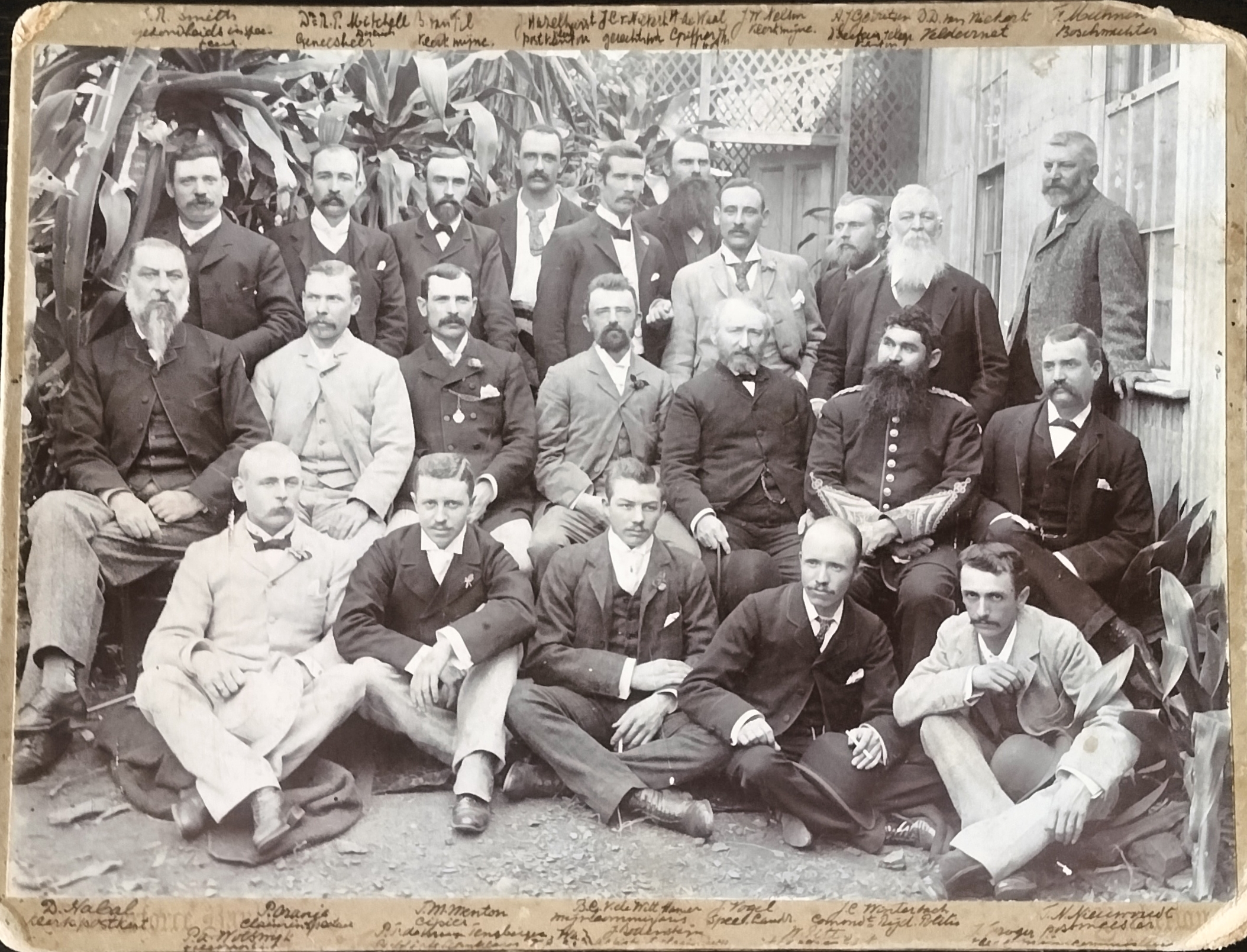
The primary aim of this article is to identify each sitter in the photograph, and where possible, reconstruct their genealogical information, occupation, and significant life events. Although the information on each sitter remains incomplete, it provides a useful starting point for further research.
Zuid-Afrikaansche Republiek (ZAR) Government in Barberton
In the 1890s, Barberton’s local government operated under the centralised authority of the Zuid-Afrikaansche Republiek (ZAR), or Transvaal Republic. Although he did not reside in Barberton, Richard Kelsey Loveday (1854 – 1910), represented the town in the Volksraad between 1891 and 1900.
As a booming goldfield with a large population of foreign diggers (Uitlanders), Barberton required a structured local administration through which the ZAR could maintain control over mining revenues, civil order and public administration.
ZAR government functions in Barberton were divided into several administrative categories and subcategories. The men featured in the photograph were employed across these different branches including mining administration, the magistrate’s office, law enforcement, postal and telegraphic services, health and sanitation and forestry or land management.
In a number of instances, the name of the sitter, or their occupation, is not decipherable. Some fellow historians/genealogists may be able to assist with the deciphering or further identification of the sitters I have not been able to trace.
Biographical information on sitters
Not all sitters, or their occupations could be identified in full in that the handwriting on the front of the photograph has become illegible for at least 2 sitters.
People appearing on formal photographs are referred to as sitters, whether they are standing or sitting. The sitters on the photograph, starting from the front left to the back right, are:
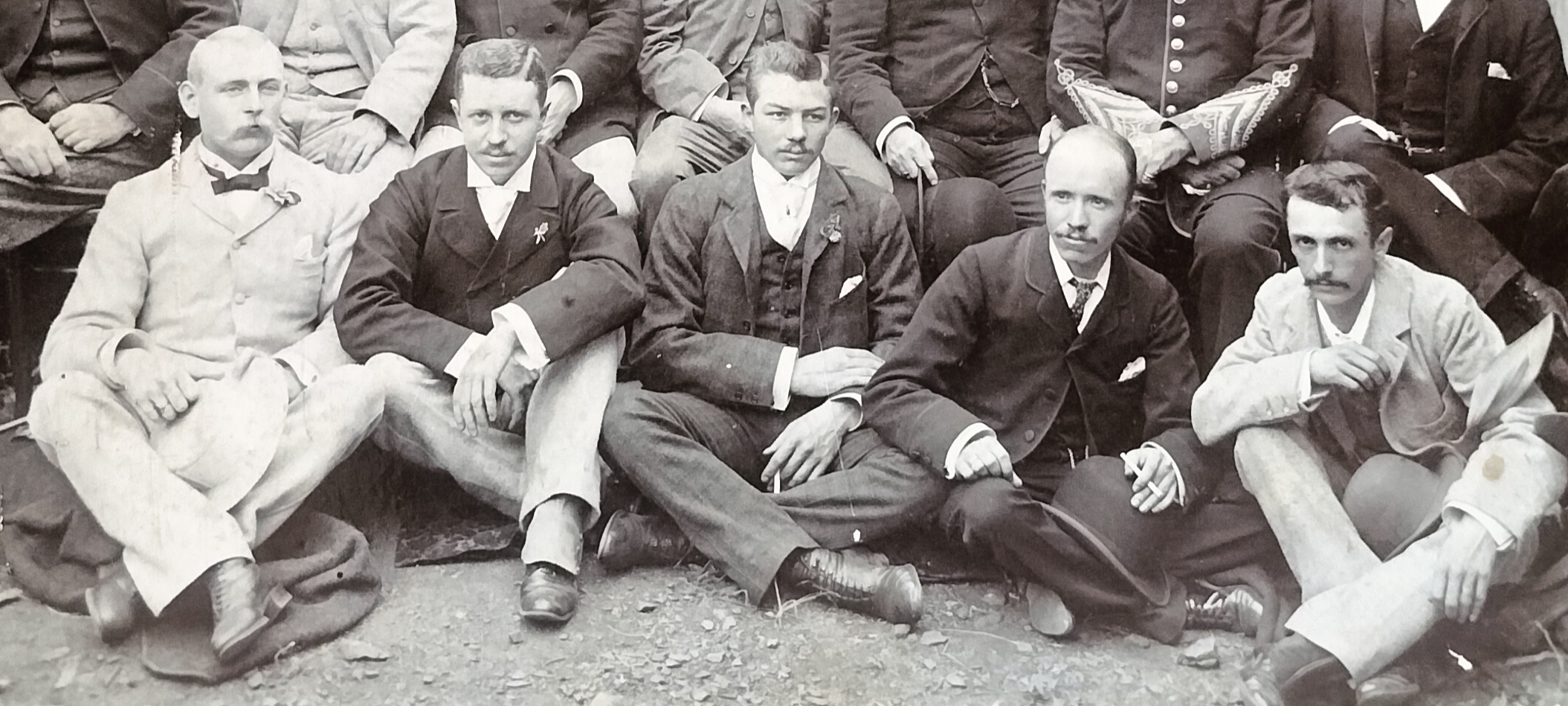
Front – Seated (left to right):
- PA Wolswijk (Telegrafist);
- PJ de Bruyn Rensburg (name unclear/District …);
- J Bodensteijn (occupation not decipherable);
- W. Pitt (position not decipherable)
- J Kruger/Frogen (name unclear /occupation not decipherable)
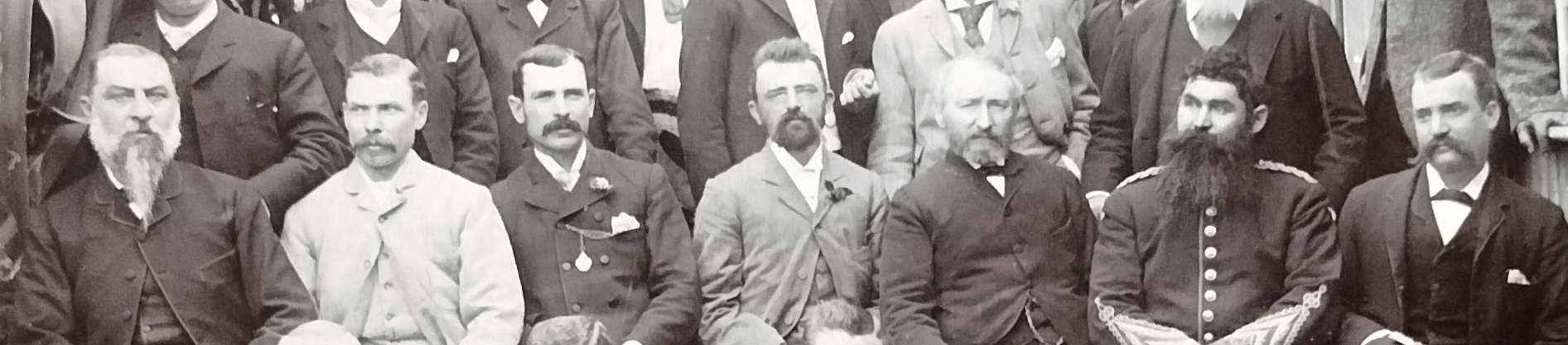
Middle - Seated (left to right):
- D Nabal (Post office clerk)
- P Oranje (Claims inspector)
- JM Menton (Cipier – Prison guard/warden or jailer)
- BGV de Witt Hamer (Mine commissioner)
- J Vogel (Magistrate)
- JC Winterbach (Police Commandant)
- JN Nieuwoudt (Postmaster)
Back row - standing (left to right)
- SR Smith (Health inspector)
- Dr. RP Mitchell (District doctor)
- B van Til (Mines clerk)
- J Hazelhurst (Post Office clerk)
- JC van Niekerk (occupation not decipherable)
- H de Waal (Griffier – court clerk/registrar)
- JW Nelson (Mine clerk)
- AJ Gerritsen (Direktor – telegraph office)
- DD van Niekerk (Field cornet)
- F Human (Boswachter)

Genealogical information of sitters – alphabetical order
Of the 22 men on the photograph, 20 have been identified. Of the 22 identified men, biographical information for half (11) remain unverified.
Two of the names written on the photograph I have not been able to decipher with certainty, namely, J. Kruger (seated front row first from the right) and PJ de Bruijn Rensburg (seated front row second from left).
Files at the South African National Archives were not extracted to possibly enrich the snippets on each of the sitters.
For a few of the sitters, the recorded initials were also unclear. In one or two instances, the initials may have been recorded in a particular order, while subsequent research suggests that they should perhaps be reversed.
1. Bodensteijn Johannes (Jan) - biographical information unverified - Seated front row 3rd from left.
During the 1890s, Jan Bodensteijn, whose surname also appears as Bodenstein or Bodensteyn, served as an official in the civic and administrative bureaucracy of the Zuid-Afrikaansche Republiek (ZAR). His biographical details remain uncertain, as several men with similar names have been traced in South African records.
Bodensteijn’s duties appear to have included processing local taxes, business and liquor licences, and municipal or state records. In this work he would have formed part of the same administrative network as other officials in the photograph, including Johannes Vogel.
He also operated within the wider postal and communications infrastructure of Barberton, working alongside officials such as postmaster J. N. Nieuwoudt, whose office helped maintain the telegraph and mail links connecting the remote Barberton district with Pretoria.
2. de Bruyn Rensburg Petrus Johannes (biographical information unverified) - Seated front row 2nd from left
Because official state documents of the period frequently abbreviated or structured names formally, his records may appear across various archival listings as P.J. de Bruyn van Rensburg, P.J. van Rensburg, or under the combined family lineage De Bruyn Rensburg.
One record suggests that Petrus Johannes de Bruyn van Rensburg was a dedicated civil servant and administrative officer for the Zuid-Afrikaansche Republiek (ZAR), best known for his financial oversight role in the gold-mining district of Barberton during the late 19th century.
3. de Waal Hendrik (1861 – 1934) – Back row 6th from left
Hendrik de Waal was born in the Cape Province on 6 January 1861.
On 1 October 1888 he married his first wife, Dina Maria Taljaard (1863–1893). Dina died in Barberton at a young age in 1893, the same year in which the photograph under discussion was taken. Her death notice was signed by D. D. van Niekerk, the local field cornet at the time. He also features on the photograph under discussion.
Dina’s death on 15 July 1893 occurred only four months after the birth of the couple’s second child, leaving De Waal with two children younger than two. Their second child, Dirk Johannes Adriaan, died in Barberton on 25 September 1893, at only six months old. The loss of two loved ones in such quick succession must have been devastating for De Waal.
De Waal remarried on 24 September 1897 in Wolmaransstad, where he married Petronella Francoretha Bosman (1876–1928). Petronella also predeceased him. The couple had six children.
De Waal died in Wolmaransstad on 18 May 1934. His death certificate records his occupation as a farmer.
4. de Witt Hamer Boudewijn Gerrit Versélewel (1855 – 1930) – Seated middle row 4th from left
De Witt Hamer arrived in South Africa in 1885, having previously served as an officer in the Netherlands Army, where he held the rank of lieutenant.
After landing in Durban, he briefly worked in journalism and is recorded as having been editor of the Natal Afrikaner.
Following the first gold rush to the Transvaal, he entered the service of the Zuid-Afrikaansche Republiek (ZAR). He first served as a collector of Transvaal taxes and later as a court clerk in Johannesburg and Pretoria. In 1891, records indicate that De Witt Hamer applied for naturalisation. A year later he was appointed Mining Commissioner of Barberton, succeeding the late Mr J. L. van der Merwe.
In 1897, De Witt Hamer resigned from office to enter political life and was elected as the member for Barberton in the Second Volksraad. By 1899 he was serving as secretary to Christian Joubert.
During the Anglo-Boer War he was captured and sent first to Elandslaagte and later to St Helena as a prisoner of war.
After the war, he worked for De Volkstem in Pretoria and later served as secretary of the Miners’ Phthisis Board from 1911 to 1923.
He was awarded an Anglo-Boer War medal as well as the Dutch Order of Orange-Nassau. He was also a well-known Freemason and a founding member of the Hollander Korps (Dutch Corps), in which he became commander with the rank of captain.
It is recorded that he married Dutch-born Louisa Ferdinanda Eekhout (1859–1911) in Amersfoort in 1885. The marriage appears to have been childless and to have ended before 10 April 1897, when he married his second wife, Swiss-born Glady Disteli (1875–1962). The couple had one daughter, also named Glady, who was born around 1904.
De Witt Hamer died on 18 December 1930 in Dundee, KwaZulu-Natal, at the age of 75.
5. Gerritsen Albertus Gerhardus (biographical information unverified) - Back row 8th from left
A.G. Gerritsen (frequently recorded as Geritsen or Gerritson in ZAR administrative papers) was a central operational figure within the postal, telegraph, and customs services of Barberton during the transition from the late 1890s into the early 1900s.
Records indicate that he was already the appointed Director of the Barberton telephone/telegraph office in 1890, the same year that a telephone exchange was implemented in Pretoria.
6. Hazelhurst James “Jim” (1868 – 1916) – Back row 4th from left
James “Jim” Hazelhurst was born on 14 April 1868, most probably in Pietermaritzburg, although another source gives Utrecht as his place of birth. On 7 August 1895 he married Annie Sophia Albasini (1874–1951) in Pietersburg. The couple had four children.
Hazelhurst arrived in Barberton in 1886 where he was the assistant postmaster and left the town approximately one year before his marriage to Annie. He later served for a period as postmaster in Heidelberg before relocating to Rhodesia, present-day Zimbabwe.
His move to Rhodesia marked a shift from ZAR postal administration to commercial transport. Having previously worked as a postal accountant, he entered the service of Zeederberg Coaches as a local manager. This appointment may have been facilitated by family connections, as his wife’s sister was married into the Zeederberg family.
Hazelhurst died in Rhodesia in 1916, at the age of 48. His cause of death was recorded as a fractured skull, although the circumstances leading to the injury remain unclear. It is possible that the injury was connected to a transport or carriage accident, but this has not yet been confirmed.
After his death, Annie remained in Rhodesia, where she died in 1951.
7. Human Frederik (biographical information unverified) - Back row 1st from right
The first name is assumed to be Frederik, a common Afrikaans name that appears frequently in South African genealogical records for the ZAR period. Human served as a forester, managing timber resources that were in high demand for deep-level mining operations at the time.
8. Kruger J (occupation and biographical information unverified) – Seated front row 1st from right
This name written on the photograph is not decipherable and is only assumed to be Kruger. No record could be traced of a Kruger active in Barberton at the time.
9. Menton Thomas Madden (+-1859 – 1904) – Seated middle row 3rd from left
Irish-born Thomas Menton, also documented as J. M. Menton, was a former British soldier who is recorded as having deserted his post in the 1880s. He subsequently entered the service of the Zuid-Afrikaansche Republiek (ZAR), where he held several prominent law-enforcement and penal positions. During the early 1890s he served in Barberton as goaler and law-enforcement official.
After his period in Barberton, Menton became better known in historical records as Chief Warden of the South African Republic Police (ZARP), appointed in 1890, with responsibility for correctional facilities during the height of the Transvaal gold-rush period.
During his tenure as governor of the early Johannesburg gaol, the facility became known colloquially as Mentonville. The name appears to have emerged in April 1895, when the Paul Kruger government began constructing a high brick wall around the maximum-security prison site on Hospital Hill. Because Menton was the gaoler at the time, locals combined his surname with the naming convention of London’s Pentonville Prison to produce the mocking nickname Mentonville (Norwich, 2026).
Menton married Emma Mary Horseman (1866–1928) in Harrismith on 10 June 1882. The couple had five sons, two of whom are recorded as having been born in Barberton, in 1893 and 1898 respectively.
Menton died at the Pretoria Asylum on 25 December 1904, at the age of 45. His occupation was recorded on his death certificate as “Chief Detective, late ZAR”.
The cause of death was recorded as “general paralysis of the insane”. Also known as general paresis or paralytic dementia, this condition was understood as a severe neuropsychiatric illness and is now associated with late-stage neurosyphilis, in which infection affects the brain and central nervous system years after the initial illness.
After Menton’s death, Emma Mary later remarried.
10. Mitchell Robert Peter Dr. (1860 – 1919) – Back row 2nd from left
Scottish-born Dr R. P. Mitchell graduated with an M.B., C.M. from the University of Edinburgh in 1883. He emigrated to South Africa the following year, briefly practising medicine in Natal before moving to Barberton in 1886, where he became a prominent senior medical practitioner and political figure. Records indicate that he applied for naturalisation in 1892 and that he was appointed as the district’s medical practitioner in 1893, the same year the photograph was taken.
In 1894 Mitchell moved to the Witwatersrand, where he established a joint practice with Dr B. Bertram and secured several appointments with local mines.
Mitchell became deeply involved in Transvaal politics and joined the Reform Committee. Following the failure of the Jameson Raid in early 1896, he was imprisoned in Pretoria.
He eventually returned to Barberton in 1910, where he resumed medical practice until the start of the East African Campaign during the First World War.
Mitchell married Elaine Agnes Haddon (c. 1869–1914) in Barberton on 10 July 1890. She died in 1914. The couple had seven children, five of whom were still minors at the time of her death.
Mitchell did not remarry. He died five years after Elaine, on 11 November 1919, in a military hospital in Dar es Salaam, Tanzania. He was not yet 60 years old and left two minor children.
11. Nabal Dirk Conelius (1844 -1897) – Seated front row 1st from left
Dutch-born Dirk Cornelius Nabal married the British-born widow Annie Maria Griffith (1847-1890), born Thomas, in Potchefstroom on 11 October 1875. Annie brought three Griffith children into the marriage.
In the photograph, Nabal’s occupation is recorded as postal clerk. When he died in Barberton at the age of 53, his death certificate still described him as a clerk.
Annie died in Barberton on 3 May 1890, leaving Nabal with three minor children from their marriage. Her death certificate was signed by Field Cornet D. D. van Niekerk, thereby linking this family record to another sitter in the photograph under discussion.
The eldest child from Nabal and Annie’s marriage, also named Dirk Cornelius, was recorded as an evangelist at the time of his death.
Records indicate that Nabal somehow transgressed the gold law (article 86) in 1892. The details thereof are unknown.
Nabal’s name has significance in early Transvaal legal history because an earlier dismissal gave rise to an important constitutional test case in the early 1880s.
Nabal was employed in Heidelberg, Transvaal, during the British annexation period. After retrocession in August 1881, his employment was provisionally retained, but the Volksraad terminated it on 31 December 1881 without just cause or compensation.
Nabal sued the state for wrongful dismissal and associated damages. His claim was dismissed on the basis that Volksraad resolutions had the force of absolute law and could not be judicially contested. The verdict therefore went against Nabal. Fourteen years later, Chief Justice Kotzé, the same judge, adopted a different view in Brown v Leyds (1897), a shift that contributed to his own dismissal by President Paul Kruger.
12. Nelson JW (John William) (1865-1937) - (biographical information unverified) - Back row 7th from left
Two possible J. W. Nelsons have been traced: John William Nelson and James William Nelson. Although no clear evidence has yet been found placing either man in Barberton, the sitter is tentatively assumed to be John William Nelson.
If this identification is correct, his biographical information remains limited. John William Nelson married Letitia Hermina Preller in Pretoria in June 1888, but she died the following year. He later married Susan Gunning (1867–1950) in 1895. No confirmed details have yet been traced regarding their later lives or whether they had children.
13. Nieuwoudt JN (Johannes Nicolaas) - (biographical information unverified) - Seated middle row 1st from right
The sitter is tentatively identified as Johannes Nicolaas Nieuwoudt, who appears in the photograph as Barberton’s postmaster. If this identification is correct, he would have managed the town’s busy post office during the 1890s, when postal and telegraphic services were central to Barberton’s mining economy and administrative life. Further confirmed details regarding his personal life have not yet been traced.
14. Oranje Pieter (1863 – 1943) – Seated middle row 2nd from left
Dutch-born Pieter Oranje is recorded as having been a civil servant, architect and plant collector. It has been suggested that he emigrated from the Netherlands as a draughtsman with the NZASM. He applied for naturalisation as early as 1891 but only became a naturalised citizen in February 1900.
In 1888 he became supervisor of public works in Barberton and, in December of that year, was appointed to oversee the completion of the local jail and its associated outbuildings.
By 1889 Oranje was also serving as Barberton’s claims inspector, and by February 1893 he had taken on the additional role of inspector of roads. In the late 1880s or early 1890s, Oranje also acted as architect for additions to the Barberton hospital. In 1898 he also drew up plans for a new school building in Barberton. In 1901, shortly after British forces had taken over the administration of the Transvaal during the Anglo-Boer War (1899–1902), he was appointed as a clerk in the office of the district commissioner at Barberton.
On 8 July 1904 Oranje was appointed forest ranger in the Department of Agriculture of the Transvaal Colony, stationed at Barberton. He collected plants in the vicinity of the town for the Transvaal Museum. Most of his specimens are now housed in the National Botanical Institute in Pretoria. Some of his plants, including the type specimen of Schotia transvaalensis—the dwarf boer-bean, known in Afrikaans as the klein- or Transvaalboerboon—are held in the herbarium of the Royal Botanic Gardens, Kew, in England.
In 1913 Oranje was serving as a beacon inspector in the Department of Mines of the Union of South Africa. In 1925 he purchased the farms Wilsonvale 176 and Vlottenburg 57 in the Barberton district.
In September 1894, nine months after the photograph under discussion was taken, Oranje married Evelyn Mary Treadwell in Barberton. She was eleven years his junior, and their marriage certificate records his occupation at the time as claims inspector in Barberton.
Evelyn died on 14 August 1895, twenty-five days after the birth of their daughter, also named Evelyn Mary. Oranje later married Maud Mary Hardwich (1869–1947) in the Komga district on 16 September 1897.
Oranje was a Freemason. He died in East London on 7 March 1943, at the age of 79.
15. Pitt William (biographical information unverified) - Seated front row 4th from left
No confirmed biographical information on Pitt has yet been traced. One record exists indicating that a WE Pitt applied for naturalisation in 1891, suggesting that he may have originated from Britian.
16. Smith SR (Sidney/Sydney Robey) - (biographical information unverified) - Back row 1st from left
Sydney Smith was tasked with the actual day-to-day enforcement of public health bylaws as Barberton’s health inspector. His duties would have included the monitoring and implementation of preventative public-health measures against malaria, a disease long associated with the region’s reputation among travelers as part of the “Valley of the Shadow of Death”. He would also have been concerned with town sanitation, including waste disposal, overcrowding in digger settlements, and access to clean water.
No further confirmed biographical information on Smith has yet been traced.
17. van Niekerk Daniel David (1842 – 1923) – Back row 2nd from right
Daniel David van Niekerk, also recorded as David Daniel van Niekerk, was born in Pietermaritzburg in 1842. During the 1890s he served the ZAR in the De Kaap Goldfields, in the Barberton district, in a dual administrative capacity as field cornet (veldkornet) and as an inspector concerned with roads or public works.
Within the ZAR administrative system, a field cornet was an important local official, elected by the burghers of a ward. In peacetime, the office combined administrative, policing and minor judicial functions. In wartime, however, the field cornet assumed a military role, broadly comparable to that of a junior officer, and was responsible for leading local burghers in commando service.
As a former ZAR official with both administrative and military responsibilities, Van Niekerk appears to have faced difficulties in the aftermath of the Treaty of Vereeniging in 1902. In the immediate post-war years, he petitioned the British colonial administration for assistance, adjustment or compensation relating to his former official position and wartime status.
Van Niekerk’s death certificate indicates that he was first married to Elizabeth van Wyk, who died around 1866. He later married Anna Oosthuizen in Wakkerstroom, and the couple had five children.
Van Niekerk died in Middelburg, Transvaal, at the age of 81.
18. van Niekerk Johannes Christoffel (assumed first names) – (biographical information unverified) - Back row 5th from left
Biographical information on Van Niekerk could not be determined beyond reasonable doubt in that it is a common Afrikaans name that appears frequently in South African genealogical records for the ZAR period.
One record indicates that a JC van Niekerk applied for the role as a clerk in Barberton during 1892, a year prior to the photograph been taken.
19. van Til Bartus (1867 – 1910) – Back row 4th from left
Dutch-born Bartus van Til emigrated to the Transvaal in 1888, apparently seeking better opportunities as an agriculturist.
Van Til married Malvina Elizabeth Marsden (1870–1934) in Barberton in January 1895. His occupation was recorded as clerk on their marriage certificate, suggesting that he may not have pursued his agricultural ambitions. By the time of his death, his occupation was recorded as storekeeper.
He died in Carolina, Transvaal, on 7 February 1910, at the age of 43, leaving his wife and six young children. The couple’s last child was born nine days after his death.
By the time of Malvina’s death, one of her children had predeceased her. Gerhardus was a 19-year-old fireman when he died.
20. Vogel Johannes (biographical information unverified) – Seated middle row 5th from left
One of the three older men in the photograph, Vogel served as the local resident Magistrate (Landdrost), overseeing civil and criminal disputes in the Barberton district, a role he accepted in 1890 already.
During Vogel's era, Barberton transitioned from a chaotic 1880s gold rush hub into an established administrative district. The local magistrate's court would have handled complex mining claim conflicts, insolvency cases, and local labour disputes.
21. Winterbach Johan Carel (1850 -1907) – Seated middle row 2nd from right
Johan Carel Winterbach was born in Tulbagh, Cape Colony, on 11 December 1850. He was the second eldest of twelve children born to Dirk Jacobus Winterbach and Hester Francina Elizabetha Verster.
After settling near Lydenburg as a young man around 1870, he married Susanna Jocina Malan (1853–1945) in Lydenburg on 18 May 1874. The couple had seven children and initially lived on the farm Boshoek.
Whilst based in Barberton, Winterbach submitted two separate requests for compensation, one for his role in the Mapoch war and the second for the arrest of a local.
As part of the post-Boer War re-marriage phenomenon, Winterbach and Susanna remarried in 1904 to legally reaffirm their union after the Second Boer War.
Winterbach was a notable Boer military officer who served in several defining conflicts in the Transvaal region during the late nineteenth and early twentieth centuries. These included:
- Service during the Sekhukhune Wars (1876–1879) and the Mapoch War (1882).
- Service as a gunner (kanonnier) during the First War of Independence (1880–1881).
- Appointment as commandant for the Lydenburg District in 1882.
- Appointment as commandant of the Mounted Police (Berede Polisie) from 1886, based in Barberton.
- Appointment as commandant of the Swaziland Border Police, which operated from Barberton.
- Service as a Boer commandant during the Anglo-Boer War (1899–1902).
Winterbach authored Herinneringe (Memories), in which he reflected on some of his military experiences.
After the Second Anglo-Boer War, Winterbach returned to Lydenburg, where he lived first on the farm De Groote Boom, on the Spekboom River, and later on Zwakwater.
Winterbach died on 17 August 1907, although some records suggest 1908. He was 57 years old and is buried in Lydenburg. His death certificate records his occupation as a farmer.
22. Wolswijk Paul Alexander (1866 -1915) – Seated front row 1st from left
Dutch-born Paul Alexander Wolswijk married Helena Johanna de Cock (1867–1907), also of Dutch origin, in Pretoria in January 1906. Both were residing in Pretoria at the time of the marriage. The marriage took place relatively late in life: Wolswijk was about 41 years old, while Helena was about 38.
In 1890, Wolswijk was transferred to Barberton as a telegraphist. By 1899, he was working as a clerk in the Department of Foreign Affairs. At the outbreak of the Anglo-Boer War, he offered his services as a field telegraphist and, in August 1899, requested a Mauser rifle and 50 rounds of ammunition. He is also recorded as having been a Boer prisoner of war.
After the Anglo-Boer War, Wolswijk appears to have established himself as a photographer in Pretoria. By about 1903 he owned or managed the West-end Studio at 41 Bloed Street.
The West-end Studio places Wolswijk within Pretoria’s early twentieth-century commercial photography trade, when studio portraits remained an important way to record family, occupational and civic identity. Its Bloed Street address suggests a central location serving Pretoria’s administrative, commercial and residential communities.
A 1913 directory entry indicates that P. A. Wolswijk was then working as a house and insurance agent.
He is also recorded as having been a shareholder in the Pretoria Oost-Einde Skool Vereniging Beperkt, associated with the East End School in Meintjes Street, Sunnyside.
Wolswijk died in Pretoria in April 1915, at the age of 49. He was declared insolvent at the time of his death.
By then he was already a widower. Helena had died on 9 April 1907, at the age of 40, only about 16 months after their marriage. The couple had no children.
The photographer - Wilberforce Bayly (1865-1944)
A barely visible rubber stamp at the bottom of the photograph identifies Wilberforce Bayly as the photographer.
The photograph’s exact setting is unknown, but it was probably taken either outside a government office in town or at Bayly’s studio.
Bayly was born in Hampshire, England during 1865 and arrived in Barberton during 1886.
In Barberton’s early years, Bayly played an active role in the town’s civic and cultural life. He was among the first, and possibly the first, Masters of the Free Masons Nederland’s Constitutions’ Jubilee Lodge, which did not survive the Anglo-Boer War. A keen musician, he belonged to the old Barberton Orchestral Society, which contributed to the town’s cultural development. He also took part in productions by the Barberton Dramatic Society and, with his eye for scenic effect, served as its Scene Master. Bayly was remembered as a willing worker in charitable efforts and in ventures intended for the cultural enjoyment of Barberton’s residents. He is also recorded as having been a Justice of the Peace.
Wilberforce married Ruby Noel on 27 January 1894. Ruby predeceased him, dying in Barberton in April 1939 at almost 70 years of age. The couple had four children: Brian, Noel, Esme Lownds and Beryle. Each child carried their mother’s maiden name, Noel, as a second name.
At one stage, Bayly’s studio operated from the business premises of the Crossley Brothers, general dealers who sold books, printed materials, seeds, newspapers, photographic supplies and toys.
Bayly managed Lee’s studio during Lee’s absence, but he too left Barberton at the outbreak of the Anglo-Boer War in October 1899. During his year away from the town, he appears to have been based in Lourenço Marques and Durban.
When Bayly returned to Barberton the following year, he supported Thomas Lee’s claim for government compensation. He stated that, on his return, he had seen British troops in possession of photographic materials that had disappeared from the studio.
A separate government claim by his brother, A. W. Bayly, for goods commandeered during the war by both the Boers and the British under General French, confirms that Wilberforce was manager of A. W. Bayly & Co. when the war began in 1899.
In 1909, Bayly applied for freehold title over two Barberton stands, numbered 428 and 429. Both properties were registered in Ruby’s name in 1916.
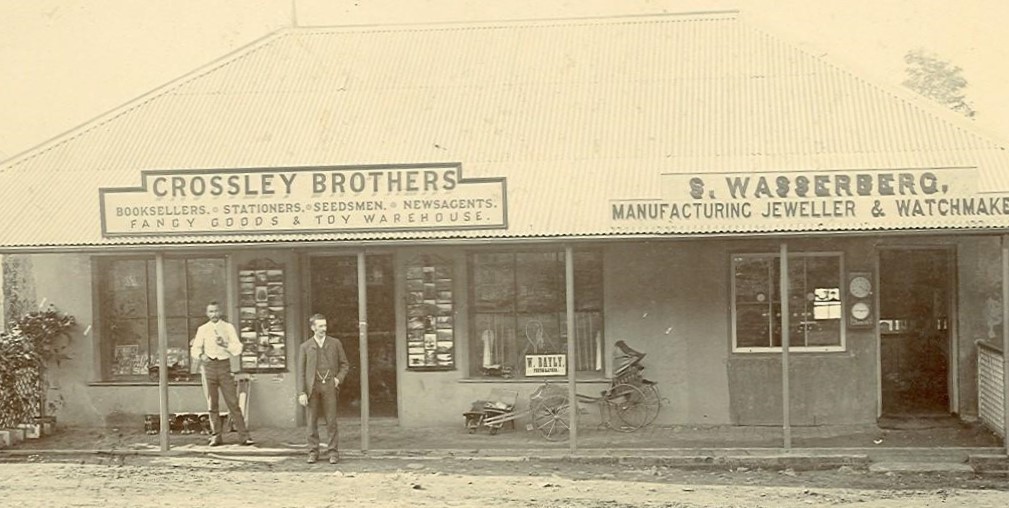
In 1910, Bayly was granted a mining lease (mijnpacht), apparently with the intention of using suction dredging on alluvial soil. It is unclear whether he ever pursued mining, as he left Barberton around the mid-1910s to take up business interests in Lourenço Marques. During the early part of his absence, Thomas Lee managed the Bayly studio for a time.
Bayly remained in Lourenço Marques until illness forced him to retire. He returned briefly to Barberton before staying with his daughter, Esme Lownds, in Toulon, France. His health did not improve, and he spent the final two years of his life under care in Johannesburg.
Bayly died in Johannesburg on 12 June 1944, aged 79, as reported in The Gold Fields News on 13 June 1944.
One of Wilberforce’s daughters later made a substantial donation to the Barberton Museum, which now holds several family photographs taken by him.
Closing
In the photograph, 20 of the 22 sitters were identified, hopefully correctly.
Research on the 22 men was complicated in that Eastern Transvaal historical sources make surprisingly little reference to the sitters, suggesting that many government employees remained in their posts, or in Barberton itself, too briefly to leave a lasting impression. This makes the photograph all the more significant.
According to the inscription on the back of the photograph, one of the sitters died between December 1893, when the photograph was taken, and May 1895, when the inscription was added. I remain curious as to which sitter this was and what the cause of death may have been.
The reference to a dismissal is equally intriguing. Who was dismissed and what were the circumstances?
In my research, I seldom attempt to provide final answers to every question that arises. Many gaps remain, the answers to at least some of the unresolved questions may yet be found.
Sources
- Artefacts.co.za (extracted 18 August 2026). Pieter Oranje
- FamilySearch (variety of files extracted from familysearch.org)
- Google AI (various related questions asked – of little value to the research)
- Hardijzer, C.H. (2018). Photographers active in Pretoria – First 60 years (1855 to 1915) (theheritageportal.co.za)
- Hardijzer, C.H. (2020). Where there was gold there were photographers – Barberton goldrush (theheritageportal.co.za)
- Lombaard, B.V. (unknown). Die herinneringe van Kommandant J. Carel Winterbach 1850 – 1907 (www.winterbach.za.net)
- Norwich, O. (2026). The history of early goals in Johannesburg and the development of the Johannesburg fort. (www.theheritageportal.co.za)
- Ploeger, J. (1994). Nederlanders in Transvaal 1850 – 1950. Van Schaik. Pretoria
- Plug, C. (2025). Pieter Oranje. S2A3 Biographical database of South African Science. (www.s2a3.org.za)
- Plug, C. (2025). Richard Kelsey Loveday. S2A3 Biographical database of South African Science (www.s2a3.org.za)
- Southern African Legal Information Institute – SAFLII (extracted July 2026). Nabal vs Bok (1883). (www.saflii.org)
- Unknown. (extracted July 2026). Kommandant Johan Carel Winterbach (www.winterbach.za.net)
- Unknown. (extracted July 2026). Winterbachs in South Africa – Johan Carel Winterbach (familytrees.genopro.com)
- Wikipedia. (extracted 18 August 2026). General paralysis of the insane
- Wikitree (extracted 18 August 2026). De Witt Hamer (wikitree.com)