
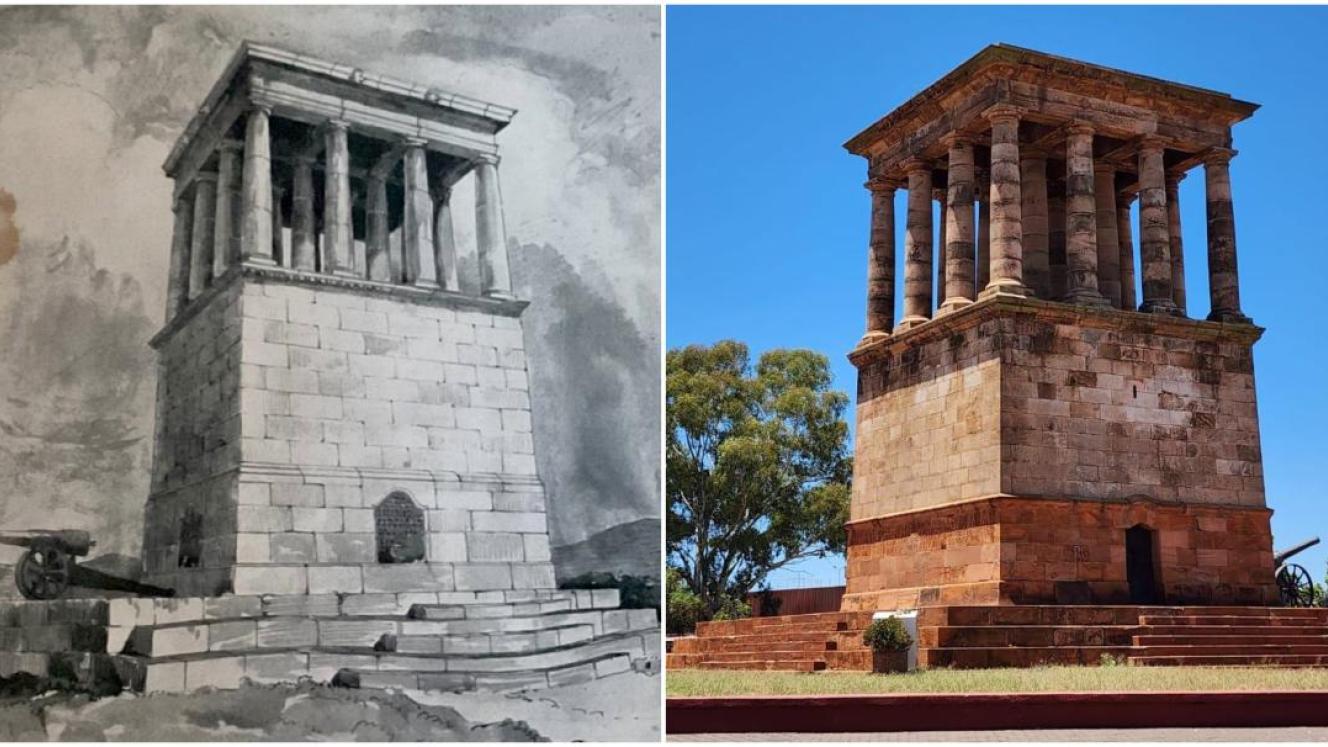
Late last year I purchased a copy of the Diamond Fields Advertiser, Illustrated Christmas Number of 1901. It is a remarkable document — a window into a mature Kimberley returning to normal life after the trauma of the South African War (Anglo-Boer War). The town had endured the long months of siege (14th October 1899 – 15th February 1900) and although the war was still in progress at the time of publication, it was already receding as a front line. British authority had been reasserted, and a process of civic recovery was underway.
The publication offers a vivid contemporary lens through which to view Kimberley at this moment of transition. Advertisements, group photographs, and civic commentary reveal a community re-establishing itself — socially confident, commercially active, and unmistakably shaped by a single dominant industry. There was only one enterprise of consequence, and the entire local economy revolved around it: diamonds.
Among the many articles, one drew my attention. It described a proposed memorial to the curiously named Honoured Dead, designed by Herbert Baker. Even on the printed page, the project conveyed an architectural ambition far beyond that of a conventional monument.
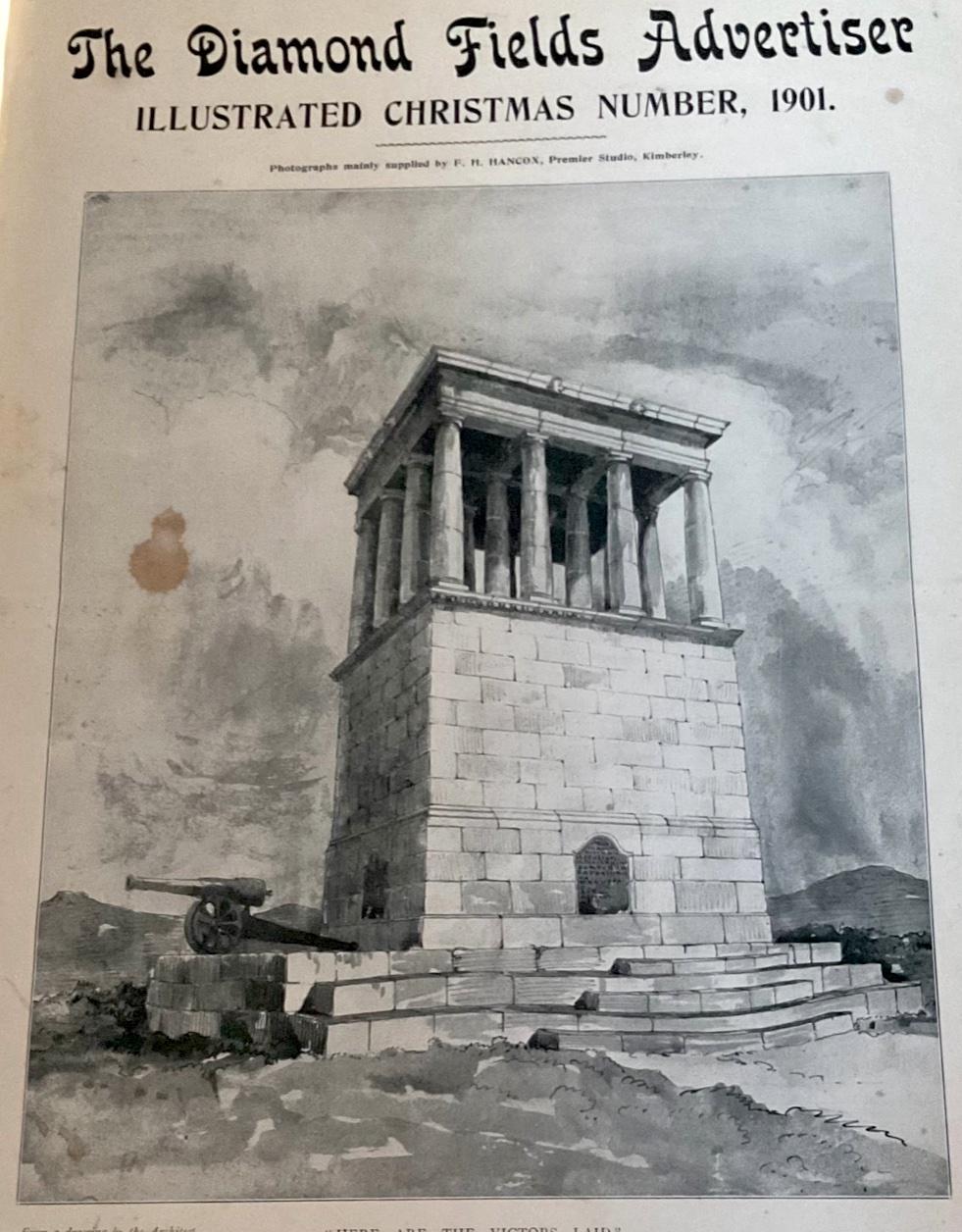
Cover of the 1901 Edition
It was a moment in time when Baker had a well-established practice in Cape Town, benefitting hugely from the patronage of Cecil Rhodes. Rhodes was still alive (he died in March 1902) and was still thinking about Kimberley and his experiences there during the siege. De Beers had played a key part and it was in its workshops that the Long Cecil canon was fashioned.
Rhodes began to think about a memorial at quite an early point and his first idea was a Roman style nymphaeum or bath. This was not realised. Instead, the memorial was far more monumental in the form of the Memorial to the Honoured Dead. It is still extant in Kimberley and is a provincial heritage site. It is something of a curiosity as it combines a function as a mausoleum or tomb, a memorial and a prominent monument.
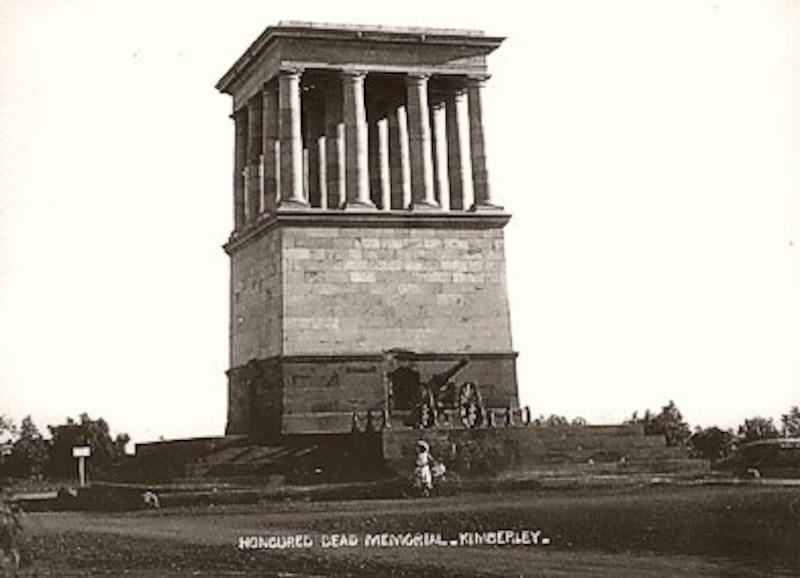
Old postcard of Honoured Dead Memorial
The 1901 Vision in Print
The Diamond Fields Advertiser published both a perspective drawing and architectural plans for the proposed memorial, designed by Baker and commissioned by Cecil Rhodes. The accompanying description referred to a “noble and imposing tomb,” to be erected on a commanding site outside the town.
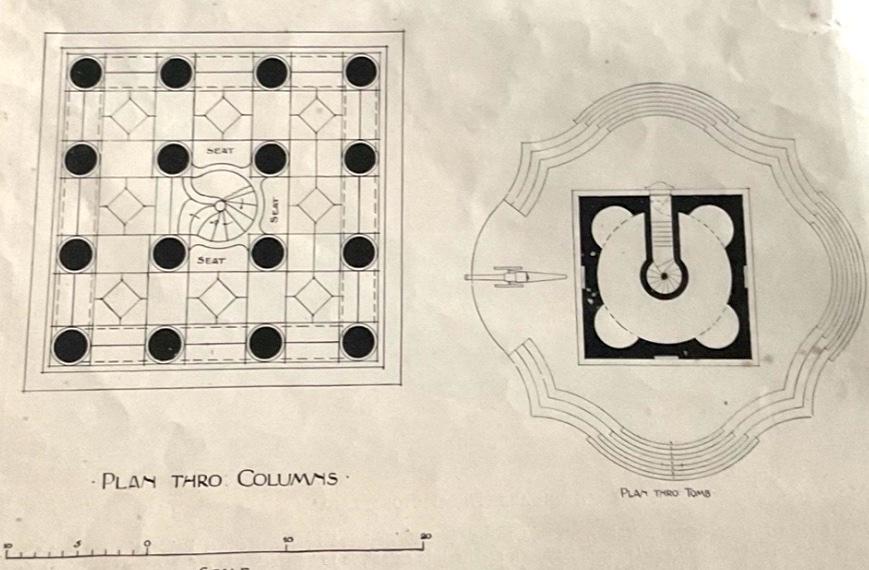
Plans of the Memorial to the Honoured Dead (Diamond Fields Advertiser)
The design is already fully resolved. Rising from a massive masonry podium, the structure takes the form of a square tower crowned by an open classical colonnade. Within the podium lies the burial chamber for those who died during the Siege of Kimberley — the defenders of the town who endured bombardment, privation and loss.
From the outset, Baker conceived the structure not merely as a marker but as an architectural experience: an ascent from ground to podium, the weight and permanence of masonry, and above, the ordered calm of classical form open to light and sky. Even in reproduction, the design conveys authority and restraint.
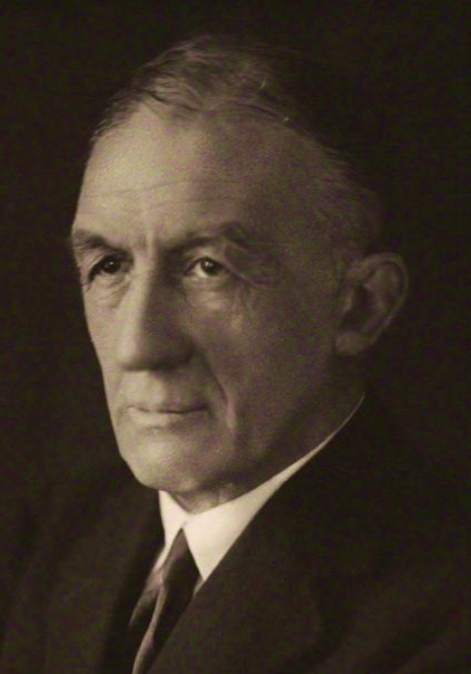
Herbert Baker
Rhodes and the Idea of Commemoration
The origins of the memorial lie in Rhodes’s own experience of the siege. Present in Kimberley throughout the period of encirclement, he shared in its dangers and privations and remained deeply engaged in the affairs of his diamond mining town. For Rhodes, the defence of Kimberley was not an abstract military episode but a lived and personal experience.
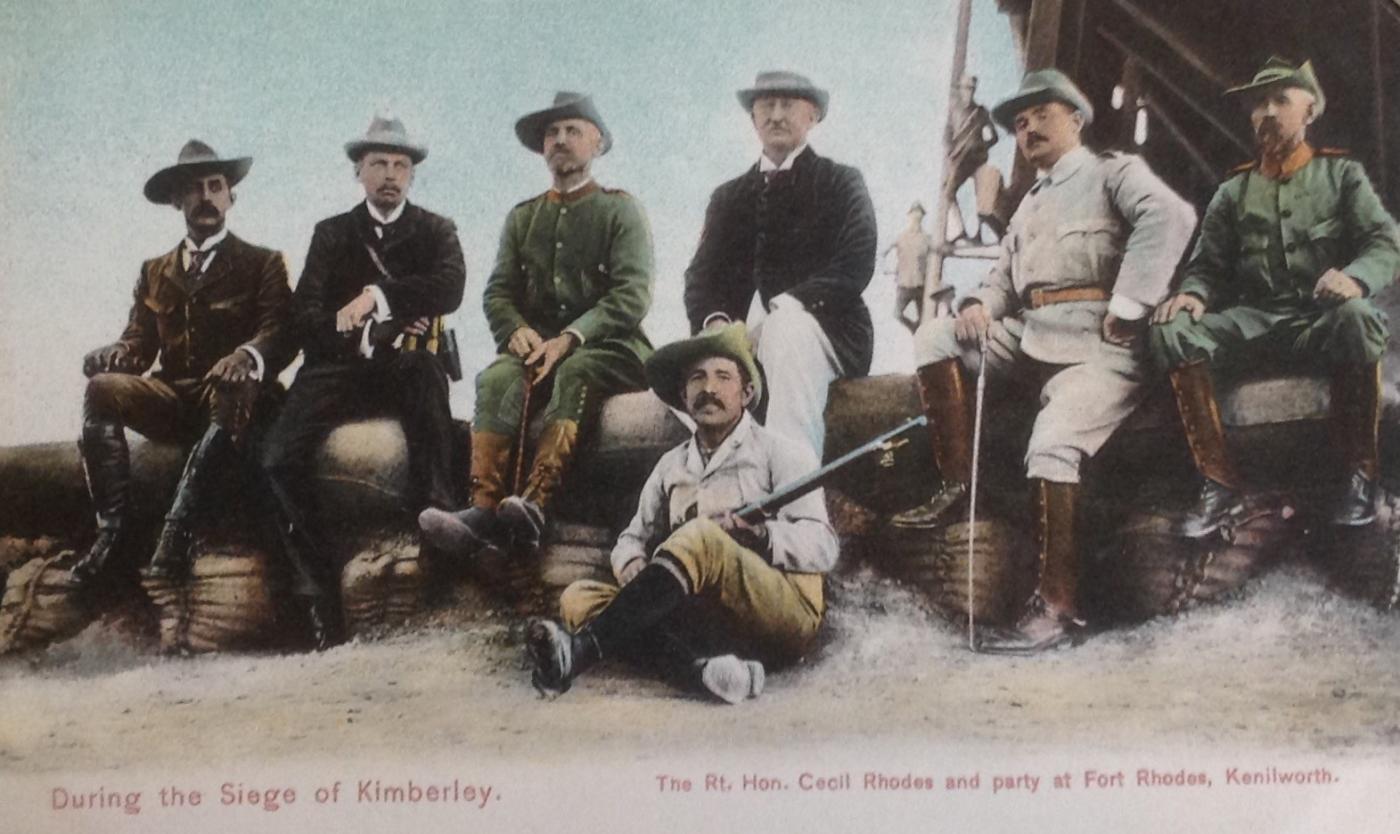
Postcard showing Cecil Rhodes and party during the Kimberley siege (Carol Hardijzer)
According to Dr R. J. L. Sabatini, Rhodes conceived the idea of a memorial during the siege itself, envisaging a monument of sufficient scale and dignity to commemorate what he regarded as a heroic stand. After returning to Cape Town, he discussed the project with Baker. An early proposal took the form of a nymphaeum — a classical fountain or bath enclosed by marble columns — but this gave way to the more austere and enduring architectural solution ultimately realised.
In this way, Rhodes’s impulse to commemorate the siege found its architectural expression not in local precedent, but in the deeper traditions of the classical Mediterranean world.
Raw Emotion and Collective Memory
At the time of publication in 1901, the emotions surrounding the siege were still immediate. Kimberley had endured bombardment, deprivation and uncertainty for four months. Families had lost sons, husbands and children; civilians and soldiers alike had shared hardship.
The memorial emerged from this atmosphere of grief and relief following the lifting of the siege. It was not conceived in historical distance but in living memory.
Rudyard Kipling’s epitaph, carved into the monument — “Here are the victors laid” — captures this emotional complexity, transforming loss into heroic narrative.
The memorial was formally dedicated on 28 November 1904, a date chosen with deliberation: five years earlier, on that same day in 1899, Colonel Henry Scott-Turner and twenty-two other defenders were killed in action at Carter’s Ridge.
The enduring presence of Kipling’s words on the monument is reflected in a later literary recollection by Dan Jacobson, who remembered that the first lines of Kipling he ever learned were those “incised in large Roman capitals” on the walls of the Honoured Dead Memorial in Kimberley. In this way, the monument functioned not only as a site of burial and remembrance, but as a vehicle through which imperial memory and literary culture were inscribed into the consciousness of those who encountered it. The carved text, like the architecture itself, gave permanence to an interpretation of the siege — shaping how it would be remembered by later generations into the consciousness of those who encountered it. The carved text, like the architecture itself, gave permanence to an interpretation of the siege — shaping how it would be remembered by later generations.
Who financed the Memorial?
Financially, the project reflects a significant act of corporate patronage. As Hedley Chilvers records, in his book, The Story of De Beers, De Beers Consolidated Mines contributed £7,800 of the total £10,000 cost, an example of what he described as the company’s “liberality in benefices.” The memorial thus stands not only as a work of architecture, but as the outcome of a negotiation between private vision and corporate responsibility: Rhodes’s commemorative ambition realised within the limits imposed by financial governance.
Those Who Lie Within
Within the memorial lie the remains of twenty-seven individuals who died during the siege between October 1899 and February 1900. They include members of the Kimberley Town Guard, the Diamond Fields Artillery, colonial volunteers, imperial troops and civilians.
Their remains were gathered and re-interred within the podium after the siege — a deliberate act that transformed the structure from commemorative monument into a true mausoleum. Their collective burial echoes classical Mediterranean traditions in which architecture served as the container of communal sacrifice.
The inclusion of civilians — particularly a child — underscores the shared suffering of the town and reinforces the memorial’s identity as a civic tomb rather than a purely military monument.
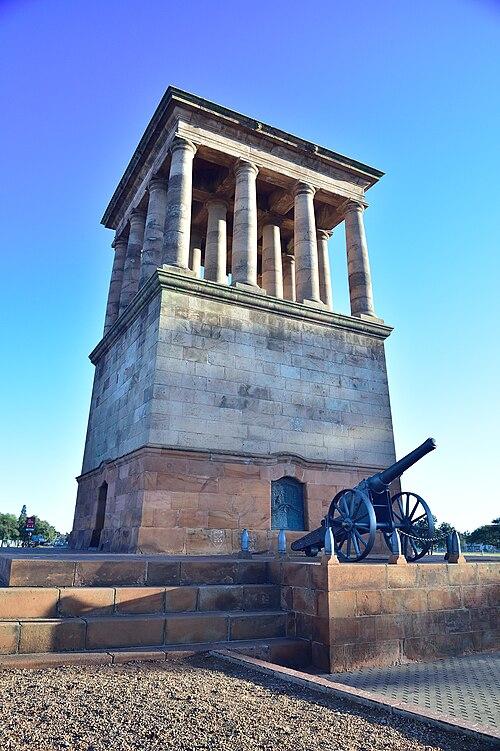
Another view of the Memorial (Wiki Commons)
Classical Sources and the Question of Inspiration
The question of the memorial’s classical inspiration has attracted considerable discussion.
Baker himself later recalled that the design was conceived “after the manner of a Greek tomb which he (Rhodes) had seen, and I had sketched at Agrigentum.” The monument in question was the Tomb of Theron at Agrigentum in Sicily, a tower-like funerary structure rising from a high podium.
Other commentators have identified similarities with the Nereid Monument at Xanthos in Lycia, a temple-like tomb combining a raised base with a surrounding colonnade. Yet the evidence increasingly suggests that Baker’s design draws upon a wider range of classical sources.
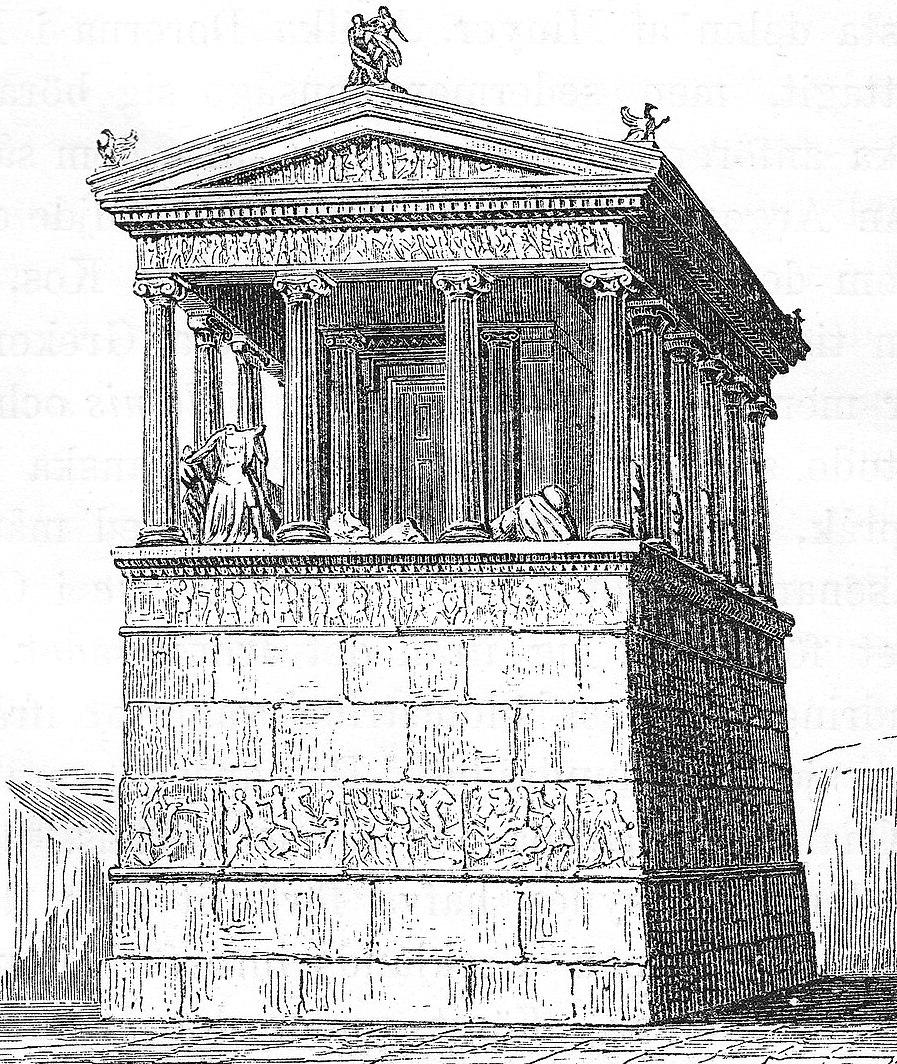
Nereid Monument Illustration (Wikipedia)
As Desirée Picton-Seymour has observed, the memorial reflects a broader engagement with the Greek classical ideal, incorporating elements derived not only from Sicily but also from Paestum and Asia Minor. Judith Horner suggests that the Kimberley design combines the mass of the Agrigentum tomb with a colonnaded superstructure, while Michael Keath records Baker’s recollection of a ruined tomb on the Alban Hills near Rome.
The Kimberley memorial is thus best understood not as a direct copy of any single ancient structure, but as a synthesis of forms encountered across the Mediterranean world — with Baker’s own recollection giving primacy to Agrigentum.
Clarifying the Segesta Question
Doreen Greig has drawn attention to the temple at Segesta in Sicily. Baker himself, however, makes clear in Architecture and Personalities that Segesta informed his later design for the Rhodes Memorial, particularly in its use of plain, unfluted Doric columns.
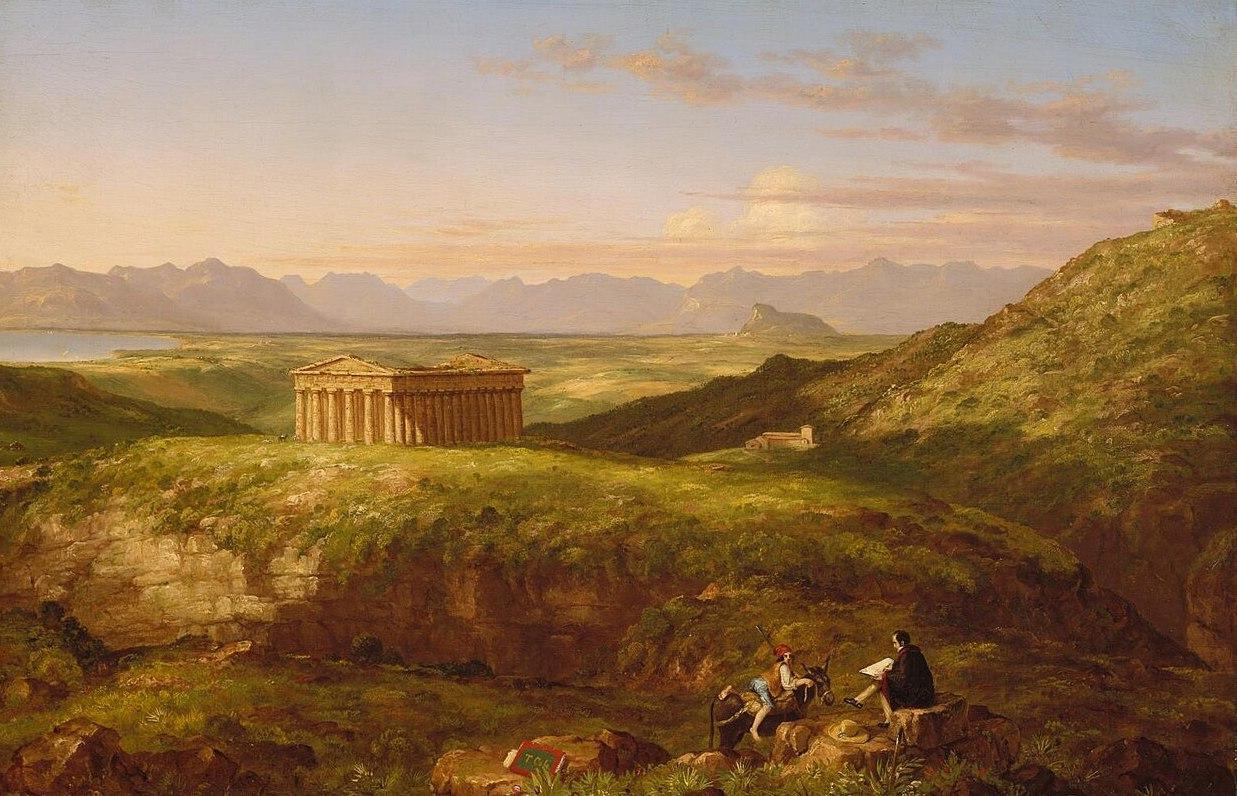
Segesta Temple in Thomas Coles' painting from 1843 (Wikipedia)
The Kimberley memorial belongs to an earlier phase of Baker’s work and draws instead on funerary precedents. In this sense, it may be understood as an antecedent to the Rhodes Memorial rather than its direct classical counterpart.
Greig nevertheless concludes that, despite a somewhat complex lineage, the monument remains “an impressive, coherent work of art” possessing a distinctive individuality.
Tomb, Memorial and Monument
It is useful to distinguish between four related forms: tomb, cenotaph, memorial and monument.
- A tomb contains the physical remains of the dead
- A cenotaph is an empty tomb — a symbolic form
- A memorial preserves remembrance
- A monument asserts historical significance through architectural presence
The Kimberley Memorial to the Honoured Dead is fundamentally a tomb — a mausoleum containing human remains — yet it simultaneously functions as memorial and monument.
By enclosing the dead within a massive podium and elevating them beneath a classical colonnade, Baker aligned the structure with ancient traditions of heroic commemoration. In doing so, he also created a visible statement of imperial presence, transposing the authority of classical civilisation into the South African landscape.
Construction, Architectural Character and Dedication
The memorial was constructed by Howard and Scott using stone from the Matopos Hills together with local sandstone, under the supervision of D. W. Greatbatch. It rises approximately 52 feet and weighs around 2,000 tons. Flights of steps lead to the podium, above which stands a colonnade of Tuscan columns supporting a simple entablature. The design is marked by restraint: its power lies in proportion, mass and clarity rather than ornament.
At its base stands the gun Long Cecil, designed by George Labram during the siege — a tangible reminder of Kimberley’s defence.
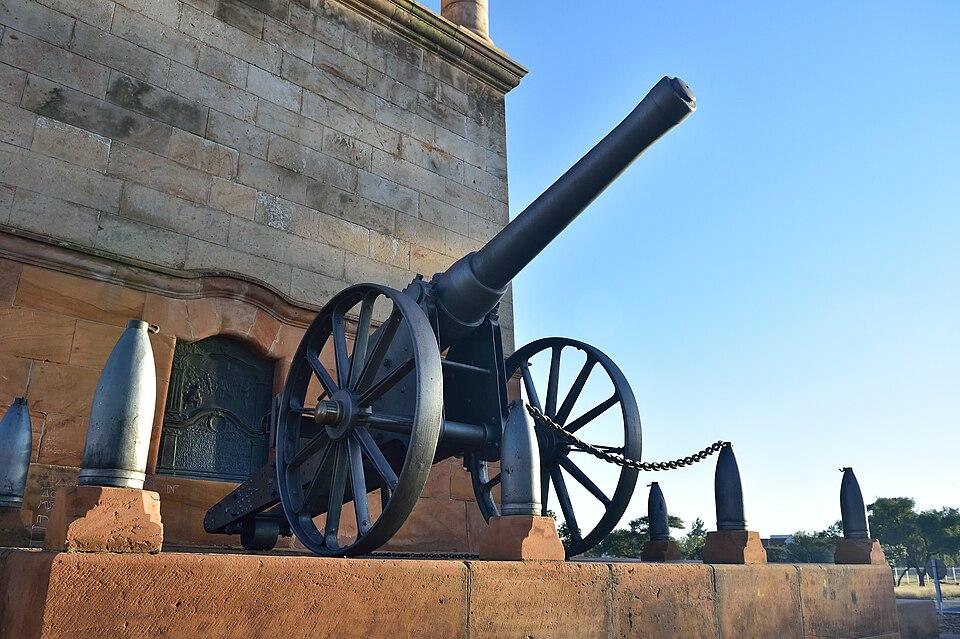
Long Cecil (Wikipedia)
The memorial was dedicated on 28 November 1904, five years after the death of Colonel Scott-Turner and his men at Carter’s Ridge.
A Visit a Century Later
I visited the memorial myself some years before the Covid period. Encountering it within the modern city was a striking experience. The monument dominates the surrounding road system, standing on what is effectively a traffic island from which streets radiate outward.
More than a century after its construction, it appears almost curiously dislocated — a powerful architectural object, yet somewhat stranded within contemporary urban life. Its original emotional immediacy has inevitably receded.
And yet the architecture retains its authority. The mass of the podium, the ordered colonnade, and the strength of its siting continue to assert presence. The monument still invites reflection — on memory, empire and the passage of time.
Today the Monument is a Provincial Heritage Site (Northern Cape Province) and sadly has experienced vandalism.
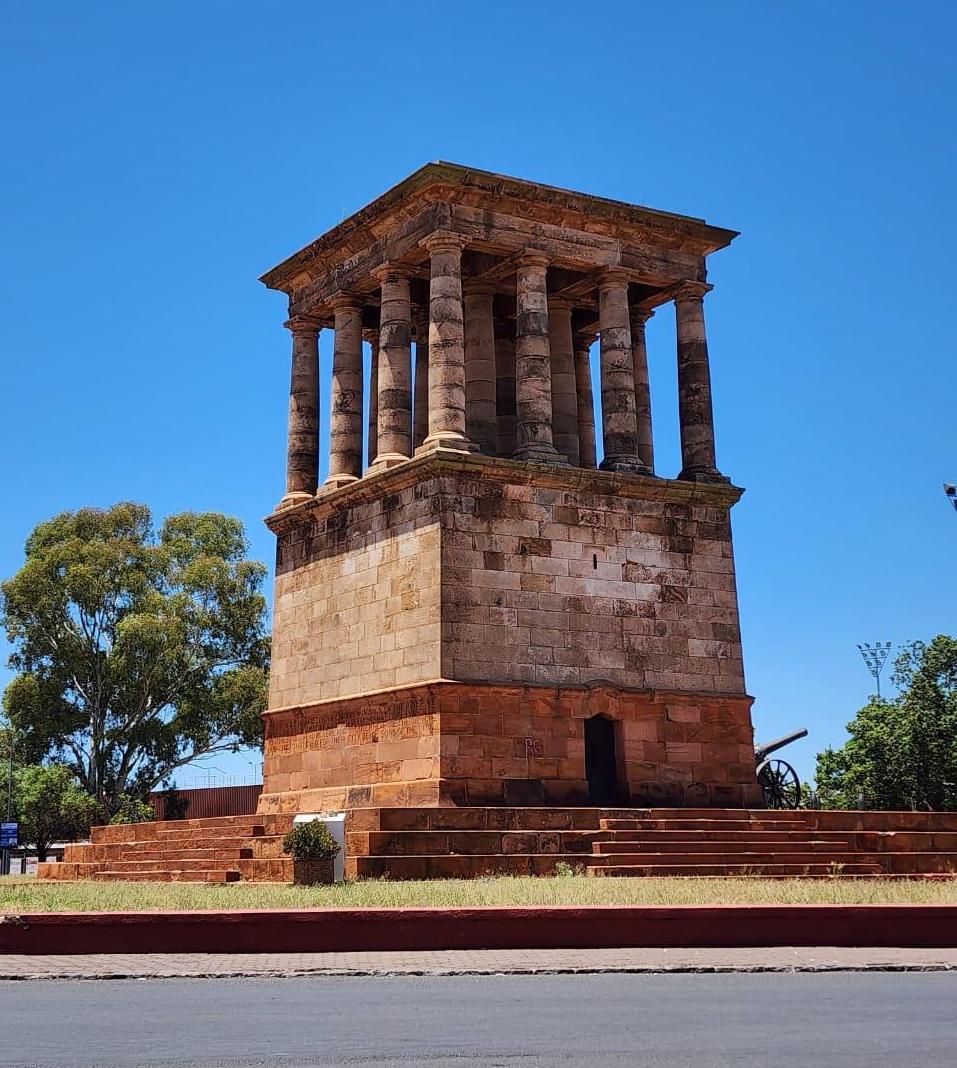
The monument still invites reflection (Kathy Munro)
From Tomb to Statue to Cenotaph: A Changing Language of Memory
Within a remarkably short span, Kimberley’s commemorative landscape reveals a striking evolution in both form and meaning.
The Honoured Dead Memorial (1904), conceived by Baker, represents a late-Victorian synthesis of tomb, monument and sacred architecture — physically enclosing the dead while elevating their sacrifice through a classical architectural language.
Only a few years later, commemoration shifted toward heroic individualism in the 1907 equestrian statue of Cecil Rhodes, sculpted by William Hamo Thornycroft. Here the emphasis moved from collective mourning to the celebration of imperial vision and personal agency.
By the aftermath of the First World War, this mode gave way to a more austere and collective expression in the Kimberley Cenotaph (1928), designed by William Timlin. A “memorial without a body,” it commemorated some 400 local men who died in the conflict and was notably unveiled by bereaved mothers rather than civic leaders.
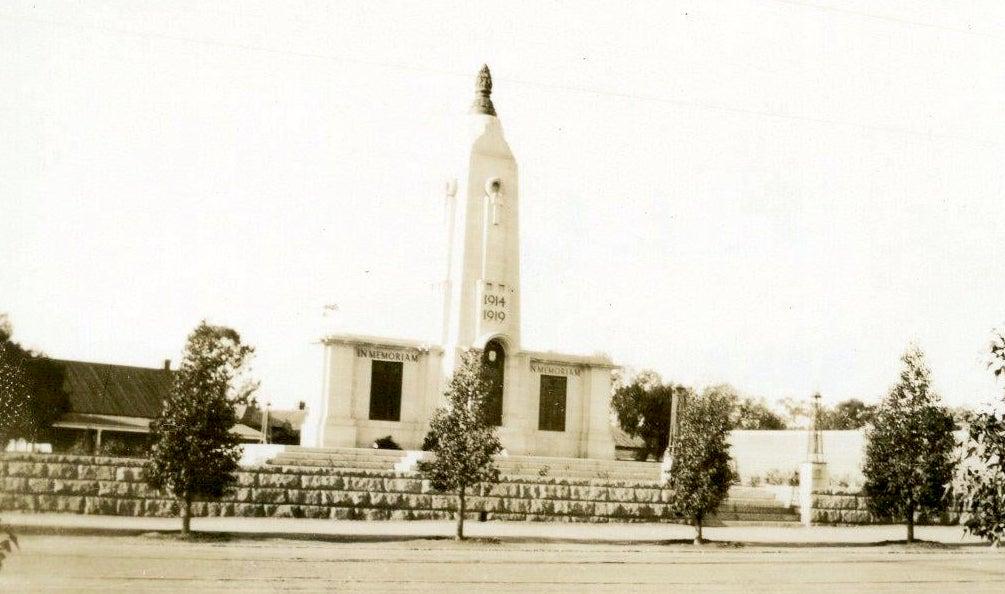
Kimberley Cenotaph (McGregor Museum)
Inspired by the cenotaph designed by Edwin Lutyens in Whitehall in 1919, Timlin’s design reflects a new architectural language — stripped, abstract, and closer to the emerging idiom of Art Deco.
In this progression — from sepulchral monument to heroic statue, to abstract cenotaph — one observes a decisive shift from the embodied and particular, to the individual and celebratory, and finally to the universal and elegiac.
Conclusion: Reflections on Legacy
The Kimberley Memorial to the Honoured Dead marks the beginning of Herbert Baker’s long engagement with the architecture of remembrance. Drawing upon the forms of the ancient Mediterranean — from Sicily to Asia Minor — he absorbed an entire classical world into a new architectural language of imperial commemoration.
In later years, when the vast losses of the First World War demanded new forms of remembrance, that language would evolve but endure — giving dignity to grief and permanence to memory.
The monument also reflects an early manifestation of Rhodes’s belief in education through travel — a belief that would soon shape generations of scholars. In this sense, Baker himself may be seen as the first beneficiary of that vision.
The pages of the Diamond Fields Advertiser of 1901 thus preserve more than the announcement of a memorial. They capture the moment when patron, architect and history converged — and when architecture became the vessel through which memory, empire and loss were given enduring form.
Kathy Munro is an Honorary Associate Professor in the School of Architecture and Planning at the University of the Witwatersrand. She enjoyed a long career as an academic and in management at Wits University. She trained as an economic historian. She is an enthusiastic book person and has built her own somewhat eclectic book collection over 40 years. Her interests cover Africana, Johannesburg history, history, art history, travel, business and banking histories. She researches and writes on historical architecture and heritage matters. She is a member of the Board of the Johannesburg Heritage Foundation and is a docent at the Wits Arts Museum. She is currently working on a couple of projects on Johannesburg architects and is researching South African architects, war cemeteries and memorials. Kathy is a member of the online book community the Library thing and recommends this cataloging website and worldwide network as a book lover's haven. She is also a previous Chairperson of HASA.
References
- Baker, Herbert. Architecture and Personalities. London: Country Life, 1944.
- Baker, Herbert. Cecil Rhodes by His Architect. London: Oxford University Press, 1934.
- Chilvers, Hedley, The Story of De Beers, London, Cassells, 1939
- Duncan, Paul and Alain Proust, Alain . Inside Kimberley. Kimberley: Africa Press, 2017, pp. 136–143.
- Diamond Fields Advertiser. Illustrated Christmas Number. Kimberley, 1901.
- Greig, Doreen. Herbert Baker in South Africa. Cape Town: Purnell, 1970.
- Horner Judith, Kimberley Drawn in Time, Kimberley 2004 p.100
- Jacobson, Dan, Kipling in South Africa, review article in the London Review of Books vol 29, no 11, 7th June 2007
- Keath, Michael. Herbert Baker: Architecture and Idealism 1892 - 1913: The South African Years, Ashanti, 1992
- Roberts Brian. Kimberley: Turbulent City, David Philip, 1976
- Lockhart, J. G., and Woodhouse, C. M. Rhodes. London: Hodder & Stoughton, 1963
- Pakenham, Thomas. The Boer War. London: Weidenfeld & Nicolson, 1979.
- Rotberg, Robert I. The Founder: Cecil Rhodes and the Pursuit of Power. Oxford: Oxford University Press, 1988.
- Stewart, John. Sir Herbert Baker: A Biography. Johannesburg: Jonathan Ball, 2023
- Duminy Karel (photos ) & Sabatini, R J L: 50 Years on the Diamond Fields 2007 (Kimberley Africana Library)