
This is a riveting and intellectually ambitious family history: the story of the Posel family, and most particularly the paternal grandparents of the author, Maurice and Erna Posel, written by sociologist and historian Deborah Posel.
Everyone has a family history to tell, and genealogical reconstruction has become a popular pastime in the digital age. Yet Darker Shade of Pale is emphatically not a conventional exercise in ancestry. Instead, Posel uses the fragmentary remains of one family’s past to dispel romantic myths while probing far more demanding historical and sociological questions about Jewish emigration from Europe and the making of colonial society, with all its complexities of race, hierarchy, ethnicity, and belonging.
Working with remarkably little direct documentary evidence (a handful of photographs, scattered archival traces, and inherited family lore) Posel undertakes an act of historical reconstruction grounded in extraordinarily wide contextual reading and an acute sensitivity to the significance of small, often overlooked details. Through this method, she transforms a partial family narrative into a powerful and illuminating analysis of Jewish emigration from Europe in the late nineteenth and early twentieth centuries.
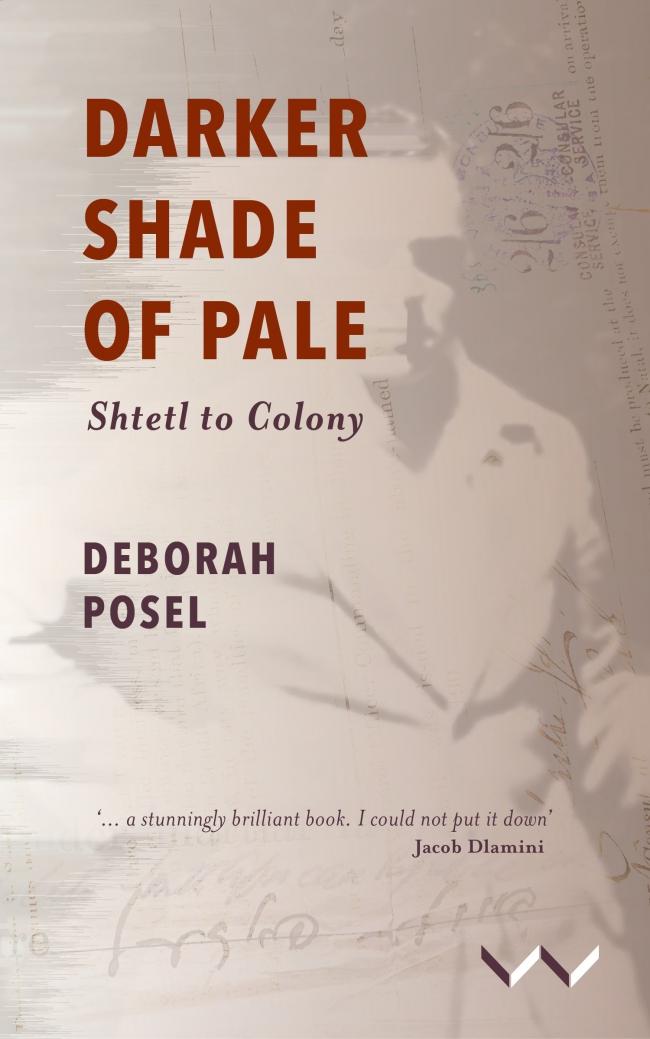
Book Cover
One of the book’s major achievements lies in its demolition of the enduring myth that life in the shtetl was in any sense idyllic. Posel’s portrayal is unsentimental and convincing. Shtetl existence emerges as narrow, frequently impoverished, and constraining, marked by limited economic opportunity and persistent vulnerability. The book makes entirely clear why emigration was not simply an act of aspiration but often one of necessity. At the same time, Posel resists romanticising the country of adoption. The British colonial world that greeted Jewish émigrés—whether Cape Town in the 1890s or Johannesburg in the early twentieth century, remade under British administration after the South African War—offered opportunity, but also hierarchy, racialised ordering, and precarious belonging. Emigration thus involved an exchange of one set of constraints for another, rather than a simple passage from darkness into light.
In less capable hands, this approach might easily have collapsed into conjecture. Here it largely succeeds because the author is a seasoned sociologist. Posel consistently situates the particular within broader structures of migration over time: the physical and geographical movement of people, the patterns of social mobility that followed, and the gritty determination, entrepreneurship, and risk-taking that shaped immigrant lives across generations. She charts a familiar but never simplistic trajectory—from impoverished smous and trader to established business owner, and onward to sons and grandchildren becoming engineers, doctors, and academics—without resorting to triumphalism.
However, Posel is careful to show that social upward mobility, while possible, was neither automatic nor universal. It was achieved through business success, wealth accumulation, and, crucially, education for one’s children. Material success was often accompanied by geographical relocation within the city. Newly arrived immigrants might first settle in areas such as Doornfontein or Ferreirasdorp; improvement in circumstances could bring a move to Yeoville or Bellevue. Sons might then be educated at King Edward VII School for Boys, while daughters attended Johannesburg Girls’ High School at Barnato Park.
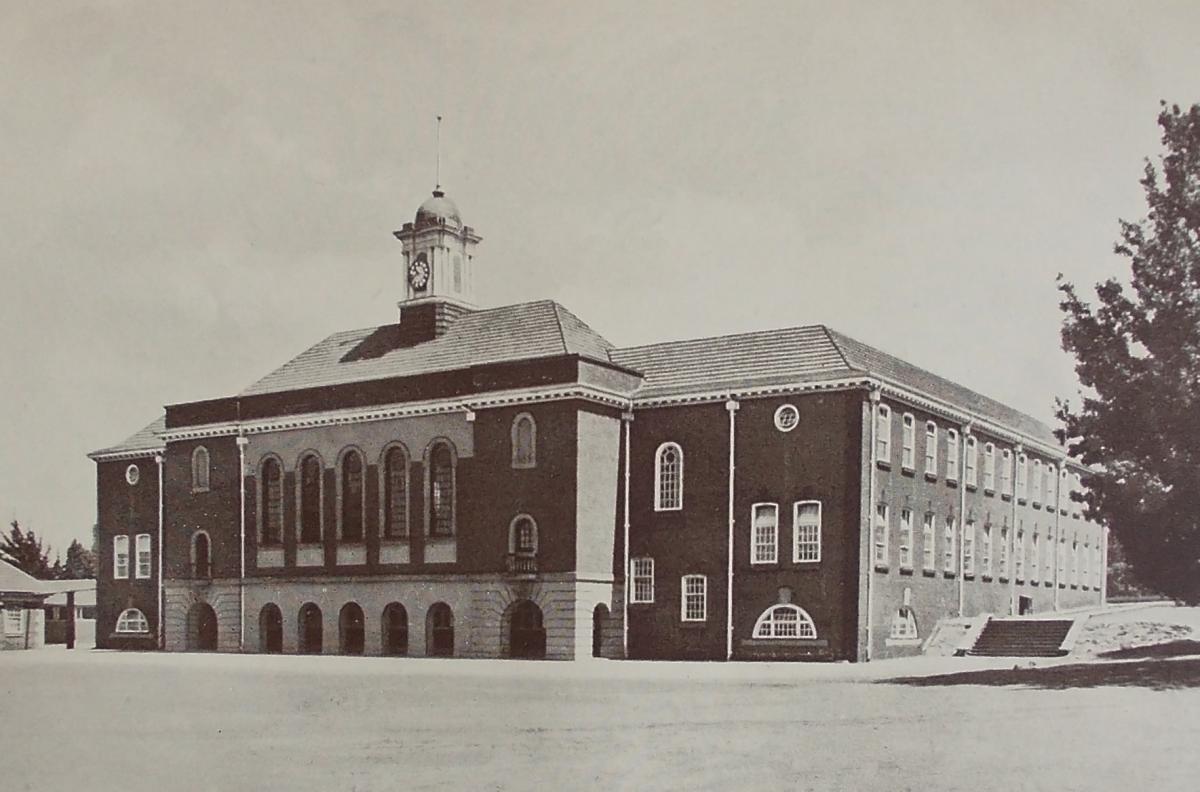
Old photo of KES (SA Builder)
Further prosperity could result in relocation to the more aspirational suburbs of Dunkeld, Hyde Park, or Illovo. Yet Posel makes clear that such mobility carried costs. These included identity crises, religious slippage or crossover, and generational rupture, as children rejected the values and attitudes of their immigrant fathers and entered elite professions (medicine, accounting, law) in the thrusting city of gold, Johannesburg. At the same time, the book resists any linear narrative of success: Posel shows that many Jewish émigrés remained poor, living out their lives on the margins, for example in District Six in Cape Town. An additional and compelling theme is that of lifespan and longevity. Here, death certificates retrieved from the archives become vital documentary fragments, revealing not only causes and age of death but family relationships—modest records that serve as essential building blocks in reconstructing fuller social and historical patterns.
The wider historical canvas is never far from view. Posel captures the turbulence of twentieth-century European history (trauma, anti-semitism, dislocation, and violence) as background forces shaping individual lives. She traces her grandfather’s roots to the Lithuanian shtetl of Pumpian in the Pale of Settlement, and her grandmother’s Germanic origins in Czernowitz, then part of the Austro-Hungarian Empire, before recounting their meeting and marriage in Johannesburg. This union appears less a romance than a convergence of necessity and desperation, and possibly a loveless one.
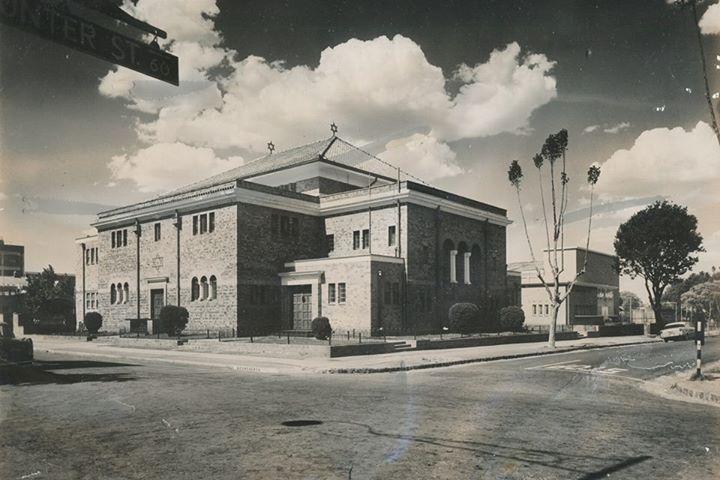
Posel's grandparent were married at the Yeoville Synagogue
A central thread of the book is the author’s attempt to understand the embittered and emotionally damaged life of her grandfather Maurice. Writing in the first person, Posel interweaves diligent archival research and travel with a readiness to acknowledge the limits of what can be known. Inevitably, she relies at times on supposition, imagination, and carefully reasoned inference. This is a methodological minefield, particularly when reconstructing interior lives and motivations across generations. Posel is generally transparent about this process, and her conjectures are argued rather than asserted. Even so, the balance between evidence and inference occasionally feels strained. While the author’s intellectual honesty mitigates this risk, the reader is sometimes asked to accept conclusions that rest more heavily on interpretive plausibility than on demonstrable fact. The method is defensible, but it demands a high level of critical attentiveness from the reader.
When Posel turns to material conditions in Johannesburg, the analysis is compelling but incomplete. Her discussion of family property—notably what appears to have been a slum dwelling at worst, or severely overcrowded accommodation at best, known as Posel’s Yard—would have been significantly strengthened by the inclusion of detailed maps of the inner city. In this context, the absence of reference to Goad’s insurance maps is a missed opportunity. These maps remain an essential archival source for understanding building density, insurance compliance, and the economic status of specific properties and businesses, and their use could have sharpened the book’s already strong material analysis.
The scholarship underpinning the work is formidable. The bibliography is wide-ranging and impressive, and the footnotes are forensic and precise. A partial family tree and two European maps are included. However, the absence of an index is a serious omission in a work of this length, complexity, and scholarly ambition. With over ninety chapters and a wealth of themes—migration, class mobility, colonial society, anti-semitism, and family psychology—the lack of an index substantially limits the book’s usefulness as a reference work. It is surprising in a publication of this stature, issued by a leading academic press. With an index, enhanced cartographic material, and modest typographic adjustment, a future edition could become far more influential and enduring.
This book was given to me as a Christmas gift and quickly became my holiday reading. My sole practical criticism—beyond the structural omissions noted above—is that the type size (10.5) is too small for sustained comfortable reading. Otherwise, Darker Shade of Pale is a work of considerable intellectual distinction: subtle, rigorous, and deeply rewarding.
Kathy Munro is an Honorary Associate Professor in the School of Architecture and Planning at the University of the Witwatersrand. She enjoyed a long career as an academic and in management at Wits University. She trained as an economic historian. She is an enthusiastic book person and has built her own somewhat eclectic book collection over 40 years. Her interests cover Africana, Johannesburg history, history, art history, travel, business and banking histories. She researches and writes on historical architecture and heritage matters. She is a member of the Board of the Johannesburg Heritage Foundation and is a docent at the Wits Arts Museum. She is currently working on a couple of projects on Johannesburg architects and is researching South African architects, war cemeteries and memorials. Kathy is a member of the online book community the Library thing and recommends this cataloging website and worldwide network as a book lover's haven. She is also the Chairperson of HASA.