In the article below, journalist Lucille Davie recounts the fascinating story behind Nelson Mandela's capture near Howick in the early 1960s. The piece was originally published on the Brand South Africa website on 2 July 2013. Click here to view more of Davie's writing.
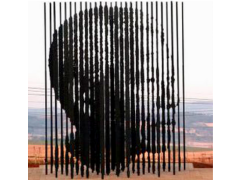
Nelson Mandela’s head rises dramatically from the ground on a small plot outside the village of Howick in KwaZulu-Natal. His face is sculpted in 50 thin steel columns, marking the spot where he was arrested in 1962.
It was here, on 5 August 1962, that Mandela’s car was stopped by the security police, and his life took a completely different course. He was on his way back to Johannesburg after visiting Chief Albert Luthuli, at the time the president of the African National Congress (ANC), in Groutville, some 80km north of Durban. He posed as a chauffeur, driving with Cecil Williams, a theatre director and member of Umkhonto we Sizwe or MK, the armed wing of the ANC.
The sculpture, by artist Marco Cianfanelli, consists of 50 steel columns, ranging in height from 6.5m to 9.5m. A path leads to the sculpture; at 35m, the portrait comes into focus, with the 50 columns perfectly in line to represent his face in a flat image. The site was unveiled in August 2012 – the 50 columns representing the 50 years since Mandela’s capture. It was designed by architect Jeremy Rose of Mashabane Rose Associates.
Cianfanelli says that they “wanted to create an iconic and monumental sculpture...