
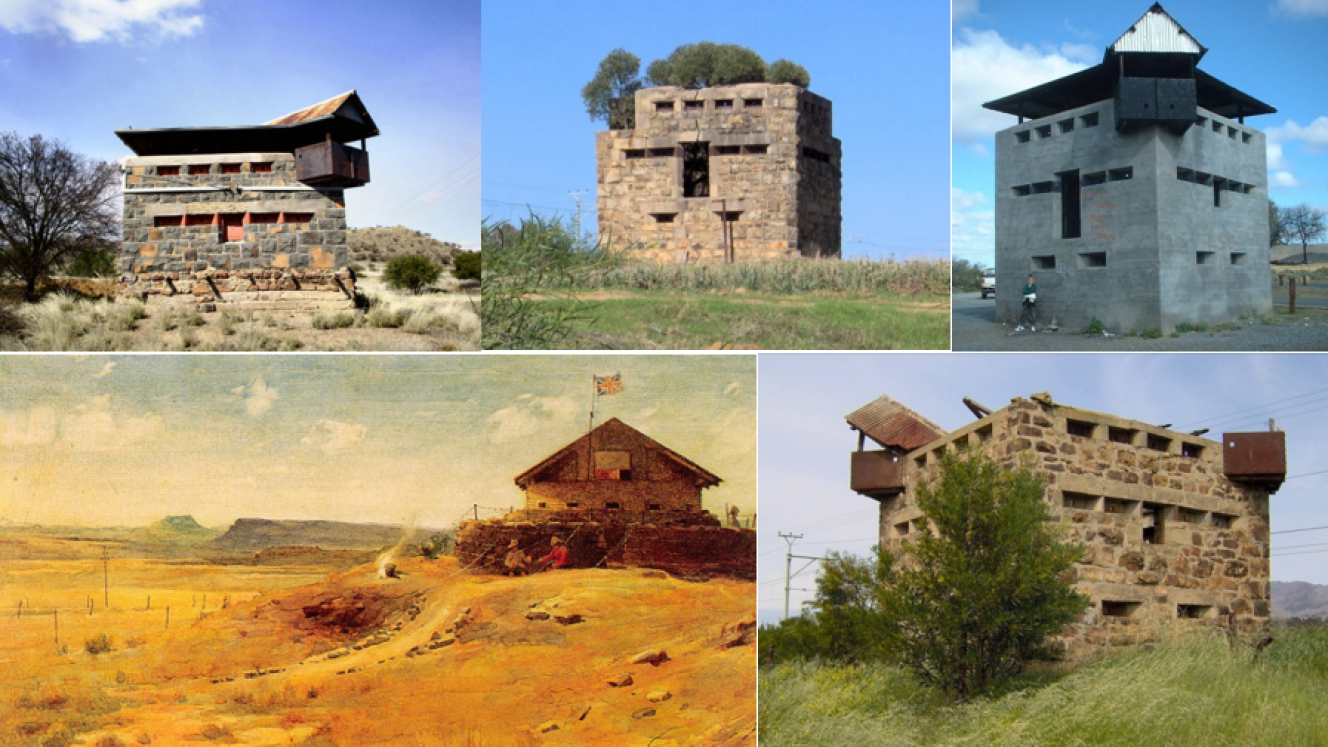
In the passages below, Johan van den Berg provides a fascinating account of the various blockhouses built by the British during the South African War. The details form part of a larger report titled 'The Evolution of the Block House System in South Africa'. Thank you to Jayson Clark from the Tulbagh Valley Heritage Foundation for sending the report through. The pioneering work of Richard Tomlinson on this topic must be acknowledged. His seventeen year journey set the standard for Blockhouse research in South Africa. Click here to read his epic piece: Britain's Last Castles: Masonry Blockhouses of the South African War, 1899-1902.
1) Corrugated Iron Blockhouses
The earliest rectangular examples in the eastern Transvaal (now Mpumalanga Province) were built in January 1901 by a civilian contractor from Lourenço Marques. After that, the octagonal and the final circular patterns were designed by Major Spring R. Rice, of the 23rd (Field) Company, Royal Engineers, manufactured in kit form at RE factories in Middelburg (Transvaal), Bloemfontein, Cape Town and other centres, sent by train to the station nearest to their final site and delivered to site by ox wagon. There they were erected by infantry soldiers who dug a sentry trench round each blockhouse and surrounded the site with a barbed-wire entanglement. After the war ended, most of these buildings were sold or given by the military authorities to the owners of the land on which they were built. The provisions of the Vereeniging Peace Treaty also stipulated that the blockhouses be removed as soon as possible after the cessation of hostilities. Consequently, very few examples of the corrugated blockhouses have survived.

The Barberton Blockhouse
2) Masonry (Mortared Stonework and Concrete) Blockhouses
The masonry blockhouses were designed by Royal Engineers personnel using a variety of plan shapes and styles and built by civilian contractors, employing good quality mortared stonework or shuttered unreinforced concrete for the walls, timber upper floors, timber and corrugated iron roof and steel loopholes, window shutters and door. They were also usually surrounded by a sentry trench and barbed wire fence. Because of their solid and permanent method of construction, the masonry blockhouses are the most numerous class of Anglo-Boer War fortification to have survived in good condition. Major-General Elliot Wood, the Chief Engineer of the British Army in South Africa, produced a design for a three-storeyed masonry blockhouse which was widely used and is the archetypal and still the most easily recognised masonry blockhouse pattern.
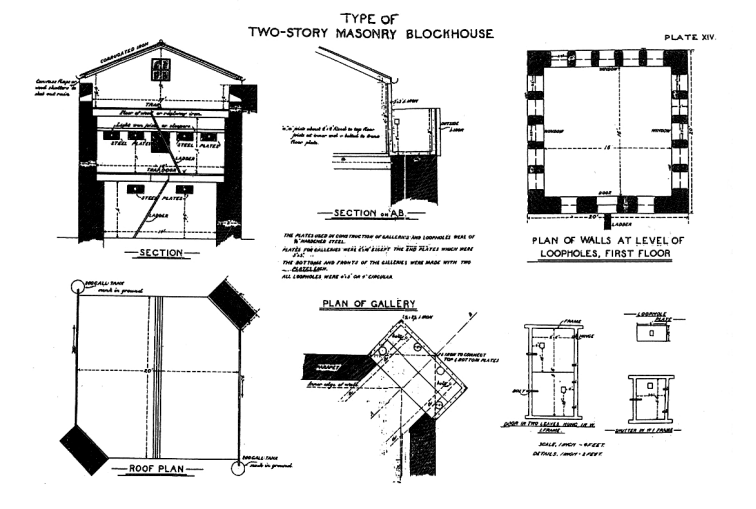
Type of two-storey (actually three-storey) masonry blockhouse
A study of the structures has revealed a great deal of freedom given to Royal Engineers officers in designing masonry blockhouses and this in turn has created a number of different regional design types. These have been classified as follows:
2.1) Standard Pattern
This type is based on Major-General Wood's design and is found extensively along the Cape Town-Warrenton railway line, at Stormberg Junction and Burgersdorp on the East London Aliwal North railway and defending the towns of Aliwal North (Buffelspruit Blockhouse) and Harrismith. Along the railway lines, these structures defended major river bridges and stations. The plan size is 6,1m square externally and they were built of mortared stonework (often quarried at the site) or, in a few cases, of unreinforced concrete.
Entry to these buildings is by ladder to a first floor doorway into the main living level, from where ladders led down to the ground floor storage level and up to the observation level on the second floor. (The only exception to this arrangement is at Orange River Station which is only two storeys high, having omitted the storage floor.) The entrance has a stable door of thick steel, steel-shuttered windows in the other three walls at this level give extra light and the walls are loopholed at all levels, the loophole plates being 12mm steel and sometimes doubled in thickness. At two diagonally opposite corners of the 2nd floor, two cantilevered steel angle (machicouli) galleries allowed the garrison to give flanking fire along the walls.
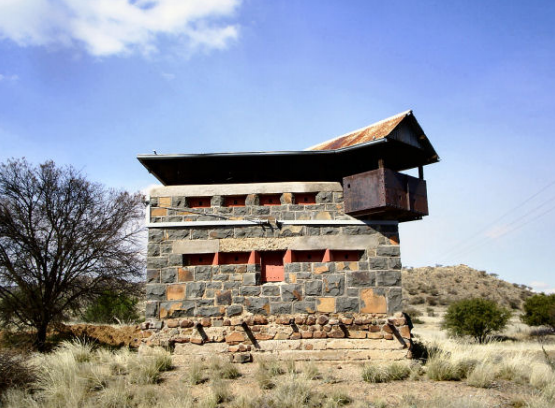
Blockhouse at Orange River Station
The blockhouse is covered with a pyramid-shaped or gabled roof of corrugated iron and timber, with gutters and downpipes which collected rainwater into a tank at ground level; this often meagre supply was supplemented by the delivery of water by train or by water wagon from the nearest town, and food, mail and other necessaries were supplied in similar manner. Canvas 'drops' were provided to close the gap between the wall top and the eaves of the roof on the 2nd floor and these could be rolled up in fine weather.
Most Standard Pattern blockhouses are accessible for inspection on the outside but, because of the high-level entrance, access to the interior is difficult without a ladder. Examples which are readily accessible inside are to be found at the recently-restored ones at Beaufort West, Modder River near Kimberley and the two at Burgersdorp. Examples that can be visited in the Western Cape are at Wellington, Hermon, Tulbagh, two at Wolseley, and on the N1 a few km beyond Laingsberg. The ones at Hermon and Tulbagh are in a sad state of disrepair (there apparently are a number of blockhouses still in existence along the Worcester-Touws River-Beaufort West line of which no information regarding the condition is currently available due to their remoteness/inaccessibility – comment: Maj Tony Gordon, SAMHS, Cape Town Branch).
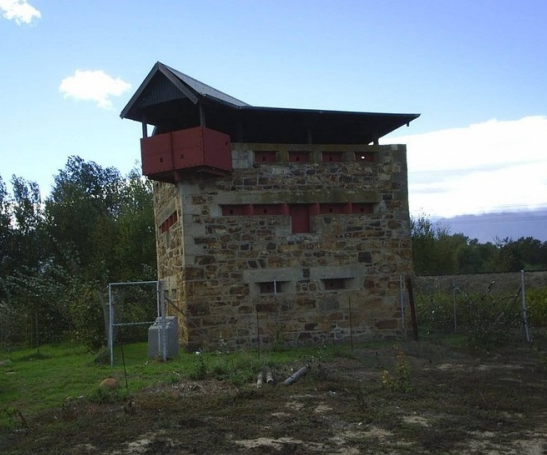
Wellington Blockhouse
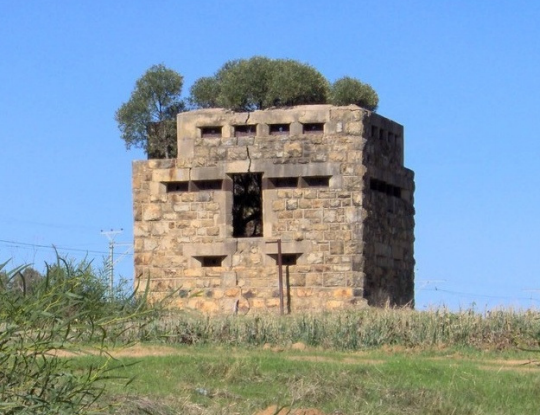
Hermon Blockhouse
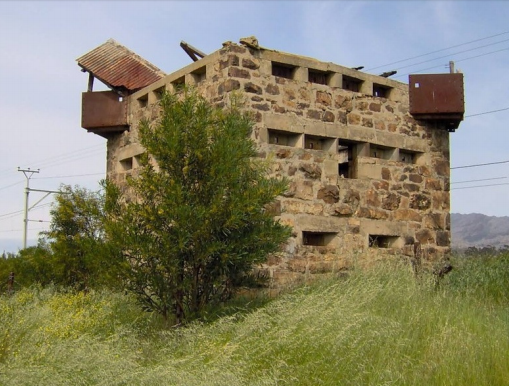
Tulbagh Blockhouse
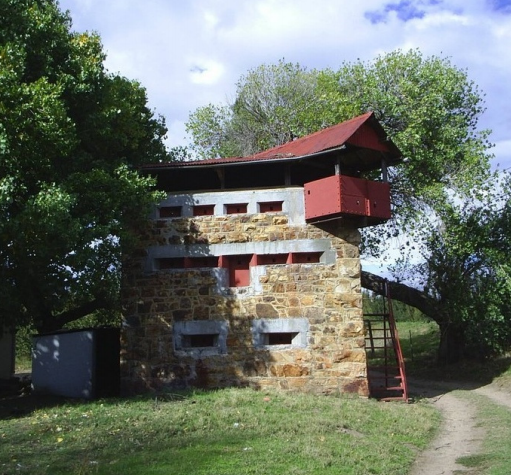
Blockhouse at Wolesley
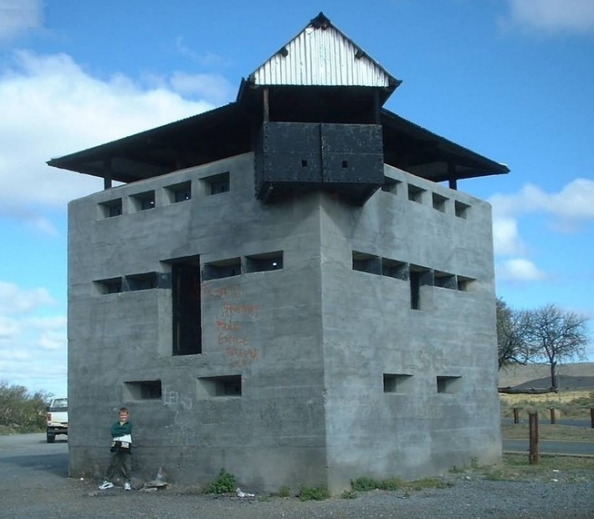
Laingsburg Blockhouse
Numerous variations of the multi-storey blockhouses, as designed by Major-General Wood, existed, and luckily, due to their sturdy construction, most are still in existence. Their condition varies: some are protected as declared heritage sites, whilst others are preserved by tourist organisations and/or concerned individuals. Sadly, a number have fallen into disrepair or have been vandalised.
2.2) Magaliesberg pattern
A most distinctive design is to be found defending the passes and high points of the Magaliesberg to the west of Pretoria. These examples feature crenellated parapet walls (like a mediaeval castle) rising above a flat roof.
2.3) Daspoortrant pattern
This type is peculiar to the mountain ridges around Pretoria and is characterised by a regular rectangular plan (6,1 to 6,25m wide by 11,0 to 11,3m long externally) and timber ground floors. The pattern is mostly represented today only by foundations
2.4) Vereeniging pattern
This very distinctive design was restricted to the main Cape Town-Pretoria railway line between Vereeniging and Elandsfontein (present-day Germiston), but is now represented by the sole example at Witkop.

Witkop Blockhouse
2.5) Orange River Octagonal pattern
This type is square with the four corners cut off, three-storeyed with a shallow-pitched corrugated roof rising to a central ventilation turret. The entrance is at 1st floor level, reached by a steel ladder against the wall to a landing outside the door.
2.6) Aliwal Hexagonal pattern
This pattern is two-storeyed under a corrugated hexagonal 'umbrella' roof, with a similar gap between the parapet and the eaves as in the Standard pattern
2.7) The 'one-offs'
In addition to the 'series patterns' already described, there is a wide variety of masonry blockhouses - there appears to be only one example: Warmbaths is a curious hybrid. Its plan of 6,15m square, 1st floor entrance facing the railway and regular ground floor loopholes accord with the Standard pattern, but the irregular window and loophole arrangement on the 1st floor make it a Standard Pattern variant. At Krugersdorp, Fort Harlech Blockhouse is inside the town boundaries. It is 2-storeyed, rectangular in plan with the corners cut off and is flanked by two angle bastions which are larger in plan and height than those at Witkop. It has lost its upper floor and the roof has been altered, but it retains its steel door and loophole plates at both levels. The blockhouse at Prieska is hexagonal in plan and its most memorable feature is the bulbous profile of its walls, built of mortared tiger's eye quartz. At Jacobsdal the blockhouse is single-storeyed, 6,2m square and is remarkable for the internal wall thickening or firing step which probably gave access to the loopholes, which are placed 2,2m above the floor. Noupoort blockhouse gives the impression of a converted windmill. Circular in plan and tapered, the whitewashed stone tower is about 7m high with the entrance in a small gabled extension to the corrugated umbrella roof. The well-known small fort perched high on a rock above the R62 road at Cogman’s Kloof, 3km south 7 of Montagu, is included in this category because of its mortared stonework construction and the presence of an internal stonework platform for a water tank, which seems to indicate that the building originally had a roof from which the rainwater was collected. Lastly, there are two large forts in Pretoria which were built by the Royal Engineers, namely Quagga Redoubt on the ridge north of the suburb of Laudium and East Fort on Strubenkop in Lynnwood. Both incorporated blockhouses in the circuit of their walls and both have been damaged by the construction of reservoirs.
3) Drystone Infantry Forts
These structures were irregular in plan, often incorporating natural features such as rock outcrops or followed the contours, were built in dry unmortared stonework by infantry regiments, sometimes for occupation by the regiment for a limited period until it moved on, whilst others were garrisoned for longer periods. It should be borne in mind that a large proportion of the soldiers who took part in the Anglo-Boer War were civilian volunteers who came from all walks of life, including rural men who were used to building stone walls in their civilian jobs and would form the nucleus of fort-building crews in their regiments. The temporary rock sangars constructed in the early phase of the construction of the blockhouse line between Lamberts Bay and Calvinia can also be included in this category. Examples still in existence are:
3.1) Fort Cornwall, Irene, has a small drystone structure with steeply battered outer wall faces on the crown of Cornwall Hill, surrounded further out by trenches and dugouts cut into the rock of the hilltop. They were constructed by the Duke of Cornwall's Light Infantry Brigade who garrisoned the hill after Lord Roberts' army captured Pretoria in June 1900.
3.2) Pienaarspoort, where the Delagoa Bay railway cuts through the eastern extremity of the Magaliesberg 25km east of Pretoria, has a series of at least 6 forts south of the poort and a further 2 to the north of all shapes and sizes.
3.3) Eagles Nest Fort, Meredale, Johannesburg, is a boot-shaped fort nearly 50m long by 6 to 13m wide.
3.4) Rustenburg has a series of 6 forts on the south-eastern outskirts of the town, and a concentric circular fort still surrounded by its sentry walk defending the pass at Olifantsnek on the R30 road 16km south-east of the town.
3.5) Heidelberg was defended by two large forts on hills to the north-east and southeast of the town.
4) Town Guard Forts
This type of fort was built usually in unmortared stonework by part-time troops who served in the local Town Guard, and these forts are generally situated close to the town concerned.
4.1) Upper Van Stadens Dam Forts, Port Elizabeth. These small structures are situated 35km west of the town, on the hill overlooking the dam.
4.2) Jansenville has a fine rectangular fort measuring some 15m by 21m on a hill north of the town, unique for its “protection” by “noorsdoring” (a spiny cactus) which deterred the Smuts Commando assaulting it as they bypassed the town in September 1901.
4.3) Knysna Fort (Thomson's Folly) has a plan like a small mediaeval castle, with a drystone perimeter wall following the contour of the hilltop and enclosing an area about 35 x 32m.
4.4) Uniondale Fort [Western Cape], to the south of the town, has a circular loopholed wall about 8m in outside diameter with an external entrance passage, all built of stone with mud “dagha” (mortar), but the building has been considerably restored.
As mentioned in the introduction, these details form part of a report titled 'The Evolution of the Blockhouse System in South Africa'. Click here to view.
References
- Amery, L.S. (General Editor), et.al: THE TIMES HISTORY OF THE WAR IN SOUTH AFRICA 1899-1902, Vol. V: Sampson, Low, Marston & Co., London, 1907 (1st ed.).
- Barthorp, Michael: THE ANGLO-BOER WARS 1815-1902: Bok Books, Durban, 1987.
- Farwell, Byron: THE GREAT ANGLO-BOER WAR: Harper & Row Publishers, New York, 1976.
- Ferguson, Thomas G.: BRITISH MILITARY INTELLIGENCE, 1870-1914 – The Development of a Modern Intelligence Organisation: Arms & Armour Press, London, 1984.
- Holt, Edgar: THE BOER WAR: Putnam, London, 1958.
- Judd, Denis & Surridge, Keith: THE BOER WAR: John Murray, London, 2002.
- Lee, Emanoel: TO THE BITTER END – A Photographic History of the Boer War 1899-1902: Book Club Associates, London, 1985.
- Marix Evans, Martin: ENCYCLOPEDIA OF THE BOER WAR: ABC-CLIO, California, 2000.
- Maurice, Major-General Sir Frederick, et. al.: HISTORY OF THE WAR IN SOUTH AFRICA 1899-1902, Vol IV: Hurst & Blackett, London, 1910. 1
- Oberholster, J.J.: THE HISTORICAL MONUMENTS OF SOUTH AFRICA: The Rembrandt van Rijn Foundation for Culture (at Request of The National Monuments Council): Struik (Pty.), Ltd., Cape Town, South Africa), 1972.
- Pakenham, Thomas: THE BOER WAR; Jonathan Ball Publishers, Johannesburg, 1979.
- Pretorius, Fransjohan (Editor): SCORCED EARTH: “The British Blockhouse System” by Johan Hattingh: Human & Rousseau (Pty.) Ltd., Cape Town, 2001.
- Royle, Trevor: THE KITCHENER ENIGMA: Michael Joseph, London, 1985.
- Trew, Peter: THE BOER WAR GENERALS: Jonathan Ball Publishers, Johannesburg, 1999.
- Warner, Philip: KITCHENER – The Man Behind the Legend: Hamish Hamilton Ltd., London, 1985.
- Westby-Nunn, Tony (Compiler): A TOURIST GUIDE TO THE ANGLO-BOER WAR 1899- 1902: “British Blockhouses and British Forts” by Richard Tomlinson: Westby-Nunn Publishers CC., Cape Town, 2000. Collated & arranged from the above-listed sources by JOHAN VAN DEN BERG, April 2009.