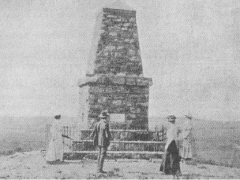
Forgotten men of the Indian Army left their imprint in Observatory, Johannesburg during the early 1900s. Although their story has been largely forgotten and lost to public memory, a monument at the summit of Observatory Ridge honours their memory. This Indian Monument stands as a memorial to Indians who fell in the Anglo-Boer War / South African War of 1899-1902, overlooking the valley where Indians served at a remount camp during the War. Erected soon after the end of hostilities, the Indian War Memorial was launched in the first flush of peace amidst a wave of enthusiasm and fanfare. Public interest and understanding of the monument then dissipated over much of the twentieth century.
More recently, the rise of revisionist accounts of the War has seen more inclusive representations of the conflict coming to the fore. Commemorations to mark the centenary of the Anglo-Boer War, held in 1999-2002, brought a flurry of publications and public events in which the experience of black people in the War, having long been ignored and suppressed, were highlighted as never before. Yet this first “inclusive” anniversary failed to raise the public profile of the Indian Monument, or to recover its meaning and significance.
The War Memorial takes the form of an obelisk of sandstone cut from the hill on which it stands. A tablet on the monument’s east side bears the inscription:
To the memory of British Officers Natives NCOs and Men Veterinary Assistants Nalbands And Followers of the Indian Army Who died in South Africa, 1899-1902
When I picked up a tourist brochure in the Northern Cape and read something about German war graves at Kakamas, my interest was piqued. The existence of German war graves implies that there must have been German troops in South Africa. I do possess a fair knowledge of German and South African history and just couldn't think what the historical event was. What were some of my countrymen doing in South Africa fighting a war and why?
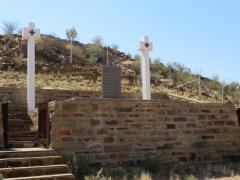
The site is at the north side of the Orange River across from Kakamas, near a small town called Lutzburg, about 85 km west of Upington along the N14. The coordinates are: 28.7436ºS, 20.6363ºE and altitude 682m.
Information board (Horst Müller)
Some internet research and a visit to the gravesite revealed what had happened here.
At the beginning of the First World War, when the Union of South Africa was drawn into the war against Germany through being part of the British Empire, it was expected of the South African forces to move into German South West Africa. Whilst the South African army was mobilising, some of the Schutztruppe (territorial troops) did not wait and attack being the best form of defence moved towards the Orange river in order to block the crossing point at Kakamas.
Many commentators have written about the guns falling silent in Europe on 11 November 1918 and the reasons we should be remembering 100 years on. For South Africa and other African countries though, the war continued until 25 November 1918 when the Germans finally lay down their arms at Abercorn, today’s Mbala.
While many South Africans will recognise the names Delville Wood and SS Mendi and some have awareness of South Africa’s relationship with South West Africa (Namibia), the fact that 51,541 men, excluding carriers, labourers, medical forces and women, served in East Africa in various roles is hardly known. During the four years and three months of campaigning in East Africa (today’s mainland Tanzania, Rwanda and Burundi), two South Africans commanded the forces on behalf of the British Empire: Jan Smuts from 19 February 1916 to 6 January 1917 and Jaap van Deventer from 23 May 1917 through to the end of the war.
Jan Smuts (via Wikipedia)
Although not present at the surrender of the Germans on 25 November 1918, van Deventer oversaw the negotiations from his various locations visiting the troops and Dar es Salaam. It was van Deventer who insisted that the German officers be allowed to retain their swords and personal weapons when the British War Office wanted them to be surrendered. He also tried to arrange...
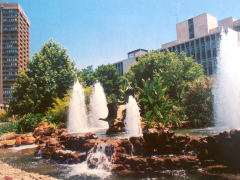
In November 1982, Harry Oppenheimer presided over the opening of a landmark fountain in the heart of the Sandton CBD. The fountain, located on the corner of 5th Street and Rivonia Road in front of the Sandton Civic Centre, was donated to the town by Kay Barlow in memory of her husband Charles Sydney (Punch) Barlow.
Kay Barlow and Harry Oppenheimer at the opening of the fountain (Rand Daily Mail)
Barlow used his considerable wealth to help preserve South Africa's built environment and natural heritage. He was passionate about birds and made a great contribution to ornithology over the decades. According to various sources published after his death, he even had a few sub-species of birds named after him. This is why Kay Barlow commissioned the talented sculptor Robin Lewis to create two large bronze Fish Eagles to be placed...
The 100th centenary of the end of the First World War will be celebrated this Sunday 11th November 2018. On the 11th hour of the 11th day of the 11th month of 1918 the armistice came into effect; men still poised to fight one another were stopped in almost mid battle in France. Church bells pealed and the guns fell silent. The physical losses had been horrendous. The total number of casualties, through war, destruction, disease, revolution and famine is in reality unknown because the conflict was so widespread. The four horsemen of the apocalypse rode the planet and with possible losses of military and civilian casualties topping 40 million the war was among the most catastrophic in human history; that figure includes military deaths of between nine and eleven million on both sides of the conflict. One has only to travel through the battlefields and cemeteries of northern France and Belgium to grasp the enormity of the catastrophe and the tragedy of loss of a blighted generation. We still remember today with our gatherings at cenotaphs, we place wreaths against war memorials all over the world and wear poppies to remember men and women who died in the conflict. It was truly the Great War.
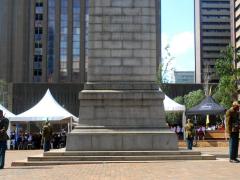
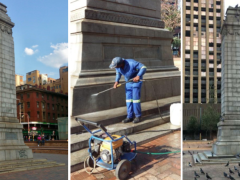
Many readers will be aware that the Joburg Cenotaph was vandalised recently. The City of Joburg's Heritage Department pulled out all the stops to ensure that it was cleaned before the hugely important National Remembrance Sunday Service on 11 November 2018. Below are before, during and after photos via The Heritage Portal and Sticky Situations.
Before
Vandalised Cenotaph (The Heritage Portal)
During
[[{"fid":"6877","view_mode":"media_adaptive","fields":{"format":"media_adaptive","field_file_image_alt_text[und][0][value]":false,"field_file_image_title_text[und][0][value]":"Cleaning the Joburg Cenotaph - Sticky Situations - October 2018"},"link_text":null,"type":"media","field_deltas":{"7":{"format":"media_adaptive","field_file_image_alt_text[und][0][value]":false,"field_file_image_title_text[und][0][value]":"Cleaning the Joburg Cenotaph...
September was Heritage Month but here I was in October invited to spend a weekend at Kedar Heritage Lodge to join the celebrations for the unveiling of a memorial to Sir Winston Churchill. Why October? Why Churchill in the Bushveld? Then I remembered. Kedar is a modern reincarnation of President Kruger’s farm and country estate, Boekenhoutfontein (meaning Beech-wood Spring). Now located in the Northwest Province, it was once a jewel in the Transvaal Republic. The 10th October was President Kruger’s birthday (his dates 1825-1904) and if you were a child during the fifties, it was a date that was writ large in school history of that era. We used to celebrate Kruger Day as a public holiday. Today 10th October is just an average working day. It was one of those holidays that was dispensed with when South Africa transitioned to a democracy for all. Saturday 13th October was the nearest weekend to that now forgotten 10th October. The Kruger Farm has become Kedar Heritage Lodge and is part of the Recreation Africa group of hotels and restaurants owned by Robert Forsyth. This company began purchasing farmland in the area including the portion owned by Kruger’s daughter Gezina. Purchases continued and today the Hotel group owns some 1 200 acres.
On 26 July 2018 concerned stakeholders including representatives from the Johannesburg Heritage Foundation (Kathy Munro), the Kensington Residents Association (Isabella Pingle) and the Johannesburg East Joint Plans committee (Andre Marais) met with Eric Itzkin, Zoleka Ntobeni, Councillor Carlos Da Rocha and Cebo Mhlongo of the City. We paid a site visit to the Bez Valley War Memorial. This is the First World War War memorial commemorating the 64 men of Bezuidenhout Valley who lost their lives while fighting or serving on battlefields and theatres of war in France, South West Africa, East Africa, North Africa and the Middle East. They were soldier volunteers for the British Empire and Allied cause in the war against Germany and the Central powers between 1914 and 1918. The first name on the central panel of names on the granite plinth was Sir George Farrar of Bedford Court who died following a tragic railway accident in the South West African campaign.
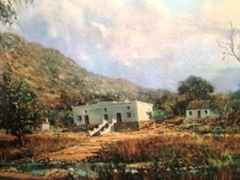
Painting of Bedford Court
The men commemorated on the memorial were all white and many of immigrant descent or first generation South Africans. Those were the racial, cultural and social restrictions of that era. Black members of the SA Native Labour Corp who were also volunteers and service men are now remembered and commemorated at various memorials across the city and all who served are remembered at the Cenotaph on Beyers Naude Square. The...
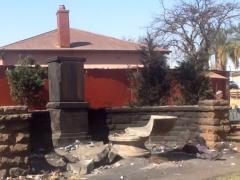
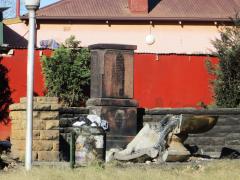
On Saturday morning 16th June 2018, I attended a Johannesburg East Plans committee meeting. Our work is about heritage preservation while considering appropriate changes and new developments. Isabella Pingle, the representative of the Kensington Ratepayers and Residents Association, placed a photo before us showing the damage recently done to the Bez Valley World War I Memorial. The Memorial has effectively been destroyed despite the recent efforts of the local councillor Carlos Da Rocha and the community to clean the small park. In late 2014 an effort was made by City Parks, the Johannesburg Heritage Foundation and others to revamp the memorial. It is one of those Johannesburg heritage spots that has been hanging on by its finger nails. The challenges of preservation have overwhelmed the City of Johannesburg.
What is left of the Bez Valley War Memorial (Isabella Pingle)
This small local memorial is located opposite Darras Centre on the boundary edge of the suburbs of Bezuidenhout Valley and Kensington. The address is the corner triangle where 5th Street, 9th Avenue and Kitchener Avenue intersect. The memorial is a block away from the main thoroughfare - Albertina Sisulu Road. It is a triangular patch of park land that falls within the orbit of the City Parks of Johannesburg.
[[{"fid":"5565","view_mode":"media_adaptive","fields":{"format":"media_adaptive","field_file_image_alt_text[und][0][value]":false,"field_file_image_title_text[und][0][value]":"Location of the Bez Valley...
On the 21 January 1960 a major calamity befell the coal mine at Coalbrook, situated in the Northern Free State 21km south west of Vereeniging. 437 miners were buried alive 180 meters below the surface when an estimated 900 pillars collapsed. A major rescue effort was undertaken, unfortunately without any positive results.
This article covers the history of the coal mine, the events leading up to the disaster, the causes, the aftermath and what we find there today.
The Clydesdale Collieries about 1910 (Ref 1)
The Mine
The first shaft was sunk in 1904 to a depth of 437 feet, the company was the The Clydesdale (Transvaal) Collieries Company Ltd. Production commenced in March 1905 at a rate of 12 000 tons per annum. Production increased over the years reaching 500 000 tons by 1950.
A step-up in production came with the construction of the Taaibos power station and after that also the Highveld power station on a property near the mine. The first turbine at Taaibos was commissioned in December 1954. Other units followed...
In the article below, Lucille Davie recalls the tragedy of the Westdene Dam Disaster. The piece was originally published on the Brand South Africa website on 20 June 2013. Davie's story was sparked by a visit by then mayor Parks Tau to various sites commemorating the loss of children. Click here to view more of Davie's work.
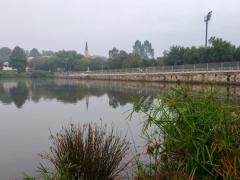
Dewald van Dyk’s shoes lie in the murky depths of Westdene Dam in Johannesburg. They have been there since 1985, when he dived into the dark waters again and again to pull out children whose school bus went into the dam.
Van Dyk was a paramedic at the time, and he was part of the emergency services team that arrived at the dam 15 minutes after the accident happened. There were 76 schoolchildren on the bus that day; only 34 survived. They ranged in age between 13 and 17, and were catching the bus home from school on Wednesday, 27 March 1985.
This year, on Youth Day, 16 June, the executive mayor of Johannesburg, Parks Tau, visited several sites in the city to commemorate children who had died in various incidents. He visited Alexandra, where pupils marched on 18 June 1976, two days after Soweto exploded in student revolts. What started as a peaceful march was a protest against the imposition of Afrikaans in township schools.
Several hundred people were gunned down by police in Johannesburg on 16 June 1976, and as the riots spread across the country, the body count rose to over 560. A plaque...
In the article below, journalist and heritage enthusiast Lucille Davie reveals the fascinating story behind the Prestwich Memorial in Cape Town. The article was first published on the Media Club South Africa website on 30 September 2013. Click here to view more of Davie's work.
Sometimes new developments can lead to more than just creating fresh spaces. During excavations for a new residential block in Cape Town, old bones were uncovered, the unmarked graves of slaves dating from the 17th and 18th centuries.
The modern story goes back to 2003, when construction began for a new luxury apartment block in Prestwich Street, Green Point. The bulldozers soon unearthed the bones, and excavation was halted. Archaeologists from the University of Cape Town were called in, as prescribed by the National Heritage Resources Act.
The remains were exhumed and taken to the mortuary at the Woodstock Day Hospital. Decisions had to be made regarding what would be done with them, as human remains are always a sensitive issue. Descendants need to be consulted, and reburial is sometimes a contentious point.
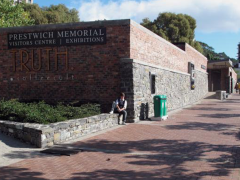
This story ended with the opening of the Prestwich Memorial, on the corner of Buitengracht Street and Somerset Road, in 2008. The single-storey building is finished in grey Robben Island slate. It makes a striking statement, built next to the first Presbyterian Church in the country, completed in 1828. It was the first church to allow freed slaves through its doors, after slavery was abolished in 1838 in South Africa.