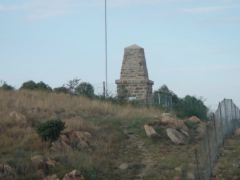
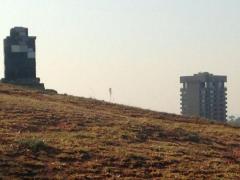
The passages below, taken from the City of Joburg's heritage inventory form, reveal the captivating history behind the Indian War Memorial. The three metre high sandstone memorial stands at the summit of the Observatory Ridge with majestic views over the surrounding suburbs.
View over the eastern suburbs from the Observatory Ridge (The Heritage Portal)
The memorial commemorates the sacrifices of Indian auxiliaries who lost their lives during the Anglo-Boer War of 1899-1902. It is the oldest war memorial in Johannesburg, unveiled on 31 October 1902, five months after peace was declared. In total some 9 000 men were brought out from India to bolster the British forces. They took up non-combatant functions as stretcher-bearers, farriers (‘nalbands”), veterinary assistants, grooms, orderlies, ammunition and water carriers and washermen.
The Memorial from below (The Heritage Portal)
An Indian detachment staffed a large remount camp in the valley below the memorial site, in what is now Bezuidenhout Park. Up to 4 000 horses could be accommodated at Bezuidenhout Valley’s large central remount station...
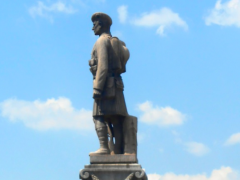
The sculpture shows a soldier in kilt and Scottish regalia. It fits in most dramatically with its position on a rising site on the triangular ground where St Andrew’s and Ridge Road meet. Visually it is very satisfying. It may not be a great work of art, but it is certainly a fine memorial, beautifully proportioned and well executed.
South African Scottish Memorial (The Heritage Portal)
The memorial was designed by William Tait Conner, a Scottish architect born in Glasgow who moved to Johannesburg in 1903 (click here for fascinating details from Artefacts). He served with the Transvaal Scottish in the First World War, attaining the rank of major. His partner A. Hamilton was killed in the conflict. Tait Connor won the competition to design the War Memorial in Boksburg, but gave his services freely for this work in 1922.
[NB - See the comments section for clarification on this paragraph] The sculptor was Arthur Taylor, who must have been a man of some eminence in Aberdeen. Alf Beattie, a member of the South African Scottish and a survivor of the Battle of Delville Wood, had known Taylor when he had grown up in Aberdeen. He wrote to his old friend and suggested he sculpt a SA Scottish...
This month it was my pleasure to visit Sappersrus. The occasion was a gathering of the tourism association of the Hartbeestpoort Dam/Magaliesberg area to meet and learn about Sappersrus and its history and attend a small memorial ceremony. We enjoyed excellent hospitality and a lunch in the well-designed lapa close to the water. I was asked to deliver a short talk on the Battle of the Somme, Delville Wood and memorialization. Our hosts were Irene Small and Ashley Williams, who run the Sappers facility and Foundation. They keep the faith of past traditions, recruit new members and educate people about the Sappers and their role in World War II and other South African military engagements. Their task is to continue the charitable work of the Sappers Foundation (as the older Sappers Association is now known) and promote the Heritage Centre. Sappersrus also offers weekend accommodation to anyone wanting a break in pleasant country surroundings.
Sappersrus is located on the road from Hartbeestpoort Dam to Magaliesberg on the north bank of the Magalies River. It is at this point that the river flows into Hartebeespoort Dam. It is about 42 kms from Pretoria and about 1 hour 15 minutes drive from Randburg. It is very accessible and the roads from all directions are excellent.
The history of Sappersrus dates back to the Second World War and the comradeship among the South African Engineers Corp. The Sappers were the engineers of the army and South African Sappers saw service in East Africa, North Africa and in Italy...
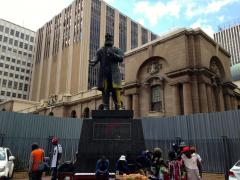
If you visit the High Court in Johannesburg you will notice a massive statue on the western edge along Pritchard Street. The statue commemorates the life of Captain Carl von Brandis -the 'Father of Johannesburg'. In the following article, P. J. Edginton uncovers some fascinating biographical details. The article first appeared in the old Johannesburg Historical Foundation's journal Between the Chains.
A man who could efficiently carry out his duties as a senior Government official, keep order in an unruly community with tact and humour and yet hold the affection of the inhabitants of a rough mining town must have been a remarkable character. Such indeed was Captain Carl von Brandis, the first official Mining Commissioner of the Witwatersrand and, shortly thereafter, the first magistrate of Johannesburg.
Von Brandis Statue in 2015 (The Heritage Portal) - The paint you see has been removed by the City of Johannesburg
Born in Germany in 1827 of a military family, he saw service in Austro-Hungary and Italy. In 1857 he came to the Cape with the German Legion (a British regiment). It was here he met and marred Jane Margaret Hohne, who bore him four children and who was a devoted wife throughout his varied career. By 1859 he was serving the Government of the...
In a speech given to the Sandton Historical Association in the late 1970s, Councillor Bill Hedding mentioned a very special historical site in the area - a school that managed to survive the onslaught of apartheid legislation and was connected to some of the most influential people in South Africa at the time. It also appears that part of the school is one of the few, if not the only, memorial to US President John F Kennedy in Africa.
No story about the schools in Bryanston would be complete without relating the story of the school which has had the biggest battle to survive. I refer to the Witkoppen School for Blacks [now Witkoppen Primary School], which though it is not in Bryanston, has been the concern of Bryanstonians and others for many years. A Mr Mason, who had started the nucleus of a school in 1927, donated two acres of his farm on which it stood to the African people of Witkoppen. The Anglican Board of Management controlled the new school.
Main Entrance to Witkoppen Primary School (The Heritage Portal)
In 1955 the Bantu Education Act was passed and the then Bishop of Johannesburg, the Rt Rev. Ambrose Reeves, decided to close the school rather than hand it over to the state. The Principal, Mr Jack, called a meeting of...
On 19 October 1986, a Tupolov Tu-134 plane travelling from Zambia to Mozambique crashed 65km from Maputo on the South African side of the border near the town of Mbuzini. The plane was carrying Samora Machel, the President of Mozambique, as well as high ranking Mozambiquan government officials and was manned by a Soviet air crew. Of the 44 passengers, 34 including the President died in the crash.
The official Commission of Inquiry into the accident, chaired by Judge Cecil Margo, highlighted pilot error while other reports claimed that a false beacon planted by South African agents was the catalyst for the crash. Speculation and debate on such a painful episode will, no doubt, continue.
In the 1990s a monument to commemorate the crash was commissioned. It was unveiled by Nelson Mandela of South Africa and Joaquim Chissano of Mozambique in January 1999. Since then the Samora Machel Monument has hosted various commemoration ceremonies and has been promoted as a major tourist attraction. Last month we visited the site and to say we were impressed is an understatement. The monument is incredibly powerful, the museum is enlightening and the staff are welcoming and informative.
The Samora Machel Monument and nearby museum (The Heritage Portal)
Perhaps our positive experience was due to low expectations created by negative online reviews. Many of the reviews on...
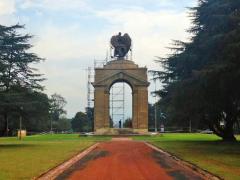
[Originally published in April 2015] At a time when many memorials have been neglected and dozens of statues have been vandalised it is wonderful to report that the landmark South African / Anglo Boer War Memorial in Saxonwold is being restored. Scaffolding is in place and a competent contractor has been appointed.
It appears as though this will be a comprehensive restoration which will include the iconic bronze winged figure positioned on top. The City of Johannesburg must be commended for initiating and financing this important work.
The memorial was designed by the famous architect Edwin Lutyens and completed in 1910. It was known as the Rand Regiments Memorial and honoured British soldiers killed during the conflict. This one sided approach meant that the memorial stirred controversy for many years. In the late 1990s this was rectified when the memorial was rededicated to "the memory of the men, women and children of all races and all nations who lost their lives in the Anglo Boer War, 1899-1902".
We were lucky enough to be taken around the site on two separate occasions to look at the work being conducted. The second visit included a once in a lifetime journey to the top of the memorial to see the winged figure of Victory, Nike. Enjoy the photos below.
During the past few months a number of South African university campuses have seen a spate of student protests against the presence of statues honouring our colonial past. Rightly or wrongly, these have resulted in the vandalization and removal of some of these memorials.
Without entering into a debate on some of the more ludicrous, and sometimes racist arguments put forward by either side, this is a matter which has implications for our national heritage, and for the preservation of our historical environment, and is thus in need of serious consideration.
In 1811 Joseph de Maistre wrote that every people gets the government it deserves. By extension then, they also get the heritage they merit, and as building after building in our city centres continue to fall before the demolisher’s hammer, many white South Africans have been left wondering exactly what they have done to warrant the destruction of so many of their memories.
To many, 1994 marked a turning point in our history, when we had the opportunity of leaving the horrors of racism behind and embracing a bright new future, free of the guilt and remonstrations for past actions. But that is not the way of history, whose flow does not have sharp corners or U-turns, but moves inexorably through linear time. Instead of being blind to the lies and dark secrets of our colonial past, history has a habit of bringing these to the surface where, like suppurating sores, they are revealed for all to see. The...
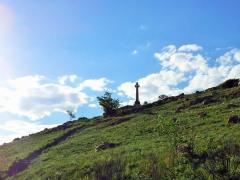
This is one of Johannesburg’s earliest war memorials, overlooking the site of one of the largest remount camps of the Anglo-Boer War, 1899-1902. Originally a memorial to the Scottish Horse which was later disbanded, that regiment was antecedent to the famous Transvaal Scottish Regiment formed in 1902, which saw service in both World Wars. It contributes to a sense of multi-cultural heritage.
The Memorial is located on Caledonia Koppie, an easily accessible view point to the east of the city centre which is sometimes used for alternative Christian devotions due to an interpretation of it as being “a cross on a green hill outside of town”.
History
The monument commemorates the officers, non-commissioned officers and men killed in action and died of wounds, disease and accident, who were members of the Scottish Horse Regiment, during the South African Anglo-Boer War in 1901-1902. The Scottish Horse was a mounted infantry regiment financed and led by the Marquis of Tullibardine (later the 8th Earl of Atholl) during the War. After the War, the Scottish Horse, in South Africa, was disbanded but parented the Transvaal Scottish Regiment.
This memorial was erected in 1905 and is the same as that erected on the Esplanade of Edinburgh Castle in Scotland. The only original difference between the two being that the hollow metal die replaced the solid granite die of the Scottish memorial to facilitate transport to and erection in South Africa.
The position of the memorial was probably chosen as it overlooked the site of the Scottish Horse camp in Bezuidenhout Valley where...
[Originally published August 2015] Last week Roger Fisher of Artefacts fame (and so much more) got in touch to ask if the small memorial plaque in the Standard Bank, Commissioner St, Johannesburg, for Standard Bank employees killed during the First World War still existed. Letitia Myburgh, Head of the Standard Bank Heritage Centre confirmed that it still did and sent through some details. The email conversation inspired Kathy Munro to write a fascinating piece on the lesser known memorials located in corporate and institutional offices.
In gathering information about South African war memorials, one is reminded that many men from the mines, companies, banks and institutions enlisted in the military and volunteered for services to fight in both World Wars as patriotic South Africans. The South African record of service was impressive. Often the names of men who were killed or died on active service were commemorated in plaques prominently positioned in foyers of corporate head offices. Sometimes Rolls of Honour were inscribed in a special commemorative volume or even published in a book (e.g. see Barclays Bank: "Bank in Battledress"). Commemorative plaques offered a dual memorial, acknowledging that the person had been an employee or colleague of a specific firm and offering the comfort to families of a Memorial honour. The enormity of loss and sacrifice in war meant that memorialization was a way of assuaging grief and triumphing over the finality of death.
Standard Bank's archivist and Heritage Head Letitia Myburgh, has kindly sent us some information and photographs of their war memorials. These days the memorials have slipped into the category of heritage survivals...
The monument honours Boer veterans of the Anglo-Boer / South African War, 1899-1902. Small plaques cover all four sides of the monument, a two metre-tall rectangular structure, spilling over onto the base. The memorial is crowded with inscriptions, set on a patchwork of small plates of different sizes and of various materials: sandstone, granite, slate, soapstone, etc. There are 41 small plaques to men who fought in the war. It stands on the crest of the ridge, on the south-eastern corner of the New Nation School, overlooking the old Gas Works.
Crowded with inscriptions, set on a patchwork of small plates (The Heritage Portal)
View over the Gas Works (The Heritage Portal)
History
The monument was unveiled on the grounds of the Cottesloe Primary School as part of the Voortrekker Centenary celebrations in Johannesburg on 3 December 1938:
“In early December 1938 a group of elderly men moved slowly up the Brixton Ridge overlooking the Gas Works, each weighed down by a slab of sandstone, slate or granite. Nearly every plaque was awarded a place on a crude, two and a half...
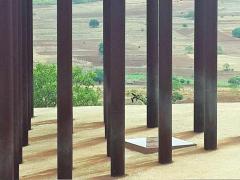
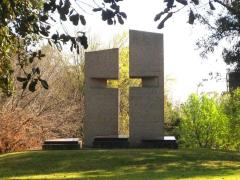
The Katyn Memorial stands on a rise in an attractive park setting, in good view from the nearby Atholl Oaklands Road. The structure is constructed of bushhammered reinforced concrete with a set of three plaques in red granite. The sculpture theme is derived from ancient Slavic forms assembled to create an interplay of open and solid spatial forms creating the image of the non-existing cross.
Reverse Angle of the 'Non-Exisiting Cross'
The monument was erected to commemorate the Katyn Forest Massacre, in which 14 500 Polish officers, police officers and citizens were executed by the Stalin regime of the Soviet Union in 1940. The monument has since been extended to commemorate the Warsaw Flights and Polish Home Army during World War II.
Katyn Memorial - September 2015
The commemoration of the Katyn Massacre started out as just a plaque in 1973. Known as the Katyn Commemorating Plaque, it found little support from the National Museum of Military History, as its inscription was viewed as fairly controversial. Despite that setback, the newly formed Katyn Memorial Committee approached the Johannesburg City Council to find a suitable place for its...