
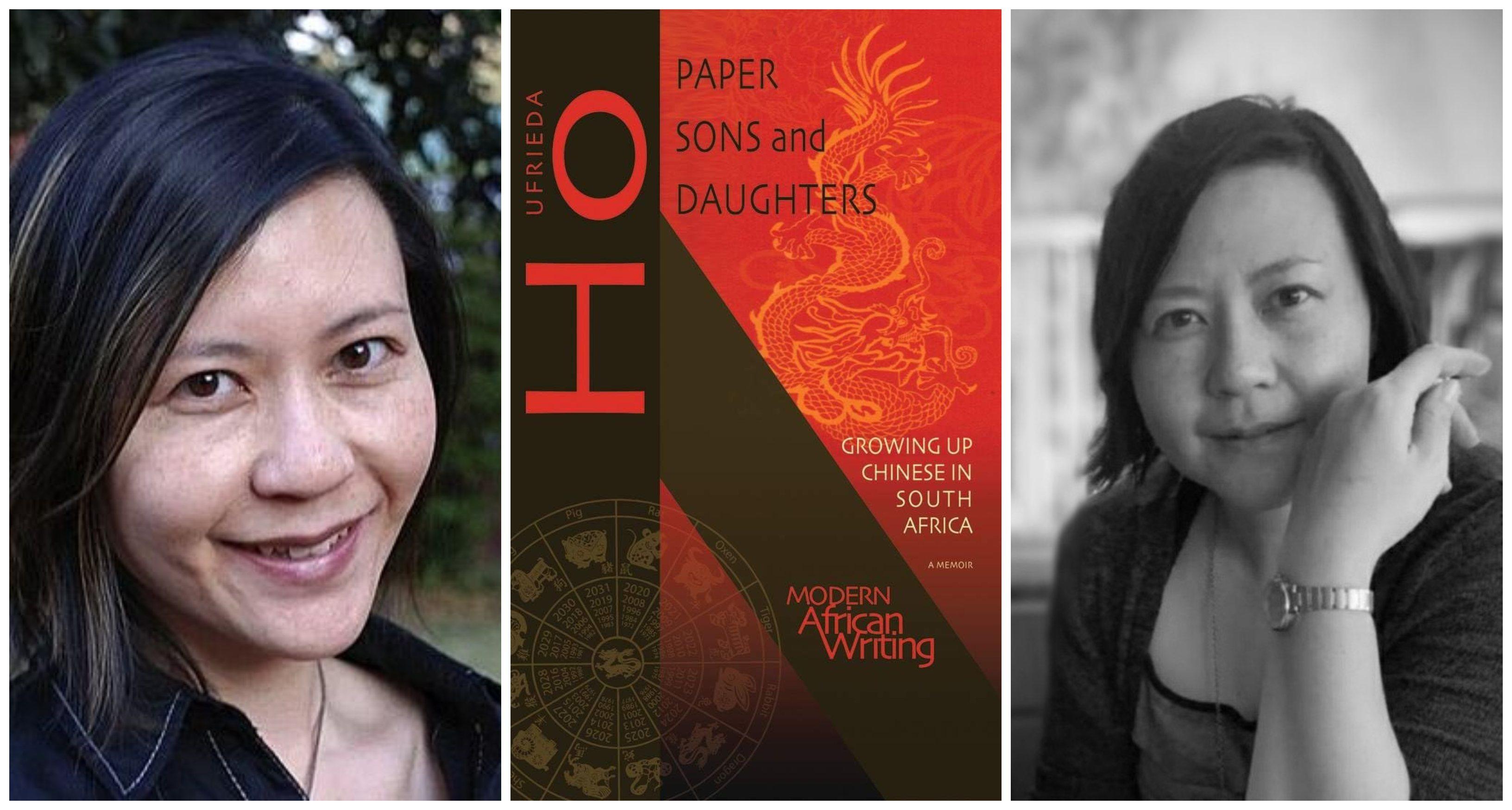
The sudden passing of Ufrieda Ho on 9 March 2026, just short of her fifty-third birthday, is a profound loss to South African journalism and literature. Those who knew her work will remember a writer of warmth, curiosity, and moral clarity, someone who approached the human condition with empathy and an instinct for the telling detail. Among her achievements, her 2011 memoir Paper Sons and Daughters: Growing Up Chinese in South Africa, published by Picador Africa when she was only thirty-eight, stands as a remarkable and enduring contribution to South African writing.
With the perspective that time now gives us, the book reads not only as a memoir but also as a cultural document: an evocative account of family, migration, identity and survival in the shifting political landscape of twentieth-century South Africa. It is also a rare narrative. Few memoirs open such an intimate window onto the inner life of a Chinese South African family navigating the complexities of apartheid and its aftermath.
At one level Paper Sons and Daughters is a classic coming-of-age story. Ho recounts her childhood in the Johannesburg of the 1970s and 1980s and traces her journey into adulthood during the turbulent years of South Africa’s political transition in the 1990s. But the memoir is never confined to the experience of a single individual. Instead, Ho carefully interweaves the lives of several generations—grandparents, parents and children—showing how each carried the marks of migration and displacement.
Her grandparents and parents had arrived in South Africa under difficult circumstances. Some came as stowaways, others travelled under false identities, drawn by the enduring Chinese dream of the “Gold Mountain”—the belief that somewhere far away prosperity awaited those brave enough to seek it. Yet the reality they encountered on the Witwatersrand was far from the promised land of milk and honey.
In apartheid South Africa the Chinese community occupied an ambiguous and often uncomfortable position within the rigid racial hierarchy of the state. They were not classified as Black, yet they were not accepted as White. The privileges reserved for the white minority were denied to them, and they existed in a narrow social space between categories that had been brutally defined by law. In that space, families like Ho’s attempted to make lives of dignity and stability.
Language itself was one of the first barriers. Newly arrived immigrants struggled with English or Afrikaans and often had to negotiate daily life across several linguistic worlds, including African languages such as Zulu. Economic survival depended on perseverance and ingenuity. Many became small shopkeepers—the owners of the modest neighbourhood stores and spaza-type businesses of earlier decades—while others worked as seamstresses, butchers or tradespeople.
Ho writes with affectionate precision about this world of small enterprise and daily improvisation. In her own family story, her father’s life adds a further layer to the portrait. He was a gambler and a runner in the numbers game known as Fahfee, a system of betting that circulated quietly through the working-class communities of Johannesburg. Through these details the reader glimpses a city rarely recorded in official histories: the informal networks, the risks and hustles, the fragile livelihoods that sustained immigrant families on the margins of a racially stratified economy.
One of the great strengths of Paper Sons and Daughters is its vivid sense of place. Ho recreates the texture of Johannesburg life with remarkable clarity. The eastern suburbs—Bertrams, Judith’s Paarl, Lorenzville—emerge as living landscapes filled with small shops, family homes, community rituals and the everyday negotiations of immigrant existence. Through her attentive eye these neighbourhoods become part of the emotional geography of the memoir.
What distinguishes Ho’s narrative, however, is the way she reflects on her family story from several different vantage points. The memoir unfolds across four stages of consciousness. First there is the curious child observing the rhythms and tensions of family life. Then comes the questioning teenager confronting social boundaries and discovering the complexities of identity. The university student follows, exposed to wider intellectual and political worlds. Finally, the adult emerges: a young cadet journalist learning her craft and beginning to interpret both her family history and the society around her.
This layered perspective allows Ho to examine her past with both affection and critical insight. The memoir provides a rare and fascinating glimpse into Chinese cultural traditions as they were transplanted to South African soil. She writes about family rituals, religious beliefs, attitudes toward elders, and the expectations placed upon children. Chinese sons and daughters were expected to be obedient, respectful, conformist and studious. Education was not merely encouraged; it was regarded as the essential path out of hardship.
Yet the children of these immigrants were growing up in a very different environment from that of their parents. South African schools, friendships and neighbourhood life exposed them to a society with more relaxed social codes and different expectations of individual freedom. The negotiation between these two worlds—traditional family values and the emerging culture of a new country—forms one of the memoir’s most compelling tensions.
Running through the book, however, is an awareness that each generation of the family endured its own share of tragedy. The earlier generation had already suffered profound displacement. They left the deep rural villages of a China shaken by political upheaval during the middle decades of the twentieth century. Migration fractured families: husbands travelled ahead while wives and children were left behind, sometimes for years. These separations created wounds that time never fully healed. Beneath the determination to succeed lay a quieter undercurrent of resentment and longing.
Ho does not romanticise these hardships. Her narrative acknowledges the darker episodes that marked the family’s journey. An uncle contracts leprosy, a devastating stigma in any community. Life in exile carries loneliness, anxiety and economic insecurity.
The memoir reaches its most heartbreaking moment in the final pages. In a quiet but devastating denouement, Ho recounts the murder of her father while he was making one of his rounds collecting and distributing Fahfee winnings. The moment is sudden and tragic, bringing the long arc of the family’s struggles in South Africa into painful focus.
And yet, despite these trials, what remains most striking about the family’s story is their resilience. Again and again they adapt to circumstances that might have defeated others. They remain pragmatic, industrious and often remarkably cheerful in the face of hardship. The strength of the family unit—the warp and the weft in the fabric of their transplanted life—holds them together.
Entrepreneurial effort, self-sufficiency, and an unwavering commitment to education provide the path forward. Slowly the family begins to put down roots in South African soil.
One of Ho’s most perceptive insights emerges gradually through the memoir. As she grows older, she becomes aware that even within their struggles her family occupied a position of relative advantage compared with the profound deprivation imposed on Black South Africans under apartheid. The recognition is uncomfortable but necessary, and Ho confronts it with honesty. She poses difficult questions both for herself and for her community about privilege, solidarity and moral responsibility.
Through it all Ho herself emerges as a figure of remarkable vitality: curious, reflective, and deeply concerned with the human condition across racial and cultural divides. Her writing carries a distinctive voice—warm, candid and attentive to nuance. She is unafraid to acknowledge contradictions within her own identity and within the communities she describes.
When the final pages of Paper Sons and Daughters close, the reader is left with a mixture of sadness and admiration. The memoir challenges simplistic stereotypes about the Chinese community in South Africa. It reminds us that behind the familiar image of industrious shopkeepers and diligent students lies a far more complex story—one shaped by migration, cultural endurance and adaptation.
Above all, the book reveals the extraordinary durability of an ancient civilisation transplanted thousands of miles from its origins. Chinese traditions, values and cultural memory were carried across oceans and replanted in African soil, where they continued to shape the lives of new generations.
In preserving the story of her own family, Ufrieda Ho preserved something larger as well: a small but significant chapter in the mosaic of South African history. Her memoir stands as a testament to the immigrant experience in all its contradictions—hardship and humour, tragedy and perseverance, loss and renewal.
Now, in the wake of her untimely death, the book takes on an added poignancy. It reads as both a personal remembrance and a lasting gift to South African literature. Few writers have captured so vividly the texture of everyday immigrant life or the quiet heroism of families determined to build futures in unfamiliar lands.
Paper Sons and Daughters endures as a warm, reflective and deeply humane memoir of the late twentieth century. In remembering Ufrieda Ho, we also remember the voices and histories she so carefully brought to life—stories of struggle, resilience and belonging that continue to shape the South Africa we inhabit today.
Published in 2011 by Picador Africa, paperback - best place to find this book is in the secondhand bookshops of Johannesburg and Cape Town.
Kathy Munro is an Honorary Associate Professor in the School of Architecture and Planning at the University of the Witwatersrand. She enjoyed a long career as an academic and in management at Wits University. She trained as an economic historian. She is an enthusiastic book person and has built her own somewhat eclectic book collection over 40 years. Her interests cover Africana, Johannesburg history, history, art history, travel, business and banking histories. She researches and writes on historical architecture and heritage matters. She is a member of the Board of the Johannesburg Heritage Foundation and is a docent at the Wits Arts Museum. She is currently working on a couple of projects on Johannesburg architects and is researching South African architects, war cemeteries and memorials. Kathy is a member of the online book community the Library thing and recommends this cataloging website and worldwide network as a book lover's haven. She is also a previous Chairperson of HASA.