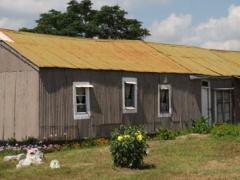
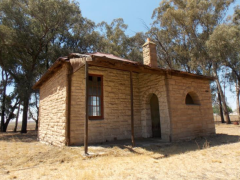
A short drive south of the city, some 10 kilometres outside the CBD, are remnants of Joburg's first settlement of Khoisan, South Africa's oldest people.
They are to be found at the Eikenhof Khoisan Farm, portion 80, consisting of 247 hectares of land immediately south of the Klipriviersberg mountain, on the banks of the Klip River. The site has been occupied by Khoisan people for about 100 years, squeezed between several farms belonging to whites, who moved into the area from the 1850s onwards.
The Khoisan community appears to have settled on the site in the mid-1890s. A cluster of houses was established in the veld around a church, which doubled as a school. In those days it was known as Jackson's Drift, a reference to a crossing point about a kilometre downstream.
Over thousands of years the original peoples of South Africa – the San or Bushmen, and the Khoi – have lived side by side, and are now commonly called the Khoisan.
There are other interesting elements to the site: Stone Age artefacts, early traces of gold mining exploration, the battleground for control of Joburg in 1900, and a wetland.
Today the site consists of four buildings: the Ebenezer Congregational Church (see main...
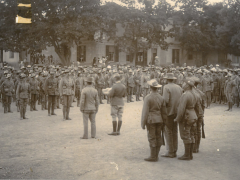
Huge was the surprise when the author received multiple enquiries on a Prisoner of War (PoW) camp photograph that was included in a recent article on photography during the Anglo-Boer war (click here to view).
This Diyatalawa PoW camp photograph has the names of all 54 men captured on the back thereof (See Photo 5 below).
This unexpected interest confirms that genealogical research and natural curiosity around family links and history, even some 120 years after the event, are alive and well.
The intention of this article is therefore twofold, namely to list the names of the sitters identified in these 6 group photographs in order to assist current and future researchers and also to briefly reflect on the photographic activity at these PoW camps.
Prisoner of war camps
Around 24 000 boer prisoners were transported to various overseas camps. During this period some 577 men perished either at sea or in the camps – mainly due to natural causes. It has been recorded that the eldest prisoner was 78 at the time whilst the youngest was 7 years old. Camps existed in South Africa, Bermuda, St. Helena, Ceylon, India and Portugal.
Camp photographers
Although much has been published by historians about life and activities in these various PoW camps, little is known about professional photographers active in these camps. It is thought that the majority of these would have had no direct link to South Africa and that they were based in the countries or on the islands...
Joseph Calder Munro, a Scot by birth, made a significant contribution to Pretoria’s photographic history. Many of his photographs have survived and can be found in various national and private research collections. Photographs produced by him still surface on a regular basis - mainly at antique fairs.
After completing training and an internship in England, Munro continued his photographic career in Pretoria during 1890 (then aged 25), some 15 years after Pretoria’s first photographer the Swiss HF Gros established himself in Pretoria (click here for details).
Although he was not the first photographer to settle in Pretoria, he became known as one of the more prolific portrait photographers of his time. Many well-known personalities and leading citizens of the capital frequented his studios.
Amongst all those that attempted to earn a living from photography during Pretoria’s earlier years, Munro was the longest practising photographer – Some 50 years! His activity ranges from 1890 to 1940 (until the time of his death).
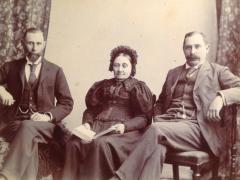
Two different poses. Why is it that men were typically seated during portrait photography sessions during this era? It has been suggested that it was protocol in those years, mainly for the female to show off her dress. Couple on the right have been recorded as Piet and Marta Rautenbach.
Photography is the only “language” that is understood worldwide, resulting in a bridge being created between nations and cultures – it connects the family of humanity. Independent of political influence – where people are free – it provides us with an honest reflection about life and events, allows us to share in the hope, joy and despair of others, and potentially lightens political and social burdens. This way we become witnesses, not only of humanity, but also of the brutality of human kind (Gernsheim as quoted in Sontag 1977).
Since the first war was photographed during 1846, photography and war have become inseparable. Any war photographed fills gaps in our perception around the events and occurrences surrounding it. It provides for an improved context.
South African photographs from the Anglo-Boer War, those that have survived, have become additions to our heritage.
Image of Boer Prisoners of War held at Diyatalawa Camp in Ceylon. What makes this image unusual is that the name of each of the 54 individuals on the image has been captured on the back of the photograph. Photograph was initially thought to have been taken at the Ragama camp. Originating format – unknown.
[[{"fid":"3528","view_mode":"media_adaptive","fields":{"format":"media_adaptive","field_file_image_alt_text[und][0][value]":false,"field_file_image_title_text[und][0][value]":"Unknown concentration camp. Carpenters. The table is clearly...
Beautifully situated in the Heidelberg Kloof is the Kloof cemetery, the original and oldest cemetery of the town. In fact, the oldest grave goes back to before the town was established. I'd like to take you on a walk through the graves, picking up a specific grave stone here and there.
Heinrich Ueckermann
The town started with Heinrich Ueckermann, he set up the first trading store in what now is the town.
Heinrich Ueckermann
He originated from Germany and named the place after Heidelberg in Germany where he studied (the sources don't reveal what he studied). He arrived in South Africa in 1849, disembarking in Durban. He set up business in Pietermaritzburg and two years later got married to Elizabeth Mary Mason. She bore him 14 children.
After the birth of their first son, they trekked extensively by ox-wagon into the interior as far as the Soutpanberge. It was on this trek that their first daughter was born in 1856 (a personal note: it is always an amazement to me how tough people were in those days that they could trek for months on end and have babies at the same time). On another trek he got to the farm Langlaagte and decided that this was a good place to establish a trading store thus bringing an end to their wanderings.
We South Africans live in a polyglot society, which under our Constitution, has 11 official languages that “must enjoy parity of esteem and must be treated equitably”. Mother tongues range from Afrikaans to IsiZulu, from isiXhosa to Setswana, however to stop us being a modern Tower of Babel we largely use one language to communicate between each other and that is English. In doing so we are reflecting a world wide trend. In today’s world English has become the “Lingua Franca” replacing French as the language of diplomacy and German in the field of science. It has also become one of the essential languages for global trade.
In 21st century South Africa, English is used in many walks of life, in media and advertising, in education, law, commerce and government. English is the language of the big city especially Johannesburg, South Africa’s financial capital. Although should one drive 50 miles (80 km) in any direction out of “Egoli”, you are more likely to hear Afrikaans or an African language being spoken. How is it then that a European colonial language has managed to become so influential?
To answer this question a look at South African history from the beginning of the 19th century is needed.
The English language first came to the southern tip of Africa 1795 when the British occupied the Cape of Good Hope in order to protect their trade with India and the Orient. They left in 1803 as part of the terms of the Treaty of Amiens, but in January 1806 they returned for good, after...
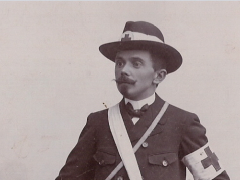
Jannie Roggeband, a Dutch citizen, was a field ambulance volunteer during the Anglo Boar War (1899-1902). Roggeband had a powerful accolade published in the Ficksburg community newspaper on 4 January 1923, a few days after the death of General George Alfred Brand (10 February 1875 – 24 December 1922). General Brand, one of President and Lady Brand’s 11 children, passed away at the young age of 47. A family photograph circa 1882, in the author’s collection, shows George and his older siblings, 7 of which were boys.
As a collector and researcher of Anglo Boer war related images, the author, on occasions, finds absolute gems where a letter or newspaper clipping is found with a photograph that relates to the “sitter” (person in the photograph), who was either a participant in the Boer War or simply a citizen caught up in the war.
Photographs in themselves tell stories, but to find the Roggeband photograph with a newspaper clipping certainly provides insight into the personalities as well as the nature of the relationships between various parties during the war (sometimes opposing parties).
Based on the author’s research, Jannie Roggeband has not been identified or named as a Dutch Volunteer in any previous research conducted. No mention, for example, is made of him in the recently published book by Chris Schoeman on the Dutch involved in South Africa during that era (Brothers in Arms: Hollanders in the Anglo Boer War).
This article not only reflects on the personality of Brand...
As a collector and researcher of Anglo Boer war related images the author, on occasions, finds original letters or newspaper clippings that relate to the “sitter” (person in the photograph) who was either a participant in the Boer War or simply a citizen caught up in the war.
Photographs in themselves tell stories, but to find personal letters either written by, or addressed to, the sitter enriches the story. The author feels compelled to record some of these personal stories – like this one:
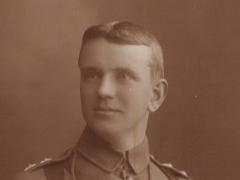
Lieutenant Andrew Meikle, a British soldier, clearly had some dealings with Commandant Brand’s bride to be during the war. Andrew, on reading about her marriage to Brand (General at that stage), writes a letter, dated 19 January 1904, to the new Mrs. Brand reflecting on some of their interactions during the war.
It has been suggested that Mrs. George Alfred Brand, a Miss van der Merwe prior to her marriage to George Alfred Brand (1875 – 1922), walked away from the Bethulie camp and joined a nursing unit where she has been referred to as an angel sent, nursing the ill and wounded – friend and enemy alike.
The letter to her reads as follows:
My dear Mrs. Brand
It was with a great amount of pleasure, that I received the announcement of your marriage, and I am sure that no one will wish you more happiness and prosperity that I do.
I am afraid my small amount of Taal will not enable me to read...
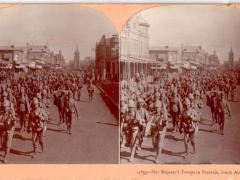
Stereo photography is a craze that has swept the world since 1851, so much so that modern View Masters are still being produced commercially today. Stereo images (two photographs of the same subject, taken from slightly different angles but covering the same subject area, and mounted side by side) must be viewed through a special viewer where the two images then fuse into one giving a visual impression of subject depth – or a three dimensional effect.
These images created a sense of reality to the viewer, and even today would have the viewer gasping when looking at uniquely created stereo images.
Stereo photograph of Cape Town
Stereo view imagery was probably the most common form of visual entertainment during the Victorian era, achieving similar popularity that modern television and cell phone technology provides the worldwide population today.
A stereo camera with two lenses (side by side) was required to produce these images. These cameras themselves today are highly collectable.
The reason for the growth in popularity of stereo viewing, from the mid 1800’s onwards, lies in the increase in literacy levels, improving social conditions as well as travel that became more common. So big was this craze that the London Stereoscopic Company had a slogan...
With a melodic sounding name the Riemland is largely an area of wide flat horizons interspersed with not much else. It is however home to some very interesting heritage hotspots in the country. The Riemland covers most of the north and north-eastern Free State, including the towns of Sasolburg, Heilbron, Petrus Steyn, Lindley, Arlington and Senekal.
In days gone by large herds of game roamed the area. Hunters came to shoot the game and made thongs or riempies from the hides. These riempies were a necessity to most farmers and were mostly used as rope. The Riemland therefore is the area from where the riempies came.
Accompanied by tour guides Twin Mosia and Piet Lombard, History and Heritage Tourism students of the North-West University, Potchefstroom Campus, visited some of the heritage sites in the Riemland area from 30 September to 3 October.
The Coalbrook tragedy
One of the largely forgotten heritage sites of the Riemland is the place where the Coalbrook mining disaster took place in 1960. The bodies of the 435 miners who died there on 21 January, after a large underground cave in, were never found. This is the biggest mining disaster in South African history and ranks under the ten biggest coal mining disasters in the world.
This occurred about 180 m below the surface in the area north east of the No. 2 Shaft of the Clydesdale Colliery. About 1 000 miners were underground at the time of which 435 became trapped. Rescue operations started immediately but were...