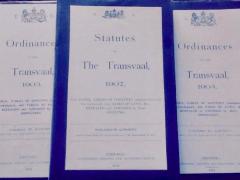
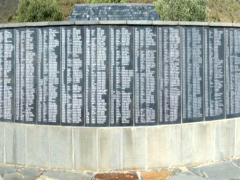
Ordinances of the Transvaal 1903, 1904 and Statutes of the Transvaal 1907. Whoever wants to look at old, dry, dusty, obsolete law books? Law books date, they take up space on shelves and laws are repealed. Legal language is precise and unemotional. The Transvaal ceased to exist in 1994 and today a completely different provincial government structure has replaced the pre 1994 arrangement of four all white driven apartheid provinces and the 10 bantustans.
But step back in time and old law books acquire an antiquarian and historical interest and become yet another prism through which we can attempt to understand the past. Laws, ordinances and statutes are building blocks of an orderly society. They are an expression of the norms and values of a society at a particular point in time. Laws embody the canons of justice. They give authority to the executive arm of government in matters large and small. A society without law shifts into an anarchic state. Laws enable government to implement policies, ideologies and principles. Law gives expression to changed circumstances in societies.
It is the bread and butter of lawyers to read law books but the layman can broaden his reach and grasp by also trying to read a law book or two.
I recently dropped in on a sale of a deceased private collection of Africana and history books. Buying three old law books dating back to the early 20th century was not my first choice as I gathered up a miscellaneous but appealing selection of books. At R40 for a hard cover here was an opportunity not to be missed. Then...
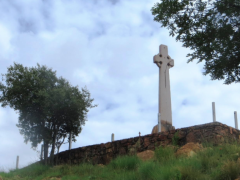
Last weekend (Sunday 3rd February 2019) I joined ten heritage stalwarts of Kensington who came together to acknowledge history and pay homage to a remarkable war memorial and the men whose names once appeared on it. We gathered because during January 2019 the memorial had been extensively and probably irreparably damaged. Erica Lűttich had together with her students created an art installation by wrapping the memorial in cloth. We Johannesburg residents and heritage protectors are saddened, shocked and appalled by this latest assault on one of Johannesburg best known war heritage landmarks with a rich history. It is one of Johannesburg’s earliest war memorials, erected in 1905 - making it 114 years old this year.
A damaged section of the memorial (The Heritage Portal)
Missing plaques and graffiti (The Heritage Portal)
When you read the book ‘Letters of Stone’ by South African author Steven Robins, which tracks the lives and fates of the Robinsky family in Southern Africa, Berlin, Riga and ultimately Auschwitz, you may be tempted to visit Williston to experience first-hand where one of the principal figures of this poignant story lived. Here you will find Robinsky Street, commemorating Robins’ great uncle Eugen Robinski who fled Konigsberg, East Prussia to become a successful businessman, hotel owner and one-time mayor of this small Karoo town.
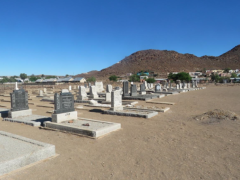
But even if your interests are more mundane, Williston will not disappoint. Situated on the Karoo Highlands Route, the town and surrounding areas offer, amongst others, beautiful clear night skies, rock paintings, corbelled houses, remnants of the Anglo Boer War, artisanal cheeses, succulent Karoo lamb and the possible sighting of that rarest and most endangered of all South African animals, the Riverine rabbit. But for this author the main attraction lay in the Williston Cemetery.
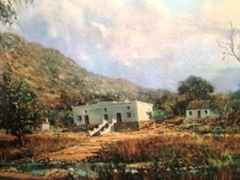
Stuurmansfontein Corbelled House (South African Panorama)
The older and smaller Karoo towns offer the cemetery enthusiast some of the most historical and interesting tombstones in South Africa. Unfortunately, all historical cemeteries are facing similar problems; slow deterioration of tombstones due to prolonged exposure to harsh climatic conditions and then the more immediate and hazardous one, malicious damage...
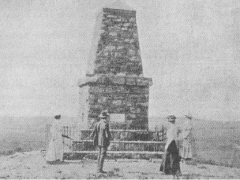
Forgotten men of the Indian Army left their imprint in Observatory, Johannesburg during the early 1900s. Although their story has been largely forgotten and lost to public memory, a monument at the summit of Observatory Ridge honours their memory. This Indian Monument stands as a memorial to Indians who fell in the Anglo-Boer War / South African War of 1899-1902, overlooking the valley where Indians served at a remount camp during the War. Erected soon after the end of hostilities, the Indian War Memorial was launched in the first flush of peace amidst a wave of enthusiasm and fanfare. Public interest and understanding of the monument then dissipated over much of the twentieth century.
More recently, the rise of revisionist accounts of the War has seen more inclusive representations of the conflict coming to the fore. Commemorations to mark the centenary of the Anglo-Boer War, held in 1999-2002, brought a flurry of publications and public events in which the experience of black people in the War, having long been ignored and suppressed, were highlighted as never before. Yet this first “inclusive” anniversary failed to raise the public profile of the Indian Monument, or to recover its meaning and significance.
The War Memorial takes the form of an obelisk of sandstone cut from the hill on which it stands. A tablet on the monument’s east side bears the inscription:
To the memory of British Officers Natives NCOs and Men Veterinary Assistants Nalbands And Followers of the Indian Army Who died in South Africa, 1899-1902
Middelburg is one of those towns one usually bypasses while travelling to the Loskop Dam, the Kruger Park or the Mpumalanga Escarpment, not realizing it offers interesting sightseeing opportunities.
There is a historic Dutch Reformed Church established by the controversial Reverend Frans Lion Cachet in 1866, when the community was still known as Nazareth. Later the town’s name was changed to Middelburg, as it was midway between the two principal Transvaal towns of Pretoria (Tshwane) and Lydenburg (Mashishing).
It contains an attractive railway station erected when the NZASM Delagoa Bay line was laid. By the time this railway line reached Middelburg, the town had already become an agricultural centre of some importance and the hub of the regional transport roads. Its railway station was expected to become important because of the nearby coal fields. As a result more care than normal, went into the design and construction of this station building.
Then, there is the very interesting and historical Municipal Cemetery, which one enters from Bhimy Damane Street.
For anyone interested in the history of the Voortrekker migration, there is the grave of Carolus Johannes Trichardt, eldest son of Louis Trichardt who was the leader of the ill-fated Trichardt Trek of 1835 – 1838, who explored large stretches of East Africa for possible settlement areas for the migrants.
For a student of the old Transvaal Republic, the cemetery contains a memorial to 26 British Soldiers who died in the campaigns of 1879 to 1880, following its 1877 Annexation by Great...
The primary purpose of this article is to introduce the first known catalogue (Version 1 – as at November 2018 - click here to download) of Anglo-Boer war stereographic images produced by the American based Underwood and Underwood Publishing Group.
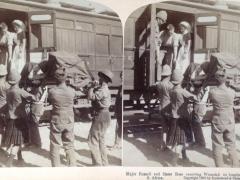
War correspondents and news photographers descended upon South Africa at the start of the Anglo-Boer war, among them the photographers of Underwood & Underwood. These photographers were not news photographers after sensational, gory war images, nor were they part of any pro-British or anti-Boer propaganda campaign. They stayed away from conflict zones but still captured other military related activity with their primary market, namely the American middle class in mind.
Underwood and Underwood produced sets of images in boxes made to look like a single, or a pair of books entitled: “The South African War through the Stereoscope”. These boxes were then filled with Anglo-Boer war stereo photographs pasted onto curved cardboard. More titles were added as the war progressed.
Wooden stereo camera similar to that used by Underwood and Underwood photographers during the Anglo-Boer war
What is a stereoview?
The stereoscope was invented as early as 1838 by Sir Charles Wheatstone and improved through the years.
Stereoviews became a popular photographic medium worldwide. Since 1851, stereo photographs were produced on a large-scale in the UK and Europe before they became widely distributed in the United States...
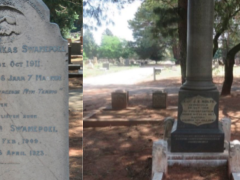
A friend who grew up in Germiston claimed at his recent birthday bash that while you could leave Germiston, it would never leave you. His words mulled through my mind as I arrived at the Primrose Cemetery. Visiting a historic cemetery like Primrose is similar to visiting an interesting museum. Instead of viewing artifacts one sees the tombstones of people who participated in events that may have shaped one’s life in one way or another. One also starts better interpreting the tombstone symbols and appraising the epitaphs.
A typical Victorian and Edwardian tombstone symbol - hand of deceased trustingly placed in God’s protective hand (SJ de Klerk)
The most touching epitaph I have read was on the obelisk commemorating Lady Sale who died in 1853. She was the wife of Sir Robert Sale who conquered Afghanistan in 1839. Lady Sale died only three days after landing in Cape Town, while travelling from India and was buried in the old Somerset Road Cemetery. Her obelisk was made...
September was Heritage Month but here I was in October invited to spend a weekend at Kedar Heritage Lodge to join the celebrations for the unveiling of a memorial to Sir Winston Churchill. Why October? Why Churchill in the Bushveld? Then I remembered. Kedar is a modern reincarnation of President Kruger’s farm and country estate, Boekenhoutfontein (meaning Beech-wood Spring). Now located in the Northwest Province, it was once a jewel in the Transvaal Republic. The 10th October was President Kruger’s birthday (his dates 1825-1904) and if you were a child during the fifties, it was a date that was writ large in school history of that era. We used to celebrate Kruger Day as a public holiday. Today 10th October is just an average working day. It was one of those holidays that was dispensed with when South Africa transitioned to a democracy for all. Saturday 13th October was the nearest weekend to that now forgotten 10th October. The Kruger Farm has become Kedar Heritage Lodge and is part of the Recreation Africa group of hotels and restaurants owned by Robert Forsyth. This company began purchasing farmland in the area including the portion owned by Kruger’s daughter Gezina. Purchases continued and today the Hotel group owns some 1 200 acres.
Most Gauteng holiday makers break their journey to the KZN Coast at one of the Ultra City or Star Stop facilities at Harrismith or Van Reenen’s Pass. Once fortified with fuel, fast food and soft drinks, they continue on their way, aware they are halfway to Durban.
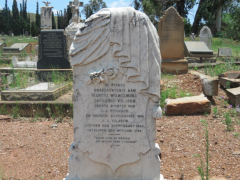
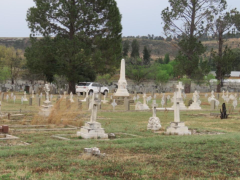
This is a pity as they miss the opportunity to visit one of the more interesting and historical cemeteries in South Africa. This is the old Harrismith Municipal Cemetery, situated north-east of the corner of Laksman and Greyling Streets.
Harrismith was established in 1849 and is one of five towns in South Africa named after Sir Harry and Lady Juanita Smith. The other four towns are Ladismith in the Western Cape, Ladysmith in KZN, Smithfield as well as Aliwal North, which commemorates Smith’s victory over the Sikhs in 1846. But I digress.
The Harrismith Cemetery contains a number of historical graves which link us to momentous events in our history:
The now almost forgotten War of 1865 to 1868 between the Free State and Basutoland, also known as the Sequiti War;
The Anglo Zulu War of 1879;
The South African War of 1899 to 1902;
The 1914 Rebellion; and
World War I.
When entering this cemetery, the British Garden of Remembrance, about half an acre in extent, lies to the right of the cemetery roadway.
It contains the graves of 437 imperial soldiers of which, 111 were killed in action or died of their wounds. In the Free State Province, only the President...
A few years ago, I needed to write my memoir to understand myself but as my mother had had a great effect on my childhood and the person I became, I realised that that was where I should start. However, it soon became apparent that her childhood was the reason for who she became. So perhaps I needed to start with my grandmother, who died when my mother was eleven years old. But I didn't even know my grandmother’s name!
‘My Mother’ I came to realise was the only name I had ever heard for my grandmother, when mentioned by my late mother. Grandmother had died giving birth to twin boys and they and another boy of 2 years-old, my mother’s half-brothers, were the only family she had. There was a step-father who died not long after that. As an English-speaking South African, this was how my journey to the ‘other side’ of the Anglo Boer War began.
Something I have come across quite often in my recent reading of South African history, is mention of racial-conflict and I am always surprised to discover that this means between the Boers and the British. It explains now why I always felt, growing up in Pretoria in the 1940s, that the Afrikaans speaking children seemed to hate me. It might also explain why my mother did not tell her children that her mother had been from a Boer family, withholding her name and any information she might have had, on what her mother experienced during the war...