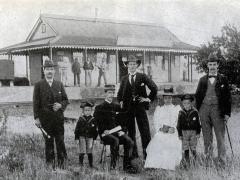
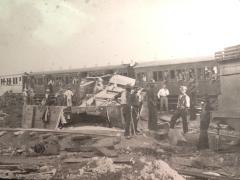
When the Boer raiding party rode into Elandslaagte on 19 October 1899 they first made a turn at David Harris’ imposing red-brick residence. Harris, the General Manager of the Elandslaagte Colliery, was having dinner with Simpson Mitchell-Innes of the farm “Blanerne”, who was also one of the Directors of the Colliery. The ten minutes spent in conversation there gave the acting Station Master, G.P. Atkinson and his clerk, D. Christie, an opportunity to warn Ladysmith of the Boer’s arrival via the telegraph. Atkinson also managed to persuade the engine driver, H.W. Cutbush, that a hurried departure might be in order. The train chuffed out of the station, with the Boers now in hot pursuit. The train guards, an officer and 9 men of the 18th. Hussars, opened fire and wounded one Boer in the leg. The Boers were unable to keep up, and the train made good its escape.
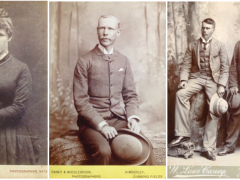
David Harris and his wife
Pienaar was incensed with this failure, and threatened to shoot Atkinson. The latter’s rifle was confiscated and he was confined to house arrest, but not before Pienaar had cooled down and returned to apologise for his bad behaviour!
All the activity at the station allowed the Mine Manager to conceal the...
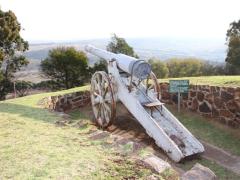
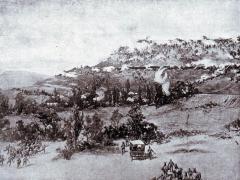
Known as “Long Toms”, the four 155mm siege guns installed in the forts to protect Pretoria, were supposed to be far too big and cumbersome to move, yet one of them (nicknamed Schanskop Tom), which had originally been installed at Fort Schanskop, was used to drive the British out of Dundee. It was manoeuvred up Impati Mountain and shelled the British camp on Ryley’s Hill. Unable to retaliate, the British were forced to withdraw from Dundee and make a hazardous, but mostly uncomfortable (in the pelting rain) retirement to Ladysmith.
H. Watkins-Pitchford, one of the Veterinary Officers stationed in Dundee, wrote to his wife that –
“The big gun of the enemy drove us out. They had managed to put one of their 40 pounders (6 inch) guns on a truck and had brought it from Pretoria on our railway, which had, of course, been left intact, with our usual disregard of our foe. This gun was mounted upon the top of a hill overlooking the town, and with it they poured in heavy shells at a range at which we were hopeless to reply as we had only light guns in our possession”.
This gun was subsequently moved to Pepworth Hill, just north of Ladysmith, as the Boers tightened their grip around the town. It came into action again during the abortive British sortie on 30 October, later to become known as “Mournful Monday”. Arthur Conan Doyle, the creator of Sherlock Holmes but at that time a Doctor serving...
In the article below, journalist Lucille Davie reveals the rich history of the Old Fort and describes the restoration efforts of 2007/8. The article was first published on the City of Joburg's website on 24 January 2008. She also explores the old tunnels which will fascinate many a reader. Click here to view more of Davie's writing.
The Constitutional Court has been built, No 4 prison and the Women’s Jail have both been restored. Now it’s the turn of the Johannesburg Fort.
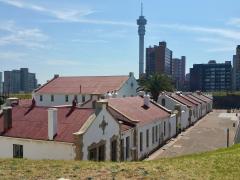
Work began in June last year, and will see the old prison, the ramparts, the tunnels, and the governor’s house across the road being given a long-overdue facelift. In all some R11-million is being spent on the restoration, overseen by the Johannesburg Development Agency (JDA).
The history of the site goes back to 1893, when Transvaal President Paul Kruger built a prison on the brow. Three years later, in 1896, after the botched Jameson Raid, Kruger converted the prison into a fort, carving ramparts from the ridge to form the Fort.
During mid-2019, an exceptional Anglo-Boer War (1899 – 1902) collection of artefacts went up on auction at a Johannesburg based auction house. Photographic images in this collection fetched high prices. However, images that high-end bidders did not pursue with the same vigour were magic lantern slides in the collection. Why would this be?
Anglo-Boer War – Posed images of Boer soldiers are less common compared to those of British soldiers.
Often ignored by collectors and researchers, or even misidentified in historical photograph collections, magic lantern slides have been described as having a less than authentic reputation? Is this a justified view?
In this article, the author briefly reflects on the history of the lantern slide as well as South African themed magic lantern slides. From the outset it needs to be stated that more research is required on the many facets of the South African lantern era.
Brief History of the magic lantern
Magic lanterns were in use long before the first photographic image, the daguerreotype, was produced during 1839.
The magic lantern was first described during 1659 by the Dutchman Christian Huygens. In a diagram attached to his notes, he showed the arrangement of a concave mirror behind the light source, a biconvex condensing lens, the slide, and a biconvex objective lens which became the...
With reference to the early Durban based photographers Caney, one author recently confirmed the challenge in “disentangling” the relationship between the various Caney individuals.
The number of Caney photographs identified in the Hardijzer Photographic Research Collection also confirms that closer scrutiny was required as to who these photographers were. The photographs in this research collection, all dating from prior to 1905, include studio-based images as well as images captured during the Anglo-Boer war.
This article not only intends to clarify the various links between the Caney men (and possibly one female in the same family), but also corrects some misinformation previously published. The three key aspects that are corrected in this article are:
Date of Benjamin Williams Caney’s death. All websites state the incorrect date of death – This is a significantly important aspect;
Benjamin William Caney had four sons who survived into adulthood and not three;
Benjamin William Caney was not an active photographer during the Anglo-Boer war.
The primary purpose of this article is therefore to determine how the various Caney photographers relate to each other. This required the analysis of internet, archival and photographic sources as it relates to the three Caney brothers who arrived from abroad. This analysis was expanded to their respective South African born children and grandchildren.
Of the 9 Caney men recorded in the three generations, 5 have been recorded as active South African photographers between the period 1860s and 1915 - Some were clearly more visible as photographers or had more success compared...
Dawn. Dundee, Natal. 20 October 1899. It was bitterly cold. Indeed, it had uncharacteristically snowed the previous week. Huge banks of fog covered the town and surrounding high ground. Intermittent drizzle made everything clammy and miserable. Breath puffed out like a steam train. All in all, a time for any sensible person to be indoors, in bed.
But all was not as peaceful as it seemed. Throughout most of the night, streams of Boers from the Utrecht and Wakkerstroom Commandos had been stealthily occupying Talana Hill, a prominent landmark some two miles east of Dundee, stumbling as quietly as possible over the slickly wet rocky terrain until the summit was reached. It was their intention to rudely awaken the slumbering British garrison in the town below with the opening shots of the first major battle of the Anglo Boer War.
Some few hundred yards to the south of Talana, members of the Middelburg, Vryheid and Piet Retief commandos had also taken up positions on a hill known as Lennox 3.
According to Lieutenant Cecil Grimshaw (2nd Battalion Royal Dublin Fusiliers):
In the afternoon of the 19th. October (Thursday) orders came in to us @ 3:30 to furnish a piquet of 12 men on the Landman’s Drift road in the vicinity of the cross roads leading to Landman’s Drift & Bart’s Drift …. About 7 p.m. it began to pour and we were all pretty well soaked through in an hour. Just about 8 p.m. my sentry on the road challenged someone who...
Although suffering from the worst drought in decades, one hopes that the rainy season is going to hit Zululand with a vengeance this year. From mid October onwards the heavens open up and the countryside transforms itself from harsh, barren, rock strewn tawny hillsides into rolling slopes covered with emerald green grass, rushing rivers and sparkling air. Looming massively on the skyline, and lit most afternoons by truly spectacular forked lightning streaking across the pitch black sky, Itala Mountain has a particularly eerie feel to it. Just like its cousin 30 miles to the west: Isandlwana.
Situated next to the Mhlatuze River, which, in 1901, formed the boundary between Natal and the Boer Republic of the Transvaal, it commands the road leading from Nqutu to Babanango, and the winding track heading off southwards toward Nkandla. On a clear day, one can see almost a hundred miles in most directions from the summit.
It has always been a strategic spot in the various altercations that have taken place across the centuries here. My interest in the site was originally sparked by a visit with Fred Duke and Neville Worthington many years ago. Then a few months later I came across an old group photograph entitled “The Officers and NCO’s of “G” Squadron, Natal Carbineers, Mooi River Camp. 31 August 1924”.
The soldiers in the photograph still stare self importantly back at you, even after 80 years. What sparked my interest was that a local farmer from Vant’s Drift, Major Harry Walker...
A Northumbrian by birth, Dr Prideaux Selby was already a middle aged bachelor when he sailed with the Byrnes' settlers to South Africa in 1850. He became the first doctor and Justice of the Peace to the Boer families in the Biggarsberg and lived at “Mooiplaas” for 25 years. He was held in high regard and loved by the Boer families – so much so that the names “Prideaux” and “Selby” were used extensively by the Boer families to name their children.
John Sneddon Dobie in his “Journal” of 1863 describes him as a “pegtop” clad in flapping white ducks and riding off on horseback under an umbrella to tackle an epidemic of measles in the scattered farmhouses.
He gave a home to and trained the first itinerant school teachers to the Voortrekkers, James Edwin Twyman and Richard Bodien.
Shortly before the beginning of the Anglo-Zulu War in 1879, he moved to the farm “Zarana” in the Dundee area and was a refugee in Fort Pine after the disaster at Isandlwana. A family account tells of Doctor Selby delivering babies at the Fort.
Two days after Lieutenant-Colonel Black had led a volunteer out of Fort Melvill to make a reconnaissance of Isandlwana battlefield, Lord Chelmsford decided to send all the cavalry to Rorkes' Drift in order to bury the dead at Isandlwana and bring back the wagons and anything else of value to the military.
Captain Robson brought the Buffalo Border Guards and Newcastle Mounted Rifles from Fort Pine accompanied...
In the article below, journalist Lucille Davie traces the fascinating history of various South African War battles in the Magaliesberg. The piece was originally published on the City of Joburg's website on 10 December 2009. Click here to view more of Davie's work.
Boer strategy in the Battle of Nooitgedacht left the British hopelessly outmanoeuvred, in one of many battles fought for control of the Magaliesberg in the Anglo-Boer or South Africa War of 1899-1902.
The beauty of the Magaliesberg belies the fact that it was the scene of 10 fierce battles between the two forces. In the Battle of Nooitgedacht the Boers gave the British a thorough hiding but in the end it was to no avail - the sheer force of numbers of the British finally forced the Boers out of the Magaliesberg.
Map of Magaliesburg Battles produced by Recreation Africa Leisure Industries
These battles provided the Boers with excellent training in the guerrilla tactics that helped them win many battles against a better-armed and larger force.
The Battle of Nooitgedacht (meaning “never thought of”) can be traced through the remains of small fortifications on the top of the Berg, overlooking the original farm of the same name. Various graves...
The year of 1812 is mainly remembered for Napoleon Bonaparte’s ruinous retreat from Moscow, when his “Grande Armee” was forced to evacuate the city or face starvation with the Russian winter impending. It was the beginning of the end for “Boney” and his defeat would eventually lead him to abdicate as emperor of France in 1814. Napoleon’s failed “Russian Campaign” would be known as the “Patriotic War of 1812” by the Russians and seventy years later would be celebrated by the first performance of Tchaikovsky’s “1812 Overture” in Moscow. Therefore it is ironic that the 1812 Overture is played every 4th of July to celebrate American Independence Day and many Americans consider the piece to be a celebration of their victory against the British in their “War of 1812”. This misconception arose in 1974 when Arthur Fiedler, the conductor of the Boston Pops orchestra performed the piece, complete with canons roaring and bells ringing, during the Independence Day celebrations of that year, which began the tradition.
The other misconception is that the Americans were victorious in the War of 1812, ask any Canadian and he or she will tell you otherwise. The truth of the matter is that the peace treaty signed at Ghent on Christmas Eve of 1814, ended the war with no conclusive winner, in effect it ended as a draw, even though extra time was played on January 8th 1815 when the Battle of New Orleans was fought, a victory for the United States. Owing to slow...