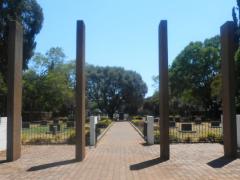
In 2014 The Heritage Portal Team visited Irene and were taken on an emotional tour of the Concentration Camp Cemetery. Below are a few historical details of the camp courtesy of the Centurion Heritage Society.
The Irene concentration camp was opened on 2 November 1900. The population of the camp increased rapidly and refugees were housed in tents under extremely poor conditions.
Often hundreds of families would be ‘dumped’ by train at the camp, sometimes without prior arrangements to provide for their arrival. The only possessions these people had were the clothes they wore and occasionally a few valuables, which they could carry.
There were often not enough tents to accommodate everyone. In some cases up to 20 people were housed in a 6-sleeper tent. Rations were at all times insufficient. A weekly ration consisted of 7lb flour, 4oz salt, 6oz coffee and 12oz sugar. Children received half of this. Milk, fresh fruit and vegetables, soap, candles and toiletry were scarce and only provided when the camp doctor prescribed it as a ‘medical comfort’. These rations represented approximately 29% of the calorie requirements of an adult and only 15% of that for a child. Meat was not often available, and the families of fighting commando members received nothing.
The Camp Cemetery
Piles of rock indicated the original graves. Only some of these had tombstones. Over the years some of the tombstones were removed and some were lying around. As a consequence most of the graves could not be identified. The British authorities numbered...
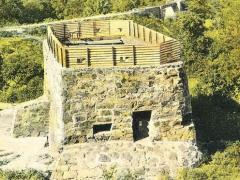
During the South African War of 1899-1902 blockhouses formed an essential part of British military strategy against Dutch forces. Initially these were fairly substantial and were used to guard key military points, but once the war moved into its final stages, they were used, together with barbed wire, as a means of limiting the movement of Republican commandos. All in all, some 8000 blockhouses were built over a period of two years, and although most were eventually dismantled, a number still remain in silent testimony of a bitter and foolish war.
When war broke out in October 1899 the British army was faced with the problem of engaging an enemy in the southern African interior with lines of communication stretching some 800-1200 km. The nearest available ports were Cape Town, Port Elizabeth and East London, and the only rapid means of reaching the theatre of war available to them was the Cape’s newly-developed railway system whose lines had only reached Colesberg in 1883, Kimberley in 1885, and Mafeking in 1894. The shorter route from Durban had been cut off early on in the war by the Republican invasion of Natal, and in order to limit the threat of Republican attacks upon the railway infrastructure further south, the British began to build a series of blockhouses to guard key railway points and bridges.
At first the men on sentry duty lived in either army tents or in corrugated iron sheds provided by the railways. However these structures offered little protection from...
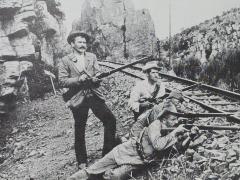
Following hot on the heels of the 'Race to the Rand' here is the third installment of the History of Southern African Railway Series by Peter Ball. The article looks at the role of the railways during the South African War (the Second Anglo-Boer War).
At the end of the Nineteenth Century the railway network in Southern Africa was near to completion as all the major trunk lines had been laid down. Bulawayo, in Southern Rhodesia had been reached, in 1897, with plans to extend the line still further into central Africa, with the eventual hope of linking up with a line coming down, through the Great Lakes region, from Egypt and the Sudan; the fabled Cape to Cairo Railway Railway construction ceased abruptly in 1899 when it became plain that war was on its way. A war that would decide, once and for all, who would control South Africa.
The Second Anglo-Boer War, which raged for 2 years and 8 months, between the 11th October 1899 and 31st May 1902, was the outcome of the ideological differences between the British Empire, at its zenith and a small but very rich young republic, known as the Transvaal. The reasons for the War have been made plain in other texts, notably “The Boer War” by Thomas Packenham (published 1979) and suffice to say here that the War was a tragedy that should never have been allowed to happen.
It could be argued that the first shots of the War were fired four years before...
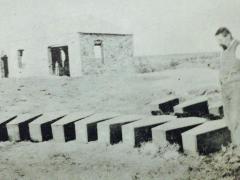
The Battles of Magersfontein and Modder River are two well known engagements that took place during the Anglo-Boer (South African) War. Below are excerpts from an incredibly moving article written by W. Westerman about his experiences ensuring many of the dead received an honourable farewell. The piece appeared in the March 1908 edition of the South African Railway Magazine. Thank you to the Heritage Office at Transnet for giving us access to their archives.
The day after [the Battle of Magersfontein] they commenced to bring in the wounded, the O.C. gave me permission to visit the hospitals, so taking some cigars with me, I went through the tents. All I can say about the sad sights witnessed is, once seen, never forgotten. Next day they buried the dead or as many as possible; the funeral dirge played by the pipers made the ceremony for many of us civilians almost unbearable; the reader must hear it to feel it.
After this we had a little peace, which gave us time to go over the battle fields gathering bodies of any forgotten Boer or Briton and reinterring any not properly buried in the turmoil of war.
[We continued to do] anything we could to assist those suffering from wounds or disease in the Railway Schools, which had been turned into Hospitals and were filled with enteric cases. This fever being so very prevalent amongst the troops, and spreading to the civilians became so alarming that Prof [unclear] was sent out by the Imperial Government to enquire into the matter. Being instructed...