
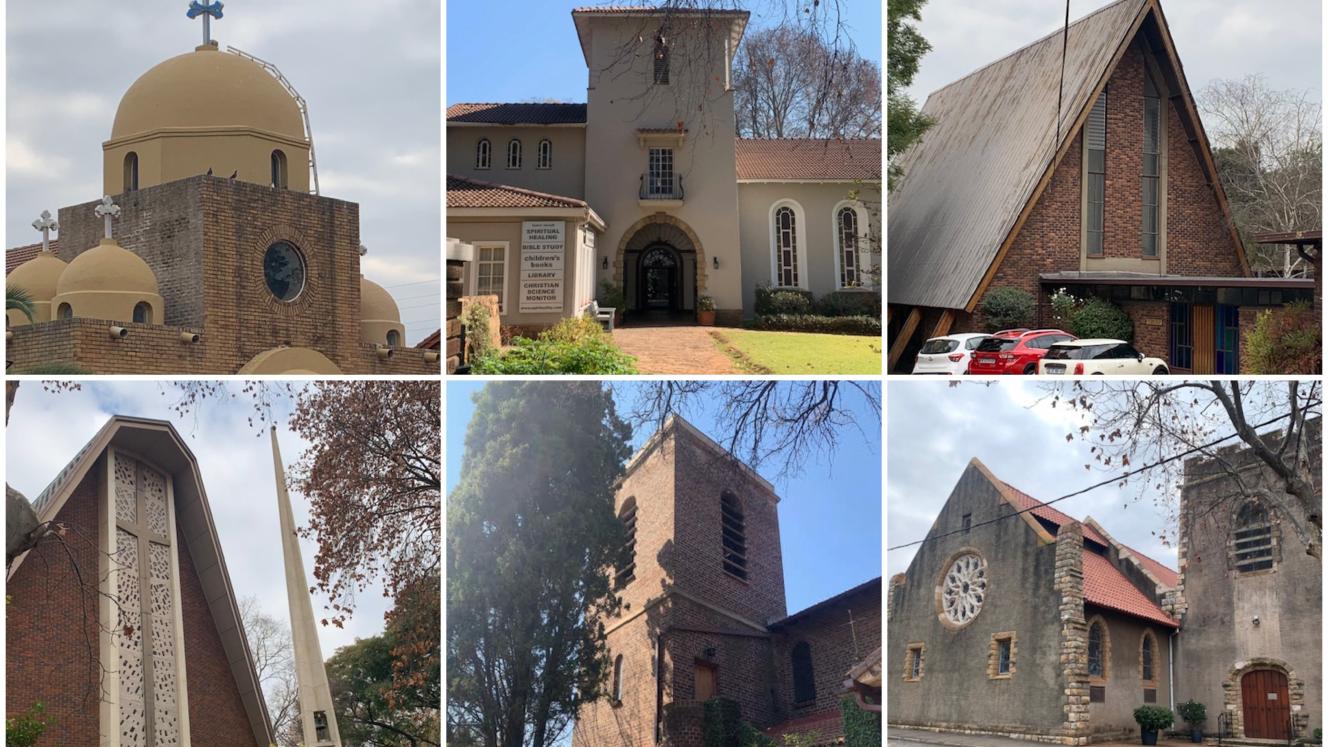
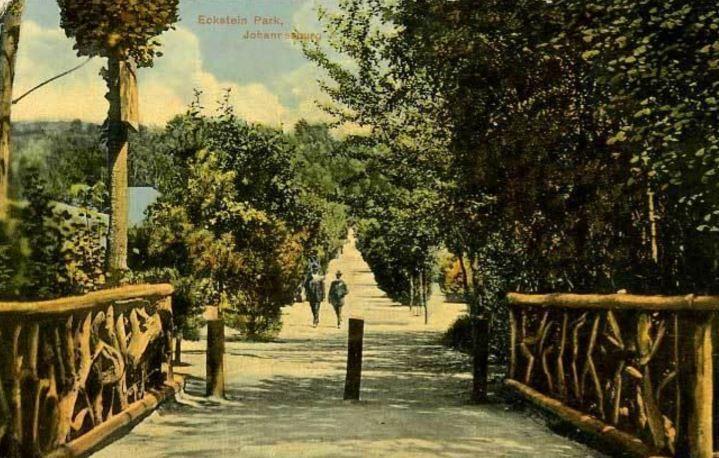
A drive along Lower Park Drive reveals one of Johannesburg's most unexpected heritage landscapes. Within a few hundred metres stand six churches, each representing a different Christian tradition and each contributing to the distinctive character of Parkview. Established in the opening decades of the twentieth century, Parkview was laid out according to Garden City principles, with generous tree-lined avenues, parks and schools, creating an environment designed for healthy suburban living. Developed by the Braamfontein Company, an offshoot of the Corner House group of Hermann Eckstein and Wernher Beit, it was one of seven suburbs constituted the “park” suburbs to the north falling on either side of the old Pretoria Road (now Jan Smuts Avenue). This was a civic-minded mining enterprise, that saw the economic sense of well managed estate development for professional middle class people. With the proximity to the Zoo and the Zoo Lake both the gifts of the company to the City of Johannesburg, Parkview quickly attracted families seeking a quieter life beyond the bustle of the city centre.

One of the first impressions for a visitor is the remarkable concentration of churches. Within a relatively small area stand six churches representing six distinct Christian traditions: Christian Science, Dutch Reformed, Lutheran, Anglican, Presbyterian and Coptic Orthodox. Together they present a fascinating cross-section of Christianity, each with its own theology, liturgy, architecture and history. Remarkably, there are no mosques, synagogues or Hindu temples within Parkview itself, although these faiths are represented in neighbouring suburbs. Parkview's religious landscape therefore reflects the predominantly Christian suburban society that emerged in Johannesburg during the first half of the twentieth century.
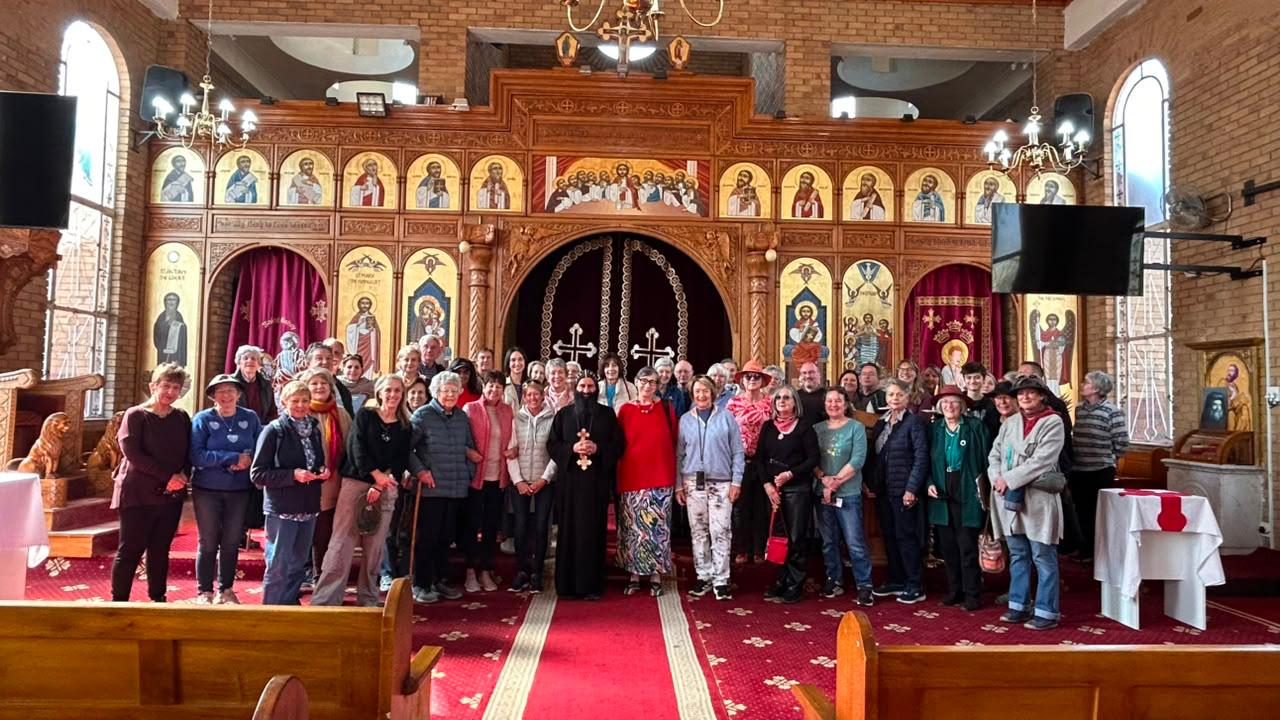
On a bright Saturday morning, fifty people gathered in Parkview for a Johannesburg Heritage Foundation walking tour led by Kathy Munro, Karen Curry and Eugenie Drakes. We embarked on a church tour to stimulate reflection, inform and above all to offer an experience. We welcomed two members of the Parkview Residents Association as our guests. We were here to visit four of the suburb’s churches. We hoped for twenty people to join us on this walking tour with a church focus; in fact, fifty people arrived and wanted to share the morning. We had originally planned on a two-hour tour, but we found the experience could not be condensed into less than three hours as we moved from church to church. At four of them the doors were opened for us, and we were welcomed into the interiors. Going inside changed perceptions - we were no longer on the outside looking in but caught, at least briefly what it could mean to be a congregant in each of these churches.
These churches were established over more than a century as successive communities made Parkview their home. Some served English-speaking congregations, other later arrivals offered pastoral care for more recent Afrikaans-speaking residents, while the newest religious complex in the suburb, the Coptic Orthodox Cathedral, reflects the arrival of Egyptian immigrants who have enriched Johannesburg's multicultural and religious life. It is interesting that churches evolve often from an initial hall or a small chapel into something grander and more important. Over time church buildings become landmark buildings and add to the architectural character of the suburb. Once a church is over 60 years old they too are protected by the Heritage legislation.
Churches are about the people who worship but they also reflect changing demographics and social evolution. Attendance at weekly services is no longer what it once was, and most denominations have experienced declining membership. Yet these churches remain far more than places of worship. They continue to provide pastoral care, charitable outreach, educational programmes, concerts, fellowship and community support. Their congregations preserve traditions that stretch back generations while adapting to the changing needs of modern Johannesburg.
This article explores the history of four of Parkview's churches, their architecture, their beliefs and the communities they continue to serve. Together they tell an important story of faith, migration, identity and continuity, and remind us that these familiar landmarks are not only places of worship but also significant elements of Johannesburg's rich cultural and architectural heritage.
For heritage practitioners these churches demonstrate that significance extends beyond architecture. Their value lies equally in intangible heritage—in worship, music, memory, ritual, craftsmanship, oral history and continuing community use. They remain living heritage.
1. Third Church of Christ, Scientist (69 Roscommon Road)
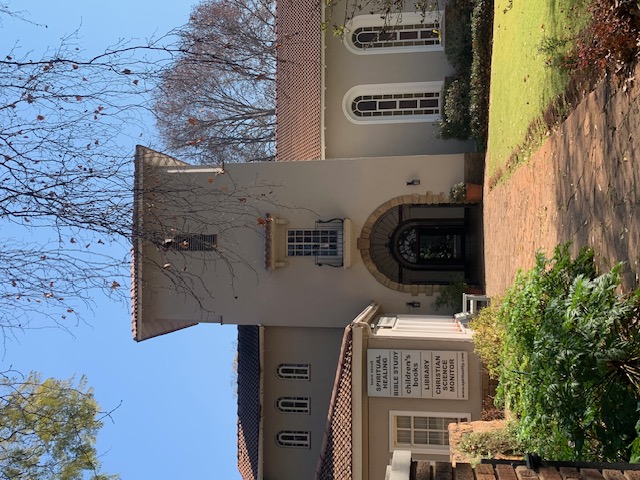
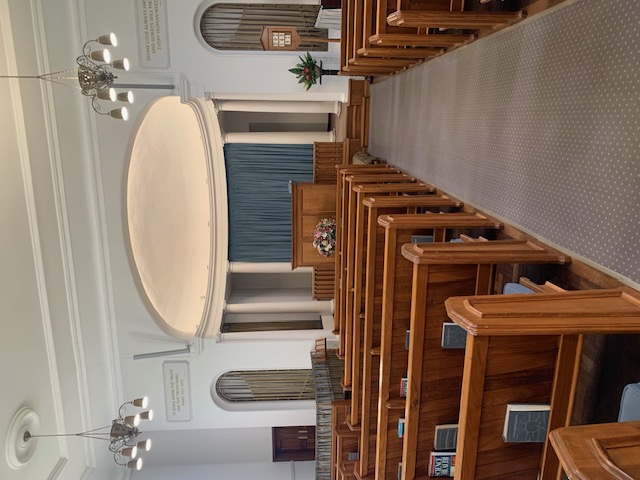
The first Christian Science congregation in Johannesburg dates from 1912, with the movement expanding as the city grew. Parkview became home to the Third Church of Christ, Scientist, whose buildings were developed in stages. Gordon Leith designed the church hall in 1926 and the Sunday School in the 1930s, while the present church was completed during the 1950s to the design of Nurcombe and Summerley. Christian Science, founded by Mary Baker Eddy, emphasises spiritual healing through prayer and the understanding of God's laws. Although the movement is much smaller today than during its mid-twentieth-century peak, the Parkview church remains an important architectural and historical landmark.
Bob Tucker shared his beliefs and told us about the church’s reliance on the word of the Bible and the book written by Mary Baker Eddy – Science and Health. There are no ministers but there are readers. Leadership is drawn from the congregations. The spirit of this church is exhibited in its simplicity, the classical architectural forms and its evolution. The siting of the church with its large stand running from Lower Park Drive to Dundalk Avenue overlooks the Zoo Lake and is like an extended park. The quality of the craftsmanship of the wooden pews, the plain look of the church gives time for inward thoughts, there are no distractions and one is struck by the interior beauty of the light pouring through the high windows. The subdued light enhances the quiet simple atmosphere. The Sunday school catered at one stage for well over one hundred children but today it is the sincerity and intensity of the believers that offers stability and continuity.
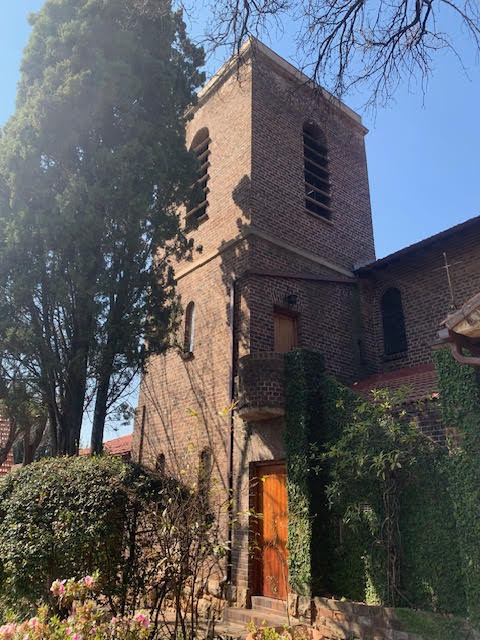
2. St Francis of Assisi Anglican Church (46 Tyrone Avenue)
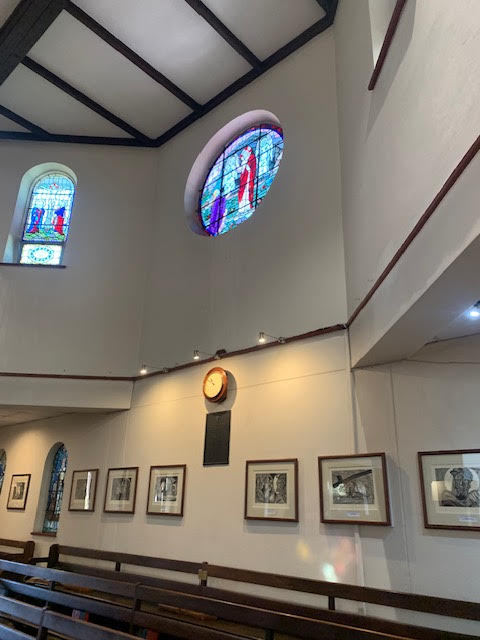
The Anglican presence in Parkview began in 1922 when St Francis was established as a chapelry of St George's Church, Parktown. It became an independent parish in 1927, with the present church, designed by Charles Douglas St Leger, completed during the 1940s. Dedicated to St Francis of Assisi, the church is renowned for its beautiful architecture, stained glass and strong musical tradition. It has long been recognised for its commitment to worship, education, social outreach and thoughtful engagement with contemporary issues within the Anglican tradition. Symbolism in the key features of the church underpin the distinctive formal character of this church with its traditional architectural forms.
Karen Currey put the church history into the context of an evolving mining city on the veld, the need for spiritual sustenance among English speaking immigrants to Johannesburg; she gave us a gentle introduction to the origins and life of St Francis and his religious message in his life and preaching.
I enjoyed the 15 minutes of sitting in a carved wooden pew and taking time out. We caught the atmosphere and could wonder and marvel at the fine craftsmanship, the expression of soul in so many almost unnoticed artworks.
3. St Columba's Presbyterian Church (45 Lurgan Road)
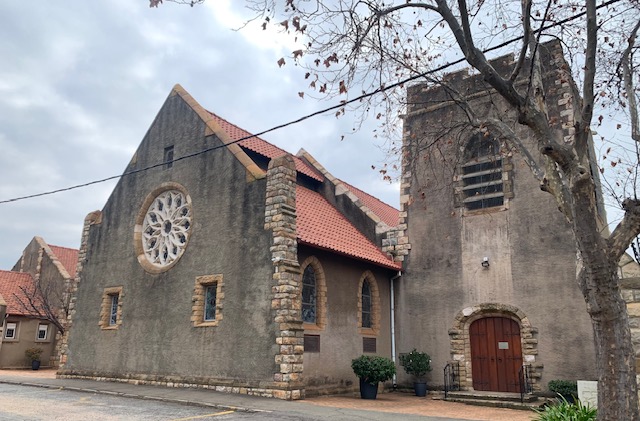
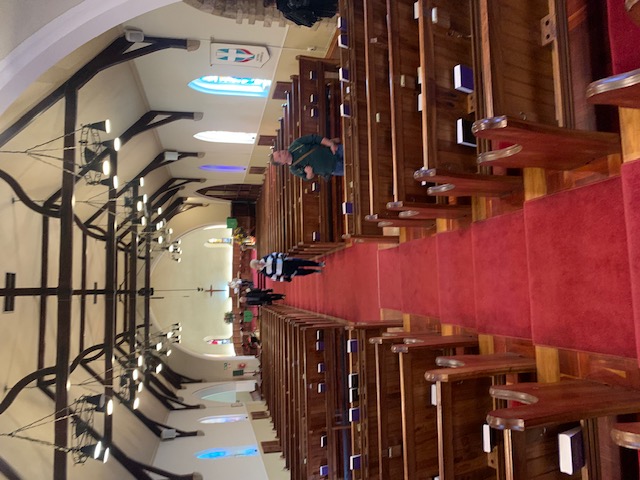
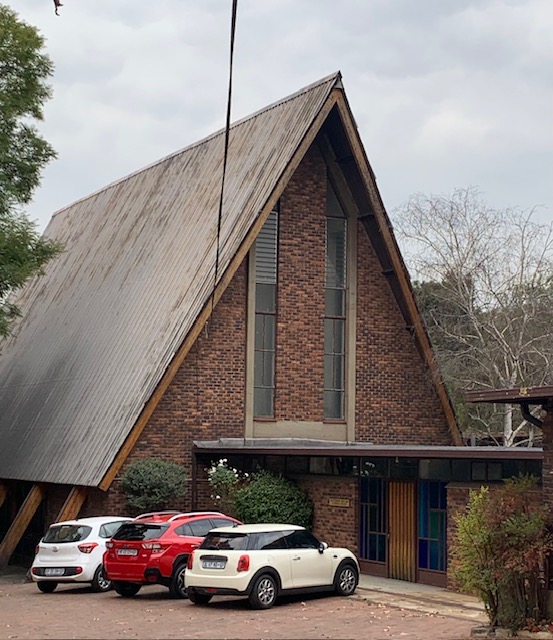
This church was founded by immigrant Scots. St Columba was named after the sixth-century Irish missionary whose work shaped early Scottish Christianity. St Columba's reflects Johannesburg's strong Scottish heritage. The Presbyterian tradition dates back to John Knox and his thundering attack on 16th century Catholic church idolatry. Knox emphasised the authority of Scripture, shared church leadership through elders and a thoughtful Reformed theology. Fast forward to a church founded in the 1920s in this suburb. Over the decades the congregation has served generations of Parkview families while maintaining an active programme of worship, education, music and community service. This church too has associations with other Presbyterian churches in Johannesburg.
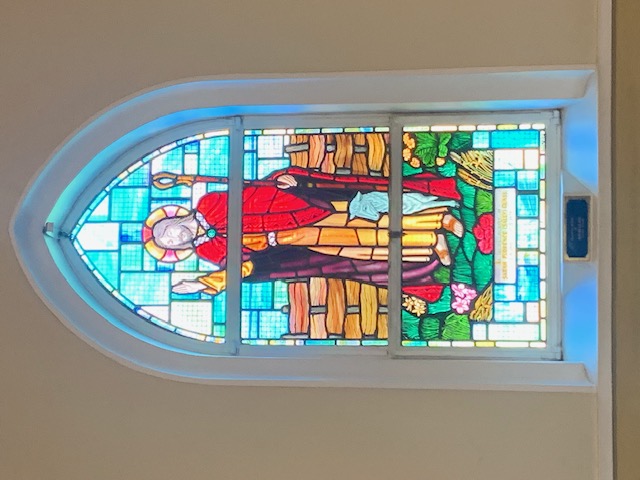
We entered the church through the earliest structure – now the church hall where preparations for a weekend food festival and a charitable fund-raising drive were underway. Kathy recalled her friendship with Rev Jack Dalziel, once minister of this church. The church itself is more austere than the Anglican church but has a welcoming presence and this too was another church that took on a clear leadership role in taking a stand against apartheid. The main stained-glass windows tell multiple stories of benefaction giving art and meaning. The stained-glass art glass of my friend Stephanie Fassler is to be found here.
4. The Coptic Orthodox Cathedral (11 Selkirk Road)
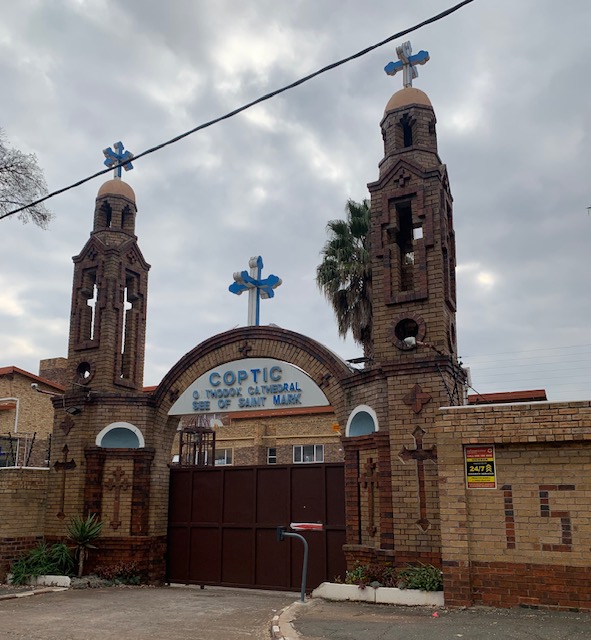
Eugenie took the lead for this part of our tour and ensured a warm welcome as the gates rolled open on Selkirk Road. The youngest of Parkview's churches represents the oldest continuous Christian tradition in Africa. The Coptic Orthodox community acquired the former St Winifred's School (later the Hellenic College) and its surrounding grounds in 1992. The Coptic community now fills several stands in Selkirk Road; the original school buildings were adapted to serve as the first cathedral, but because Coptic churches are traditionally oriented towards the east, a new cathedral was designed and built between 1994 and 1999. The cathedral serves Johannesburg's Egyptian Coptic community while welcoming visitors interested in its ancient liturgy, distinctive iconography and rich spiritual traditions. Its presence adds an important multicultural dimension to Parkview's religious landscape, linking modern Johannesburg with one of the world's oldest continuous Christian churches.
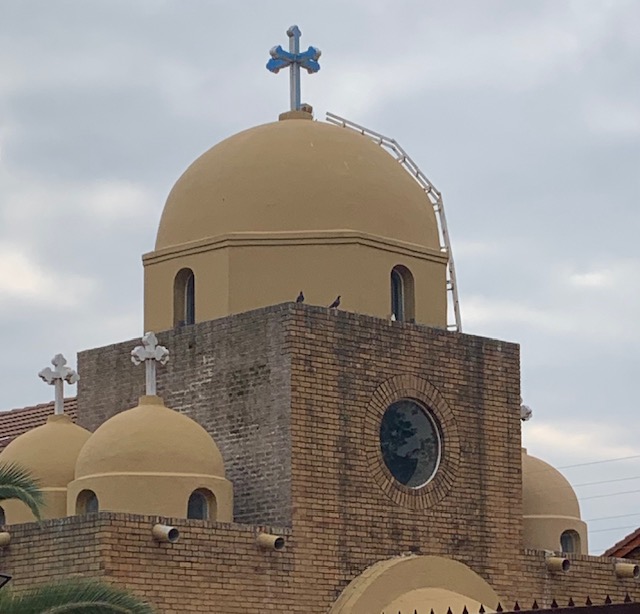
The cathedral, crowned by its central dome and four smaller domes, has become one of Johannesburg's most distinctive religious buildings. Many of its finest features—including its carved oak doors, timber screens, icons and furnishings—were crafted in Egypt before being assembled in Parkview, creating a direct architectural and spiritual link with the Coptic homeland. Inside, the rich iconography, carved woodwork, embroidered altar curtains and brass candelabra reflect a liturgical tradition that stretches back almost two millennia.
The Coptic Orthodox Church traces its origins to St Mark the Evangelist, who established the Church in Alexandria in the first century AD. It remains one of the oldest Christian communities in the world and the oldest in Africa. Although the cathedral serves Johannesburg's Egyptian Coptic community, it is also the centre of a growing African mission that extends well beyond South Africa.
Much of the cathedral's development was guided by Metropolitan Antonios Markos., whose vision and leadership established the Coptic Church firmly in South Africa and across the African continent. His recent passing marks the end of the pioneering phase of the Church in Parkview. Under his leadership the former school property was transformed into a vibrant religious centre, with accommodation for clergy and visitors, and facilities serving both the local congregation and the wider African Church. We were told that the community awaits the ordination of a new Bishop for the diocese of South Africa.
We were welcomed by the revered monk, Father Kosman Elanba Bishoy who has been in South Africa for a mere eight months. He told us about the church, its history and faith with knowledge charm and humour. Coptic Christianity is rooted in ancient traditions in Egypt but also aware of current social issues of South African society.
Today the cathedral stands not only as a place of worship but also as a symbol of Johannesburg's changing cultural landscape. It reminds us that while Parkview's older churches reflect the city's early English and Afrikaans communities, the Coptic Cathedral represents a newer chapter in Johannesburg's history, shaped by migration, diversity and the continuing vitality of one of the world's oldest Christian traditions.
5. NG Parkkruin Familiekerk (13 Dundalk Avenue)
The Dutch Reformed congregation reflects the growth of Johannesburg's Afrikaans-speaking community during the twentieth century. Originally established as the Nederduitse Gereformeerde Kerk Parkview, the congregation has evolved into the Parkkruin Familiekerk while remaining rooted in the Reformed tradition of John Calvin.
The church has adapted to changing demographics and worship styles while continuing its emphasis on Scripture, family life, pastoral care and community service. Its history mirrors the wider story of the Dutch Reformed Church in South Africa, including periods of division, renewal and reconciliation.
This church remains to be explored on a future visit to Parkview.
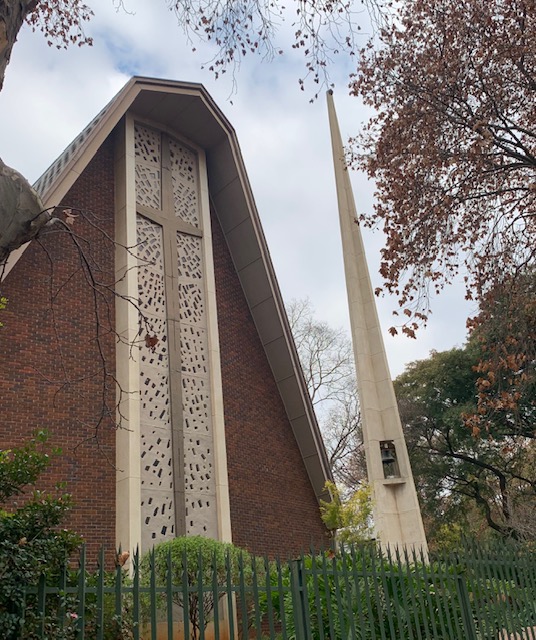
6. St Peter's by the Lake Lutheran Church (43 Lower Park Drive)
Established to serve English-speaking Lutherans in Johannesburg's northern suburbs, St Peter's by the Lake has become one of the city's most diverse congregations. Drawing members from many cultural backgrounds, it reflects the Lutheran emphasis on salvation by grace through faith, the authority of Scripture and the centrality of worship and music. Over time the congregation has evolved into a welcoming community that balances traditional liturgy with a modern South African identity. This church remains to be explored further.
Presence and Absence
Parkview's religious landscape is as notable for what it lacks as for what it contains. Despite its remarkable concentration of six Christian churches representing six different traditions, the suburb has never developed a synagogue, mosque or Hindu temple. Instead, Jewish residents have traditionally worshipped at nearby synagogues in suburbs such as Parkwood, Greenside, Saxonwold or Houghton, while Muslim families have been served by mosques in neighbouring communities. Hindu temples are similarly found elsewhere in Johannesburg, reflecting the historical settlement patterns of the city's Indian community.
Equally striking is the absence of a Roman Catholic church. Given the prominence of Catholicism in Johannesburg, one might have expected a parish church in Parkview. Instead, Catholic residents have long belonged to neighbouring parishes, particularly those in Parktown, Greenside and other nearby suburbs. The explanation probably lies in the way churches were established during Johannesburg's suburban expansion. Denominations assessed population size, available resources and the proximity of existing congregations before creating new parishes. Parkview was therefore well served by nearby Catholic churches, making a separate parish unnecessary.
There is, however, one unexpected spiritual presence. In Tyson Road stands an ashram offering yoga, meditation and spiritual development. While not a temple in the formal sense, it reflects the broadening of Johannesburg's spiritual landscape during the late twentieth century, when interest in Eastern philosophies and contemplative practices grew among people from many different religious and cultural backgrounds.
Reflections
These patterns remind us that the religious geography of a suburb is never accidental. It reflects history, migration, planning, demography and changing patterns of belief. Parkview's six churches tell a story far larger than that of individual congregations. They chart successive waves of settlement, language, culture and faith that have shaped the suburb for more than a century. Their buildings enrich the townscape, while their congregations continue to provide worship, fellowship, charity and pastoral care. Together they form an important part of Johannesburg's cultural and religious heritage.
One unexpected discovery was the importance of landscape. Every church sits within generous grounds of mature trees and carefully tended gardens. These green spaces complement Parkview's Garden City origins and soften the transition between public street and sacred space. They create places of quiet reflection before one even enters the buildings. Gardens, lychgates, winding paths and shaded walkways mediate between the busy street and the quiet sanctuary within. The transition is gradual, encouraging visitors to slow their pace and prepare for reflection.
Three of the churches we visited were outgrowth or off shoots of pioneering religious endeavours in the inner city. Johannesburg's early reputation was of a rough mining camp—predominantly male, transient, hard-drinking and often lawless. Yet the history of its churches reveals another story. As families settled, churches, schools, hospitals, orphanages and voluntary organisations appeared alongside the mines. These institutions became part of the warp and weft of a growing city, providing stability, education, charity and community.
Parkview's churches also invite comparison with other early Johannesburg suburbs. Yeoville, developed during much the same period, followed a different religious path. It supported Anglican, Presbyterian, Methodist and Roman Catholic churches, while its substantial Jewish population sustained two synagogues. Today the synagogues have closed as the Jewish community has moved northwards, while the original Methodist church disappeared with the construction of the Harrow Road motorway and was replaced by a new church near St John's College. Such comparisons remind us that places of worship evolve with changing patterns of migration, demography and urban development. Churches may flourish, decline, change denomination or find entirely new purposes.
Our Johannesburg Heritage Foundation tour revealed another, less tangible, dimension of Parkview's churches. The curiosity to learn more about church history and who made these churches was the commonality of a journey for the soul as well as the mind. The warmth of the many welcomes was striking. These are not museum pieces but living communities, proud of their history and committed to preserving their heritage.
Although each church reflects a different Christian tradition, they share remarkable qualities. Their carefully tended gardens provide peaceful settings; their architecture is harmonious, distinctive and beautifully suited to worship; and their stained, coloured or etched glass enriches the interiors with light and symbolism. The names of architects such as Gordon Leith and Charles Douglas St Leger recur, yet every church is also the product of generations of ministers, priests, readers, elders and devoted congregants who have sustained these communities of faith. The Third Church of Christ, Scientist is the first of the Parkview churches to receive a Johannesburg Heritage Foundation Blue Plaque, but each of the six churches merits recognition as a significant heritage landmark.
The heritage of these churches is experienced not only through architecture but also through sound. During our visit the sanctuaries were quiet, allowing us to appreciate the stillness of these sacred spaces. Yet they are also places shaped by music. Bells summon congregations to worship; organs accompany hymns and sung liturgies; choirs enrich services with voices that echo beneath high roofs and vaulted ceilings. Many of the hymns have been sung for centuries, linking present-day worshippers with ancient traditions of Christian devotion. Music, like architecture and ritual, is part of the intangible heritage of these churches, creating memories and sustaining a shared sense of identity across generations.
Despite profound differences in doctrine and liturgy, every church possessed an unmistakable numinous quality. Each offered a sanctuary of quietness, dignity and contemplation—a place where, for a few moments, one stepped outside the noise and urgency of Johannesburg.
As we came to the end of our visit, I realised that I had previously crossed the thresholds of two of these churches to attend the funerals of friends and colleagues. That prompted a wider thought. Churches accompany people through the great passages of life—baptism, confirmation, communion, marriage and death. They are places where joy and sorrow are shared, families gather across generations, and memory is preserved through ritual and tradition. Their significance lies not only in their architecture but also in the countless human stories they have witnessed.
Why do these churches survive when so many other institutions have disappeared? Churches survive because they are not simply buildings. They are communities. They continue to adapt while preserving memory, architecture, ritual and service.
The churches of Parkview are far more than handsome buildings standing among the trees. They represent expressions of Christian faith, varied architectural responses to worship and enduring communities that have served Johannesburg for more than a century. Their ministers and congregants have educated children, comforted the bereaved, celebrated marriages, cared for the vulnerable and preserved traditions. They remain centres of worship, learning, music, fellowship and service. Their gardens offer tranquillity, their stained-glass windows beauty and their sanctuaries a rare sense of peace. Collectively they form one of Johannesburg's richest ensembles of religious heritage, reminding us that the history of a suburb is written not only in its streets and houses but also in the communities that gather, worship, serve and care for one another.
Kathy Munro is an Honorary Associate Professor in the School of Architecture and Planning at the University of the Witwatersrand. She enjoyed a long career as an academic and in management at Wits University. She trained as an economic historian. She is an enthusiastic book person and has built her own somewhat eclectic book collection over 40 years. Her interests cover Africana, Johannesburg history, history, art history, travel, business and banking histories. She researches and writes on historical architecture and heritage matters. She is a member of the Board of the Johannesburg Heritage Foundation and is a docent at the Wits Arts Museum. She is currently working on a couple of projects on Johannesburg architects and is researching South African architects, war cemeteries and memorials. Kathy is a member of the online book community the Library thing and recommends this cataloging website and worldwide network as a book lover's haven. She is also a previous Chairperson of HASA.