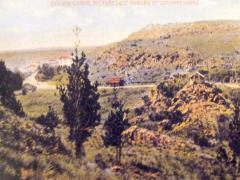
In the article below, Norah Henshilwood traces the early history of Claremont and reveals some of her memories of the suburb. The piece first appeared in the 1976 edition of Restorica, the old journal of the Simon van der Stel Foundation, today the Heritage Association of South Africa. Thank you to the University of Pretoria (copyright holders) for giving us permission to publish.
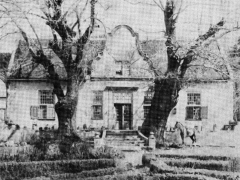
Of all the suburbs of Cape Town, Claremont is the one that through business expansion and population growth has changed more than any other. Originally its area on the mountainside was part of a farm that in 1660 had been granted on the banks of the Vers River (later named the Liesbeek) to one of Van Riebeeck's "free burghers". When M. Thibault, the Government architect, made an official survey in 1812, this farm, called Veldhuysen, or Veldhuyse, extended over more than ninety-nine morgen. A German owner later changed the name to Feldhausen. Sir John Herschel, the famous astronomer lived here for four years while he mapped the stars of the Southern Hemisphere and from here he viewed Halley's Comet through his telescope, the site of which is marked by an Obelisk, still to be seen adjoining the grounds of the Grove Primary School. Elliott's photograph of the old Feldhausen homestead led Fransen to describe it as "one of the most beautiful homesteads of the Peninsula".
By the beginning of this century the homestead had become a boarding house and later a private hotel with the name altered to "Herschel Hotel"...
The weekend of the 24/25 June 2017 saw the launch of the Jozi Walks initiative of the Johannesburg Development Agency (JDA). Individuals, community organizations, tourism companies and NGOs joined hands in offering a series of free and innovative walks through Johannesburg, north, south, east and west. It was exciting, fun and showed off Jozi at its best over a two day celebration of the Jane Jacobs walk my city philosophy.
60 people joined Brett McDougall and Kathy Munro of The Johannesburg Heritage Foundation (JHF) on a Sunday afternoon for a three hour guided walk through the eastern Joburg suburbs of Orchards, Maryvale, Sydenham and Orange Grove. The theme was 'Louis Botha Corridor of Creativity'.
The walk started at the Orchards Project at 6 Pine Road where we launched Jozi Walks and told our guests about the JHF. Everyone was armed with a map. Roger Chadwick of the Orchards Project spoke about the opportunities for public street art in the neighbourhood with the walls along Louis Road and the Spark Gallery turning creative graffiti into an art form. Our first stop was at the 1946 communal hall of the North Eastern congregation of the Jewish Community, the forerunner of the Pine Street shul; today it is the 24 Carrots building and has passed on to new uses and hands but the façade of golden, facebricks and the style of the 40s’ with contemporary street art enhancing the frontage is worth close inspection. This was the moment for a group photograph.
[[{"fid":"3597","view_mode":"media_adaptive","fields":{"format":"media_adaptive","field_file_image_alt_text[und][0][value]":false,"field_file_image_title_text[und][0][value]":"1946 North Eastern Congregation Communal Hall - Kathy Munro - June 2017","external_url":""},"type":"media","field_deltas":{"1":{"format":"media_adaptive","field_file_image_alt_text[und][0][value]":false,"field_file_image_title_text[und][0][value]":"1946 North Eastern...
Potchefstroom is home to the longest avenue of oak trees in South Africa. The grand oaks stretch for almost 7km and contribute to the character and beauty of the city. Recent research indicates that the number of trees has declined from 710 to 530 and certain sections are in a deplorable state. In the article below Lennie Gouws explores the history and current state of iconic Oak Avenue.
Concerns about the condition of the oak trees of Potchefstroom have infuriated the people of Potchefstroom over the decades.
In 1977 the whole town was up in arms when plans were underfoot to uproot part of the Oak Avenue. The Potchefstroom Teachers Training College applied to have a part of Hoffman Street closed, due to the fact that it divided the campus of the College, after a new administration building was erected west of Hoffman Street, whilst the rest of the campus was on the eastern side of the street.
This meant that the street directly to the east of Hoffman Street, Tom Street, had to be widened to accommodate increasing traffic. In order to do so the trees had to be removed.
According to Richard Ingram, editor of the Potchefstroom Herald at the time, the newspaper was inundated with letters on the matter and the Herald launched an editorial campaign to preserve the trees.
A public petition was drafted and signed and led to the avenue being declared a National Monument. According to the proclamation of this heritage site, the Oak Avenue “lends to the...
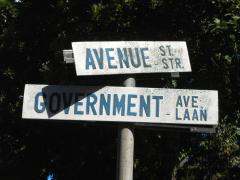
In 1983 J. G. Brand, City Engineer of Cape Town, penned this brief article about Government Avenue, the oldest pedestrian thoroughfare in South Africa. The piece appeared in the 1983 edition of Restorica, the journal of the Simon van der Stel Foundation (today the Heritage Association of South Africa). Thank you to the University of Pretoria (copyright holders) for giving us permission to publish.
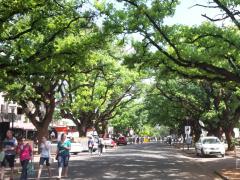
When Simon van der Stel arrived in 1679 he took an immediate interest in the Company's Garden and set about refashioning it. During the re-development he made the central walk broader than it had been previously, thus dividing the Garden into two distinct halves and establishing the Avenue we know today. Before the planting of the English oak, Quercus robur, the Avenue had been planted with several other tree species, including lemon and orange. Oaks were first planted either in van der Stel 's time or shortly thereafter. Although some of the oaks in the Avenue appear ancient it is most unlikely that any date back to his governorship.
Formerly the oaks planted were all Quercus robur, but because of the seasonal attack of mildew which causes them to deteriorate, it is now policy to use Quercus cerris, the Turkey oak, as a replacement tree.
It is hard to imagine that the small park adjacent to Redhill School and opposite the Morningside Shopping Centre in Sandton was once a major 'outspan' where weary travellers (and oxen of course) rested on the way to Johannesburg. The following article, first published in the 1984 Sandton Historical Association journal, brings the story alive.
An old 'outspan', at least 150 years old, has just recently become a new Sandton Park, and will be preserved forever as an open place. This is Outspan Park in Morningside.
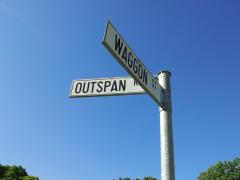
When the early farms were laid out in the Transvaal as the Voortrekkers surged northwards in the 1840s and 1850s, and the first Land Grants were made, special attention was given to allowing open spaces between farms, where travellers or visiting families could graze their oxen while resting overnight or for several days to attend the markets. Known as 'outspans' they were, in fact, the first public parks. Many of these public areas remain today, and are of great significance when nearly all those original farms have been divided and sub-divided. One such "Outspan" in Sandton is in Morningside, just near a road which was thoughtfully named Outspan Road. In October of 1983, a special cairn was erected by the municipality near a small spring on the 'Outspan', and this was officially unveiled by the Mayor of Sandton [we could not find this on a site visit].
It has become a tradition that on Spruit Day in October each year (the anniversary of the...
For many years Bill Hedding was known as the ‘Father of Bryanston’. He played a central role in the development of the suburb and the recording of its history. He was the founder of the now defunct Sandton Heritage Association, a long term city councillor and at one point the Mayor of Sandton. In the late 1970s he gave a speech on the history of Bryanston. Below are a few edited excerpts to give the reader an idea of the origins and development of the suburb.
Because Bryanston is on fairly elevated ground, "modern" early settlement of the area tended to be confined to lower lying areas where water was available, near spruits and rivers. Until recently the area abounded in game, including larger antelopes. With the advance of man with his guns, this game, especially the larger antelopes, soon disappeared, though duiker and steenkop survived until the early 1950s. The tenacious guineafowl survived a decade longer, with a flock still surviving on the undeveloped ground immediately to the north of Bryanston Laerskool in Sloane Street [now filled with a number of residential complexes].
The Braamfontein Spruit which forms the southern and eastern boundary of Bryanston has a special significance in the history of South Africa. A prospector by the name of Pieter Jacobus Marais, while on his way from Potchefstroom to Pretoria in 1878 [other sources state the journey happened in the early 1850s] camped at the natural causeway across the river in Bryanston Extension 7. Being a prospector...
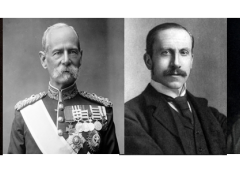
Part of Kitchener Avenue, in Kensington, Johannesburg has been replaced by Albertina Sisulu Highway. Perhaps soon, Rhodes Park, Roberts Avenue and Milner Crescent will be renamed to burnish the heroes of more recent history? Significantly, Cecil John Rhodes statue on the UCT campus has been recently vandalized in a fierce show of anti- colonialism. It might thus be apposite to record something about the lives of those British ‘heroes’ who played such a prominent role in South Africa during and around the time of the Anglo-Boer War, at the turn of the Nineteenth Century. These street names are a comment on the nature of pro-British sentiment just over a century ago. In an extension of the intense Anglophilia of the times, we note that many of Kensington’s other streets are named after British Navy warships.
The four short essays that follow are about men who served Britain when she was strong and ubiquitous. All men wore power with distinction. They were superior and one might guess, unconsciously arrogant, able to focus immense resources, ruthless when the occasion demanded and utterly loyal to British interests. They attended and managed Britain’s affairs in South Africa at the end of the Victorian Age. Might our history have been any different without them? Alas, one has to live with one’s history even though one retrospectively ponders more positive outcomes.
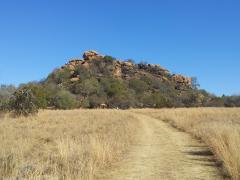
To the north of Johannesburg lies a hill of great historical, archaeological and geological importance. In the article below Lilith Wynne explores the archaeological aspects of the Lone Hill site. The article first appeared in the 1988 Journal of the Sandton Historical Association, two years after Professor Revil Mason made his 'discovery'.
Right in the middle of Sandton is a site which could become an important part of our community life and a focal point of education. According to Professor Revil Mason, Director of the Archaeological Research Unit of the University of the Witwatersrand, this discovery represents one of the finest Iron Age Smelting and Forging sites in Southern Africa, and may even be the most complete.
Regrettably, the area is scheduled for town house development. Fortunately, soon after the discovery, building and development was stopped by the owner, Mr Oswald Buckner. Sponsored by the Sandton Council, the Archaeology Unit with Professor Mason and Mr Robbie Steel moved onto the site to make a detailed investigation. It soon became apparent that in Sandton we have a site of national historical importance, one that merits all efforts to preserve it.
Development around the area today (The Heritage Portal)
Excavations begin
The first excavation showed a large iron smelting area, dated by samples of charcoal to about three hundred years ago. Fragments of...
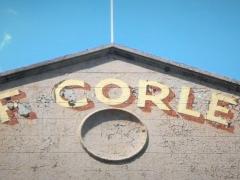
His name is immortalised in one of Johannesburg's most well-known streets, it is inscribed on the foundation stone of the landmark Johannesburg Library and it is painted on his old office which is now home to the popular Arts on Main in the Maboneng Precinct. But who was D.F. Corlett? The following article, published in the South African Builder in September 1923, gives some insight into the man.
Foundation Stone of the Johannesburg Public Library (The Heritage Portal)
Daniel Fargher Corlett was born at Ballaugh, Isle of Man. He served his time with his father, taking charge of the business for the two years prior to leaving for South Africa.
Like many other young fellows possessed of energy and ambition, he realised the limited opportunities in his native land, and emigrated to South Africa in April, 1897, coming direct to Johannesburg.
Portrait of D.F. Corlett (SA Builder)
He secured employment with Messrs. Prentice & Mackie, the well-known contractors, and was with them at the outbreak of the Boer War in 1899. During the campaign he served with Bethune's Mounted Infantry, returning to Johannesburg...
Travel back in time to 1886. Gold has just been discovered on the Witwatersrand, and the koppies and veld between Pretoria and Heidelberg, home to a handful of boer families, their tenants and workers, are starting to attract the attention of the world. The dusty track connecting the Viljoen homestead, nestled below the ridge among abundant orchards, to Pretoria has been extended south and west to the city of tents which has mushroomed on the uitvalgrond between the farms Doornforntein, Langlaagte and Braamfontein.
The Viljoen farm is beautiful. Orange, fig, peach and apple trees were planted by JC Esterhuysen in the mid-19th century, and the abundance of these on the otherwise treeless veld has led to the farm being called Lemoen Plaas. The farm is also blessed with water: a fountain just below the farm house is a source of the Sand Spruit, which forms the western border of the property.
The situation of the farm house, at the foot of the ridge that needs to be climbed before reaching the diggings beyond, means that the Viljoens are frequently visited by weary travellers, including President Paul Kruger who rests here before continuing his journey into Johannesburg to mark the first anniversary of the gold fields. No doubt Viljoen sees an opportunity in this nuisance, because his home is soon converted into the Wayside Hotel. Other amenities are soon added: tea gardens, swimming baths and a collection of wild animals to amuse visitors. In 1893 air balloon ascents are provided by...