On 19 October 1986, a Tupolov Tu-134 plane travelling from Zambia to Mozambique crashed 65km from Maputo on the South African side of the border near the town of Mbuzini. The plane was carrying Samora Machel, the President of Mozambique, as well as high ranking Mozambiquan government officials and was manned by a Soviet air crew. Of the 44 passengers, 34 including the President died in the crash.
The official Commission of Inquiry into the accident, chaired by Judge Cecil Margo, highlighted pilot error while other reports claimed that a false beacon planted by South African agents was the catalyst for the crash. Speculation and debate on such a painful episode will, no doubt, continue.
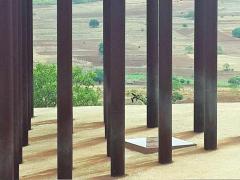
In the 1990s a monument to commemorate the crash was commissioned. It was unveiled by Nelson Mandela of South Africa and Joaquim Chissano of Mozambique in January 1999. Since then the Samora Machel Monument has hosted various commemoration ceremonies and has been promoted as a major tourist attraction. Last month we visited the site and to say we were impressed is an understatement. The monument is incredibly powerful, the museum is enlightening and the staff are welcoming and informative.
The Samora Machel Monument and nearby museum (The Heritage Portal)
Perhaps our positive experience was due to low expectations created by negative online reviews. Many of the reviews on...
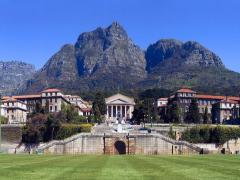
During the past few months a number of South African university campuses have seen a spate of student protests against the presence of statues honouring our colonial past. Rightly or wrongly, these have resulted in the vandalization and removal of some of these memorials.
Without entering into a debate on some of the more ludicrous, and sometimes racist arguments put forward by either side, this is a matter which has implications for our national heritage, and for the preservation of our historical environment, and is thus in need of serious consideration.
In 1811 Joseph de Maistre wrote that every people gets the government it deserves. By extension then, they also get the heritage they merit, and as building after building in our city centres continue to fall before the demolisher’s hammer, many white South Africans have been left wondering exactly what they have done to warrant the destruction of so many of their memories.
To many, 1994 marked a turning point in our history, when we had the opportunity of leaving the horrors of racism behind and embracing a bright new future, free of the guilt and remonstrations for past actions. But that is not the way of history, whose flow does not have sharp corners or U-turns, but moves inexorably through linear time. Instead of being blind to the lies and dark secrets of our colonial past, history has a habit of bringing these to the surface where, like suppurating sores, they are revealed for all to see. The...
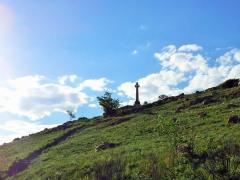
This is one of Johannesburg’s earliest war memorials, overlooking the site of one of the largest remount camps of the Anglo-Boer War, 1899-1902. Originally a memorial to the Scottish Horse which was later disbanded, that regiment was antecedent to the famous Transvaal Scottish Regiment formed in 1902, which saw service in both World Wars. It contributes to a sense of multi-cultural heritage.
The Memorial is located on Caledonia Koppie, an easily accessible view point to the east of the city centre which is sometimes used for alternative Christian devotions due to an interpretation of it as being “a cross on a green hill outside of town”.
History
The monument commemorates the officers, non-commissioned officers and men killed in action and died of wounds, disease and accident, who were members of the Scottish Horse Regiment, during the South African Anglo-Boer War in 1901-1902. The Scottish Horse was a mounted infantry regiment financed and led by the Marquis of Tullibardine (later the 8th Earl of Atholl) during the War. After the War, the Scottish Horse, in South Africa, was disbanded but parented the Transvaal Scottish Regiment.
This memorial was erected in 1905 and is the same as that erected on the Esplanade of Edinburgh Castle in Scotland. The only original difference between the two being that the hollow metal die replaced the solid granite die of the Scottish memorial to facilitate transport to and erection in South Africa.
The position of the memorial was probably chosen as it overlooked the site of the Scottish Horse camp in Bezuidenhout Valley where...
The monument honours Boer veterans of the Anglo-Boer / South African War, 1899-1902. Small plaques cover all four sides of the monument, a two metre-tall rectangular structure, spilling over onto the base. The memorial is crowded with inscriptions, set on a patchwork of small plates of different sizes and of various materials: sandstone, granite, slate, soapstone, etc. There are 41 small plaques to men who fought in the war. It stands on the crest of the ridge, on the south-eastern corner of the New Nation School, overlooking the old Gas Works.
Crowded with inscriptions, set on a patchwork of small plates (The Heritage Portal)
View over the Gas Works (The Heritage Portal)
History
The monument was unveiled on the grounds of the Cottesloe Primary School as part of the Voortrekker Centenary celebrations in Johannesburg on 3 December 1938:
“In early December 1938 a group of elderly men moved slowly up the Brixton Ridge overlooking the Gas Works, each weighed down by a slab of sandstone, slate or granite. Nearly every plaque was awarded a place on a crude, two and a half...
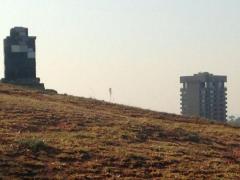
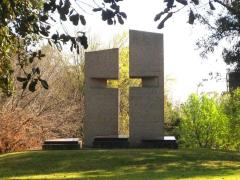
The Katyn Memorial stands on a rise in an attractive park setting, in good view from the nearby Atholl Oaklands Road. The structure is constructed of bushhammered reinforced concrete with a set of three plaques in red granite. The sculpture theme is derived from ancient Slavic forms assembled to create an interplay of open and solid spatial forms creating the image of the non-existing cross.
Reverse Angle of the 'Non-Exisiting Cross'
The monument was erected to commemorate the Katyn Forest Massacre, in which 14 500 Polish officers, police officers and citizens were executed by the Stalin regime of the Soviet Union in 1940. The monument has since been extended to commemorate the Warsaw Flights and Polish Home Army during World War II.
Katyn Memorial - September 2015
The commemoration of the Katyn Massacre started out as just a plaque in 1973. Known as the Katyn Commemorating Plaque, it found little support from the National Museum of Military History, as its inscription was viewed as fairly controversial. Despite that setback, the newly formed Katyn Memorial Committee approached the Johannesburg City Council to find a suitable place for its...
The Petrus Molefe Monument, also known as the Umkhonto we Sizwe (MK) Monument, is located in the Petrus Molefe Eco-Park on Mtambo Street in Dhlamini Soweto. Molefe was the first operative to be killed during the early operations of MK. Thank you to the City of Johannesburg for giving us permission to publish the details below.
The launch of uMkhonto we Sizwe (Spear of the nation) the armed wing of the ANC, was announced on 16 December 1961 by a series of bomb blasts against apartheid structures in Johannesburg, Durban and Port Elizabeth. Petrus Molefe was the first MK operative to be killed during those operations. He lost his life in Dube Soweto, when an explosive device which he was carrying went off. He was accompanied by Ben Ramotsi, who was seriously injured. Molefe is buried in Nancefield Cemetery, Soweto.
The Petrus Molefe Monument was commissioned by Johannesburg City Parks, with guidance and input from Community Development (Arts, Culture and Heritage). The monument was formally unveiled at the opening of the Petrus Molefe Eco-Park on 9 December 2011. The launch of the new park, attended by MK veterans, was held in the run-up to the 50th Anniversary of Mkhonto we Sizwe (16 December 2011).
The Artwork
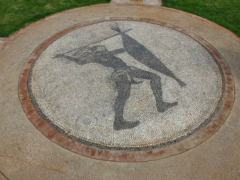
The artwork is set around four brick columns. In the middle of columns is a wide circle with a floor-mosaic of the MK emblem of a warrior with a spear and shield (see main image). The MK logo is done as a pebble –mosaic in...