South African mining photographs from as early as 1870 have been identified. These early diamond surface mining activity photographs were taken by Weber & Sederstrom at New Rush (Kimberley). When gold was found in Johannesburg some 14 years later (1884), it was initially not difficult to mine as the gold was found near the surface and prospectors had many laborers to assist them with the digging.
But soon, miners found that they had to dig deeper and deeper to find the gold - 100 meters became a 1000 meters, or more, within a short period. This type of mining became known as deep-level mining.
Although deep-level mining was very expensive, dangerous and difficult, the introduction of the cyanide extraction process during 1890 made the recovery of gold excavated at these deeper levels economically more feasible.
Indications are that by the end of 1889, the Jubilee and Langlaagte mining companies had already sunk shafts for deep-level mining purposes.
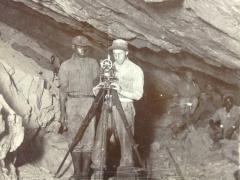
Deep-level mining in turn resulted in a growing curiosity at both local and international level – People wanted to see what was happening down below – It had to be photographed!
The inscription suggests that this photo was taken at the State Mine. Men seem to be repairing an underground rail track
[[{"fid":"3476","view_mode":"media_adaptive","fields":{"format":"media_adaptive","field_file_image_alt_text[und][0][value]":false,"field_file_image_title_text[und][0][value]":"Attending to an injured mine worker at the Crown Mines. It is not clearly...