
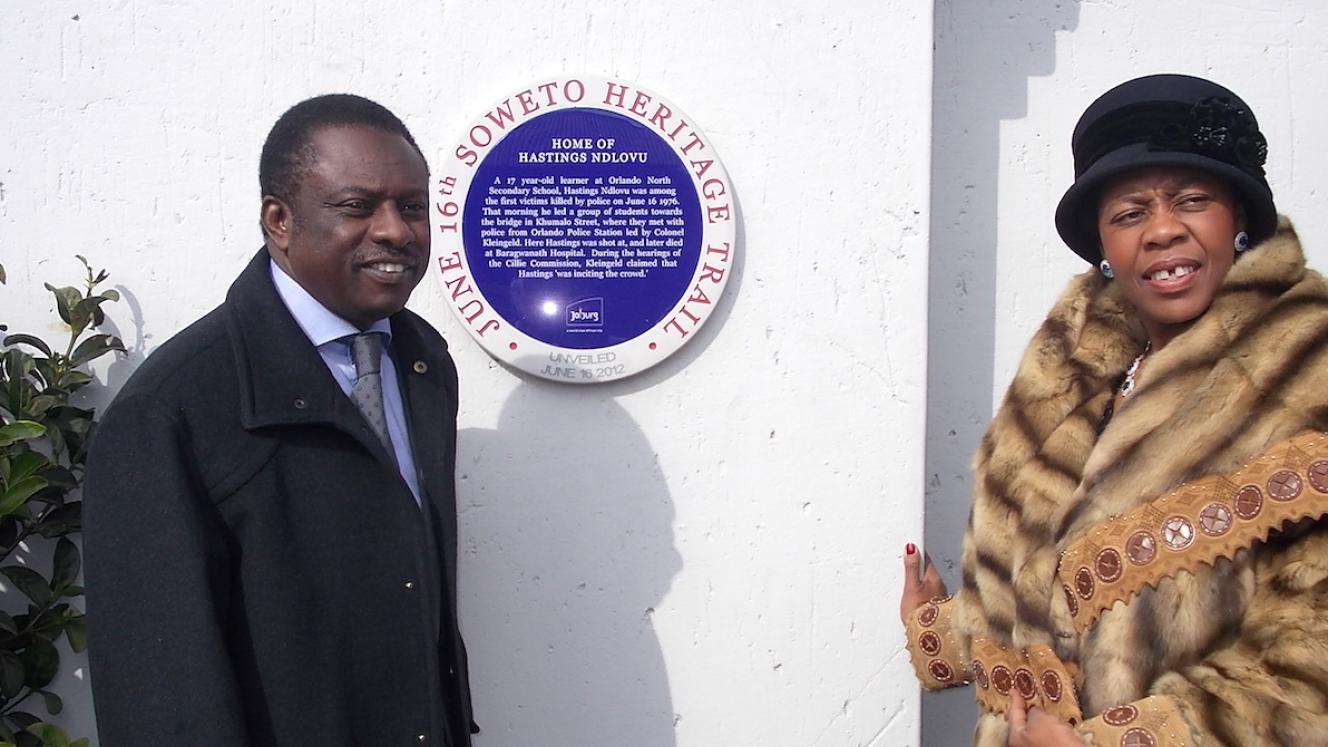
On the morning of 16 June 1976, I was the casualty officer at Baragwanath Hospital who received the first victims of what would become known as the Soweto Uprising.
For the 30th anniversary of the uprising, Ali Hlongwane, then curator of the Hector Pieterson Museum, commissioned me to provide an account of my experience, to be published in an anthology that he was preparing.
Among the students I treated that morning was one whose shooting would assume lasting historical significance. In my account, I incorrectly recalled the location and appearance of the bullet wound to his head. Journalist Lucille Davie drew on my account before its publication in the anthology, quoting from it in an article first published on the City of Johannesburg website in January 2005 and subsequently reproduced by The Heritage Portal and elsewhere. Click here to read.
As quoted by Davie, I described what I believed I had seen when I entered the casualty department:
“…a bullet wound to one side of his head, blood and brains spilling out of a large exit wound on the other side, the gurgle of death in his throat. Only later would I learn his name: Hastings Ndlovu.”
Davie’s article was published in January 2005 under the title “Hastings Ndlovu’s day too.” The anthology Soweto ’76: Commemorating the 30th Anniversary of June 16, 1976, edited by Hlongwane, Ndlovu and Mutloatse, appeared in May 2006 and included the testimony of Hastings’s father, Elliot Ndlovu.
When Davie’s article appeared, Elliot Ndlovu’s account that appeared in the anthology was not yet in the public domain and therefore could not have been consulted or reconciled with my own account. By the time the anthology was published, however, my description had already been reproduced on several websites and was becoming part of the historical record.
I introduced this error into the public record, and it is therefore mine to correct. Hastings deserves to be remembered accurately—not through a flawed clinical account that has circulated for twenty years, but through an honest account of what happened to him that morning. I offer this correction in that spirit, and in his honour. This essay is my attempt to reconcile those accounts, correct the historical record, and explain how the error was discovered forty years later and how I came to make it.
In examining how the error occurred, I have tried to distinguish carefully between what I know, what I remember, and what the surviving evidence allows me to conclude. In 2016, a decade after the publication of my account of treating the first victims of the Soweto Uprising, I had the privilege of meeting the Ndlovu family at a private dinner marking the fortieth anniversary of the uprising and honouring Hastings’s memory.
As I recounted, treating Hastings forty years earlier, I was startled when the family challenged my recollection of his wound. Based on their own examination of his body at the police mortuary, they described a single, small entry wound in the centre of his forehead. They had seen no wound on one side of his head and no large exit wound on the other. There was only one wound: small, circular, and centred in his forehead.
Looking back forty years, I realised that I could not actually summon the image I had described. Nor could I yet visualise the wound as the family remembered it.
I left the dinner unsettled. I could not immediately reconcile their account with mine, but neither could I dismiss it. Their recollection was specific, consistent, and expressed with quiet certainty.
The family’s account was not the only evidence that contradicted mine. Years earlier, Hastings’s father, Elliot Ndlovu, had given a poignant account of identifying his son at the police mortuary. For accuracy, I reproduce his testimony as it appears in the anthology. In the passage below, the translator’s rendering of the Zulu phrases appears in parentheses, while square brackets record the transcriber’s observation of his gesture:
“When we entered the mortuary—inside the hall, there is this chap lying here, just at the entrance. This fellow, my neighbour Seutloadi, says to me, ‘Here is the boy.’ So ngimbambe ngendlebe, (held my boy by the ear,) ngimphendule, (how here is this chap) bamushaye ngenhlam lapha (and see they have shot him here). [Mr. Ndlovu says this, pointing between his eyes.] […]”
The testimony is both intimate and precise. Elliot Ndlovu held his son by the ear and turned him as he examined him, then pointed between his own eyes to indicate the location of the wound.
This account is consistent with what the Ndlovu family later told me and directly contradicts my published description of an entrance wound on one side of Hastings’s head and a large exit wound on the other.
In the weeks following the dinner, I often returned in my mind to that morning, trying to reconcile my memory with the family’s account. I vividly remember intubating Hastings—placing a breathing tube into his throat—and my procedural memory remains detailed and clear. Intubation was a skill essential to anaesthesia and resuscitation, and one I had taken pride in mastering.
Yet when I picture that morning now, I cannot see the wound on the side of his head that I described in my original account. More importantly, I cannot recall the clinical response that such a wound would have required.
A gunshot wound entering one side of the head and leaving a large exit wound on the other, as I had described it, would have been immediately obvious. It would have required urgent clinical care—dressing the wound, applying pressure, and possibly later surgical cleaning. The absence of those clinical memories is itself significant. An experienced casualty officer who intubated a patient would not be likely to forget an obvious, haemorrhagic head wound on that same patient. The wound I described in the Davie article is therefore inconsistent with the clinical actions I remember taking that morning.
I also remember how desperate I was to find some possibility of saving him. I asked a colleague, Dr Risik Gopal—a registrar in neurosurgery and high school friend—whether surgery to remove the bullet from Hastings’s brain might be justified. His response, later confirmed by his chief, was unequivocal: such an operation would not only be futile but would worsen the brain injury. The brain injury was itself fatal.
I would not have posed that question if the bullet had exited through the opposite side of the head, as I had initially described. A through-and-through wound leaves no bullet to remove; asking whether it should be removed makes sense only if the bullet remained inside the skull. My clinical actions that day, and the response I received, therefore contradict my original description of the wound.
What I now believe happened is this: I knew that Hastings had sustained a non-survivable gunshot wound to the head. My neurosurgical colleague confirmed as much. When I consulted Dr Gopal while preparing my original account, he had no specific memory of the case.
When I came to formulate an account of the event three decades later, I could still clearly recall the enormity of the underlying brain injury and the horror it had produced in me, even though I could no longer summon a clear image of the wound itself. In the absence of that image, my mind appears to have reconciled the wound with its devastating consequences by supplying a head wound more visibly proportionate to the damage it had caused—one more commonly associated with a gunshot wound to the head: a bullet passing through the temples, with an entrance wound on one side and an exit wound on the other. In my account, I described what I had expected to see, not what I actually saw.
But now, as these associated memories have been rekindled, I have a vivid sense of the wound as I saw it then: a small, seemingly innocuous hole in the centre of his forehead, no larger or more alarming in appearance at the time than the decorative dot of a bindi.
Malcolm Klein was the casualty officer at Baragwanath Hospital who received the first victims of the Soweto Uprising on the morning of 16 June 1976, including the student Hastings Ndlovu.