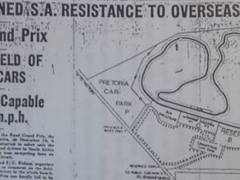
It is hard to imagine that there was once a Grand Prix Race Track in Kelvin, Sandton. The article below, compiled by Ted Steyn, uncovers some remarkable local racing history. The piece appeared in the 1992 annual magazine of the Sandton Historical Association.
Until 1936 all the area now known as 'Kelvin' was farmland and it included the farms of Lombardy and Bergvalei (or Bergvlei). In 1936 the South African Motor Racing Company was formed by enthusiasts who wanted a race track near Johannesburg in order to promote their sporting activities.
Location of Kelvin (Google Maps)
The Kelvin area was chosen for this purpose and, at the substantial cost of £32 000, a 2.5 mile race track was built on a 195ha site, which had its centre at the present junction of Sunnyway and Fairway. The land was bought for £13,244.22 from Michele Angelo Zoccola and comprised portions of the farms Lombardy and Bergvlei. The racing track development was financed by Sir Ernest Oppenheimer, F.A. Unger and others, and was named the 'Lord Howe Circuit' commemorating the racing driver son of the Earl of Athlone who had been Governor-General of South Africa between 1923 and 1931.
A few years ago Mushroom Farm Park in Sandton Central was used by the Bombela Consortium to access the Gautrain Tunnel during construction. As soon as the work was completed the company rehabilitated the green space and today it is a phenomenal resource for the Sandton community as well as many local and international visitors. Many people have asked about the name and want to know if there was ever a mushroom farm in Sandton Central. The following article, compiled by Avril Reid and first published in the Sandton Historical Association's 1994 journal, sheds some light on the matter (edited by The Heritage Portal).
The ‘Mushroom Farm’ is a tranquil and green public park near Sandton City with a pond and a small stream flowing though it. Surrounded by high rise office buildings, flats and town houses, this park is an oasis in the busy hub of the business world.
Mushroom Farm Park (The Heritage Portal)
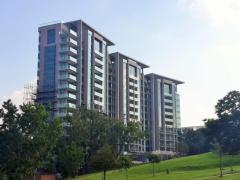
Metropolis On Park, a new luxury residential apartment block, rises above Mushroom Park (The Heritage Portal)
But why the strange name “Mushroom Farm”? The reason is simple - because that’s just what it used to be. Where the park is today...
In 1979 Dorothy O'Kennedy, an old resident of Rivonia, commenced a tremendous journey of discovery to find Rivonia's First Shop. Her story was published in the annual journal of the Sandton Historical Association. We retraced her steps but were unable to confirm whether or not the old building is still there. If you have any information on the shop please contribute to the comments section at the bottom of the article. Rivonia has certainly changed since this piece was first published!
I did not realise that I was part of the history of Sandton, until I noticed an appeal in The Star for people who had lived here in the early days to come forward and tell what they could remember.
In 1912 my family moved from Johannesburg to Rivonia - known then as Edenburg. I was eight years old, and I lived there until my marriage in 1926. My parents owned the tea garden Sleepy Hollow which was visited by people en route between Johannesburg and Pretoria. In those days it was much smaller than the present well known hotel.
One of the things which I remembered about my childhood in Rivonia was that Mr and Mrs Shull had a shop which was the focus of the neighbourhood, but no one else seemed to have mentioned it when reminiscing about the 'old days' so I determined to look for it, and to discover whether the building still existed.
As I had not returned to Rivonia for many years, I...
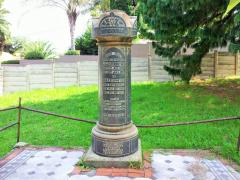
Every day thousands of people pass Sandton's first monument without realising it is there. On a small piece of land tucked away near the top of South Road lie the graves of some of the original settlers in the area and the monument erected in their honour. The Esterhuysen family owned the farm Zandfontein in the middle of the 19th century. It is on a portion of this farm that the modern skyscrapers of Sandton have emerged. Below are a few passages from various old Sandton Historical Association journals providing some background on the heritage site.
"Just as we go to press comes the news that the graves of the Esterhuysen Family in Sandown, Extension 24, are finally to become Sandton's first historical monument . On October 30th [1982] there will be a ceremony at the Monument, when the Mayor of Sandton will receive from the developers Schahat Cullum, the deeds to the stand on which are buried Jan Christoffel Esterhuysen and his wife Maria Buitendag and others."
The Monument from a distance (The Heritage Portal)
"Eight years have passed since our association first started trying to ensure that these graves were preserved for posterity, and we can justly claim credit for helping to bring this campaign to a successful conclusion."
"The Esterhuysens came to the farm Zandfontein in 1836 and we hope that their monument will stand for many more centuries." [this date needs to be...
Norscot Manor lies to the north of Sandton, west of the William Nicol Drive and just north of the N1 Motorway. The home of the Eriksen family until 1982, Norscot now belongs to Sandton who have developed it as a community centre to serve their northern suburbs, and have already made one wing into a Public Library. Norscot was built in 1936 on a scale few could afford today and was ideally suited to lavish entertaining as well as being the quiet secluded home the Eriksen's wanted. As for its name, NORSCOT, we know that the "nor‟ was for Norway and "scot‟ was for Scotland and that Mr and Mrs Ernst Eriksen lived there with their two children [The family's phenomenal wealth came largely from its success in the motor industry].
The first house the Eriksens lived in in Johannesburg had been the stables of what is now the Hope Home in Westcliff. It was a stone house, designed by Sir Herbert Baker, which they rented from the well-known South African authoress Sarah Gertrude Milne. While there, they looked around for somewhere to build a permanent home. And it was while driving out to the north towards the mountains that they came across the water-melon farm belonging to Chris van der Walt and his brother near what is today the Sandton suburb of Fourways. Thus it was that plans evolved for the building of the second Norscot (their house in Kloof, Natal, had also had that name).
Below are a few edited excerpts from an article on the early history of Tara compiled by Avril Read from the Sandton Historical Association. They appeared in the Association's 1987 journal.
Tara was a large and opulent house built in the style of the 1930s, great attention being paid to the quality of materials and soundness of structure. It was approached through the majestic gates on the south side down a drive which ended in a circle under the decorated portico. There were several garages - unusual for the 30's - and the Tilletts kept two large cars, a brown Lincoln and a dark blue Dodge, both 7-seaters, with pull-out seats behind the driver. There was a European chauffeur who drove them everywhere.
The driveway and main entrance to the house (The Heritage Portal)
Moving Towards the Gardens (The Heritage Portal)
The magnificent entrance hall is fully pannelled in teak and the formal staircase, also pannelled, had stairs with shallow risers, - a concession to Mr. Tillett's cardiac condition. Apparently he always paid great attention to his health, and a lift was installed to the first floor for his benefit. This has now been removed, and the space used...
Just a few hundred metres from the Sandton Gautrain Station is a little piece of history... the 'Little Church in the Pines', one of Sandton's oldest buildings. Below are a few passages outlining the Church's history taken from the 1992 Sandton Historical Association magazine. The author? None other than the legendary Juliet Marais Louw...
"The little church is still there in Stella Street, Sandown, its story begins with that colourful personality, Sytze Wierda who came from Friesland in Holland in 1887 to organise the Public Works Department for President Kruger. With Sytze Wierda came his wife, Hermina, and his four daughters, Nellie who was twenty at the time, Hendrika, fifteen, Anna, twelve and Suse, eight.
Mr Wierda was an architect who had designed the Central Railway Station in Amsterdam, among other work. For the Kruger government he planned the Raadzaal and the Palace of Justice in Pretoria, the Paardekraal Monument, Johannesburg's Rissik Street Post Office and the old post offices in Braamfontein and Jeppe, also the Marshall Square buildings, the bridge over the Olifants River, Wierda Bridge over Ses-Myl-Spruit on the Pretoria Road (the railings have been incorporated into the gates to Rivonia Primary School), the forts of Klapperkop and Schanskop in Pretoria and the Johannesburg Fort. In addition he surveyed the Delagoa Bay railway line. His salary was £500 a year.
Nellie Wierda married Charles Ferdinand Obermeyer who had come from Holland in 1882. He chose to become a most skillful cabinet-maker and later a builder and contractor. During the...