When I talk to 76 year-old Clive Chipkin in his Parkview studio, he tells me that the book was probably in him from the beginning, from as far back as University days, although he doesn’t know whether he intended to write it at that stage of his life. Almost in the same breath he tells me that he’s just returned from a first time visit to Israel where, against expectations, he liked it; particularly the modern, thirties architecture of Tel Aviv and Haifa. Slender, energetic Chipkin, is still designing, still traveling far afield for his work, still recording and relating the stories of Joburg’s always changing, architectural and social structures. His mind is as lively as a sack full of grasshoppers, as dripping with memory as a honeycomb. He’s an idealist, a gossip, intrigued as much by people as by facades and building fashions, perhaps more so. He loves associating buildings and spaces with their creators and linking the creators with their times. I think I might label him a pragmatic intellectual, or an intellectual pragmatist perhaps?
He claims that he came to Wits in 1947, not knowing much about architecture. He thought it had more to do with town planning; more of a social discipline. In high school, when...
Geoffrey Klass was supervising the offloading of some old pieces outside his building when a young woman from a nearby business stopped to admire one, an Edison disc machine. ‘Ooh, that’s nice, what’s that?’ she asked. Klass told her it was a gramophone. ‘Oh, I’ve heard of those but I’ve never seen one.’ Klass smiled. She thought he was being friendly which he was, but he was also silently pondering how quickly familiar objects become forgotten; one generation’s marvel becomes obsolete in the next. Such is the speed of technological change stemming from the supercharged twentieth century that the Klass emporium of beauties, rarities and wonders, comprises, not only a collector’s paradise, but provides myriad cultural history lessons, in a vast uncatalogued museum.
Geoffrey Klass at work (The Heritage Portal)
To enter Collector’s Treasury at 244 Commissioner St, deep in the old city, is to enter a world of munificent chaos: piled cartons of books clog the entranceway stairs and the narrow passage leading to the main display room. This contains a great profusion of rarities: glass, porcelain plates...
Mervyn King spoke to me in a conference room. I asked to see his office expecting it to offer clues to an outstanding career. It wasn’t special: not particularly large, certainly comfortable and expensively furnished, but not greatly different to any other functional space in the building. No memorabilia were evident, just piles of paper for a project on which he was slaving. I asked about the two eighteenth century naval prints hanging on one wall and was told that they were left over when the other executives had selected their art. King has aged well apart for a little off the top. His eyes are steely blue and he exudes a controlled energy. He’s undoubtedly wealthy. He tells me that he’s arranged to ‘die a poor man.’ His money lies in trusts for the family. His wife has to nag him to buy new suits and shirts although he looks immaculate. He collects wine and legal tomes. They’re bequeathed to the family. He loves his car, a Jag. Annual holidays are indulgent, but life largely comprises work.
Mervyn King, well known Joburg advocate, former judge and businessman, has spent much of his working life telling people how they might behave. It’s comforting to acknowledge therefore, that his ethos stems...
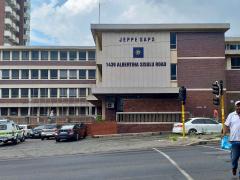
Ronel Bischoff is forty two. She’s small and attractive; looks very good in uniform. She’s married, mother to three teenage daughters, one of them adopted. As Director, with the equivalent rank of brigadier, she has recently taken command of the 222 member, Jeppe Police Station, on the eastern edge of central Joburg. Her ‘government issue’ office features landscape and wild animal pictures. Two teddy bears huddle together on a chair. I assume they’re for kids whose mothers are letting their hair down to the Director. Perhaps they help the children themselves to speak? Jeppe has long been known as one of the tougher urban postings. Its area of jurisdiction encompasses Jeppestown, Ellis Park, Bertrams, Troyeville, Belgravia, Doornfontein and part of Kensington. Diverse, might describe the precinct well. It comprises major sports stadia, several industrial and commercial areas, million rand homes on Langermann Kop, restored old miner’s houses in Troyeville. It presents a complex panorama of early Joburg.
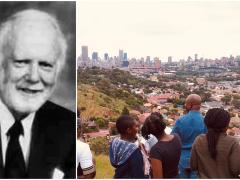
Ellis Park from above (The Heritage Portal)
It’s partly a rough area, full of people desperately...
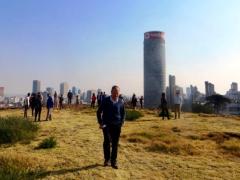
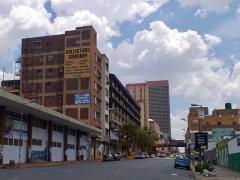
On a Saturday afternoon, after a morning spent in a similar manner, a man wearing black trousers, a black T shirt and cap, all offsetting his white hair and beard, is showing a group of tour guides around Newtown and Joburg centre city. He walks energetically and purposefully, one might even describe him as bulldoggish in the way he moves, and he recites the facts supporting the city’s revitalization. For three hours he demonstrates the renewal of Joburg. The visitors are stunned. Their pencils are never still; their cameras click away. They crane their necks, viewing this transformed city. What he doesn’t tell them is that were it not for him and some far sighted and dedicated colleagues and associates, our city, the repository of living memories, of history, of wonderful architecture, would be well nigh moribund and lost in irreversible decay. After the tour, Neil Fraser downs a quick beer and rushes off to another engagement.
Neil Fraser
I talk to Fraser, born in 1939, Executive Director of the Central Johannesburg Partnership, in his office situated in a magnificent reclaimed building in...
The author and poet Mike Alfred followed up his book Johannesburg Portraits: From Lionel Phillips to Sibongile Khumalo (Jacana, 2003) with a second series of writing about contemporary Johannesburg people a few years later. In a series of interviews and reflections Alfred captured the pen portraits of people who he encountered in Johannesburg, people who made a difference to and who had an impact on the kaleidoscope of Johannesburg in the first decade of the 21st century. Mike’s book is about their lives, their achievements and their relationship with the city.
Biographical writing is an art. It is intimate writing that requires the author to capture personality, essence, character and achievements. A good interviewer will draw out the interviewee to reflect on life and its meaning; the voice of the person is given space to be heard. Good biographic writing gets beyond boring publicity hype and reveals the person’s soul in authentic conversation. The interviewer needs to shift between past and present to draw out the making of the man or woman, their values, their history and their passions. Mike tackles the task almost effortlessly and the result is a series of biographical sketches that should be shared and preserved. One wishes to hold the reader’s interest and at the same time “ring true”. Seventeen Joburg people feature.
Mike anticipated that this second book would be published at the time (i.e. during the first decade of the 21st century); unfortunately it was not and has now moved into an archival category.
Mike migrated to Cape Town late in 2019. It was with a sense...