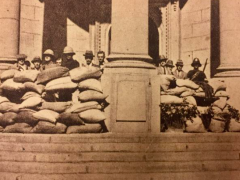
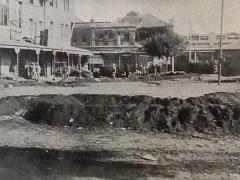
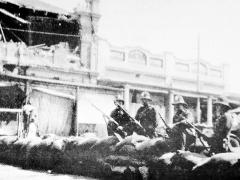
In Fordsburg, passersby hurry through a nondescript market square bordered by Albertina Sisulu, Dolly Radebe, Mint and Central Roads, quite unaware it marks the final stronghold of armed strikers during the 1922 Rand Revolt.
Known as the 1922 Miners’ Strike, Rand Revolt or even Red Revolt, occurring merely five years after the Bolsheviks seized power in Russia, it remains the greatest violent political upheaval on the Witwatersrand (Rand).
Although the Rand has changed almost beyond recognition, many of the historical sites exist, to provide a glimpse of that seismic event. Some of these sites will be disclosed in a future article.
Accounts vary, but the Report of the Martial Law Inquiry Judicial Committee reported the fatalities of the strike and subsequent armed revolt to comprise 43 soldiers, 29 policemen, 11 revolutionaries, 28 suspected revolutionaries and 42 civilians.
A further 133 soldiers, 86 policemen, 45 revolutionaries, 73 suspected revolutionaries and 197 civilians were wounded.
After the revolt was quelled, 4 692 men, 62 women and 4 children were detained for questioning. Eight hundred and fifty-three people, including 9 women were charged with various contraventions, from murder and treason to minor infringements of the martial law regulations.
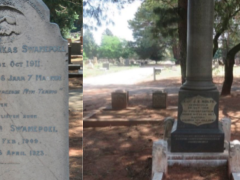
Ten unions established the Transvaal Strike Legal Defence Committee, to raise funds for legal representation to those appearing in court. Forty-six people were charged with murder and 18 were sentenced to death. Only four namely, C. C Stassen, S. A. (Taffy) Long, Herbert K. Hull and David Lewis were executed between 5 October and 17 November...