Following hot on the heels of the 'Race to the Rand' here is the third installment of the History of Southern African Railway Series by Peter Ball. The article looks at the role of the railways during the South African War (the Second Anglo-Boer War).
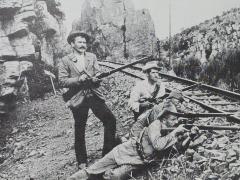
At the end of the Nineteenth Century the railway network in Southern Africa was near to completion as all the major trunk lines had been laid down. Bulawayo, in Southern Rhodesia had been reached, in 1897, with plans to extend the line still further into central Africa, with the eventual hope of linking up with a line coming down, through the Great Lakes region, from Egypt and the Sudan; the fabled Cape to Cairo Railway Railway construction ceased abruptly in 1899 when it became plain that war was on its way. A war that would decide, once and for all, who would control South Africa.
The Second Anglo-Boer War, which raged for 2 years and 8 months, between the 11th October 1899 and 31st May 1902, was the outcome of the ideological differences between the British Empire, at its zenith and a small but very rich young republic, known as the Transvaal. The reasons for the War have been made plain in other texts, notably “The Boer War” by Thomas Packenham (published 1979) and suffice to say here that the War was a tragedy that should never have been allowed to happen.
It could be argued that the first shots of the War were fired four years before...
In the first installment of the series on the history of Southern African railways, Peter Ball described some of the earliest railways in the country and the extension of a number of lines into the interior. In this article he looks at the fascinating politics and economics of the 'Race for the Rand'.
Johannesburg was literally and figuratively built on Gold, the discovery of which in 1886 was to change the entire economic and financial structure of South Africa. The inconvenient truth for Britain was that the Rand Goldfields were in another country, to be exact the Transvaal Republic (a.k.a. South African Republic), which had regained its independence, after the Battle of Majuba Hill, Natal on the 27th February 1881.
Johannesburg, springing up as it did in the midst of a rural, land locked Boer republic, was situated 345 miles (555 km) inland from the nearest harbour (Delagoa Bay); it had grown, within four years, from a mining camp into a boom town (second only in size to Cape Town) and urgently needed good communications to develop further.
Johannesburg in the early 1890s (Seventy Golden Years, Johannesburg City Council)
The Race to the Rand was a three (iron) horse race over many physical and political hurdles and the riders wore the colours of the Cape...
Over the coming months we will be publishing a series of articles, compiled by Peter Ball, on the history of Southern African railways. The first installment looks at some of the earliest railways in the country and the extension of various lines into the interior (driven by the great mineral discoveries of the second half of the nineteenth century).
The Gautrain which now runs between Johannesburg and Pretoria was opened in stages commencing with the spur from Sandton City to O.R. Tambo Airport, which started running at the time of the 2010 Soccer World Cup. It was built as a high speed commuter train service having interchange stations with the existing Metrorail system. As the speed of a train was required to be 162 kph (100 mph), the latest railway technology, as tried and tested in Britain was incorporated into the design brief. Part of that brief was to base the Gautrain carriages on the "ElectroStar" electric multiple units already in use on the London outer suburban services. Britain's mainline railways run on tracks having a gauge of 1435 mm (4'-8 ½") between the rails (known as the Standard Gauge), whereas in Southern Africa the gauge is the Cape Gauge of 1067mm (3'-6"). The "Gautrain Rapid Rail Link: Planning and Implementation Study" evaluated the two gauges and recommended utilising the Standard Gauge on the grounds of safety (at speed) and ease of procurement of rolling stock, thus reverting back to the gauge used by the first railways built in Southern...