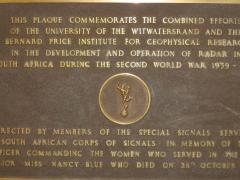
A little-known story in South Africa is the remarkable effort under the direction of Professor (later Sir) Basil Schonland, Director of the Bernard Price Institute of Geophysical Research (the BPI), at Wits, to design and build a radar set within three months of the outbreak of war in September 1939.
Britain took the decision earlier in the year to inform its Dominions of the secret device (then called RDF) for detecting enemy aircraft and ships by means of radio waves. A senior scientist from each of those countries was invited to England to be briefed on the technology. South Africa chose to send a military man then serving in London. Needless to say, he was non-plussed.
However, the New Zealand scientist, Ernest Marsden, called into Cape Town on his way home where he was met by Schonland. During their three-day journey by sea to Durban, Marsden briefed Schonland on all he had learnt at Bawdsey Manor near Ipswich.
On his return to Johannesburg Schonland assembled his design team: engineers from Wits (Guerino ‘Boz’ Bozzoli), UCT (Noel Roberts) and Natal (Eric Phillips). They were joined by the BPI’s physicist Dr Philip Gane. Their task was to design and build a radar set in order, as Schonland put it, “to learn the technique”.
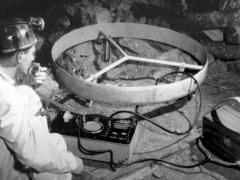
Within just three months they had succeeded in producing a working system, consisting of a separate transmitter and receiver, each with its own rotatable antenna. The first trials were disappointing. No radar “echoes” were received from a test target...