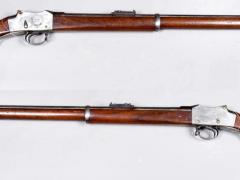
“I am inclined to think that the first experience of the Martini-Henrys will be such a surprise to the Zulus that they will not be formidable after the first effort.” Lord Chelmsford. 23 November 1878.
The Rifle
The outcome of the battle of Isandlwana, which took place on 22 January 1879 and resulted in the deaths of 1357 British and Colonial troops, shocked the “civilized” world. The British enjoyed overwhelming fire superiority – rifles, cannon and rockets, against spears. This meant that the Zulus had to close to about 30 yards before they could do much damage, whereas the British could kill them at far longer ranges.
Isandlwana Hill (Talana Museum)
The standard British-issue rifle used at the battle was the Martini-Henry. This was a falling block, single shot breech loading rifle, which was a vast improvement from the old muzzle-loaders and even Snider conversions previously in use.
The forerunner of the Martini-Henry was the Peabody rifle, invented by Henry O. Peabody of Boston in 1862. The breech block was hinged at the rear and, when the lever beneath the stock was operated, moved so that the front of the block fell clear of the chamber, allowing space for a round to be slid over the block and into the breech. The weapon had an external...