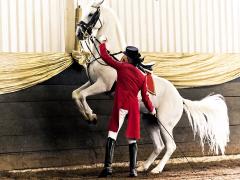
The Lipizzaner’s survival was secured by several rescues that bridged the collapse of war-torn Europe with the birth of a new tradition in the Southern Hemisphere. In April 1945, the breed’s future was famously defended during Operation Cowboy, when American and German forces formed an unlikely alliance to shield imperial bloodlines from the advancing Red Army. While this military intervention protected the foundation of the Spanish Riding School, a similar commitment drove Count Elemer Jancovich-Besan to spirit a private herd from Hungary to the sanctuary of South Africa. As detailed in the article below, these efforts laid the groundwork for a classical school that continues to flourish today.
On April 28th 1945, in the final days of World War 2, American troops from the 42nd Cavalry Reconnaissance Squadron teamed up with German Wehrmacht soldiers in a rare moment of cooperation to rescue Lipizzaner horses from a stud farm in Hostau, Czechoslovakia.
Renowned for their e!egance and lineage dating back some 400 years, these prized horses had been relocated by the Nazis to breed an "Aryan" horse. As the Soviet Red Army advanced, fears grew that the horses would be slaughtered for food, as had happened in Hungary.
The operation liberated over 300 horses held at the farm. The mission was sanctioned by General George S Patton, himself a horse lover.
'Operation Cowboy' was a rare moment when enemies united to preserve heritage amid the chaos of war.
In 1948, the Pietermaritzburg Royal Agricultural Show became the unlikely stage for a moment that would...