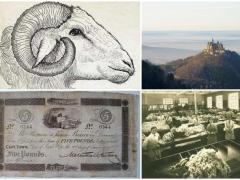
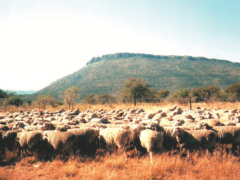
We as a family are very proud of what Magdalene Morse-Jones has achieved with this work. Thanks to her research we now know about our family roots. The first part of the story looks at our ancestral home, Hohenzollern Castle in Germany (then Prussia) while the second reveals some of our early family history. The third and fourth parts trace the beginnings of the South African wool industry and highlight the contributions of the Shuman Family. Click here to read the original pdf article. (William Shuman)
The wild men are mythical figures that appear in the art and literature of medieval Europe. The image of wild men survived to appear as part of heraldic coat-of-arms, especially in Germany, well into the 16th century.
The Kingdom of Prussia was a German kingdom that constituted the state of Prussia between 1701 and 1918. It was the driving force behind the unification of Germany in 1871 and was the leading state of the German Empire until its dissolution in 1918.
Kingdom of Prussia Coat of Arms 1871–1918
Hohenzollern Castle is the ancestral seat of the imperial House of Hohenzollern. The third of three hilltop castles built on the site, it is located atop Mount Hohenzollern, above the edge of the Swabian Jura of central Baden-Württemberg, Germany.
[[{"fid":"12795","view_mode":"media_adaptive","fields":{"format":"media_adaptive","field_file_image_alt_text[und][0][value]":false,"field_file_image_title_text[und][0][value]":"Castle Hohenzollern - Lukas Riebling via Wikipedia"},"link_text":null,"type":"media","field_deltas":{"4":{"format":"media_adaptive","field_file_image_alt_text[und][0][value]":false,"field_file_image_title_text[und][0][value]":"Castle Hohenzollern - Lukas Riebling via Wikipedia"}},"attributes":{"title":"Castle Hohenzollern...