Which of our city’s architectural treasures don’t receive the credit they deserve? During lockdown we explored Joburg’s most underrated historic buildings on our Instagram and Facebook pages, and we’re happy to share them here too!
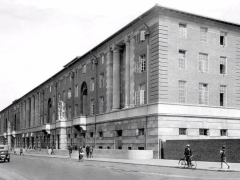
Our first nomination is the Lion Match Factory in Industria. Designed in 1936 by Richard Day, the monumental Lion Match Factory is an Art Deco palace of industry. The facade is delineated by a series of simplified columns, decorated with three matches on their capitals. The columns are framed by a cornice of crisp parallel lines that emphasise the building’s horizontality. The architect clearly defines three entrances - two on either end in monumental projecting wings, and the main entrance framed by elegant Art Deco waterfalls and topped with a clock and flagpoles.
Lion Match Factory, Industria (Johannesburg Heritage Foundation)
Our second nomination for Joburg’s most underrated historic buildings is House Hains in Yeoville. Almost everyone knows Dolobran in Parktown, the most whimsical and romantic of Parktown’s mansions. Its architect, Cope-Christie, designed precious few buildings in Johannesburg, but...
The Johannesburg Heritage Foundation held its annual general meeting on Saturday 3rd August at Northwards. It was one of our best attended AGMs with over 80 members and associates present. The afternoon combined the formal annual general business meeting, report backs and a talk on Blue Plaques.
Brett McDougall, the outgoing chair of the JHF, presented the Chairman’s report and review of the achievements of the Foundation during the past year. The JHF has concentrated on its research activities, conservation work, a school tours programme, training tour guides, weekend heritage tours, lectures and a bus tour programme during the annual Heritage Weekend. A major activity has been the ongoing digitization of heritage documents housed at the JHF Research Centre. The three Joint Plans Committees guide architects, developers and planners in the management of heritage on the ground. The JHF has installed over 20 blue heritage plaques during the past year, painting the town with blue history word bites. Stakeholder engagement has seen the JHF connect with the City of Johannesburg, JAG and Museum Africa, Gauteng Provincial Government, the Provincial Heritage Association of Gauteng, The Johannesburg Urban Forest alliance (JUFA), Egoli Heritage Trust, the Wilds project and the Heritage Association of South Africa. It has been a full active and energetic year led by Brett McDougall and the Board of Management. JHF activities are publicised on the website and social media platforms; fund raising has been achieved through book sales and the sales of new books to our members. The focus has been on tackling heritage neglect, campaigning for conservation, putting our money where our mouth is with backing the restoration...
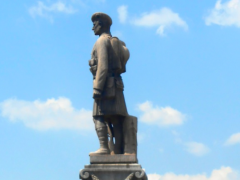
The sculpture shows a soldier in kilt and Scottish regalia. It fits in most dramatically with its position on a rising site on the triangular ground where St Andrew’s and Ridge Road meet. Visually it is very satisfying. It may not be a great work of art, but it is certainly a fine memorial, beautifully proportioned and well executed.
South African Scottish Memorial (The Heritage Portal)
The memorial was designed by William Tait Conner, a Scottish architect born in Glasgow who moved to Johannesburg in 1903 (click here for fascinating details from Artefacts). He served with the Transvaal Scottish in the First World War, attaining the rank of major. His partner A. Hamilton was killed in the conflict. Tait Connor won the competition to design the War Memorial in Boksburg, but gave his services freely for this work in 1922.
[NB - See the comments section for clarification on this paragraph] The sculptor was Arthur Taylor, who must have been a man of some eminence in Aberdeen. Alf Beattie, a member of the South African Scottish and a survivor of the Battle of Delville Wood, had known Taylor when he had grown up in Aberdeen. He wrote to his old friend and suggested he sculpt a SA Scottish...