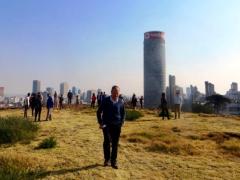
A few weeks ago I was privileged to be invited by Clive Chipkin to join his Joburg tour for a group of visiting American students from Brown University, USA. The group of 22 postgraduate students spent a week in Johannesburg at the Public Affairs Research Institute (PARI) in Parktown. Hats off to Brown for devising a study abroad programme on the complexities of South Africa beyond 1994 and its transition to democracy.
Clive Chipkin devised a personal tour to place Johannesburg in the context of its natural topography, the Witwatersrand. His tour reached across the grandest of hill top sites of the Witwatersrand. Evidence of Clive’s macro thinking has already been presented on the Heritage Portal in his 2015 heritage survey of the Corridors of Freedom, prepared for the City of Johannesburg (click here to view). Clive expresses conceptual thinking in visual diagrams about place and space. He seeks viable architectural solutions for future settlement patterns in the city. For this special Brown student tour Clive drew two maps. The first map set out our specific route with the starting point as the Gauteng Legislature (of course we still call it the Johannesburg City Hall) and ended at the Cottesloe hill. The route allowed for four stopping points on the high points of Johannesburg’s Witwatersrand ridges. The second map places Johannesburg in a geographical context relating Witwatersrand hills ridges and rivers within Gauteng.
[[{"fid":"6188","view_mode":"media_adaptive","fields":{"format":"media_adaptive","field_file_image_alt_text[und][0][value]":false,"field_file_image_title_text[und][0][value]":"Panoramas and history of Johannesburg tour map - Copyright Clive Chipkin - 2018"},"link_text":null,"type":"media","field_deltas":{"1":{"format":"media_adaptive","field_file_image_alt_text[und][0][value]":false,"field_file_image_title_text[und][0][value]":"Panoramas and history of Johannesburg...